And now for something completely different...
My ancestry and heritage is not Latin but English and Irish and German, yet if I had a choice of cultures to belong to, I would be far more inclined to Latin/Hispano/Chicano than English, Irish, or German. I've always attributed this to the fact that I spent much of my childhood in mixed neighborhoods in Southern and Central Coast California, where many of my neighbors and friends were Mexicans and Mexican-American, and where Spanish and Mexican history was proudly asserted.
Today, of course, we live in New Mexico, where Spanish and Mexican history and culture are proudly asserted, and where some of our friends and neighbors, perhaps most of them, are of Hispanic ancestry. It just seems natural to me.
While our cultural interests are pretty broad, we have a special fondness for flamenco, which for all intents and purposes is the New Mexico State Dance. There are a number of world class flamenco troupes in New Mexico, and we make it a point to attend flamenco performances as often as we can.
Last night it was Las Migas from Barcelona at the National Hispanic Cultural Center in Albuquerque.
Well, that was different!
Flamenco in New Mexico tends to be very traditional with modern touches. Maria Benitez from Taos was perhaps the pioneer New Mexico flamenco dancer and teacher forty or fifty years ago. One can see the influence of Antonio Gades' choreographic repertoire and style among current troupes -- which is very contemporary though Gades' dance and musical vocabulary is based entirely in the flamenco tradition.
Las Migas breaks away from that tradition and starts one of its own. Mira:
Being todo mujeres is not all that unusual among flamenco groups, as many have been and are all women. But Las Migas is unusual in creating a lot of their own music and focusing on the music rather than the dance. And in their literature they make clear their music is a fusion of flamenco and "Mediterranean" sounds.
There was a segment of dance in their show last night, with Alba, their lead singer, dancing a very unusual and contemporary flamenco interpretation. That is what she does. Mira:
There were few people in the Disney Theatre (Roy Disney, Walt's brother, funded the mainstage at NHCC back in the day) when we got there last night, and I feared that because Las Migas was little known in Albuquerque (this was their US debut performance) attendance would be light. But it turned out the place was nearly full when the show was a few minutes under way -- road construction nearby may have caused some people to be late.
Alba started speaking in English -- her English is very good -- but she asked in Spanish whether people in the audience could understand her. The response was ¡Si! She asked in Spanish if there was anyone in the audience who couldn't understand her. No response. "¿Nadie?" No response. Well, of course. If you don't understand Spanish, you're not going to know what she's asking, no?
Clever.
So she continued through the rest of the show speaking Barcelona Spanish mixed I'm sure with some Catalan, and it strained my limited Spanish to follow along. I found I could understand enough, though, that I didn't feel left out. I even got some of her jokes, ja ja. My Spanish comprehension must be better than I thought.
The Barcelona accent is not quite Castilian, but it is recognizably Spanish from Spain and not from the Americas, particularly not Mexican. New Mexicans pride themselves on their preservation of Castilian Spanish from the 17th century, and so despite any differences there may have been between the Barcelona Spanish of Las Migas, and the somewhat antiquated Castilian spoken among many New Mexicans, there seemed not to be a language barrier with the audience at all. If there was, I wouldn't have known anyway, because I still have some difficulty with New Mexico Spanish, about as much as I had with the Barcelona Spanish of Las Migas.
I go on about this because essentially the entire show was performed and explained in Spanish (there was one song in Catalan), and English was set aside for the evening. That's a first for me at NHCC, where most performances are either in English, or bilingüe, English-Spanish. As far as I could tell, most of the audience appreciated that there was no need to use English or to cater to the Anglos in the audience (and there were more than a few of "us".)
In New Mexico, Hispanic heritage and culture may have pride of place, but nearly everyone uses English rather than Spanish day to day. Last night, it wasn't necessary. And that was, I think, liberating.
The musicianship and song styling of Las Migas is first rate. The "Mediterranean" aspects of their music were interestingly interpreted by the audience, some of whom were up and dancing in the aisles, as tropical. Of course, it was familiar that way. That part of the show was interpreted as cross-over-fusion perhaps more so than was intended, but it was fine.
Alba Carmona, the lead singer and dancer, has a very powerful, smoky voice, not quite as gutteral as much flamenco cante, but strong and clear and packed with emotion nonetheless. Hers is a different kind of flamenco cante, just as her dance is a different kind of flamenco baile. The term of art is Nuevo Flamenco. Again, that was something new for us as it may have been for most of the audience.
The group as a whole performs strongly together, obviously enjoying themselves and the music. The two guitarists were superb, and their solo segment was technically and artistically outstanding. It was not, however, "flamenco" guitar, which was just fine!
Their violinist had her own moments to shine, and I thought her contribution was a major factor taking Las Migas's work out of the "traditional" realm and into new territory.
Alba, however, was clearly the star and attention grabber, both vocally and through her dance (the others joined her dancing at the end of the first act, following her lead off stage as the house lights came up for intermission.)
NHCC has been actively seeking and presenting European acts from Spain for some time to supplement their rather strong focus on Hispanic art and artists from the Americas. Las Migas may have been one of their most successful efforts to date. It was a continuation and celebration of the venue's Latin Diva Series.
Ms. Ché is Native American (Cherokee) and she is attending a Native American art school in Santa Fe (IAIA). Yet she is perhaps even more appreciative of Hispanic arts and culture than I am. As she becomes more deeply involved in Native American arts and culture than she was ever able to do in California, she's gaining a stronger appreciation for other cultures and styles present in New Mexico, including, from time to time, the contemporary "Anglo" arts and cultural sphere -- though you should hear her criticize it! Oh my!
This was Las Migas's first appearance in Albuquerque, but we both hope it will not be their last. ¡Viva!
Showing posts with label Flamenco. Show all posts
Showing posts with label Flamenco. Show all posts
Sunday, October 16, 2016

Tuesday, November 11, 2014
Flamenco In Seville
I'm quite a fan of flamenco, and this short film of a flamenco guitarist in Seville was posted at the New Yorker a little while ago. I think it's a good tonic for so much that ails us. Olé!
Sunday, April 6, 2014
Out and About -- Again
 |
| Microseconds of the Trinity Test |
Went out to Trinity Site yesterday. Because it was the only time the site would be open this year, there were larger than usual crowds, and it took close to an hour (maybe longer, come to think of it) to get cleared at the Stallion Gate.
Trinity Site, as I've written before, is a secular pilgrimage site in New Mexico, the site of the world's first atomic bomb explosion. One goes there to pay respects, not just to the hundreds of thousands of Japanese who were incinerated at the end of World War II by the two atomic bombs dropped on their country, but to the malevolent powers that were unleashed and which still haunt the world -- and haunt New Mexico in particular. I've said there is no place on earth outside Japan where the nuclear issue is so profound and profoundly moving as in New Mexico, as current and contemporary today as it ever was.
After arriving at the parking lot, I had to strategize actually getting to the site more than a quarter mile away and then getting back, as I am still lame from an episode of sciatica in January. So I got a seat-cane for the expedition, with the thought that if I were able to sit down during the trek, I'd probably be able to make it without too much trouble. (There is a transport for the old and lame from the parking lot to the site gate, but I decided to forgo it in order to test whether I could make it on my own.) Sure enough, the cane itself was sufficient to keep me appropriately propped up and walking, and I didn't have to sit on the way to or from the monument. Yay! Simple victories.
The April weather was a challenge, though. We'd been warned there might be rain, but instead, there was virga and many downdrafts which raised whirlwinds and clouds of dust and sand that got into everything. I found my wallet was full of sand and dust when we stopped for a late lunch after leaving the site. One man fell face first into the dirt in front of the monument when a gust caught him by surprise, and others were dumbfounded by the whipping whirlwinds and clouds of sand and dust pummeling them in the face. Nevertheless, the site is spectacular, and the winds and clouds added to the spectacle.
The site was essentially identical to what it had been in 2010 when I was there on my own. But this was the first time for Ms Ché, and she was quite taken with it. She and I grew up in a world in which nuclear power was seen as a panacea for practically everything that ailed mankind -- while the specter of nuclear annihilation loomed over us every single day.
Trinity Site is where that specter originated.
Yesterday's adventure there was made all the more dramatic by the dramatic weather knocking us and everyone else around so much.
After a brief return home to clean up, we headed back to Albuquerque to attend a fundraiser for the National Institute of Flamenco whose home base burned last

There were many highlights, but one that will stay with us for a good long time was the performance of Sonia Olla and Ismael Fernandez who demonstrated -- as if there were any doubts -- what this "flamenco" thing is all about. It was brilliant. But then, so was practically everything at the event.
It was yet another day and night to remember, and yet another "Only in New Mexico" experience.
Friday, November 8, 2013
"We shoulda toined left at Albuquerque..."
The running gags in Warner Brothers cartoons got burned into my brainstem when I was little, being as that I, along with hundreds of other young'n's was plonked down at the Kiddie Matinee at the Covina Theatre every Saturday morning so that the grownups could have some free time.
The cartoons on the teevee back in the '50's tended to be of the dancing flatware and teapot sort, or dancing bones and such. Warner Brothers burlesques were saved for the big screen.
Some of the locations Bugs was getting lost trying to find -- Coachella, Pismo Beach and the like -- are places I knew pretty well; in fact, as I wrote "Pismo Beach" I could virtually catch a whiff of the piquant aroma of the bracing wind at the pier and beach, and easily imagine picking up a rope of kelp from the sand. We never did clamming there that I can recall (the clams were probably all gone by the time I was making pilgrimage), but "going to the beach" was a regular routine when I was a kid. I thought it was great that Bugs wanted to go too!
This place called "Albuquerque," though, was something quite exotic to me. Where was it, anyway? My mother knew it, or knew of it, having been through it on the train and driving on Route 66, and probably having stopped at one of the many motor courts lining neon-draped Central Avenue back in the day. Route 66 originally went through Albuquerque along 4th Street and Broadway, after heading down from Santa Fe and the torturous La Bajada Hill, but in 1937 the route was shifted to bypass all of that and turn Central Avenue into an iconic traveler's paradise. Of sorts.
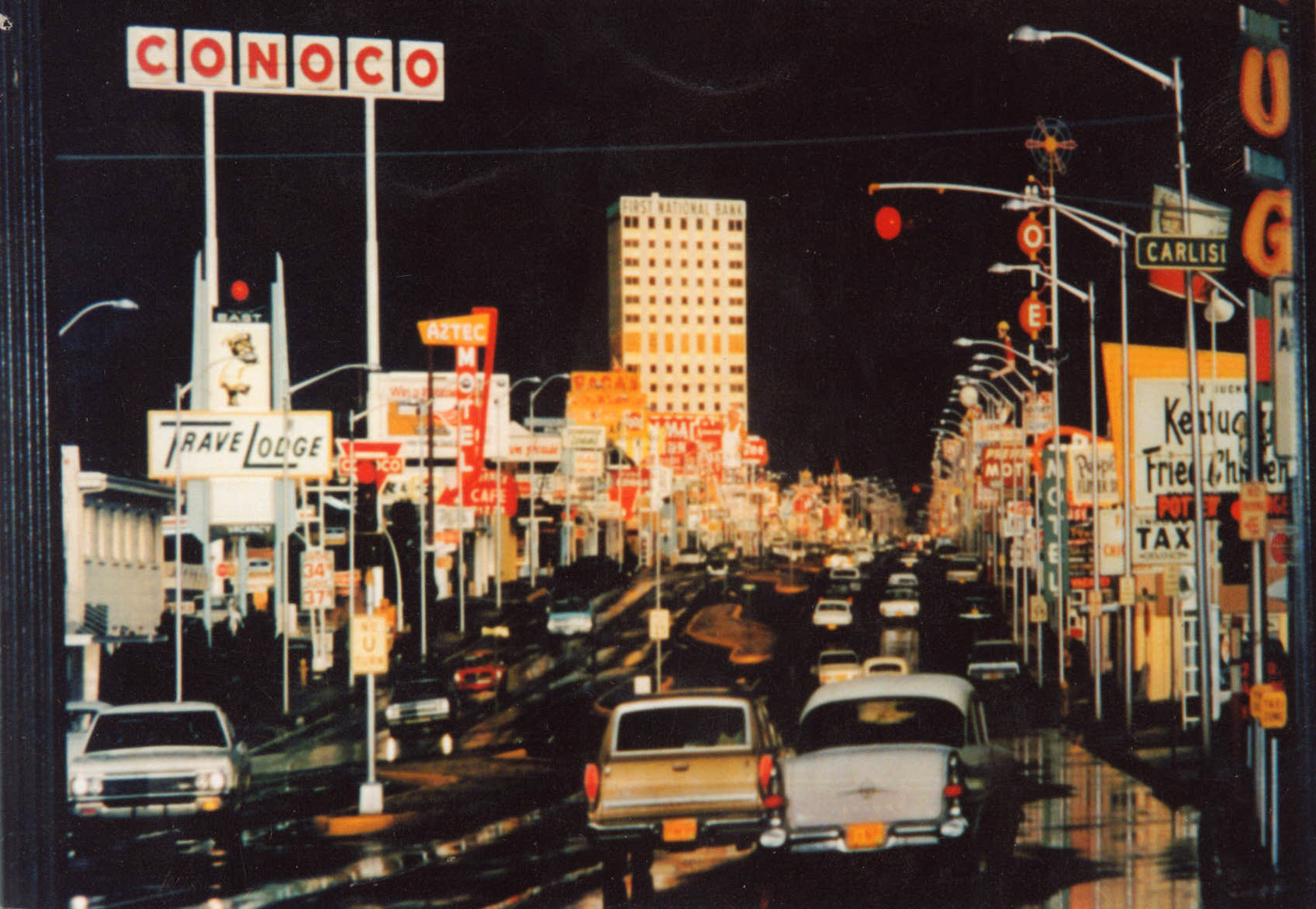
Well, Albuquerque has its reputation to consider after all.
Saturday, May 18, 2013
Uno y dos... Ay Flamenco Otra Vez. ¡Olé!
We've been attending openings and performances and literary gatherings and so on and so forth fairly often since moving to New Mexico last fall, far more often if the truth be known than was the case when we lived in California. Or at least it seems so.
Last night, it was Jesús Muñoz at the National Hispanic Cultural Center (a venue we've practically made our second home...;-).
¡Flamenco!.
Yes, very much so. Flamenco is called El Alma de España, yet it's probably not "native" Spanish, it's Gypsy, Gitano, and it reflects the Gypsy soul fully as much as the far more reserved and proper "Spanish" soul.
This was in essence a taberna (tablao) show, one that showcased two bailadores, two cantantes, two guitarraistas (one electric) and a percussion virtuoso. As I said at the show, "I want to learn to play The Box." (El Cajón)
It was, from beginning to end, in a word, brilliant.
We've noticed that flamenco has become pretty much the default (modern) Hispanic cultural art form in Albuquerque, and it's made strong inroads in Santa Fe and in the rest of Northern New Mexico. It's not a traditional art form in these parts, so I understand, only fairly recently introduced and popularized by such artists as Maria Benitez -- who was actually instrumental in introducing me to flamenco somewhat more than thirty years ago in St. Louis of all places. Flamenco classes and workshops are going on constantly and seemingly everywhere, and solo, duo, and group performances are frequent. We attend performances as often as we can, and if our health issues allowed it, I don't doubt we'd be attending classes at the very least.
We'd seen Muñoz's choreography in Rudolfo Anaya's "Rosa Linda" and thought highly of it. His "Red Note" production was being promoted on lobby cards at the performance of "Rosa Linda," so we thought why not plan on going and got ourselves some tickets. Little did we know...
This production was the distilled essence of Flamenco, just two dancers, two singers and a handful of appropriate musicians. In addition to Jesús -- who danced superbly -- the nearly legendary "La Chispa" (Valeria Montes) repeatedly stole the show with her fiery and intricate movements and perfect attitude. Her introductory dance with a Spanish shawl was mesmerizing and earned an enthusiastic response from the audience. But every time she appeared, the crowd went wild. Not that they had any less enthusiasm for Muñoz himself.
His moment, really, came when he "painted with his feet." Just before the intermission, a large piece of black plastic was brought out from the wings and laid on the floor; a somewhat smaller piece of something black -- maybe itself made of hard plastic -- was lowered from the flies. Stage hands applied red and white paint to a corner of the hard plastic. Jesús appeared in jeans and t-shirt and paint-stained white flamenco boots. He proceeded to dance. Every now and again, a stage hand would squeeze more paint from a ketchup dispenser while Jesus continued to dance. In the end, he took off his boots and marched off into the wings. His painting was raised from the floor and was displayed with two others, the others done by Reyes Padilla (whether while he danced, I don't know!) in the style of the work by Muñoz. The paintings hung through the intermission.
Singers José Vega and José Cortes Fernandez had extraordinary and complementary voices; their songs formed the basis for the improvisations of the dancers, but they also had their solos and duets and they were captivating.
Just so the guitarists, Ismael De La Rosa and Yosmel Montejo, whose accompaniment, along with their own virtuoso moments, made not a little magic on stage.
But my attention was drawn repeatedly to percussionist, K'tumba (Francisco Xavier Mera Rodriguez). Ay, if only...! I thought, I would love to sit on The Box and play...! But then, I've longed to do that for many years. One day, I keep thinking, one day for sure... Psst, he's doing a workshop on Monday and Tuesday....
There was an after party at the Hotel Andaluz in town. We had to skip it because we are old now, and it was very late (for us) to be out and about, and we faced a long drive over the hill back home. Yet were we just a bit younger...
Olé
Friday, April 5, 2013
Ay ¡Flamenco!
Flamenco! Flamenco! Flamenco! : Sevillanas from Christopher Michael Roybal on Vimeo.
Yjastros at the KiMo Theatre in Albuquerque October 30, 2009, with Alma Flamenca and Niños Flamencos.
A couple of weeks ago, after we saw "West Side Story" at Popejoy Hall in Albuquerque (located on the campus of UNM), we walked to a friend's house a few blocks away to visit for a bit. We passed by a number of posters promoting something called 'Encuentros' with a dance company called 'Yjastros.' ¡Flamenco!
Indeed.
The performance was coming up in a few weeks at the National Hispanic Cultural Center, part of the festivities leading up to the celebration of Cesar Chavez Day (which is tomorrow at the NHCC, featuring Dolores Huerta as honored guest -- and we might have to go. There's another long story involved... )
At any rate.
Flamenco is easily my favorite dance form. My introduction to it dates back some decades to St. Louis, specifically the Opera Theatre of St. Louis on the campus of Webster University. Maria Benitez and her company had been invited out from Santa Fe by Richard Gaddes, then artistic director of the Santa Fe Opera and the founder of Opera Theatre of St. Louis, to choreograph and perform in the dance segments of that summer's zarzuela, "La Verbena de la Paloma."
This was not my first encounter with opera by any means, in fact, I'd worked with a number of opera companies on the West Coast prior to heading out to St. Louis by car. It would mean my first -- and second -- encounter with New Mexico, however, since the Interstate passes right through both going and coming (who'dathunk!).
Sometimes when driving through Albuquerque, I pass by the motel where I spent the night back in 1982, (well, it wasn't actually the "night" as my arrival was at dawn, and don't think I got more than two hours' sleep before the cleaners began banging around, but that's another story, too.) That motel, the Crossroads, is apparently something of a landmark these days due to a television series I've never seen; it's something out of the 1950's, looking very much now as it did then, perched there on Central hard against I-25. You can't miss it.
But that aside...
The zarzuela was the highlight of the Opera Theatre of St. Louis season. Everyone, including me, said so. Gaddes, for his part, was gushing about it constantly, deservedly, too. He'd never tried anything like it in St. Louis, and he was very uncertain how it would go over with a hard Missouri "Show Me" crowd. But they loved it.
Maria and company also did a special flamenco performance on their own during the run of "La Verbena," and that's where I saw flamenco for the first time in its purest, live form. It was -- for me at least -- thrilling.
I've been a fan and an admirer of Maria Benitez ever since. There's a extended story that goes along with that, but I'll skip it for now to get to Yjastros and 'Encuentros' last night.
Between the time of my first encounter with Maria Benitez and flamenco in St. Louis, a number of flamenco movies were made in Spain, featuring Antonio Gades and Cristina Hoyos. Eee! The first one I saw was "Carmen" -- a flamenco Carmen, imagine -- and it was stunning. I still have visions of some of the scenes in my head. It was amazing. I'd never seen, or even thought of, anything like it. Strangely enough, or perhaps not so, the spareness of the production, the idea that it's a rehearsal for an upcoming production, the incredible discipline and skill of the performers, and the simplicity of the whole thing -- compared to Grand Opera, for heaven's sake -- was in line with my percolating notions of "poor theater" as delineated by the Becks and Grotowski and many others.
"El Amor Brujo" and "Bodas de Sangre" were not quite as spare and relevatory, at least to my reckoning, but they were in their own way just as astonishing. They can still take my breath away.
And so to Yjastros, the local-national-international flamenco company, that I'd barely been aware of prior to last night. Well, yes, I'd heard of them and knew of Joaquin and Marisol Encinias. But I'd never seen them, never thought I would until I noticed the poster after the performance of national tour of "West Side Story," and thought, "Why not?"
Yes, well.
Why not, indeed.
The show was... brilliant.
There's no other word for it. I'm sure a flamenco purist would criticize this or that dancer, dance, or the whole concept as being "not quite" something or other, and I would be the first to admit there were flaws here and there -- both technical and artistic -- but I don't care. It doesn't matter.
I couldn't get the silly grin off my face the whole time, nor could I keep myself from shouting a not infrequent ¡Olé! at a particularly intricate paso. These people were on. This was flamenco duro.
We don't see that very often, not even in New Mexico, where flamenco is one of the many cultural art forms that suffuse the place. I adore Maria and her company, and her artistry is unmatched as far as I'm concerned, but this, this Yjastros, was something else again.
It was hard, gorgeous, enthralling.
Oh, and there were standout performers. Oh my, yes. Particularly, in my view, Elena Osuna, whose every fiber of being, whose tension and passion, drew you in to a mysterious and compelling world as expressed with her feet and hands and arms and body. Even when she danced with a corps, you knew she was exceptional and she kept your attention no matter who else was onstage or what else was going on.
Carlos Menchaca was nearly -- not quite -- her match. There were only two men (besides the artistic director, Joaquin Encinias) in the dance company. Male dancers seem to be as scarce as the proverbial hen's teeth in New Mexico, so it's fairly easy for a man with reasonable talent to be a standout in dance productions, but Carlos was exceptional.
He danced "Jaleo" with Marisol Encinias, a co-director of the company (Joaquin is her brother), in a passionate duo that had the audience shouting and clapping at the audacity and spirit of the whole thing.
Marisol herself had a solo that brought the house down. It was long, intricate, emotional, and exuberant. Her stamina must be incredible. To say the least.
Joaquin performed with great vigor, not a lot of style, at the end of the show. He's got some weight on him, but that's never stopped a flamenco performer in my recollection, and he did his turn well. The crowd loved it, thought I heard one wag in the restroom afterwards saying he thought "that big dude was gonna get his heart attack right there on the stage."
Perhaps the most alluring performance was that of cantante Kina Mendez who sang through most of the show and sang and danced (in stiletto heels!) in her own solo segment.
The guitarists were nothing short of brilliant themselves.
All in all, it was a memorable evening, one of so many we've had since settling in New Mexico.
Yjastros at the KiMo Theatre in Albuquerque October 30, 2009, with Alma Flamenca and Niños Flamencos.
A couple of weeks ago, after we saw "West Side Story" at Popejoy Hall in Albuquerque (located on the campus of UNM), we walked to a friend's house a few blocks away to visit for a bit. We passed by a number of posters promoting something called 'Encuentros' with a dance company called 'Yjastros.' ¡Flamenco!
Indeed.
The performance was coming up in a few weeks at the National Hispanic Cultural Center, part of the festivities leading up to the celebration of Cesar Chavez Day (which is tomorrow at the NHCC, featuring Dolores Huerta as honored guest -- and we might have to go. There's another long story involved... )
At any rate.
Flamenco is easily my favorite dance form. My introduction to it dates back some decades to St. Louis, specifically the Opera Theatre of St. Louis on the campus of Webster University. Maria Benitez and her company had been invited out from Santa Fe by Richard Gaddes, then artistic director of the Santa Fe Opera and the founder of Opera Theatre of St. Louis, to choreograph and perform in the dance segments of that summer's zarzuela, "La Verbena de la Paloma."
This was not my first encounter with opera by any means, in fact, I'd worked with a number of opera companies on the West Coast prior to heading out to St. Louis by car. It would mean my first -- and second -- encounter with New Mexico, however, since the Interstate passes right through both going and coming (who'dathunk!).
Sometimes when driving through Albuquerque, I pass by the motel where I spent the night back in 1982, (well, it wasn't actually the "night" as my arrival was at dawn, and don't think I got more than two hours' sleep before the cleaners began banging around, but that's another story, too.) That motel, the Crossroads, is apparently something of a landmark these days due to a television series I've never seen; it's something out of the 1950's, looking very much now as it did then, perched there on Central hard against I-25. You can't miss it.
But that aside...
The zarzuela was the highlight of the Opera Theatre of St. Louis season. Everyone, including me, said so. Gaddes, for his part, was gushing about it constantly, deservedly, too. He'd never tried anything like it in St. Louis, and he was very uncertain how it would go over with a hard Missouri "Show Me" crowd. But they loved it.
Maria and company also did a special flamenco performance on their own during the run of "La Verbena," and that's where I saw flamenco for the first time in its purest, live form. It was -- for me at least -- thrilling.
I've been a fan and an admirer of Maria Benitez ever since. There's a extended story that goes along with that, but I'll skip it for now to get to Yjastros and 'Encuentros' last night.
Between the time of my first encounter with Maria Benitez and flamenco in St. Louis, a number of flamenco movies were made in Spain, featuring Antonio Gades and Cristina Hoyos. Eee! The first one I saw was "Carmen" -- a flamenco Carmen, imagine -- and it was stunning. I still have visions of some of the scenes in my head. It was amazing. I'd never seen, or even thought of, anything like it. Strangely enough, or perhaps not so, the spareness of the production, the idea that it's a rehearsal for an upcoming production, the incredible discipline and skill of the performers, and the simplicity of the whole thing -- compared to Grand Opera, for heaven's sake -- was in line with my percolating notions of "poor theater" as delineated by the Becks and Grotowski and many others.
"El Amor Brujo" and "Bodas de Sangre" were not quite as spare and relevatory, at least to my reckoning, but they were in their own way just as astonishing. They can still take my breath away.
And so to Yjastros, the local-national-international flamenco company, that I'd barely been aware of prior to last night. Well, yes, I'd heard of them and knew of Joaquin and Marisol Encinias. But I'd never seen them, never thought I would until I noticed the poster after the performance of national tour of "West Side Story," and thought, "Why not?"
Yes, well.
Why not, indeed.
The show was... brilliant.
There's no other word for it. I'm sure a flamenco purist would criticize this or that dancer, dance, or the whole concept as being "not quite" something or other, and I would be the first to admit there were flaws here and there -- both technical and artistic -- but I don't care. It doesn't matter.
I couldn't get the silly grin off my face the whole time, nor could I keep myself from shouting a not infrequent ¡Olé! at a particularly intricate paso. These people were on. This was flamenco duro.
We don't see that very often, not even in New Mexico, where flamenco is one of the many cultural art forms that suffuse the place. I adore Maria and her company, and her artistry is unmatched as far as I'm concerned, but this, this Yjastros, was something else again.
It was hard, gorgeous, enthralling.
Oh, and there were standout performers. Oh my, yes. Particularly, in my view, Elena Osuna, whose every fiber of being, whose tension and passion, drew you in to a mysterious and compelling world as expressed with her feet and hands and arms and body. Even when she danced with a corps, you knew she was exceptional and she kept your attention no matter who else was onstage or what else was going on.
Carlos Menchaca was nearly -- not quite -- her match. There were only two men (besides the artistic director, Joaquin Encinias) in the dance company. Male dancers seem to be as scarce as the proverbial hen's teeth in New Mexico, so it's fairly easy for a man with reasonable talent to be a standout in dance productions, but Carlos was exceptional.
He danced "Jaleo" with Marisol Encinias, a co-director of the company (Joaquin is her brother), in a passionate duo that had the audience shouting and clapping at the audacity and spirit of the whole thing.
Marisol herself had a solo that brought the house down. It was long, intricate, emotional, and exuberant. Her stamina must be incredible. To say the least.
Joaquin performed with great vigor, not a lot of style, at the end of the show. He's got some weight on him, but that's never stopped a flamenco performer in my recollection, and he did his turn well. The crowd loved it, thought I heard one wag in the restroom afterwards saying he thought "that big dude was gonna get his heart attack right there on the stage."
Perhaps the most alluring performance was that of cantante Kina Mendez who sang through most of the show and sang and danced (in stiletto heels!) in her own solo segment.
The guitarists were nothing short of brilliant themselves.
All in all, it was a memorable evening, one of so many we've had since settling in New Mexico.
Wednesday, January 11, 2012
Momentary Change of Pace: Just Because -- Laura del Sol and Cristina Hoyos in "Carmen"
Long ago I posted a couple of scenes from Carlos Sauras's film of his Flamenco version of "Carmen," a truly brilliant 1983 movie that has become practically legendary in certain circles.
This has got to be one of the most extraordinary dance sequences ever filmed, and there are many in this movie. I'd say it is like nothing else ever put on film, but it isn't -- because there are several Carlos Saura flamenco movies floating around, including "El Amor Brujo", "Bodas de Sangre", and "Salome" that are artistic knock-outs.
Saura's brilliance, of course, is in the transformation of a very ancient, tradition-bound and specialized dance form into a story telling form for film, and in his stunning staging (especially for "Carmen").
The larger point being "We're not really stuck on the treadmill repeating the same things over and over; we can use so very much from the past to create something new and startling and wonderful."
It's a message we need to keep hearing.
Friday, January 29, 2010
OT: Everybody Dance Now
I love this scene. It's from El Amor Brujo directed by Carlos Saura. I first posted the YouTube link on this site in December, 2007.
Here's another scene from the same movie:
Saura, Antonio Gades, and Cristina Hoyos are brilliant in everything I've seen them do.
Check out their Carmen.
[Note, this post has undergone a number of corrections, additions and adjustments since it was first put up. There may be more.]
Here's another scene from the same movie:
Saura, Antonio Gades, and Cristina Hoyos are brilliant in everything I've seen them do.
Check out their Carmen.
[Note, this post has undergone a number of corrections, additions and adjustments since it was first put up. There may be more.]
Subscribe to:
Posts (Atom)