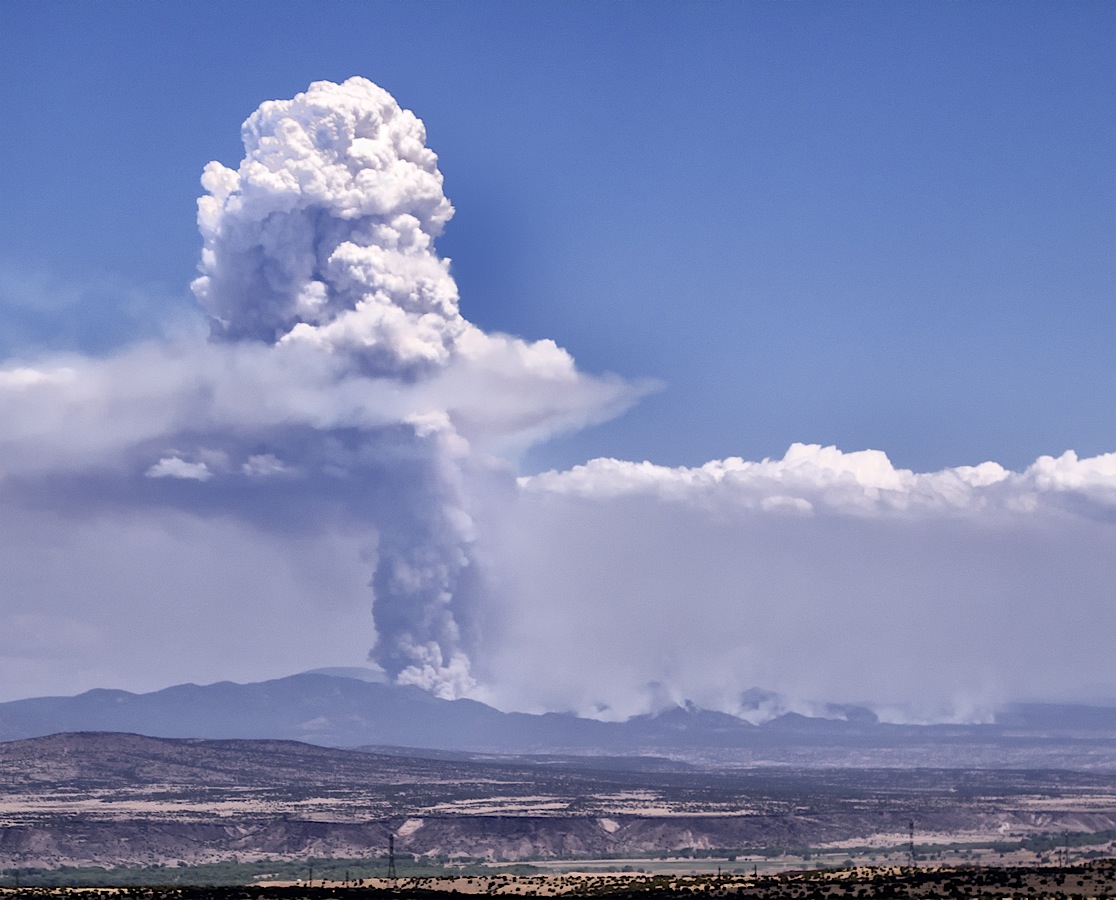
Today July 16, 2018, is the 73rd anniversary of the detonation of the first atomic bomb at Trinity Site in New Mexico.
 |
| Santa Fe Opera interpretation of The Gadget -- "Dr. Atomic" 2018 Season |
The Gadget as it was called, memories of The Gadget, the enormity of what was created at Los Alamos -- a bare 25 miles from the semi-outdoor Opera House ("the audience can see Los Alamos from their seats" quoth librettist and director Peter Sellars in one of the talks we heard before the performance), and the aftermath of the atomic bomb test at Trinity Site, July 16, 1945, some 200 miles south of Los Alamos resonate profoundly in New Mexico, in some ways more profoundly than anywhere else in the world except Japan.
There were far more US nuclear tests outside Las Vegas, NV, and in the Pacific than in New Mexico (just one -- the first one --that we know of in our backyard) but ultimately the atmospheric tests elsewhere became a kind of twisted Cold War entertainment - "whoa, wouldja lookit that!" -- that was sometimes shown to school kids before their Duck and Cover exercises to scare the shit out of them (how well I remember.)
"Dr. Atomic" deals with the tragic story of Dr. J, Robert Oppenheimer ("Oppie") at Los Alamos and Alamogordo, New Mexico, in the hours leading up to the first atomic bomb test and its echoes through time to today.
It's a complex story that doesn't exist in linear time, and apparently the complexity and non-linearity as well as the often jarring contemporary musical score can be off-putting to some opera-goers though it wasn't apparent opening night. It was a full house. The audience's attention was as intense as the music and performances. The response was enthusiastic.
I overheard one rather fancy looking woman talking during intermission: "My friend told me I wouldn't like it. Well, I rather think I do," she said. Indeed.
I can't say I "liked" it, no. But I will say I was quite taken with it and had no problem staying for its 3 hours and 20 minute length (with intermission) and the interminable after performance getting-out-of the-parking-lot minuet. (I said to one of the parking boys, "At this rate, we'll be here all night." He grinned and said, "That's only because my co-workers are incompetent. Have a safe trip home!!" Chuckle,)
We got home at 2:45 am tired but moved.
We've been semi-immersed in the story of nuclear weapons and the struggle against them in New Mexico for as long as we've been here, for almost as long as we've been coming here (more than 35 years now). I've written several pieces about it, about visiting Trinity site, about going to Los Alamos, about duck and cover, and so on and so forth. No one of my generation escaped fear of the looming mushroom cloud. It was the defining image of the post WWII era, one that seems to have been largely forgotten now or set aside by the younger generations. Thoughts of nuclear annihilation, instant incineration, barely reach consciousness except under the most extraordinary circumstances these days. And then the images seem to be off the mark.
Hardly anyone seems to understand what a nuclear weapon is or does anymore. And maybe that's a good thing.
Peter Sellars said he tried to maintain the classical tragic unities of time and place, and he tried to tell the story of the tragedy of what happened not just to Oppenheimer but for many of those who worked on developing The Bomb and of course for the hundreds of thousands of Japanese who died as a result of its use.
It's pointed out during the opera that many more Japanese civilians died during the firebombings of Tokyo and Yokahama that preceded the use of nuclear weapons on the cities of Hiroshima and Nagasaki. To say, then, an atom bomb is a unique horror is something of a stretch, no? No, it's not a stretch at all when one bomb can cause in an instant more destruction than thousands dropped over a period of hours or days.
The scientists at Los Alamos agonized over the use of nuclear weapons, and hundreds tried to convince Washington authorities not to use the creation of their laboratories on populations -- ever, if possible. Of course, then and now, there was a contrary faction who dearly wanted to use nuclear weapons, not just for effect, either.
Particularly torn by his creation was J. Robert Oppenheimer himself. A point is made that he is driven mad by what he has created. He never fully recovers, and in a sense, his creation kills him -- as well as many, many more.
Sellars reconceived the production for Santa Fe. For one thing, the production takes place within sight of Los Alamos (if you look hard!), and within hailing distance of Trinity. Those of us who live here and have paid attention know these places and these stories rather well. Earlier productions (we have a DVD of one, I believe it was in Amsterdam) focused more on the story telling than on its meaning, and they were visualized much more completely. The DVD production uses a close replica of The Gadget that is brought out at a particular time to be hoisted onto the tower, whereas in Santa Fe the Sphere that represents The Gadget and much else is never not there; its presence looming -- and leering -- throughout.
Sellars said the shiny Sphere was meant to reflect the audience, but it doesn't really do that (at least not from where we were sitting in cheap seats toward the back of the orchestra section.) What it reflected instead were the lights on stage which had the effect of creating many different facial expressions, from evil and bloodthirsty to almost benign. It was remarkable and mesmerizing. The picture above was taken by your correspondent some time before the beginning of the performance, and it is one of the many instances when the "eyes" of the Sphere gazed impassively on the scene before it.
In this production, too, Sellars made a conscious and mostly successful effort to include Native Americans on stage and integrated into the story in somewhat the same way they were part of the story of the creation of the Bomb. This is Indian Country, the events happened in Indian Country, and the effects are still felt throughout Indian Country -- particularly on the uranium miners in Navajoland and at Laguna Pueblo. That deadly effect is not dealt with directly in the opera. Sellars was asked by a Diné gentleman at one of the talks whether he'd included the miners, and he wouldn't answer directly. He said something about the "effects on everyone then and now" are included, but that isn't what he was asked. In fact, there is no mention of miners at all. There is only passing mention of Downwinders -- people who were unwittingly affected by the fallout from the Trinity test,. But at least they are there -- actual Downwinders on stage -- along with dancers from the Tesuque, Santa Clara and San Ildefonso Pueblos. They performed a ceremonial corn dance prior to the performance of the opera -- as a healing gesture -- and then returned in the second act as a Presence, representing the Original Peoples upon whom and among whom but not by whom this monstrosity of war was created and perpetrated.
The presence of the Indians helped to ground the production but I felt they were not integrated into it the way they might have been -- and that that was probably their choice. It's not their story, and they're not telling. They could and one day probably will tell their own story, though, and it will be quite different.
As we were making our way to the parking lot before the performance, there were sheriffs deputies along the road, signs saying "Ticket holders only beyond this point" and at the entrance to the parking lot a young man asked to see our tickets. He said there were protests expected, and they had to check. Hm. As we were making our way from the parking lot to the Opera House, a young man in the high priced parking area near the venue asked that we take some literature from the A.N.S.W.E.R. Coalition protesting the production and the proposed increase in nuclear weapons development in New Mexico. This was intended, said the literature, to make New Mexico the sole production site for "plutonium pits" -- something I'd never heard of -- that were the essential cores of nuclear bombs.
They were protesting the production because they saw it as a celebration of nuclear weapons and war.
Uh. No. It's not. Far from it. That's the thing about tragedy. It doesn't celebrate.
Hardly anyone seems to understand what a nuclear weapon is or does anymore. And maybe that's a good thing.
Peter Sellars said he tried to maintain the classical tragic unities of time and place, and he tried to tell the story of the tragedy of what happened not just to Oppenheimer but for many of those who worked on developing The Bomb and of course for the hundreds of thousands of Japanese who died as a result of its use.
It's pointed out during the opera that many more Japanese civilians died during the firebombings of Tokyo and Yokahama that preceded the use of nuclear weapons on the cities of Hiroshima and Nagasaki. To say, then, an atom bomb is a unique horror is something of a stretch, no? No, it's not a stretch at all when one bomb can cause in an instant more destruction than thousands dropped over a period of hours or days.
The scientists at Los Alamos agonized over the use of nuclear weapons, and hundreds tried to convince Washington authorities not to use the creation of their laboratories on populations -- ever, if possible. Of course, then and now, there was a contrary faction who dearly wanted to use nuclear weapons, not just for effect, either.
Particularly torn by his creation was J. Robert Oppenheimer himself. A point is made that he is driven mad by what he has created. He never fully recovers, and in a sense, his creation kills him -- as well as many, many more.
Sellars reconceived the production for Santa Fe. For one thing, the production takes place within sight of Los Alamos (if you look hard!), and within hailing distance of Trinity. Those of us who live here and have paid attention know these places and these stories rather well. Earlier productions (we have a DVD of one, I believe it was in Amsterdam) focused more on the story telling than on its meaning, and they were visualized much more completely. The DVD production uses a close replica of The Gadget that is brought out at a particular time to be hoisted onto the tower, whereas in Santa Fe the Sphere that represents The Gadget and much else is never not there; its presence looming -- and leering -- throughout.
Sellars said the shiny Sphere was meant to reflect the audience, but it doesn't really do that (at least not from where we were sitting in cheap seats toward the back of the orchestra section.) What it reflected instead were the lights on stage which had the effect of creating many different facial expressions, from evil and bloodthirsty to almost benign. It was remarkable and mesmerizing. The picture above was taken by your correspondent some time before the beginning of the performance, and it is one of the many instances when the "eyes" of the Sphere gazed impassively on the scene before it.
In this production, too, Sellars made a conscious and mostly successful effort to include Native Americans on stage and integrated into the story in somewhat the same way they were part of the story of the creation of the Bomb. This is Indian Country, the events happened in Indian Country, and the effects are still felt throughout Indian Country -- particularly on the uranium miners in Navajoland and at Laguna Pueblo. That deadly effect is not dealt with directly in the opera. Sellars was asked by a Diné gentleman at one of the talks whether he'd included the miners, and he wouldn't answer directly. He said something about the "effects on everyone then and now" are included, but that isn't what he was asked. In fact, there is no mention of miners at all. There is only passing mention of Downwinders -- people who were unwittingly affected by the fallout from the Trinity test,. But at least they are there -- actual Downwinders on stage -- along with dancers from the Tesuque, Santa Clara and San Ildefonso Pueblos. They performed a ceremonial corn dance prior to the performance of the opera -- as a healing gesture -- and then returned in the second act as a Presence, representing the Original Peoples upon whom and among whom but not by whom this monstrosity of war was created and perpetrated.
The presence of the Indians helped to ground the production but I felt they were not integrated into it the way they might have been -- and that that was probably their choice. It's not their story, and they're not telling. They could and one day probably will tell their own story, though, and it will be quite different.
As we were making our way to the parking lot before the performance, there were sheriffs deputies along the road, signs saying "Ticket holders only beyond this point" and at the entrance to the parking lot a young man asked to see our tickets. He said there were protests expected, and they had to check. Hm. As we were making our way from the parking lot to the Opera House, a young man in the high priced parking area near the venue asked that we take some literature from the A.N.S.W.E.R. Coalition protesting the production and the proposed increase in nuclear weapons development in New Mexico. This was intended, said the literature, to make New Mexico the sole production site for "plutonium pits" -- something I'd never heard of -- that were the essential cores of nuclear bombs.
They were protesting the production because they saw it as a celebration of nuclear weapons and war.
Uh. No. It's not. Far from it. That's the thing about tragedy. It doesn't celebrate.