Went up to Santa Fe yesterday for the 2015 commencement ceremonies for students at IAIA -- the Institute of American Indian Arts.
It was the first commencement we've attended there, and just getting to the campus at all was an adventure.
The day started at our place some fifty miles south of Santa Fe with heavy rain and thunder. So odd in the middle of May, but we've been experiencing a very wet spring in Central New Mexico, much wetter and cooler than last May.
The heavy rain let up just before we had to leave our place in order to arrive at the IAIA campus in time for commencement. The sun was shining, and the winds had stopped blowing as we left home for the drive north.
As we passed through the Galisteo Basin, a slight rain began and we could see heavy weather on the west in the Oritz and Jemez Mountains. There were signs of weather to the north over the Sangre de Cristo Mountains as well. Santa Fe is nestled below those peaks, and the IAIA campus is somewhat south of the City Different itself, perched on a peak with a dazzling 360 degree view of the mountains and plains all around.
But passing through the village of Galisteo -- where bridge repair and road repaving has been going on for months and to get through the construction zone, you have to follow a pilot car which threads its way carefully around the various piles of gravel and earth and rock -- the rain was light. The sky grew darker, though, as we turned onto Camino de los Abuelos beside the village church and headed over hill and dale, through a surprisingly unflooded wash, across the railroad tracks, through the section of road that had been washed out at some point during one of the passing storms, past the Houzous Place where many of Allan Houser's bronze and stone sculptures are on display, but Mrs Houser wouldn't live there, "out in the middle of nowhere!" she said, and on to Highway 14, the Turquoise Trail, that would take us to the turn off at Rancho Viejo leading -- eventually -- to the IAIA campus.
In the distance, beyond the abandoned ruin of the New Mexico State Penitentiary where dozens of prisoners had been killed in an appalling riot in 1980 and where ghosts now wander, I could see the sky was darker still and the clouds reached to the ground. I said, "That looks like snow up ahead," and sure enough, it was.
Snow, in the middle of May in Santa Fe. What a wonder. As we took the Rancho Viejo turnoff, the snow turned into a near-blizzard, and we wondered how the IAIA commencement would be dealt with, since it was scheduled to be outdoors in the Dance Circle. The outside temperature gauge on the dashboard had been falling and now read 34°. We weren't really dressed for Winter. It was the middle of May!
We drove through the blizzard following a half-dozen cars headed the same direction. A pick-up truck wove in and out of traffic, its driver having no patience for the courtesies others were giving drivers ahead and behind. Ms. Ché observed, "That must be a student, late for the commencement." The clock said we had fifteen minutes to get to the campus, find our way through the snow storm to the Dance Circle -- or wherever else they decided to hold the ceremonies -- and get settled before the commencement began. We were about a mile and a half from the campus, and there was no let up from the snow. The temperature gauge now read 32°. It was going to be an interesting experience.
We made it to the campus but then had to figure out where to park as all the regular parking lots were blocked off. We went to an overflow lot on the east side of the campus and jockeyed with other drivers for a decent spot in the gravel and mud. There was a car next to us, a white Lexus driven by someone who couldn't figure out what to do in the gravel and mud, who kept backing up and moving forward, alarming people already parked and trying to park sufficiently that they refused to get out of their cars until this one settled. I don't know what the problem was, but it took several minutes for the Lexus driver to stop going back and forth and alarming people. Finally, when the car's motion stopped, people in cars round about got out and slogged in the snow through the mud and gravel toward what looked like a tent, maybe a circus tent, erected over the Dance Circle. It was quite a hike.
Some people brought umbrellas, but most didn't. It was the middle of May. Nobody expected snow in the middle of May. The news cast the night before said that snow was expected "above 10,000 feet," with flurries possible as low as 8,000 feet during the night. Santa Fe is at 7,000 feet, and it was close to 11:00am, so this snow storm seemed very odd indeed.
We slogged our way toward the tent, me having to move somewhat slowly due to my lingering lameness from sciatica. When we got there, snow-dappled, muddy-booted and somewhat chilled, the welcome from the staff was pleasant. There was no heat in the tent, but many of those who were in attendance had wisely brought blankets and sat wrapped and huddled while waiting for the ceremonies to begin.
There were several hundred chairs, and we found seats quickly enough. We were not far from the platform where the ceremonies would take place. The tent was decorated with the flags of the many dozens of tribes represented by the student-graduates and the staff of the Institute. And it was cold.
After a while, the assembly was urged to cease socializing and be seated. The ceremonies were about to begin. There had been a lot of socializing beforehand. We knew a few of the student-graduates, instructors and staff, but not a whole lot of them, and we knew practically none of their families and friends, so our socializing was somewhat limited. Some of the people we thought we would see at the commencement did not show up for whatever reasons, including the weather, so ultimately there were a few empty chairs under the tent.
Soon enough, the commencement ceremonies began with the entrance of the administration, board, faculty, staff, and student-graduates, accompanied by hand-drumming and song from the student hand-drum corps. It was wonderful. While many were dressed in traditional graduation robes and mortar-boards, many of those in the procession opted for ceremonial Native dress and head-gear. Whatever they felt was appropriate to the occasion was what they wore, and it made for a highly diverse -- rather than a strictly uniform -- graduation procession. I liked it, I liked it a lot.
Feathers. There were lots of feathers. Turquoise, velvets, blankets, shawls, traditional Native dress from a wide variety of tribes, even a Plains warbonnet. Everyone was smiling. Even some laughter as the group made their way to the front. The Dignitaries sat on the platform; everyone else sat on the chairs in front.
There was a prayer ceremony that acknowledged the inclement weather, particularly the rain and the snow and how much they were needed and wanted by the people of New Mexico, and how meaningful was the snow in particular to the Pueblo people for whom it represented perhaps the best medicine possible for a gathering such as this one.
The board president acknowledged the dignitaries and supporters among the assembly, and what a surprise it was for us to hear our own names called out as "Friends of IAIA." Indeed we are, but how did they know we would be there? One of those mysteries, I'd say, of which there are so many in New Mexico. So many mysteries and so many convergences.
Luci Tapahonso, Navajo Nation poet laureate and creative writing professor at UNM gave the keynote address. She was a last minute substitute for Sherman Alexie who had to withdraw and canceled all his summer travel due to a bad back. Luci pointed out -- to much laughter -- that she wasn't Sherman, and she offered one of her best known early poems, "Hills Brothers Coffee," to the assembly. It was very well received by those who are so familiar with it they can speak the lines along with Luci and by those who were hearing it for the first time. It is as true and loving a depiction of Indian life on the Rez as any that's so far been offered by Native authors.
Jon Davis offered Sherman Alexie's thoughts to the soon-to-graduate MFA students -- just as those thoughts were transmitted from Sherman's very expensive stand up desk in Seattle. "Congratulations graduates. You must be asking yourselves, 'What the fuck am I going to do now?'" Indeed.
There were fifteen MFA graduates in the creative writing program, about half the entire MFA class, and many were intending to pursue an academic career. That's what you get an MFA for, after all. There is really no other reason for it.
On the other hand, there were some forty or so Certificate, AA, BA and BFA graduates, some of whom intended to pursue a post-graduate degree, but many of whom had no intention to. They were going to change the world, however, just you wait and see.
Many tribes were represented, but many surprisingly were not. There were no Cherokee among the graduates, for example. Well, there was one, from the Etocha Tribe of Alabama, a group recognized by the State of Alabama but not by the Federal government nor by the Cherokee Nation. In fact, the CN calls them "fraudulent." Interesting. The graduate wants to pursue a law degree. Even more interesting.
There were no graduates from California Indian Tribes, either, which was just as surprising as the absence of Cherokee. There were only a handful from Northwest tribes. The preponderance of graduates were from the Navajo Nation and from New Mexico's Pueblo tribes. But IAIA recruits globally, and their students can be of any indigenous or non-indigenous origin.
We were not able to stay for the luncheon afterwards as we had another event to attend later that afternoon, and so we bid adieu and headed back south. The day had turned warm and sunny in some places, still heavy cloud in others. The newly fallen snow glistened on the peaks of the Jemez in the west, while snow squalls were scattered through the Sangres and over the Oritz Mountains. As we continued south out of the glorious Galisteo Basin, the cloud cover over the Sandias thickened perceptibly. It was raining on the road where we were, snowing -- probably heavily -- along the crest of the Sandias and even lower down. Sun shafts pierced the clouds ahead, and to the east there were piles and piles of cotton-ball clouds piled up against a brilliant azure sky.
"Don't forget to thank your neighbor for the rain; don't forget to say hello to the sky."
Showing posts with label Snow. Show all posts
Showing posts with label Snow. Show all posts
Sunday, May 17, 2015

Tuesday, January 15, 2013
Brr...
 |
| Snow cold |
We're supposed to go into town today ("town" being Albuquerque in this case) to get some tests done at the med center, pick up some medications, take care of some errands, and possibly attend a literary event for the author of "The Feminist and the Cowboy" this evening, but when I woke up this morning, I noted a distinct chill in the air -- despite the fact that the heat was on at its usual 68°.
Something must have happened.
Looking outside, the snow is glittering brightly in the morning sun. It's gorgeous, but...
We had a fair amount of snow yesterday, enough to make a small snowman in the front which was fun. It wasn't all that cold, maybe in the high 20's or so, and there wasn't a lot of snow and ice build up to deal with on the roads. The prediction was that temps would drop into the high single digits overnight, so we took the usual precautions against frozen pipes and such and went to bed.
Well, the hot water pipe is frozen in the bathroom, even though (we thought) we left a trickle flowing through the pipes overnight (there's still hot water in the kitchen; it's usually the other way around when we go through a Big Freeze). When I checked the temp on the internets a few minutes ago, it was -6°. Yikes.
That cold a temperature was not expected. We're getting used to the fact that weather predictions in New Mexico are rarely on the mark, especially with regard to timing of weather events and temperatures -- whether hot or cold.
We're not used to such bitterly cold temperatures, however, and the fact that there will probably be a good deal of ice on the roads today and tonight may make us rethink our planned expedition and postpone it till things warm up a little bit.
It's one of the less familiar balancing acts we're becoming accustomed to out here on the Frontier...
[More about that Frontier in due time.]
Monday, December 31, 2012
Snow For the New Year
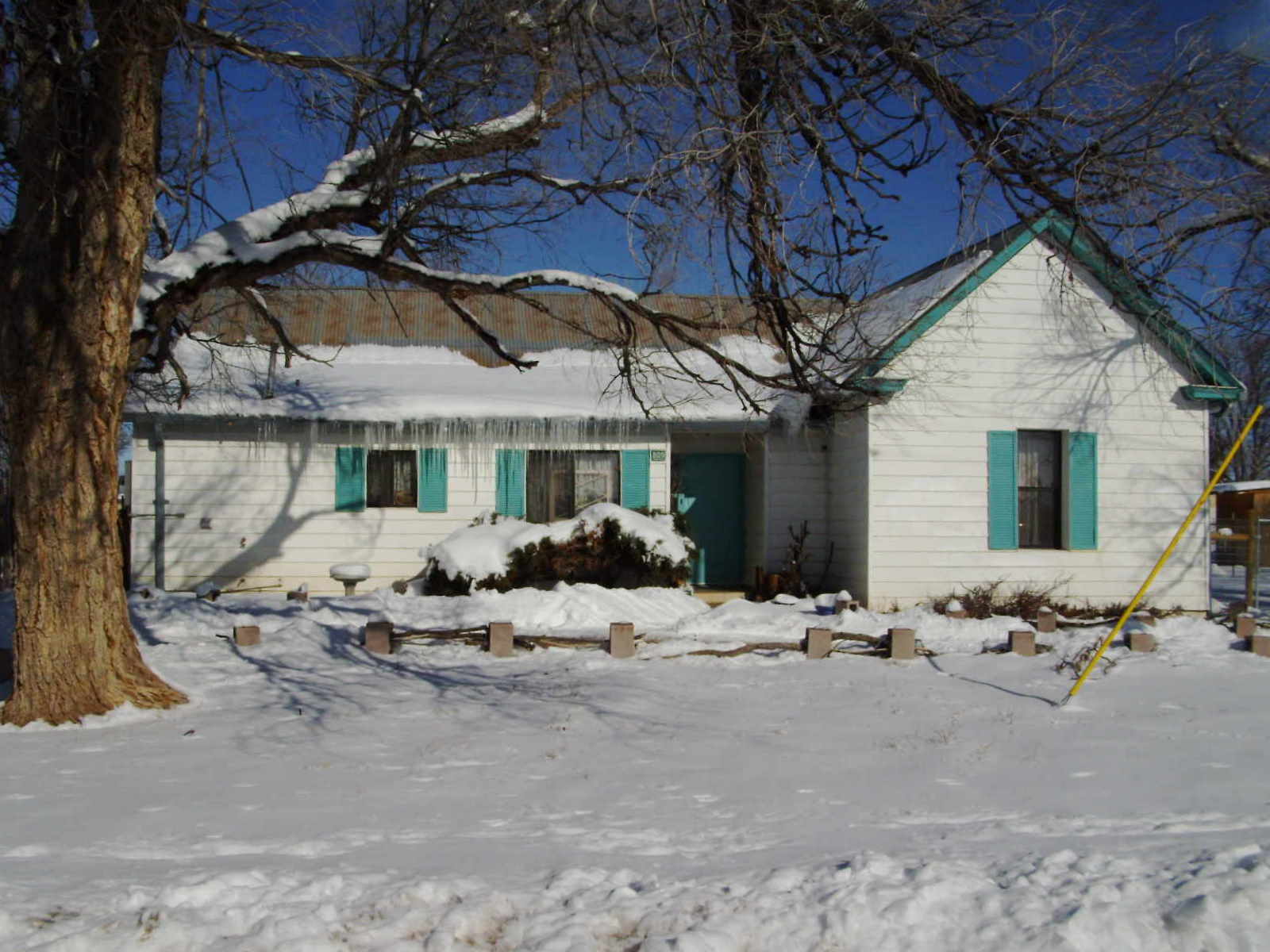 |
| Our Place in Snow |
That's actually a picture I took last Christmas.
It looks about the same outside now except that the clouds haven't cleared yet, though the sun is starting to poke through on the east.
I spent a winter in Anchorage and several winters in Upstate New York, so snow is not entirely unfamiliar to me, but it's still a treat when it happens, especially around the holidays.
Happy New Year!
Monday, December 10, 2012
CATS!
 |
| Feral Cat, December 2011 |
We've been hosts to a feral cat colony since we took over this place -- they were here well before we moved in -- and except for the Church Lady down the street, pretty much everybody around here is fine with the cats. We feed them and so do a number of neighbors. They keep the rodent population in check, but I've been concerned about the birds, as they tend to take some of them, and not necessarily the ones we would rather not have nesting in our eaves. (A story: last spring, a nest of sparrows in our eaves by the side door lost a chick that fell out one morning; a feral espied the event and took the chick within seconds, carrying it away in triumph to consume at leisure with its friends and relations. This was not by any means the first time this has happened. The grackles come by now and then to assess the cat situation from on high; we've had cats stalking birds in the trees at night -- how rude -- but at other times, they pay no attention.)
The feral population was more or less stable at 7-10 for years, but then all of a sudden, it exploded to almost 30, and then fell back to 20 where it is now. There was one breeding female who we call Queen, but her litters tended to be small, and there was usually only one or two survivors until recently. Since last year, however, there have been two or possibly three breeding females, and that has meant more CATS!
Time to do something to control the population. We've decided to take them all into town to have their health checked out and to be neutered. It's going to be quite a task. We've arranged to pick up traps and set them out and take as many cats as we can trap into town today for treatment tomorrow morning; then hopefully we'll be able to deal with the rest of them within the next couple of days, so as to get them all done this week.
Of course, we'll keep the colony together and return them to this location as it is their home place, and as I say, everyone around here except Church Lady is just as happy they're here.
I shouldn't be quite so sanguine. Actually quite a lot of people who used to live in this area are gone and there are empty places all around. Eric and Karen, our neighbors on one side, have been gone for over a year, and no one is quite sure what happened to them. [UPDATE: Word has come along with the Men In Suits. Eric and Karen have officially "disappeared," it seems. Their house is in foreclosure. The Men In Suits were there to supervise changing the locks. The city came by to drain the pipes and turn off the water. As Eric is a former mortgage broker and the house was (so far as we knew) paid off, it's probably fair to suspect they refinanced at some point, pulling out whatever they could, and then did a strategic default.] They left one of their cars and a truck, so it was assumed they'd be back, but they haven't been. The Valencias, our neighbors on the other side, are gone. Their house has been vacant for almost a year after it failed to sell; they decided they couldn't keep two houses anymore, as they had a place in Albuquerque too. Once their daughter finished school here and was planning on going to UNM, they said there was no point in continuing to pay for two houses. My sense is they did a strategic default when their place here didn't sell, but I'm not sure as we weren't here when they finally left. The property is being kept up by someone. The only thing we've heard from the people who have been over there is that they were sent by "the real estate company" to do this or that bit of maintenance, and they think the house will go back on the market soon. But it doesn't. Then we were shocked to find that Gauchy's place on the corner was vacant when we finally moved in for good in October. We had no idea. Apparently she was foreclosed, though we haven't heard the whole story. The Chaney place across from hers is also vacant and on the market. That was a surprise, too. It's been in the same family for many years, and I have no idea what caused them to sell and up and leave. Then there are the vacant places on the next street over, one of which happened just a couple of weeks ago. I think there are four vacancies altogether on that street. And so it goes.
There just aren't that many people living out here anymore.
Some days, we think there are more cats than people!
[UPDATE: We got twelve cats into the clinic. We still have eight to go; they include the four females that have been breeding so extravagantly. We are convinced they know all about these trap thingies and will not be easy to lure... A neighbor came by while the traps were being set: "'Sup?" "We're trapping the cats to get them checked out, vaccinated, and neutered." "Oh. Well you could get rid of them, you know. They make my dogs crazy." "Oh really? Didn't know that. They don't go down by your place as far as we know." "Oh yeah, they're down there all the time, make my dogs bark their heads off." "These cats have territories, and they stick pretty close; there are other cats around that aren't part of this colony, though. And I see and hear your dogs barking any time anyone walks down the street. They go crazy if they see someone in the street. Seems like they like to bark." "Well, those cats..." "Yeah, they're really something. The number of them will start diminishing pretty quick, and they won't be able to breed anymore. That's going to make a big difference." "I sure hope so..." Well... yes.
Oh. While we were rounding up cats, a large flock of sandhill cranes came trilling and honking up from the south -- there must have been 50 or 60 of them -- and swooped down low to circle and wheel over our house for it seemed like 20 minutes or more. There are open fields all around, and one, about a quarter mile away, has recently been cleared of corn stubble. I'm told the birds seek out recently plowed fields for forage. Eventually, they headed off north and west, away from the recently cleared fields. But it was quite something to have them so close above us...;-)]
UPDATE TO THE UPDATE (12/12/12): We got eight more cats to the clinic yesterday... and there were still six more, including two of the main breeding females, that refused to be trapped. We didn't have any more traps anyway. But this large a miscount of the colony was surprising. We'd been tracking 20 cats for weeks. All of a sudden there were 26. We think some of the additional ones have come from elsewhere. When we talked about it at the clinic, it was explained that cat colonies usually top out at about 20-25, and that additional cats coming around are from other colonies or households. They are looking for females in heat. Oh. That. Sure. Should we trap all of them? YES! Even if they're from somewhere else? YES! Trap them all, bring them in, get them fixed, and they will be much better "citizens." What should we do about these breeding females who refuse to be trapped? Be patient, try to make the traps less obvious (covering them and padding the floor with newspaper or cardboard), if nothing else works, get a larger trap and let cats wander in and out to eat, then, when the female we want is in there, spring the trap with a string. Ho ho. We pick up the first twelve today to return them to their territory... Should be interesting.
Sunday, December 9, 2012
Maybe Some Snow?
 |
| Snow at Christmas, 2011 (not our house, but one nearby) |
We're told that rain is on the way today and snow tonight -- most probably... But we'll believe it when we see it. Climate change has moved weather patterns mostly to the north, and that has meant that dry and mostly warm weather has persisted in our area well into December.
We went to a number of events yesterday in Albuquerque in shirtsleeve weather -- it was very pleasant, delightful really. We're into the second week of December, daytime temperatures are still in the 60's, and it's not that cold at night, sometimes dipping into the 20's. Tonight, though, the temps may get down to zero in our area, teens and single digits elsewhere. And... there is supposed to be snow...
We did some Indian Business in the morning (monthly township meeting and Christmas Party) and then took care of a good deed for one of our long time New Mexico friends who's been laid up for a while thanks to age and the physical deterioration that goes with it. She's got family, thank the gods, but I tell you, it's tough when various limbs and joints and stuff start falling to pieces and you're stuck behind a walker and you have to rely on whoever can help at the moment just to get some food in the house and a set of clothes washed. We took her her mail that had been building up out here in the country while she languishes in Albuquerque. While we were visiting, her daughter and son-in-law came by with sacks of groceries, and the dogs were thrilled that there were so many people around and something good would wind up on their plates. It's getting close to Christmas.
Then we were off to a booksigning in the North Valley featuring Rudolfo Anaya -- one of New Mexico's treasured writers and institutions -- and his new children's book, "How Hollyhocks Came to New Mexico" which is just an absolute delight, and perfect for Christmas giving. But we'll keep our copy, thank you very much!
The entire book team was there -- Los Lunas santero Nicolas Otero who did the exquisite illustrations, and Nasario Garcia who translated the English language story Anaya wrote into idiomatic New Mexico Spanish, which fits the project perfectly. Anaya himself is always a treat, hollyhocks, of course, are practically the state flower, and naturally, once again we wound up yabbering away with some of those waiting patiently in the long line as if we were lifetime friends. In a spiritual sense, perhaps we are. I don't know exactly how it works, but something draws them to us and us to them, and there it is.
The previous day we'd been to the Christmas at the Palace open house in Santa Fe, something we'd intended to do for years and never quite managed. It was your basic holiday community party, with -- of course -- that Santa Fe twist, in this case the chance to print your own Christmas card on the Palace Press. What fun. The Palace of the Governors has a wonderful santos display that I've been drawn to every time I've been there. There are dozens and dozens of characteristic New Mexico santos that have been collected from all over the state and assembled in a gorgeous exhibit in a side room of the Palace by the bookstore and in an adjacent chapel. In another room, there was a portrait of sour-faced Archbishop Lamy -- who attempted to forbid the further production and display of these "primitive" sculptures and paintings of the Saints, Our Lady, and Our Lord, saying something to the effect that they were "unworthy" of the dignity of the Church. Yes, well. That didn't go so well. It went something like the efforts of previous churchmen in New Mexico to forbid the religious totems and icons of the Indians. Sure. Just try it. Right.
Lamy is a curious character in every way, but he is characteristic in many ways of the characters who come out to New Mexico from wherever -- in his case, France -- and make a splash for good or ill in this quirky little mountain and high plains land where a river runs through it -- "so close to Texas and so far from God (or Heaven as the case may be)".
Another one of these churchmen is Father Roca out at Chimayo who came from Italy and has spent his life transforming the Santuario into what has been called the Lourdes of America. What it's called and what it is are two entirely different things, but I guess that that's beside the point. We take it all with a grain of salt. I don't doubt the many reports of healings at Chimayo; faith can do wonderful things. For a place that is considered to be so holy, however, those who care for it and welcome its pilgrims -- and the many just-plain-folks like us who visit -- are very down to earth. We were greeted at the door by Father Roca himself when we went to Chimayo some years ago, and because there were no crowds that day, he was happy to show us around and regale us with stories and blessings. Bless his heart. You don't get that at Lourdes, nor do you have the place almost all to yourself. Do you? ;-)
We took dinner at the Plaza Cafe after enjoying Christmas at the Palace festivities. An "angel" passed by as we were getting ready to leave the Palace. She offered me a basket of blessings, and asked me to take one. I picked this one out:
Therefore will we not fear, though the earth be removed, and though the mountains be carried into the midst of the sea. Psalm 46
Of course...
At the Plaza Cafe, we were amid what seemed like hundreds of children, some of whom were remarkably well behaved. Others, such as the ones at one of the tables next to us, were almost as ill-behaved as their parental units. Part of it was that it was Dad's Weekend With the Children, I'm sure. Much of their food and drink wound up on the floor somehow. Hm. I wonder how that happened. Shoes were found scattered hither and yon; the staff collected them and offered them up to the parents for distribution among the little ones; as always seems to be the case, there was a lone shoe left over.
The children at the table on the other side of us were a complete contrast. Of course, it may have helped that one of their parents was Native American (I would say "Indian," but that might be confusing), with whom we had a lovely chat while we waited for our food to come. The other parent at that table was a delightful blond woman who we assumed was not of the Native persuasion, but it's sometimes hard to know about these things from appearances. When we attend Indian township affairs, after all, many of those attending with us "don't look Indian" at all! No, they don't. On the other hand, among the Pueblos, where everyone seems to have a Spanish name, it's practically impossible for Anglos to distinguish los indios from Mexicans. OMG.
Indeed, the complexities of family, community, and cultural relationships among New Mexicans are something we may never be completely sure about. One of those Mysteries, one supposes.
Though the weather is clear and sunny and shockingly beautiful right now, they say there will be rain later today and snow later tonight, so we may not go to Las Posadas in Santa Fe (where there will be many people packing the Plaza anyway, and they like to think of it as a Local Event) so we might just stay home to sip some cider by the fire and take it easy for a bit.
Maybe though...
 |
| At Las Posadas de Santa Fe, 2011 (courtesy New Mexico Museum of History) |

At any rate, the snow at our place was a treat to watch and the mugs of mulled cider we sat with by the fire were delightful.
Monday, March 1, 2010
Snow
 View out the back this morning, snow still coming down.
The other day, I posted a picture of a painting that hangs in the north bedroom at our place in New Mexico. It's a picture of a man in an overcoat approaching a log cabin somewhere in the snowy mountain west.
Last night it started snowing lightly here, and right now there may be 3-5 inches on the ground. The storm -- such as it is -- came late. It was expected Saturday night. But that's the way the weather goes around here.
I didn't grow up in snow, so even though I've spent winters in Alaska and Upstate New York (save me from a winter's day in Rochester and/or Syracuse!) I'm still somewhat astonished by the sight of a landscape covered in snow, and just about any snowflake will thrill me. Though I'm getting used to driving in snow and ice -- even drove through blizzard conditions over the Continental Divide -- it's still in the experimental stage.
My New Mexico vehicle is an old Chevy Astro cargo van. Not exactly made for these conditions, but it is surprisingly good in most circumstances, even without snow tires (they're supposedly "hybrids" that work in all conditions -- and they do). Most people around here have Big Ol' Trucks with giant tires. Of course, if you live in the back country, you don't really have much choice. Roads are usually unpaved, they are never plowed, and getting in and out can be a challenge even in good weather. Before settling on this place, we looked at a house outside of Santa Fe that was down a narrow dirt track that crossed a stream, no bridge of course. The house was beautiful, and the setting was breathtaking, but getting to it -- and getting away from it if need be -- was guaranteed to be a trial at all times of the year.
And so it is for lots of places in this Land of Enchantment. As I've said, much of what I and many other Americans take for granted is a struggle for a lot of New Mexicans, sometimes by their choice. For example, unpaved streets are traditional in Santa Fe County and other places in New Mexico, and there is resistance to paving and other such un-green Anglo nonsense. Hardy self-reliance is an integral part of the local culture and social ethic, and yet people do rely on one another.
Tradition means a lot. Despite the fact that we've been coming here for over 20 years and have owned a house here for almost five years, we're still very much neophytes in matters of Tradition. It's unlikely we'll ever become fluent in local Tradition, but you never know.
We've brought a lot of California here, with more to come. That makes us exotics, especially given the fact that most of the Outlanders who move to this section of New Mexico are from Texas -- this area representing for them Freedom from the suffocation of Texas society and culture. While some of the local families have been here for generations, the area was not open for settlement until about 1900 thanks to an ongoing legal dispute between rival (Spanish) families that claimed the land. Ultimately, the court decided it belonged to neither of the disputants and opened it to settlement by all comers. Our place was one of about a dozen that are still standing that were built by the early settlers. Several of them are ruins or nearly so, but most are still inhabited, and that connection with the Old Days is an important consideration around here.
The older we get, the more those Old Days mean to us, too. Any Old Days.
Subscribe to:
Posts (Atom)