Completely OT: During the summer of 1973, one of the designers for the theater where we were working brought in the London cast album of "The Rocky Horror Show," and we played it incessantly backstage. Wore. It Out. The next summer, the show itself was brought from London to the Roxy in Hollywood, and a bunch of us got tickets and headed forth to see it. We were shocked to find that most of the audience was suburbanites from Van Nuys and such -- we knew because of all the white belts, polyester shirts and pant suits, and the many station wagons being valet parked. But the show was amazing. Tim Curry was amazing. The whole cast was amazing. We cheered and whooped and carried on as if we'd seen some sort of miracle. Frankenfurter's entrance, though similar to that in the movie -- in that it involved an elevator and platform heels (and Tim Curry in a cape) was a complete show stopper. The place went wild. And recall, the Roxy was -- and is -- quite a small facility, set up like a supper club, not a theater. The show took place all around and within the audience. It was extraordinary.
"So come up to the lab
See what's on the slab...."
------------------------------------
So today (actually, yesterday, now, as I was diverted by other things before I could finish this post) was our day to hie ourselves up to Los Alamos. We didn't go to the lab as it were -- I wasn't even sure where the labs were until after I checked the map again when we got home. The labs are on a ridge across a ravine south of the town. There's one way in, and you have to have a pass.
I'm sure it's grand. The folks we know who are connected with the place are... well, unique, let's put it that way.
We would not have made it at all if I hadn't taken the Red Van in for a major service call the day before. We knew something was wrong when we could barely get up Sedillo Hill on the way back from Albuquerque on Thursday. I thought it might be the dust clogging the air filter, but no, it was time for a tune up, and time to stanch some of the leaks, too...
At any rate, while I was waiting outside the shop for the repairs to be finished and signed off, I was watching the sky in the north and east. There were storm clouds gathering, lighting flashing, but it was still quite warm, and the air was strangely still. Despite all the lightning, there was no thunder, which I took as a sign that there wouldn't be any rain either. Then, out of the corner of my eye, I saw a brownish cloud moving in from the northwest. It looked fairly small at first, but it grew and grew, seemingly moving from west to east, but later I would learn it was actually moving in from the north and west, and I was seeing its looming height as it got closer.
It was a haboob. The first one I've ever seen or experienced.
I don't recommend it.
The dust cloud kept growing in height as it moved south toward the shop. Drew, the man working on the van, said he was going to drive it around the block to make sure everything was good, and I watched him turn onto the street as the dust cloud reached it. The wind picked up strongly, whistling through the portal under which I stood. The dust and grit in the air felt like sandpaper as it hit my face, and I turned away. The sky turned brown, and then it seemed like we were enveloped in a brown fog. I'd say visibility dropped to no more than 25 feet.
The wind was howling, but we were completely wrapped in brown fog. It was an image right out of the Dust Bowl of the '30s.
After a while, the air seemed to clear a bit, and I saw the Red Van coming back. Drew acted like nothing had happened as he an an assistant checked a few more things under the hood before handing me the key and sending me on my way. I drove maybe half a mile to the east, to the post office to pick up my mail, and as I did, the brown fog enveloped everything again, and the wind was blowing so hard that limbs were breaking off trees and flying through the murky air and landing in the street. Great. I couldn't see more than twenty feet or so ahead, and limbs were crashing in the streets. Needless to say, I proceeded at a crawl.
When I got to the post office, another car pulled up, and the woman driving just sat there. I went in the post office, turning away from the wind and the dust and holding on to my hat, just as another man went in the other door. He said to me, "LOVELY weather we're having, isn't it?" I said, "Couldn't get much worse." "Just wait," he said.
He was right. By the time I got the mail and headed back out to the Van, I could barely find it. I had to keep my head down, which made things difficult, but the combination of the wind and the dust made visibility practically zero, something like a white-out -- only it was brown and the air was warm and the grit cut like little razors.
I sat in the Van for a few minutes while I waited for the air to clear enough to at least see whether I was backing into another car or not.
It didn't take too long. But by the time I got back on the street, the brown fog was back, and the other drivers and I drove no faster than if we had been caught in a winter ice fog (which I have been, as I'm sure most other drivers around here have been.) Finally, when I got close to home, the air started clearing and the wind started dying down. I could smell the pungent aroma of the dust through the a/c vents in the Van. By the time I turned into our driveway, there were even a few rain drops and almost no sign of the dust cloud any more.
The whole episode had lasted perhaps fifteen minutes. It was not pleasant at all.
Old timers say they haven't seen anything like it since the '50's -- or maybe even the '30's.
Later, I talked to a friend who lives on a spread about three or four miles north, and she said she'd heard the wind, but didn't see the dust cloud. She said the wind was so loud she thought someone was outside rolling her garbage can around. When I described the dust cloud, she couldn't believe it. A haboob. Like they have in Phoenix. She's lived in this area off and on for about 20 years, and she'd never seen anything of that magnitude. Mostly, she said, she's seen dust devils, some of them quite large resembling tornadoes, but never a huge wall cloud like I described.
The dust cloud came in from the north west, feeding on the drought-parched open fields, some of which have been plowed recently but not planted. Some of the local farmers have planted several times, only to dig up the stunted crops due to lack of rain. We may have had a wild time with the dust cloud the other day, but the amount of rain that followed it could be counted by individual drops. People are putting on a brave face, but realistically, it's frightening. Two towns -- Magdalena and Cloudcroft -- so far have run out of water when their wells ran dry, and they say that the reservoirs serving Santa Fe will dry up shortly. The Rio Grande is running nothing but sand and dust south of Elephant Butte. As bad as it is, there are still a surprising number of cattle out grazing on the next-to-nothing grasslands.
And yesterday, on the way up to Los Alamos, we saw pronghorn again grazing in their own fields.
The drive up was very scenic -- except for the smoke. Like last year and the year before, there are a number of large forest fires burning and when wind and weather conditions are just right, the whole region fills with smoke blocking views and making it difficult for people like me to breathe. I've been told I have mild emphysema from all those years I was a heavy smoker. These days, even fireplace smoke in the air will bother me. Forest fire smoke can get me into coughing fits.
Thankfully, that didn't happen.
When we climbed up the last few winding miles of cliff-clinging roadway to get into Los Alamos proper, I said it was something like the climb into Tahoe, and in fact, but for the absence of the Lake, the effect and the visuals are very similar.
Los Alamos and the labs are located on the ridges formed of volcanic tuff and lava flows by the Valles Caldera just to the west. For its part, the Valles Caldera is one of the largest and most recently active volcanic calderas in the country. It's said to have last erupted around 40,000 years ago, and it is still considered active. To see and realize just how extensive the volcanic formations around the caldera are -- mile after mile after mile, very thick, is to be reminded -- if a reminder was necessary -- just how impotent we puny humans are in the face of such enormous natural forces. The burned over Jemez Mountains just outside of town made clear what the presence of the volcanic formations might not have.
It seemed particularly appropriate to have that reminder in Los Alamos given what went on there and still goes on there.
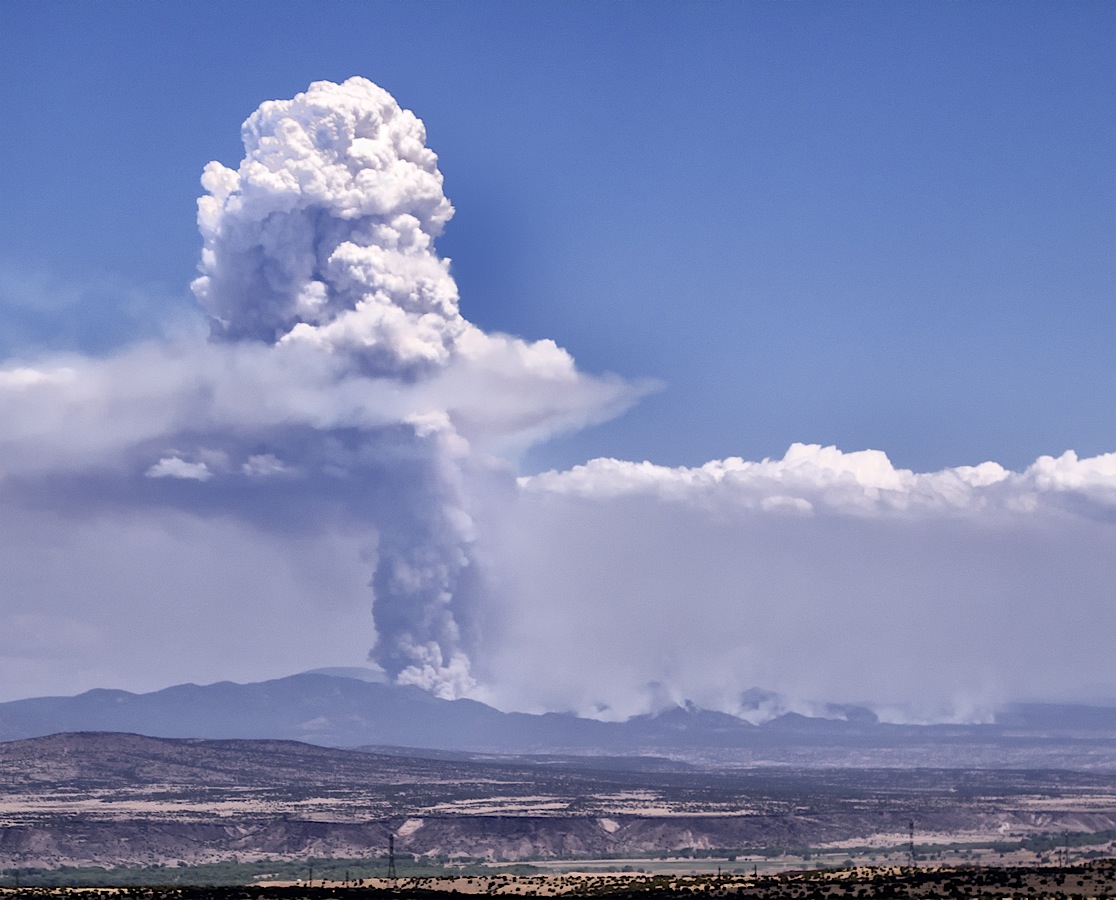
This is a view of the Las Conchas Fire in 2011 taken from Placitas (the pic is from the WikiPedia). This fire burned into Los Alamos, threatening the labs and burning dozens of homes. It also destroyed important watershed, leaving the region highly vulnerable to flash flooding.
Most of the chatter among the the folks we were with in Los Alamos was about the drought and the increasingly harsh water restrictions people are living under and what can be done about it -- which isn't much. I'm still puzzled by the lack of cloud seeding in the area -- for there are clouds most days, and some are obvious rain clouds that drop nothing -- but there are unresolved issues with the process and much dispute over its environmental effects and effectiveness, so it's not being done to my knowledge at all. Part of the problem has been that the air is so dry, in many cases rain evaporates before it reaches the ground. Even seeded clouds would face the same atmospheric conditions.
So, in New Mexico, we suffer with drought and dust and wildfires while much of the rest of the country has way too much rainfall and massive tornadoes and other storms causing immense havoc. People are highly adaptable to changing weather conditions, but still...
Los Alamos is worth a return trip, not so much for touristy things (please) as for the diversity of insights we've found among people there. It really is a "thinking" place, and not all of the thinking is dedicated to blowing shit up with nuclear weapons -- as important as that seems to be among some members of the community. No, there are other things to think about. And many in Los Alamos do so.
-----------------------------------------
Meanwhile, having seen the show live all those many years ago, the movie of "The Rocky Horror Show" was a real let down when it came out. I know it's got cult status now, and we've been to a few of the audience participation presentations -- which at least re-energize it. Of course we never considered producing the stage version when we were in that line of endeavor... While "Rocky Horror" not quite as time-bound as "Hair", it's still something of a period piece... in a manner of speaking.