
[Illustration from "The Journal of a Mud House", Elizabeth Shepley Sergeant, Harper's, May, 1922]
As you can see from the photo above, Ms Sergeant did get her Mud House into habitable condition before she had to leave Tesuque that summer, whatever summer it was, when she bought a couple of acres and its ruined adobe to have a place to stay out in the country.
The wing to the left is her new kitchen that was added to the original three room house at her direction. Well, it was built then torn down then built again because the adobes were set wrong by her main worker, José, who was quite a character if her descriptions are in any way accurate -- which I'm sure they are.
Building and tearing down and building again is fairly routine in parts of New Mexico. It's just what you do, assuming you have the time and the inclination to do something like that in the first place.
Building and abandoning the project is not unknown, either.
Or building and staying a while, then abandoning the project...
You get the picture.
Got to get those ruins to renovate somehow.
Our own project took ten months to get the house into more or less complete enough condition to move in to, quite a good deal longer than Elizabeth Sergeant's project which only took a couple of months over a summer. But then, she only had three rooms plus one added. So it wasn't that much of a job.
Except...
It can be hard to get stuff here, which she found out over and over again. I look around this house today, and I consider what it must have been like for the pioneers who built it originally starting right around 1900 when this section of the East Mountains was opened for settlement.
(The court battles over ownership of the land went on and on, and finally, if I recall correctly, the court ruled none of the claimants had a valid claim, so it was open for homesteading. Whoo-hoo! But even then, people knew it wouldn't be easy.)
There was a railroad spur, though, the remnants of which are still visible, and a little town was laid out, and a handful of settlers moved in and built their scattered adobes, most of which are still standing... more or less. Some are ruins.
From the railroad, of course, you could get things to build with. And so it was. Much of what could be got through ordering it from Back East is still visible in our house -- the doors for example as well as some delightful cabinetry in one of the halls (that I'm sure was built on site but from finish lumber that was ordered in); quite likely the floors were made from pine lumber brought in by rail. The baseboards in some of the rooms, and the window casings -- though not the windows themselves in most cases -- also date from the early period and are obviously made of fancy finish lumber from elsewhere. But when I went up in the attics, I found rather randomly placed joists and beams made of rough finished pine which I figured came from more or less local sources, and their rather casual disposition is perfectly "New Mexico" in my view.
This house is obviously self-built, and some of the details are quite fancy. On the other hand, it's quite primitive, too. There was no indoor plumbing originally, no gas for heating (there are holes in the ceilings for the chimneys of wood stoves that would have been in each room though.)
Of course there was no electricity early on, but some of the wiring clearly dates from very early 20th century, and it appears that there was a wind-powered generator on top of what's now the garage.
Over the years, the house was expanded, most of the extensions built with adobe, and sometimes I think of expanding it again by finishing the attics and perhaps adding a new wing on the north to serve as a living room and transforming the current fairly cramped living room into a rather large dining room cum library. I've also thought about reconfiguring the two west side bedrooms (now used as small library and small workroom) into one larger room with a new bathroom. Adding portals.
But not changing the basic Victorian style of this house into a "Northern New Mexico" version of the Santa Fe Style.
That's the thing. Though this is an Old Adobe ranch house, it is frankly and forthrightly in the Late Victorian (simplified) Style, and so it sometimes strikes visitors as an oddity -- because it doesn't follow the conventions of Santa Fe Style, which -- to circle back to our story -- Elizabeth Shepley Sergeant was in the process of helping to create with her renovation of a ruined adobe (that she figured dated from the 1870's) in Tesuque in the early 1920's.
It took ten months to get our place into good enough shape to move into in part because our contractor had so much trouble with his workers. Yes. Understood. They were mostly residents of the East Mountains, too, though the contractor himself lived in Albuquerque. Nevertheless, they all complained constantly about having to go clear out to our place to work on the house. It was so far, don't you know. Travel time took up so much of their day so they could only get so much done. Worse, it was so hard to get materials and supplies out there, and we such demanding owners, constantly wanting "authentic this or that" instead of what could be found or scrounged locally. In fact, I had to order quite a few things online or purchase them in California and have them sent out to New Mexico because there was nothing available locally that would fit the style of the house.
The things I wanted just weren't available locally. Picky, picky, picky!
Also, I was working in California most of the time the renovation was going on, only making periodic flights out to New Mexico to check on progress and get the contractor paid. So ten months was good time under the circumstances.
I have found since then that indeed a lot of things you might take for granted elsewhere aren't easily available in New Mexico, and if you can get or find them, they cost a lot more than they do wherever you're from. Local materials aren't necessarily cheap; in fact, sometimes they are a good deal more costly than "imports." Thus, for example, there are considerable quantities of East Indian imported building materials available -- doors and columns and quaint things of all kinds -- and they are used as substitutes for Old Spanish stuff (which can be had either as antiquities or contemporary re-creations) because they are considerably less expensive than the "authentic" Spanish materials.
It's quite a sight to see a brand new Santa Fe Style house built with and full of East Indian antiquities. But it would cost a third more or even half again as much to build or renovate your adobe with "authentic" Spanish and/or Spanish style materials. So people go with the East Indian substitutes, which are quite nice in their own right, but seem somehow... foreign!
Elizabeth Shepley Sergeant would never even have thought of doing that. In her day it was possible, "even for a woman" (which was part of what she was writing about) to renovate a house in the truly authentic style of New Mexico, using local labor and materials, and adapting what was needed to what was on hand. She needed adobes, she got adobes -- from a building that had fallen to ruin. Her renovated roof was new-fangled asphalt instead of the piled-on dirt and debris that had been put on top of the authentic vigas and latillas back in the day. She had windows put in, casements no less, still the Style around these parts but harder to get now than they were then. She had a kitchen built and a cast iron stove put in. She furnished her house with locally made furniture and objects, much of it inexpensive by her standards. Anything like it now would cost a fortune.
She had -- and apparently needed -- no electricity, no indoor plumbing, and no heat except for the corner "kiva" fireplaces that were already part of the house when she bought it, and the wood burning cook stove she installed in her new kitchen. But it sounds like she only intended to use the house in summer, and though there might be rain, it's not cold in the summertime in Tesuque. Up in Taos, though, it would be frigid as the North Pole in the wintertime. As the locals there found out again -- if they didn't remember -- when the gas supplies failed during the coldest part of the winter this year.
But her story is about so much more than the house she renovated.

And that's the thing. Ultimately, it's a spiritual journey.
The wing to the left is her new kitchen that was added to the original three room house at her direction. Well, it was built then torn down then built again because the adobes were set wrong by her main worker, José, who was quite a character if her descriptions are in any way accurate -- which I'm sure they are.
Building and tearing down and building again is fairly routine in parts of New Mexico. It's just what you do, assuming you have the time and the inclination to do something like that in the first place.
Building and abandoning the project is not unknown, either.
Or building and staying a while, then abandoning the project...
You get the picture.
Got to get those ruins to renovate somehow.
Our own project took ten months to get the house into more or less complete enough condition to move in to, quite a good deal longer than Elizabeth Sergeant's project which only took a couple of months over a summer. But then, she only had three rooms plus one added. So it wasn't that much of a job.
Except...
It can be hard to get stuff here, which she found out over and over again. I look around this house today, and I consider what it must have been like for the pioneers who built it originally starting right around 1900 when this section of the East Mountains was opened for settlement.
(The court battles over ownership of the land went on and on, and finally, if I recall correctly, the court ruled none of the claimants had a valid claim, so it was open for homesteading. Whoo-hoo! But even then, people knew it wouldn't be easy.)
There was a railroad spur, though, the remnants of which are still visible, and a little town was laid out, and a handful of settlers moved in and built their scattered adobes, most of which are still standing... more or less. Some are ruins.
From the railroad, of course, you could get things to build with. And so it was. Much of what could be got through ordering it from Back East is still visible in our house -- the doors for example as well as some delightful cabinetry in one of the halls (that I'm sure was built on site but from finish lumber that was ordered in); quite likely the floors were made from pine lumber brought in by rail. The baseboards in some of the rooms, and the window casings -- though not the windows themselves in most cases -- also date from the early period and are obviously made of fancy finish lumber from elsewhere. But when I went up in the attics, I found rather randomly placed joists and beams made of rough finished pine which I figured came from more or less local sources, and their rather casual disposition is perfectly "New Mexico" in my view.
This house is obviously self-built, and some of the details are quite fancy. On the other hand, it's quite primitive, too. There was no indoor plumbing originally, no gas for heating (there are holes in the ceilings for the chimneys of wood stoves that would have been in each room though.)
Of course there was no electricity early on, but some of the wiring clearly dates from very early 20th century, and it appears that there was a wind-powered generator on top of what's now the garage.
Over the years, the house was expanded, most of the extensions built with adobe, and sometimes I think of expanding it again by finishing the attics and perhaps adding a new wing on the north to serve as a living room and transforming the current fairly cramped living room into a rather large dining room cum library. I've also thought about reconfiguring the two west side bedrooms (now used as small library and small workroom) into one larger room with a new bathroom. Adding portals.
But not changing the basic Victorian style of this house into a "Northern New Mexico" version of the Santa Fe Style.
That's the thing. Though this is an Old Adobe ranch house, it is frankly and forthrightly in the Late Victorian (simplified) Style, and so it sometimes strikes visitors as an oddity -- because it doesn't follow the conventions of Santa Fe Style, which -- to circle back to our story -- Elizabeth Shepley Sergeant was in the process of helping to create with her renovation of a ruined adobe (that she figured dated from the 1870's) in Tesuque in the early 1920's.
It took ten months to get our place into good enough shape to move into in part because our contractor had so much trouble with his workers. Yes. Understood. They were mostly residents of the East Mountains, too, though the contractor himself lived in Albuquerque. Nevertheless, they all complained constantly about having to go clear out to our place to work on the house. It was so far, don't you know. Travel time took up so much of their day so they could only get so much done. Worse, it was so hard to get materials and supplies out there, and we such demanding owners, constantly wanting "authentic this or that" instead of what could be found or scrounged locally. In fact, I had to order quite a few things online or purchase them in California and have them sent out to New Mexico because there was nothing available locally that would fit the style of the house.
The things I wanted just weren't available locally. Picky, picky, picky!
Also, I was working in California most of the time the renovation was going on, only making periodic flights out to New Mexico to check on progress and get the contractor paid. So ten months was good time under the circumstances.
I have found since then that indeed a lot of things you might take for granted elsewhere aren't easily available in New Mexico, and if you can get or find them, they cost a lot more than they do wherever you're from. Local materials aren't necessarily cheap; in fact, sometimes they are a good deal more costly than "imports." Thus, for example, there are considerable quantities of East Indian imported building materials available -- doors and columns and quaint things of all kinds -- and they are used as substitutes for Old Spanish stuff (which can be had either as antiquities or contemporary re-creations) because they are considerably less expensive than the "authentic" Spanish materials.
It's quite a sight to see a brand new Santa Fe Style house built with and full of East Indian antiquities. But it would cost a third more or even half again as much to build or renovate your adobe with "authentic" Spanish and/or Spanish style materials. So people go with the East Indian substitutes, which are quite nice in their own right, but seem somehow... foreign!
Elizabeth Shepley Sergeant would never even have thought of doing that. In her day it was possible, "even for a woman" (which was part of what she was writing about) to renovate a house in the truly authentic style of New Mexico, using local labor and materials, and adapting what was needed to what was on hand. She needed adobes, she got adobes -- from a building that had fallen to ruin. Her renovated roof was new-fangled asphalt instead of the piled-on dirt and debris that had been put on top of the authentic vigas and latillas back in the day. She had windows put in, casements no less, still the Style around these parts but harder to get now than they were then. She had a kitchen built and a cast iron stove put in. She furnished her house with locally made furniture and objects, much of it inexpensive by her standards. Anything like it now would cost a fortune.
She had -- and apparently needed -- no electricity, no indoor plumbing, and no heat except for the corner "kiva" fireplaces that were already part of the house when she bought it, and the wood burning cook stove she installed in her new kitchen. But it sounds like she only intended to use the house in summer, and though there might be rain, it's not cold in the summertime in Tesuque. Up in Taos, though, it would be frigid as the North Pole in the wintertime. As the locals there found out again -- if they didn't remember -- when the gas supplies failed during the coldest part of the winter this year.
But her story is about so much more than the house she renovated.
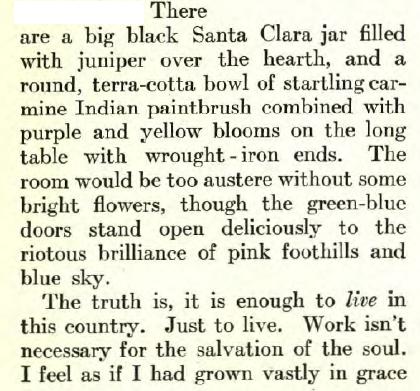
And that's the thing. Ultimately, it's a spiritual journey.
To Be Continued


