Showing posts with label Taos. Show all posts

Monday, April 17, 2023

To See The Mountain


Taos Mountain from our room


We did an overnight in Taos. That's all we can ever really do these days, an overnight get away, because of the cat situation at home. Some are old, some are sick, some don't do well on their own. Ms. is entirely devoted to them, but she needs periodic get aways, especially since I've been ill and such a burden. We hit on going to Taos in April partly as a test to see if I could do it, how far I could drive and so on, and partly because the overnight would be scheduled the day after I (finally) got to see the neurosurgeon to see if there is something that can be done about my lameness. Sure there is! More tests!

So. I booked us a Room With a View at the Hacienda del Sol (recommended) but by mistake because I intended to book somewhere else. Well, Ms. says it wasn't a "mistake" at all. She loved it. Well, except for the addled boy thump-thump-thumping for hours upstairs above our room, apparently until he got his ritalin from his parental unit-care giver and wound down. Jeeze. You always hope that doesn't happen, but more often than not, there's a screaming toddler on your flight, a crazed boy or girl screaming and running around while you're trying to sleep or meditate -- or worse, work. Or like us, a somewhat disturbed boy and a hopeless parental unit-care giver thumping around for hours in the room above. Is it somehow inevitable? Seems so.

But you know what? We hardly minded. Why bother? If things like this are inevitable these days, there's little point, eh? Our neighbor in the next room was not so easy going, though. After about an hour of thumping above, he went out in the courtyard and yelled "Hey!" at the upstairs people. The thumping stopped for about five minutes then began again. We didn't see or hear what happened after that, but our impression was that the neighbor left not to return.

Sad. But hennyway...

This place was advertised with a view of Taos Mountain you wouldn't believe, and it didn't disappoint. We had a little patio with two chairs and a table to sit and view The Mountain, and there it was, big as life, bigger really, looming as mountains will do, apparently out on the edge of the plain, no city in view. It was magical.

We've stayed at Mabel's House (The Mabel Dodge Lujan House) in Taos before, and our room had a view of The Mountain, but not like this. It was nice, I have nothing negative to say about it (maybe narrow, steep stairs?) but otherwise, it was great. 

This place, Hacienda del Sol, was different and in some ways much nicer. Our room was on the ground floor, yay, had a (non-working) fireplace lit with electric tea lights, a little patio, and a great big bed. No TeeVee, refrigerator, microwave, or other modrun conveniences. Well, except for the Keurig I didn't know how to work. Finally got it to make hot water, tho, and then later after a failure, to make coffee. Noisy and rattle-y. Very odd. But there you go. We still use a copper-bottom percolator on the stove at home! Easy-peasy.

I wanted to take in a couple of exhibits. Buck Dunton paintings at the Harwood, and Gene Kloss's works at the Couse-Sharp Historic Site. I wasn't sure I could physically do it, but you don't know unless you try, right?

And so, that's what I did and not only got through both places in one day, but enjoyed it. Yep. Tired, though, and it was great to just flop down on the bed and look at The Mountain until it was time for dinner.

Dinner. Hm. We decided to try the Love Apple right down the driveway from the Hacienda del Sol, but I couldn't get through to make reservations, so we walked down there (for me a hike) and inquired at the desk. Very nice woman said there wasn't an opening before 8:30p, but if we wanted she would would check for cancellations after 6p and give us a call. I was about to say yes when I saw the sign on the desk "Cash or check only. Thank you!" Now wait. Who carries cash or a checkbook these days? I surely don't. And I may have had $20 or so with me but that was nowhere near enough for dinner. I expected the bill would be well over $100. Hm. I said, "No thanks, we'll look for somewhere else." And so we did.

Across the (very busy) street was the renown Guadalajara Grill. We went there. "Voted The Best Mexican Food in Taos every year since 2015."  Well. I can't say my Chiles Rellenos were the best. They were enormous, stuffed with calabacitas and cheese, but they were soggy with an oddly flavored green chile sauce, and as far as I could tell, the poblanos were raw, not roasted and skinned, and they were tough. 

The plate was a mess with wet refritos and dry and flavorless Spanish rice and a big glop of sour cream in the middle. But ultimately I ate it and was oddly satisfied. Not my favorite, far from the best, but edible and filling and in parts tasty.

She said her beef tacos were excellent, and her beans and rice were very good, too. In fact, the plates looked distinctly different and were pretty obviously prepared by different people. She not only ate all of hers, but ate some of mine! And the chips and salsa we had for starters were outstanding. Fresh, good, filling.

So, that was our dinner, and we got back to our room to look at The Mountain and fall asleep even before sunset. The boy and its care giver(s) didn't arrive to go thump-thump-thumping upstairs until after dark and we were sleeping. The thumping above woke us up. Oh my. And then it pretty much became part of the background like the rattling and groaning of the baseboard heating.

At some point, it just faded away altogether. 

In the morning, we went over to the kitchen/dining room for (included) breakfast. Well now. What a treat. Freshly prepared bagel with green chile, egg, and potato pancake, tamale, sausage, fresh orange juice (from a magical juicer machine) and excellent coffee from another magic machine I've never seen before that ground the beans fresh for each cup of very strong brew that I thinned down with hot water at the suggestion of the chef. We made new friends at breakfast, a retired couple who were staying in "Mabel's Salon" -- more about which later -- for four days away from Winter in Wisconsin. Oh where? About ten miles from Ms. Ché's Wisconsin friends whom she's visited a number of times. And turns out, these new friends had lived in Woodland, CA, for years before they retired to Wisconsin and so had been near neighbors (about 25 miles from us when we lived in Sacramento)! Well. Who'd a thunk?

We chatted and enjoyed breakfast together until it was time for them to get ready to go hiking with her sister who lived in the area. They were staying a few more days, so we suggested they go over to Mable's House and take a look around. Turns out where we were staying, Hacienda del Sol, was an expansion of Mabel's first house in Taos, and part of it, where the couple was staying in "Mabel's Salon" was the original house built of adobe in the early 1800's. My, my, my. I'd read she had rented a house in Taos when she first arrived in 1917(?). Then she met Tony at the Pueblo, and one thing led to another, and he suggested she buy acreage bordering Pueblo lands where there was a ramshackle three or four room house that he would fix up for her, soon enough for them, and so she did.

That house became Los Gallos, the present Mabel Dodge Luhan House, twenty some-odd rooms, most available for short or long term stays, the place often booked solid for workshops and conferences. Here's an interesting blog post by the High Road Artist that shows off some of the place.

It's wonderful in its own way, and always includes an excellent breakfast in your stay. Ms. has stayed there more than me, but I've enjoyed my time there, too. It's a special place, but Mabel's original house in Taos, now the Hacienda del Sol, is too. 

Ms. insists it was no "mistake" making our reservations there this time. In fact, she loved it and most likely will return whenever she has the chance.

Why Taos? Welp, it was one of the first places in New Mexico we stopped at and explored way back thirty-forty years ago. I don't remember the year. I do remember it was night, and I wanted to see the D. H. Lawrence "forbidden paintings" at the La Fonda de Taos, and so I pulled up there and went in to see what I could see. I think it cost five dollars to have the man pull the curtain on the Forbidden Paintings and let me look at them for ten minutes or something. It was quite a production. At any rate, at the time I was still smoking and the altitude, 7,000 plus feet, was really getting to me, and I don't think I spent all of five minutes looking at the Paintings before I had to leave. Truthfully, they weren't very good anyway.

And so we drove around Taos for a bit in the dark, making discoveries here and there, particularly arts related, and then headed back to Santa Fe for the night. 

And the urge was to go back to Taos in the daylight and explore some more.

Dennis Hopper was still occupying Mabel's House at the time, I think. Or maybe he'd sold it. As I say, I don't remember the year. It could have been '80s; it could have been '90s. But it was some time back.

Then I stopped smoking (c. 1994) and we could go back to Taos, and I could enjoy it. And have ever since.

I wanted to see the Buck Dunton exhibit at the Harwood this time, and I did, and I wasn't disappointed. I got to see some paintings of his that I'd never seen before, and I came to what may be a fuller understanding of who he was and how his painting technique evolved. Like Gerald Cassidy, Dunton was an illustrator and his works, even as he became more of a fine artist, showed his illustrationist roots. I was particularly taken by his painting titled "My Children," a rather cautionary study of his daughter Vivian on horseback, and his son Ivan looking bored into the foreground. The children are painted in nearly photographic detail while the horses and the sagebrush background/foreground and the children's sweaters are more sketched in his Van Goghish style of varied color parallel lines. 

W. Herbert "Buck" Dunton, "My Children," public domain via Wikimedia Commons


I'm almost certain the children were not posed outdoors in the morning sun in New Mexico to be painted en plein air by Dunton (contrary to Ivan's later assertion as stated in the catalog.) No, I suspect that the children were most likely posed indoors and photographed. They could have even been candid photos. The pictures may or may not have been taken in New Mexico. If Vivian was on a horse, it may have been in New Mexico, but she could just as easily have ridden a horse in New Jersey where she and Ivan lived most of the year with their mother. And given the level of detail in her face but not her clothing, she may not have been on a horse at all.

The poses are not what you would naturally see outdoors, in other words. In my view it is likely that if anyone posed for the painting, it was not his children. The faces are from photographs. The bodies are not -- in my view -- physically proportioned correctly. He may have simply drawn bodies to fit the faces. Or even pasted the faces on other bodies altogether.

Vivian's pose on the horse, twisted around with one hand behind her on the horse's back, is one of Dunton's signature poses that he used again and again for people on horseback. And we see it in many other realist western paintings by many artists. I have the feeling it would have been automatic for Dunton to use it for a portrait of his daughter on horseback -- even though she may never have posed in that position. 

Ivan's body is strangely tilted in a way that seems very unnatural, and he seems to be growing directly out of the sagebrush and tilted perhaps because he was blown by the wind. There is no lower body. He's truncated just below the waist. Poor thing. Again, I think this is a made-up pose from Dunton; there was no boy in the sagebrush painted en plein air at dawn such as Ivan suggested later. More likely, his position and pose were photographic artifacts, probably a candid shot, that cut the boy off at the bottom of the frame.

The background is very sketchy, showing a line of horses, rounded mesas and cliched New Mexico weather including the famous "walking rain" -- that's very real, but you may never encounter it. Brilliant blue highlights are scattered throughout. 

The foreground horses and sagebrush and the childrens' clothing are painted with varicolored parallel lines somewhat like Van Gogh's technique in some of his paintings. It gives an unexpected liveliness to the foreground images. Nevertheless, the images seem studio-bound rather than en plein air. They do represent Dunton's signature technique in his later paintings. His many illustrations for magazines and books, however, look completely different and utilize very different techniques. Dunton's later painting in New Mexico strongly resemble Ernest Blumenschein's New Mexico landscapes and portraits.

Where Dunton differs is with the faces of his children, faces that are almost porcelained in their smoothness. Nothing like the rest of the painting. These faces, I'm almost certain, are painted from photographs. 

The whole composition is somewhat off kilter and disturbing. What is really going on here? 

The story is that Dunton and his wife Nelly were divorced, in part because she didn't want to live in New Mexico where W. Herbert Dunton had become "Buck" and was thoroughly integrated into the local cowboy culture -- well, as much as an artist could be -- and he didn't want to leave. The children went with their mother to New Jersey, returning to New Mexico and Taos to spend summers with their father. Perhaps reluctantly. But I have some questions. The painting was supposedly completed in 1920, the same year as the divorce if I understand correctly. So the childrens' back and forth between New Jersey and New Mexico hadn't started yet... or had it? 

Also, summer in Taos can be quite warm, and these children are bundled up in nearly identical heavy wool sweaters, hardly appropriate wear for a Taos summer morning. More suited to late fall or early winter. 

The children look either bored or unhappy, but why? Could it be because their parents aren't getting along and will soon break up? Seems to make more sense to me than that they had already broken up. 

The painting was hanging at the Harwood, but I first saw it years ago at the New Mexico Museum of Art in Santa Fe, it's usual home. It was striking then. It is striking now. 

The Gene Kloss exhibit at the Couse-Sharp was striking too, and I'll try to get to it in another post. For now, we remember The Mountain.

Tuesday, July 16, 2019

The Blumenschein House, Taos

Star Road and White Sun by Ernest L. Blumenschein c.1920, Albuquerque Museum 


Since I've been on this dwelling theme for a while, why not continue for a bit longer, eh?

I was back in Taos over the weekend to pick up Ms. Ché who'd finished her writers' conference, and we decided to stop at the Blumenschein House on our way out of town to compare and contrast it with the Couse House which we'd visited the prior weekend.

Blumenschein, together with Bert Phillips, started the process of making Taos into the place it is today when their famous Wagon Wheel broke a couple of dozen miles from town and Blumenschein won the toss to take it into the hamlet somewhere down below them to get it fixed. They had to wait, as one can imagine there in the middle of nowhere, and so they did.

While waiting, they became enchanted, so the story goes, and they spent the rest of the summer awestruck and delighted, painting up a storm, and pondering their own futures.

Phillips stayed in Taos the rest of his life. Having settled in, there's no other place he'd rather be. Blumenschein went back to Paris where Joseph Henry Sharp had told him and Bert about the enchantment to be found in Northern New Mexico, and one thing led, eventually, to another, and all of them wound up living and working in Taos at least part time, and Blumenschein and his wife Mary settled in themselves, purchasing Buck Dunton's place (or part of it) on Ledoux St, where they set up quarters of a sort and a studio in four ancient rooms said to have been a part of the village defenses against the Indians when time was.

I won't go into that history, but quite a few of the Spanish settlements in Tierra Adentro were consciously built as fortresses, and the village of Taos was no exception. The Indians were wild back in the day, particularly Kiowa, Comanche, Apache and Navajos.

The appropriate tangent at this point is to mention that there are three distinct "Taos"-es. There is the ancient Indian Pueblo at the foot of the Mountain; there is the village some three or four miles south; then there is Ranchos de Taos, several miles south of the village, where stands San Francisco de Asis mission church that's been painted by Georgia O'Keeffe dozens of times and by other painters endless numbers of times.  Side note: Dennis Hopper is buried in Ranchos de Taos, and his grave is a pilgrimage site for a diminishing number of aging Easy Riders.

Surrounding all of this is an amorphous outlying settlement area dotted with ranches and ranchettes and earthships and what have you where by far the largest number of Taoseños currently live scattered to the winds perhaps, but partaking in their own way the essence of that Sacred Placewhere they don't have to mix too much with the tourists.

At least it's not as bad as Sedona.

Anyway, none of the Taoses would be what they are today without Bluemschein and Phillips and the other members of the Taos Society of Artists and their numerous offshoots and successors and the many other influencers who have passed through or settled there since that fateful Wagon Wheel broke in the summer of 1898.

Blumenschein returned to Taos in the summertime for years, but he lived in Paris or New York, making money as a successful illustrator for magazines and books, until 1919 when he purchased "four rooms" from Buck Dunton, another member of the Taos Society, and settled in, or at least tried to. This was like camping out for the Blumenscheins and most of the other artists attracted by the Blumenscheins and others to Taos. The four rooms were built of mud and timbers, some of the structure apparently among the oldest still standing in the village, they had little heat, no electricity or indoor plumbing, and like everything else in Taos they were at the edge of Nowhere. It's hard to explain how difficult it was to get to Taos from anywhere else, and to get from Taos to anywhere else. This isolation was both a handicap and a blessing.

The house as it stands today is a rambling L shaped structure around a lush courtyard, in one corner of which is Buck Dunton's studio -- which he apparently kept even after all the other rooms on the property  had been purchased by the Blumenscheins. This part of the story is a little confusing to me. Apparently Buck bought part of the rambling structure from earlier residents, but most of the structure was owned by and lived in by long-time Hispanic residents who one by one were persuaded to vacate by Blumenschein's offers of cash money. At least that's how I interpret the story of how Ernest Blumenschein eventually acquired the entire property.

This is a pattern that repeats over and over again -- even now --throughout the fancier and more tourist oriented areas of New Mexico. It's a form of gentrification, pushing out the original settlers and descendants to make way for the shiny, sophisticated newcomers. "Sophisticated" is the key.

The Blumenscheins were nothing if not sophisticated, and yet their mud house on Ledoux Street is a curious amalgam of its primitive Hispanic roots and the high style that the Blumenscheins had acquired in Paris and New York. Curiously, there's almost no Native influence in the house at all, though apparently they employed Native servants as well as Hispanic ones (this was typical of the art colony.)

The Couse house shows lots of Native influence or at least artifacts, and Mabel's Place up the road from the Couse House was built by Native artisans from the Pueblo, and of course, Mabel was married to Tony Luhan (who had his own house on the property) who was born and raised (and had another wife and children) on the Pueblo.

There are a number of other Taos Society historic sites to explore, and eventually we may get to them, or not. I started my explorations of this sort many years ago at La Fonda de Taos where I stopped one evening to take in the D.H.Lawrence scandalous paintings. The ones there now are reproductions, but I saw the originals... and to be kind, I wasn't moved. But it started my journey to learn more about the artistic history of Taos.

It's a story of colonizers and colonization, one that has transformed some of New Mexico yet has left much of the rest of the state practically untouched.

On our way back from Taos this past Sunday we stopped off at the Santuario de Chimayó where a large group of East Indian pilgrims was taking all the Holy Dirt out of the Holy Dirt Pit and transporting it away in gallon containers. There seemed to be none left for the other pilgrims. We sat beside the abandoned crutches and Santo Niño and shook our heads in wonder and wiped the sweat from our brows as the heat and humidity of the day was surprisingly intense. We nodded to the statue of Father Roca in the courtyard. His generosity of spirit will live on....


Monday, July 8, 2019

Couse House Taos

What a day.

Those who doubt climate change should have been here yesterday Saturday when a chilly monsoon storm enveloped northern and central New Mexico leaving us surprised and wet and shivery if we weren't bundled up like ticks. The weather forecast was sunny-ish and warm. Day before the temperatures were in the 90s. Not so yesterday Saturday.

The trip up to Taos from our place takes about 2 ½ hours on a good day. Yesterday it was closer to three thanks to the rain that stayed with us or followed or preceded us pretty much the whole way.  Sometimes light, sometimes torrential, it rained and rained and rained. There were plenty of thunder claps and flashes of lightning, a few of which fell quite close to the road we were taking, the Low Road to Taos it's sometimes called, as opposed to the less traveled but better known High Road.

The Low Road to Taos back in the day
The lady in the first car looks thoroughly exhausted, and I bet she is. The road is a little better now and cars are a bit more comfortable, but it can still be a challenge to get up the hill to Taos along the Rio Grande -- which was flowing deep and fast and brown, full of rafters intent on running the many rapids, no matter the weather, before the end of the Fourth of July weekend.

So we went, and we went for a specific purpose, to attend the opening of an exhibition of photographs of Pueblo (primarily Taos Pueblo) Indians used as models by E. I. Couse, in the early 20th century.

It was.... interesting... There were a couple of dozen photos in what's called the Luna Chapel which E. Irving Couse had used as a studio until he built a new one onto the side of the house. Two models were featured over and over again, Ben Lujan and Jerry Mirabal.

With a few exceptions, they were posed crouching. The crouching Indian was a consistent theme of Couse's and it would show up in the works of a variety of other Taos and Western artists and probably still does, though I haven't really checked recently. The Cowboys and Indians genre is very popular in Southwest, but it's really not my thing.

The Couse House is a rambling adobe and frame house perched up on a tiny mesa top down the hill from Mabel Dodge Lujan's Los Gallos place where we've stayed a number of times over the years and where we feel surprisingly at home. Perhaps in our previous lives we were guests of Mabel or maybe it is something else.

The Couse House has been preserved by the artist's granddaughter pretty much as it was when he died in 1936, whereas Mabel's place has gone through a number of overhauls and other uses since she passed in 1962, most notoriously its phase as Dennis Hopper's Mud Palace.

Couse was an original member of the Taos Society of Artists, arriving not long after the artist "discoverers" of Taos, Ernest Blumenschein and Bert Phillips whose broken wagon wheel made them linger in Taos while it was fixed in 1898.

Couse had a long time association with Joseph Henry Sharp, whose studio is on the premises, and who, in Paris at the Academie Julien suggested to Blumenschein and Phillips, and later to E. Irving Couse, that they head West and check out Taos and New Mexico for a breath of fresh air and the endless inspiration of the people (especially the Indians), the land and the sky. And so they did. Sharp had been in the area earlier -- I think 1893 -- but he hadn't settled there, nor would he, so far as I can tell, for many years after the initiation of the artist colony which became the Taos Society and its successors. In fact, though Sharp had a house and studio adjacent to Couse's place, he may never have actually "settled" in Taos at all. He may have been more like Blumy, who had a house and studio of his own in Taos and spent summers there, but did not "settle" until 1919, long after his first visit, and even then, he was on the road a great deal of the time he lived in Taos.

Much art would be -- and is today -- made in Taos, but then and now, it has to be sold somewhere else. Taos is today a small town (abt. 5000 population) and back then, it was tiny. It could be and sometimes still is a challenge to get to and get out of. The market for Art was elsewhere, and to a large extent, it still is. One may create there (as I have done on occasion), but if one is serious about selling (as I am not) one must locate other places for outlets -- even though now there are lots of galleries in Taos.

The "crouching Indian" theme was what drew us to Taos over the weekend.  Sure enough, we weren't disappointed. There were dozens of photos taken by Couse of his Indian models crouching by the fire, crouching in the grass, crouching along the trail, crouching, crouching, crouching, and in his studio, there were more prints and paintings of crouching Indians examining pots, wearing bizarre and un-Pueblo-ish costumes, and the last painting Couse was working on, still on its easel, barely sketched in oil, shows yet another crouching Indian. It was his thing.


I took few pictures while we were there and this is not the painting he was working on when he died. It is an example, however, of his crouching Indian genre.

Ms. Ché wrote and read a Crouching Indian poem during one of her sojourns in Taos, and she's going back for a writer's conference on the upcoming weekend. I might go over to the Blumenschein house just to compare...

Meanwhile the new It-Boy in Western art, Mark Maggiori, sold one one of his cowboy paintings at the Scottsdale auction for almost $100,000 with fees. Before last year, he was barely a blip on the artscene. How quickly they rise!


Thursday, December 28, 2017

At Mabel's Place For Christmas

One of our principal destinations in Taos is "Mabel's Place," Los Gallos, the rickety old adobe house on a little ridge at the end of Morada Lane. Mabel Dodge Luhan and her husband Tony built it on 12 acres bordering Taos Pueblo land at the edge of town (well, it was then) starting in 1918.

The Big House, "Los Gallos"
The welcoming portal at Mabel's


Mabel lived there or in one of the smaller houses built on the property till her death in 1962. Tony died shortly afterwards. I understand the Big House and the various little houses the couple had built on the property were neglected until Dennis Hopper bought the complex in 1971, christening it The Mud Palace where he hosted a free-form counter-culture get together for the next three or four years.

The place was neglected again until a Santa Fe educator, George Otero, bought it in 1976 and began rehabilitating and expanding the deteriorated facility. He ran workshops at Mabel's Place for the next twenty years and continues to return annually with educational workshops.

My understanding is that the size and the scope of the rehab project turned out to be more than Dr. Otero could be responsible for, and so he sold it to the Attiyeh Foundation in 1996. The foundation continues the work Dr. Otero started. They operate the facility -- which includes the Big House and a number of ancillary buildings, some dating from Mabel and Tony's time, some built since -- as a bed and breakfast hotel, a conference and workshop center focusing on the arts and healing, and a center for the community.

The Big House was designed and built largely to house Mabel's and Tony's guests when they made the arduous trek up to Taos from wherever in the country or the world they'd started from. Nearly all were artists, writers and philosophers, some of whom were already famous, others were "up and coming."

There are numerous bedrooms -- eight or nine I think -- plus a series of reception rooms, a large dining room and a kitchen. Mabel had a room on the second floor just behind the deep porch in the photo above. The bed that was built for her in the room is still there. The windows in the bathroom next to Mabel's room were painted by D. H. Lawrence in 1924 to provide her with some privacy when she went to the loo. They say he was scandalized when learned that Mabel would do her business in front of uncurtained and unobscurred windows  in full view of everyone inclined to look.

But enough of the history of the place. There's plenty of information available online and in books for those who may be curious.

Our association with Mabel, such as it is, began through D. H. Lawrence surprisingly enough. Ms. Ché directed a Tennessee Williams one act called "I Rise in Flame Cried the Phoenix" years ago. The play is about D. H. Lawrence and his Brunhild-esque wife Frieda (a close friend of Mabel's as was Lawrence off and on) near the end of his life. The play centers on the disastrous exhibition of Lawrence's erotic paintings in London in 1929.

Those paintings were on display at the La Fonda on the Plaza in Taos the first time we visited the town more than 30 years ago and I took the opportunity to pay the small fee to have a look at them. Ms. Ché herself took a pass on the exhibit as she was indisposed. We'd been driving all day and into the night, having come from Meteor Crater in Arizona where we'd stopped that morning for a look-see.

I saw the paintings and couldn't quite figure out what all the fuss was about. They were not technically well done, and their eroticism was as much in the eye of the beholder as in the paintings themselves. Art and sex did not combine well in these supposedly scandalous works. But at least I saw them.

While I wasn't fond of his paintings, I was almost overwhelmed by his novels. Lawrence became my literary hero, in part because I thought he captured something in his characters that only I knew about from my own family and life experience. It was through these novels, but particularly "Sons and Lovers," that I began to suspect that my mother wasn't Irish like she seemed to think but was of English descent, for the Lawrence characters based on his own mother were so much like my mother they could have been sisters.   Later, I would discover that my mother was in fact mostly of English descent, but her English ancestors arrived in New England, New Jersey and New York in the 1600s. She had no recent connection with England at all. Of course, I had red hair and a beard (in those days) like he did, too. So far as I know, I wasn't tubercular then or later, but I'm currently being treated for pulmonary fibrosis, so...
[Edit to add: My mother's paternal grandmother was a Lawrence, but her paternal ancestors came to America from England some time in the 1640s and she probably had nothing to do with D. H. (David Herbert) Lawrence, although she was married to a D. H. (David Henry)]

Ms. Ché attended a poetry writing workshop at Mabel's Place several years ago, and that workshop was part of what spurred her to go ahead and get a degree in creative writing that she's working on now. She should graduate next May. Perhaps their oldest graduate, but what the hay! It's what she wanted to do.

She said that Mabel's Place and the spirits of Mabel and Tony and the many hundreds of artists and writers who have spent time there over the last nearly 100 years affected her deeply.

I felt much the same sense of the place on my own brief visits.

This year we decided to spend a Christmas overnight at Mabel's Place, as a kind of R&R and renewal.

Christmas at Mabel's is a simple affair. A large tree is set up in one of the living rooms, and smaller trees are in other rooms. Simple wreathes are put on some of the doors, and I understand that luminarias were put out on Christmas Eve but they were gone by the time we arrived on Christmas Day.

Christmas tree at Mabel's 
The Big House is stretched out like open arms. Staff is welcoming and serene as always. And so we return.

We've had no snow this winter at our home south of Santa Fe; it's been too warm, too dry, another La Niña winter. And it didn't seem like there was any snow in Taos, either, but as we explored, sure enough, there were patches of snow here and there, left over from a brief storm several days ago. 

Just enough to remind us that sometimes winter in Taos is just that (and also the title of one of Mabel's books.)


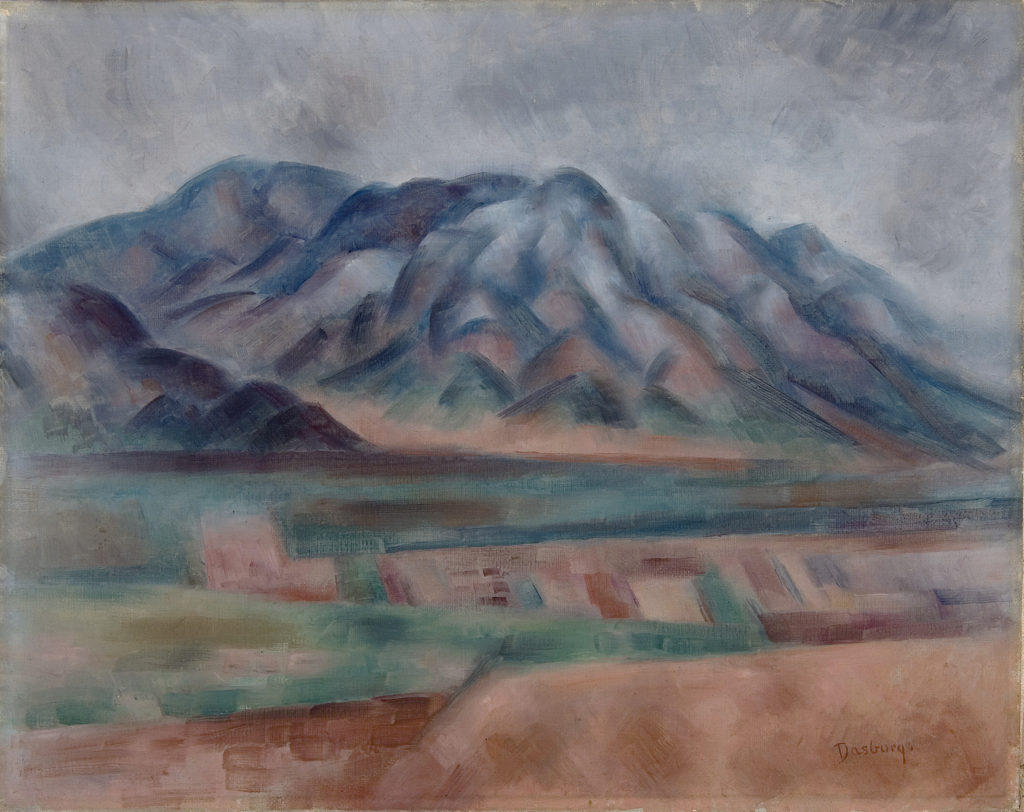
We had the Dasburg room for our stay. This is the one Ms. Ché wanted. It's in the Juniper House, a newer building -- but not that new, it's 40 years old -- with eight guest rooms and a conference room. We knew that it had a view of the sacred Taos Mountain, but we didn't know it had a little outdoor terrace (actually the roof of the room below) from which to watch the Mountain.

Juniper House at Mabel's Place, shadows of your correspondent and Ms Ché in the foreground.

The Mountain from the Dasburg "terrace"

Mabel's Place was full up on Christmas Eve. Many guests were attending the dances and Christmas Eve feast at the Pueblo. We were otherwise occupied on Christmas Eve as that is Ms. Ché's birthday. But Christmas Day was an ideal one to settle in. 

Up a steep set of stairs in Juniper House, we found the Dasburg room, named after  one of Mabel's artist guests, Andrew Dasburg, one of Ms. Ché's favorite New Mexico artists. We almost bought one of his drawings last year, but we decided to put it off for now, and it is probably for the best, as Ms. Ché was involved in that wreck in January of this year and I've been contending with the co-payment costs of very expensive RA treatment. While the price of the Dasburg drawing was certainly fair, it was a heavy expense for us at the time, and we would soon have some other expenses we didn't anticipate. cough.

I was disappointed there was no Dasburg work in the room, though there was a Georgia O'Keeffe (another of Mabel's friends). I sketched out an image of the Mountain while I was there, terming it "after Dasburg", intending to leave it in the room when we left, but I forgot. Sigh. Well. We'll just have to go back, won't we? (Smile.)

The Mountain smiled on us the whole time. It's hard to put into words the effect Taos Mountain has on us. In its own way, the Mountain has a kind of protective-watch-over energy. We can see and feel it. The Mountain is there as both the dominant element of Nature and as a stern and strong 'person' -- hard to explain.

Artists have been captivated by it for generations, and many thousands of paintings, drawings, photographs and prints have tried to capture its essence. I don't think any have quite succeeded. You have to see it for yourself. And then hope that your lines and colors will at least convey a partial sense of what the Mountain is in the flesh -- as it were.

The view is blocked by the Big House and Juniper House and the many trees bordering the property so that from most locations at Mabel's you can't see the Mountain at all, or at best you only have glimpses of it. Even in winter when the trees are bare, you only see bits of the Mountain through the branches from ground level.  From the second floor, you can see it better if you're in the right place, and from the third floor solarium, you have a 360° view of the whole property and well beyond.

We were in the Dasburg room on the second floor of Juniper House with an expansive view of the Mountain and its companions on either side. It was breath-taking though not quite as heart-pumping as the view of the Mountain from the Pueblo of Taos itself. There you are in the presence of... the ineffable.

Andrew Dasburg drew and painted the Mountain many, many times. This is an image of a more or less generic Dasburg mountain, but it's obviously based on Taos Mountain.

New Age types come to Taos and often settle there to infuse themselves with the Spirit of the Mountain. I don't know that they get what they come for, but oh well. It's not for me to judge...

I had the thought of doing some sketching with pastels while I was at Mabel's this Christmas, and so I did. It was both relaxing and inspiring to get out my pastels and have at it. Fun, actually. For years, I couldn't -- or alternatively didn't want to. Just the thought of drawing or painting made my joints ache, and it was better for me not to think about it.

But I've been getting used to the fact that I can do things now that I daren't even think of when time was. Even climbing the stairs at Mabel's is possible now though not necessarily easy. There was a time when climbing stairs was an almost impossible struggle for me. Holding a pencil was sometimes likewise challenging. So much of that struggle is over thanks to the treatments I've been given for RA. Even breathing in the rarefied though somewhat smoky winter air of Taos is... possible.

Simple things mean a lot.

I was most grateful to be able to enjoy Mabel's Place with Ms Ché without worry or fear of being unable to negotiate this or that problematic area that is obviously not handicapped accessible. The only areas that were difficult to manage were difficult for both of us.

Some areas of the Big House have low doorways on which tall people hit their heads, and there are tricky steps between one level and another which can trip you up if you aren't careful. Ah but slow and easy does it, and even if you hit your head on one of the doorways as I did, it's laugh-inducing rather than an Owie.

A pointed arch doorway at Mabel's Place -- watch your head, watch your step!


Ms Ché saw our Christmas at Mabel's  as an opportunity to renew and refresh after a very intense school year. She had put in so much time and energy that a break of this sort was essential. To take a break at Mabel's was invigorating. Even if it was only for a day -- this time.

A friend in California says we're in "Disneyland," meaning these sorts of experiences we're having aren't really "real" -- are they? Well, I guess it depends on your point of view, doesn't it?

After a wonderful breakfast in the dining room of the Big House, we packed up to leave, we really didn't want to. The daytimes and overnight we spent at Mabel's have stayed with us so strongly, though, we feel we haven't really left.

Breakfast isn't quite ready


It was a Christmas to remember!

Sunday, May 22, 2016

DNA Results, COPD, RA, and Other Things, Oh My

Well, one of Ms Ché's cousins and her husband are coming to visit from Nevada tomorrow, and we're preparing to show them the sights. Some of them, anyway. They've been all around the world, but have never been to New Mexico, and they want a fix of "vibrant art." This is the place, right?

It's gonna be a whirlwind, as it's only two-three days, and we're planning adventures to Taos to see the Mabel Dodge Luhan house and take in the exhibit on her at the Harwood, then to the Fechin house where the Taos Art Museum is located, then out to the Pueblo. Next day, Santa Fe. The Art Museum, the Museum of Contemporary Native Art, the Georgia O'Keefe Museum, the Museum of Indian Arts and Culture, several galleries (we couldn't possibly do more than a few of them) and then out to eat at Harry's Roadhouse (a must-stop-in for all out of town visitors though if it is as crowded as it can get, we'll happily go out to La Plancha in El Dorado.)

Then finally the next day, if we can swing it, out to our place, and the Route 66 tour into Albuquerque and possibly beyond. We live near what I believe is the longest stretch of the Old Route 66 still in use -- at least it's the longest stretch of it in New Mexico -- and while it isn't particularly touristy, it's actually a nice drive, and  when the weather is good, the Mother Road is always a treat.

I'm wondering how much of this I can actually do, however. One of the problems associated with RA -- rheumatoid arthritis -- is fatigue. Fatigue is also a factor in recovery from pneumonia. I've tried to do some work outdoors, catching up a little bit on spring-time chores I wasn't able to do before, and I've found I become fatigued in only a few minutes. Twenty minutes is about the longest I can go at a stretch. Each of these days of adventure next week are going to be long... We'll see how much of it I can do...

Ms. Ché and I did the Ancestry.com DNA test. Until fairly recently, it was considered a borderline fraud, in part because DNA tests are not yet able to state with certainty the specific ancestry of testees. The results obtained give general possibilities at best. Because Ancestry really didn't clarify how non-specific the results were, they got a lot of complaints from people who did the test and got results that appeared to have nothing at all to do with their actual (documented) ancestry.

I got my results back. We're still waiting for Ms Ché's.

Mine were interesting, and I think they are fairly accurate, though they require interpretation to understand.

The surprise was that I show no German ancestry, nor do my cousins who have also taken the test.

It's taken me a while to fathom that because my paternal (their maternal) grandmother's parents emigrated from (what would become) Germany in the 1850s. There's no doubt about it. We know where they came from, we have documentary evidence, yadda yadda, but there is no German ancestry identifiable in our DNA. How can that be?

Well. Could be they weren't ethnic Germans. That's the easiest explanation. It's one that fits some of the stories I've heard that suggest they were descendants of Jewish conversos. Of course, wouldn't you know, my DNA shows no "European Jewish" ancestry, either.

It does show what I take to be an overabundance of British ancestry (67%). That's much higher than I figure it should be because I only inherited British ancestry from my mother (who was essentially of British ancestry all the way down, though her people had come to America starting soon after the Mayflower -- and there are hints that she had at least one ancestor on the Mayflower itself.)

My father, on the other hand, was half Irish and half German. Well, that's what he thought. So I should be a quarter Irish, a quarter German, and half British.

The test showed my DNA was 25% Irish, no German, 67% British, 7% Eastern European, and less than one percent each Scandinavian and Iberian.

Oh. What happened to the German?

It turns out Ancestry DNA doesn't even have a German category. The closest thing it has is "Central European," and if you dig around enough in their articles about the test, they state that the test cannot distinguish between British, German, and Scandinavian ancestry with any certainty. A test report may come back, as mine did, with an overabundance of British DNA, but no Central European ancestry. The "missing German" ancestry may well be folded in with the extra-British DNA. In fact, that's probably where it is.

My cousins, on the other hand, show an excess of Scandinavian ancestry in their DNA, and once again, that may be where the "missing German" is.

The 7% Eastern European ancestry indicated in my DNA is likely from my German great grandparents, and it may be a hint of their Jewish ancestry, but I don't know. As there are no specifically Jewish markers, I'll have to let that rumor rest for a while. There are records in Germany, so maybe one day I'll probe them more deeply and find out, but for now I'll let that ride.

The tiny bit of Scandinavian ancestry indicated in my DNA is probably from my Irish-German father. His Irish ancestors claimed to be "Irish" -- ie: Celts -- but that's likely a crock, as practically everyone in Ireland has some Scandinavian ancestry from the Viking and Norman invasions. Particularly so for red-heads like me whose red-head is a variation on blond, as opposed to the red-heads who may be Celt whose red-headedness is a variation on black hair.

The tiny bit of "Iberian" -- which could be Spanish, Portuguese, French or Italian -- ancestry I attribute to my mother's father. His last name (Olive) is possibly French, possibly Scottish. Could be both given the way the French and the Scots were intertwined at one time (ie: during the reign of Mary, Queen of Scots and before).

My mother's father's mother was from Colonial New England stock -- going back as far as I could trace in America and then in England as far back as I wanted to go. My mother's father's father's line stubbed out in Virginia with my mother's father's grandfather who was born c. 1798. That's all I could find out. There was no record before that.

My suspicion is that the original Olive immigrants came from Scotland or Northern Ireland at about that time, settled in Western Virginia, then moved to Kentucky, then, finally to Indiana as the Indians were expelled and the West opened to settlement.

My mother's mother's people were British from the dawn of time.

I had thought my mother was at least partially Irish -- she seemed to think so herself, but she didn't really know, because she didn't know much of anything about her biological father. Then years ago, I saw a film version of D. H. Lawrence's "Sons and Lovers," and I was stunned that one of the very British characters was the spitting image of my mother, both visually and more importantly behaviorally. Wait I thought, was my mother actually British?

Indeed, that's what I found -- at least on her mother's side as well as on her father's mother's side, and probably significantly on her father's father's side too.

Huh. Who'd a thunk? What still intrigues me is that I recognized my mother's character in a movie of a novel by British author D. H. Lawrence, based in part on his own experience and family. Well, how about that?

Oh yes, COPD. Part of the treatment I'm undergoing is for COPD, which I never really thought I had, but apparently I do, thanks to repeated bouts of pneumonia and scarring from emphysema which is a result of smoking. I stopped smoking twenty years ago, and I thought I was doing pretty good at healing my lungs from the Devil Tobacco, but apparently several things have conspired to set me back. One of them is rheumatoid arthritis. Turns out that lung inflammation (like joint inflammation) is a consequence of RA, and lung inflammation can and does make RA patients susceptible to pneumonia.

Ay!

My doctor told me that the prednisone I take for RA symptoms is an immunosuppressant which may be exacerbating my tendency to get pneumonia, but others say that prednisone actually suppresses the inflammation which makes it less likely that I will get pneumonia. So. Who knows?

We'll see what the rheumatologist has to say about that...

----------------------------------
UPDATE: Ms Ché just got her DNA results back, and it is astonishing, practically a book in the making. No time to go into details, but the upshot is that her DNA spans the globe. Literally,


Wednesday, December 10, 2014

O Taos

Mabel Dodge Luhan House, "Los Gallos," Taos, NM, December, 2014


"On another topic...

Last weekend was Our Taos Weekend.

We haven't been up to Taos for more than thirty years, and that time it was very brief, with a stop at La Fonda on the Plaza to see the D. H. Lawrence paintings, then turn around and get the holy hoo-hah out of there. Pronto.

Well, I couldn't breathe you see. I was a pretty heavy cigarette smoker in those days, and I lived essentially at sea level in Sacramento. Taos is at about 7,000 feet altitude, and anyone from sea level is going to feel lightheaded from the apparent lack of oxygen A smoker like I was is liable to panic, and I did

Ms. Ché, on the other hand, had a different set of issues. Earlier in the day, we'd stopped at Meteor Crater in Arizona. It's a remarkable formation, a remarkable site, and we spent quite a while exploring the crater rim, reading about the impact that caused the crater and otherwise enjoying the scenery and contemplating the Apocalypse.

The shop displayed lots and lots of crystals of one sort or another, and Ms. Ché picked up an amethyst chunk to inspect it more thoroughly. Immediately, she started feeling poorly, and she set it down. She said to me, "We have to get out of here. I just did something I shouldn't have."

I asked her what she'd done. "I picked up a crystal. They say you shouldn't do that unless you're prepared for what might happen. I wasn't. I feel awful."

She looked awful, too. So we left. We stopped in Gallup over the New Mexico line an hour or two later, where she doused her face with water and sat for a bit in the sun. Then we headed the rest of the way to Taos, and got there just before sunset.

I managed to find the Plaza somehow and locate La Fonda on the Plaza; the paintings were in a room off the lobby, and a man was there taking money (I think it was $4 admission) and allowing folks to wander around the room looking at the dozen or so rather naive but racy paintings D. H. Lawrence had created while a guest at Mabel Dodge Luhan's house somewhere in town. I had no idea where her place was, and at the time, it wasn't open to the public. I was interested in the paintings because I was involved in a project, a play (I don't recall the title now) that centered on -- or at least mentioned -- D.H. and Frieda Lawrence's time in Taos and I'd been doing a lot of research. Seeing Lawrence's paintings was one of my objectives in coming to New Mexico that time. I saw them. Once I did, it was time to go...

We drove back to Santa Fe and spent the night at a quirky old motel -- I want to say it was the El Rey, but Ms. says no, it was another, just as old, but not as well known. Of course, I'm sure we've stayed at the Crossroads in Albuquerque as well, and she says no, it was another, similar place, but not close to the freeway.

By morning, both of us had recovered, and we spent the rest of the week exploring New Mexico before we had to return to California and the drudgery of everyday life. Well, such as it was. (Our "everyday life" was often quite unusual... but that's another story for another time.)

I never wanted to go back to Taos, and if Ms Ché did, she didn't tell me. In fact, she says she barely remembers being there at all on that trip. I didn't want to go back in part because I couldn't breathe at that altitude, and in part because it was such a ridiculous place full of unreconstructed hippies, charlatans, new agers, and spiritualists who had no idea what the fark they were doing. And of course there were the Famous Artists, Musicians and Movie Stars. Yet another destination ruined by colonization. By that time, we'd had more than our fill of those types. Oh, yes, more than our fill.

We'd already been involved in The Show Business (as we liked to call it) for more than ten years and would be for another twenty or so, but when it came to those aspects that involved "fame" or the "famous," we tended to step back. At that time, I worked freelance as director and designer and was contemplating opening a theater that would focus on original works by women and people of color, developing brand new works for the stage, and seeing where that would lead. That project would be another few years off, however.


So Taos was a destination for the D. H. Lawrence connection but really nothing else, and when we traveled to New Mexico after that, we stayed in Albuquerque or Santa Fe. Santa Fe was difficult for me in those days, too, because of its altitude -- also about 7,000 feet. Albuquerque was OK at 5,000 feet. Well, relatively speaking.

I stopped smoking in 1997 and gradually my lungs recovered, though the last time I had a CAT scan, the pulmonary doctor showed me all the "pockets of emphysema" that I hadn't gotten rid of. Nevertheless, the altitude doesn't bother me so much any more. Our place in New Mexico is at 6,300 feet, and I barely notice it's not at sea level. Santa Fe is a frequent destination these days, and the altitude has not been a problem.

Taos might have been a problem, but there was no reason to go there, so it wasn't an issue.

Then something happened. José Montoya died. Now José was a preeminent figure in Chicano literature, someone we knew in Sacramento through our associations with members of the Royal Chicano Air Force. We didn't know he was from New Mexico, that in fact had been born and raised not far from where we live now. I found out that he had died from a friend who had been with him only a few days before. There was a memorial scheduled in Albuquerque, and we decided to go, to pay our respects and to remember.

Many Chicano poets from all over the Southwest spoke at the memorial and read their own works and José's, and there was music and José's daughter made remarks, and it was a fine time. One of the poets was Jimmy Santiago Baca, who always makes quite a splash -- as is his way. He and José were apparently close for a long time. Maya Angelou had just died, and Jimmy made it a point to speak ill of her. Now wait, we thought. Dissing Sister Maya at a memorial for José Montoya? How rude. But Jimmy didn't care. He had things to say about the way certain authors of color  like Sister Maya were hailed and celebrated -- even though their work wasn't necessarily that good in his estimation -- whereas Chicano/Latino/Hispano poets and writers whose work was brilliant (in his estimation) were ignored by the market. Why was that? Racial discrimination was still apparent, wasn't it? It was just different now... certain authors of color could advance, but not Chicanos.

Jimmy read his own powerful poem and then he read something of José's and both were very good. The crowd at the memorial applauded lustily. He'd touched a nerve and moved the audience greatly.

Ms. Ché knew of Jimmy Santiago Baca long before his appearance at the memorial for José Montoya, but I didn't. It was my first exposure to him and his work, and I found both to be intriguing. I was very impressed with his poetry, his fierceness, his determination, and his warmth. But he dissed Sister Maya, and that was just wrong. 

Some months later, we got a notice about the premier in Santa Fe of a documentary film about Jimmy Santiago Baca called "A Place to Stand," and we decided to go. It's a remarkable film about a remarkable character, the writer and teacher himself, whose life has not been like everybody else's, not by a long shot.

He announced a writing workshop intensive in Taos to take place in December and invited attendees at the film to come on up. It would be at the Mabel Dodge Luhan House. It would be wonderful.

Ms. Ché thought this might be interesting, so she got in touch with the organizer and after some back and forth, she made arrangements to attend.

The workshop was last weekend. She didn't want to drive herself, so I drove her up to Taos on Friday, but I didn't stay. I went back home then returned on Sunday to pick her up. She had, she said, an amazing time at an amazing place, among amazing people (she said there were sixteen at the workshop) -- and she had written some remarkable works even if she said so herself.

Really? Indeed. When I got there to pick her up, she met me at the car, looking a bit worn out, actually. I asked her if she was all right. "Oh yes, just tired, that's all. It's been quite a weekend." She collected her things from her room in the Juniper House and then we went up to the Big House to check out -- and pick up a couple of more books. As we did, we encountered Jimmy. He was effusive in his praise of Ms. Ché and her works. She had done something he had not seen before in his many workshops, and he was so grateful. She'd "opened up the sky." Whatever that meant, and he didn't know, but it sounded good. Other attendees said what she had done had helped release their own inner spirit, and helped them come to grips with what they needed to see and feel and write about... yep.

She was very happy and very tired, and she said she felt at home at Mabel's Place, "Los Gallos." It was, she said, one of the most intense and inspiring experiences of her life, and she was very grateful.

She said she felt that Mabel's Place itself was part of the reason why.

Seeing it, experiencing it for myself, was part of the reason I wanted to go back to Taos this time, finally, after thirty or more years. I'd heard about Mabel's Place in Taos, seen pictures of it, read descriptions, and knew some of its history. But being there was quite a different experience than the distant observation one can make from books and such.


I could see almost immediately why so many luminaries made the trek from wherever they were from and wanted to stay at this rambling, creaky old place adjacent to Taos Pueblo lands. It's a mile or so from the Plaza, but it feels like it's in another realm altogether. The Big House rambles and creaks along a ridge above an empty acequia. There is a spectacular view of Taos Mountain from the upper floors, an entire glassed room, the Solarium, is at the very top of the house and views go on for many miles. But the house itself, though large, is very cozy and warm and welcoming. It feels like "home" just as Ms Ché had said.

I can only imagine what it must have been like before Taos was ruined and became a tourist mecca, and this place, almost alone, was the center of a literary and artistic firmament.

At any rate, being there myself, with Ms Ché, I felt some of the energy of the place and the many that had been there before us. It was/is remarkable.

We're making plans to go back and stay for a while for the sake of it.

Saturday, December 7, 2013

Consequences: The Incident on Highway 518


This is video of the protest in Taos led by Patrick Trujillo over the assault by New Mexico State Police officers against Oriana Farrell and her family, an assault which included three shots fired by Officer Elias Montoya at Farrell's vehicle as it sped away.

Officer Montoya has been fired.

This is almost unheard of in police annals these days, as practically any act under color of authority by police is considered "justified" by investigators, no matter how egregious and/or deadly.

However, from the video it seems clear that State Police Chief Kassetas is serious about an internal review and investigation of what happened that day in October on Highway 518, and about taking appropriate, timely action. This in itself is almost unheard of these days, as internal police reviews often take months or years, and it's almost a miracle if they don't justify police conduct.

This time, an officer actually lost his job as a consequence of his actions in firing at the Farrell vehicle.

Interestingly, however, the "problem officer" in the district was not said to be Montoya (though there had been other incidents concerning his use or display of firearms) but DeTavis, the original officer who confronted and argued with Farrell -- and who apparently terrified her and her children so much that they repeatedly fled.

Farrell has been arraigned and released as has her 14 year old son who was also charged in the incident. They are supposed to return to court next April, but what will happen between now and then is anyone's guess. Some reports have suggested that they will move to New Mexico or California from their home in Memphis, but so far, that is not really clear. Farrell has a great deal of support from the Memphis community, and though her actions in the incident appear to have been ill-advised, she may ultimately be exonerated.

The surprising thing is that one of the officers involved faced any consequences at all, and that the police chief not only met with the protesters personally but also spoke publicly on camera with them and about it.

Is it a trend?


Sunday, December 1, 2013

Traffic Stop on Highway 518 Outside of Taos, NM


[Unfortunately the full 42 minute video is no longer hosted on YouTube. This 18 minute video ends at the Hotel Don Fernando in Taos where the driver and her older son were arrested. The full video runs until the suspects are booked at the police station and during the trip to the police station, the driver expresses her remorse over the incident and her concern for her children again and again.]

[Note: There is a protest scheduled in Taos today over this incident. Apparently many of those who live in Taos know the main officer involved all too well, as he has quite a reputation in town. The officer firing his weapon has also apparently been previously noted as somewhat trigger-happy. But I have no personal knowledge, so I'm passing on what I've heard and read. I'm sure the stories are incomplete.]


Friday, October 11, 2013

'How They Got Art in New Mexico'

 
The Crippled Wagon of Fate on the High Road to Taos, 1898

(Essay upon attendance at the First "Artists Century" talk at the New Mexico Museum of Art, October, 2013)

La Leyenda....

One day in 1898, Ernest Blumenschein and Bert Phillips set out from Denver with a wagon and team of horses. They were highly trained and accomplished fine artists, "easel artists" as they've become known, who went Out West to experience the rough and ready Real World Adventures America still had to offer.

Apparently they were bored in Denver and thought they'd find more inspiration in Mexico. What better way to get there than by wagon and horseback over the spine of the Rockies until they reached the Rio Grande?

Except they never made it to the Rio Grande, never made it to Mexico. Well, of course they would, in time, but on this journey, they didn't.

No, instead, on the high road (such as it was) above Taos, in the wilds of Northern New Mexico, then still a territory of the USofA, a wagon wheel broke, and they were stranded. This is the legend, this is the story, endlessly repeated to this day. Blumenschein is said to have "shouldered" the broken wagon wheel -- though it was tied to the back of one of the horses --  and he humped it the twenty miles or so into the Village of Taos for repairs while Phillips stayed with the broken wagon and had lunch.

Bert Phillips having lunch beside the Fateful Wagon, 1898


Sunday, July 28, 2013

A Literary Life... Or Not. D. H. Lawrence, Mabel Dodge, and Some Others In New Mexico When Time Was and Today

Give me the moon at my feet.
Set my feet upon the crescent like a Lord,
O let my ankles be bathed in moonlight,
That I may go sure and moon-shod,
Cool and bright-footed toward my goal.
A late in life poem titled "Prayer" by D. H. Lawrence, read by Mrs. Merriam Golden at Lawrence's memorial dedication ceremony in Taos, NM, September 15, 1935.

The little snippet above is from his later work, I believe it's called "Apocalypse,"  and I've taken it from the book about Lawrence called "D. H. Lawrence in New Mexico, the Time is Different There" by Arthur J. Bachrach, a slim but quite wonderful volume of tales and truths of D. H. and Frieda Lawrence, Dorothy Brett, Mabel Dodge and Tony Luhan (Lujan) -- among others -- at their ranches in and away from Taos and elsewhere back in the day. It was a time long gone, a time most different to be sure, a time few of us remember, but if we've read or otherwise absorbed the pertinent works by the pertinent people, a time we cannot forget, a time that lives still in Taos and round about.

Who were these people? What did they think they were doing?

The premise of "Utopian Vistas, the Mabel Dodge Luhan House and the American Counterculture" by Lois Palkin Rudnick (like "D. H. Lawrence in New Mexico," published by UNM Press) is that all these Anglo ex-patriots came out to New Mexico after the First World War, many at the behest of Mabel Dodge Stearne (as she was when first she came to New Mexico in 1917, later after marrying a Taos Pueblo Indian, Antonio Lujan, she became Mabel Dodge Luhan), and here they created a counter-culture community based on the primacy and originality of the Native Indians and the Spanish settlers, the ultimate truth of art, and the purpose and primal beauty of the new community they themselves could -- and did -- create. They were said to have given up on the America they'd been taught to believe in and love and came to the realization that the true artistic spirit of the continent could be found in New Mexico, perhaps only in New Mexico, this vast and quirky, almost empty frontier land, where much has never changed in eons.

This is the place.