Whoo boy, the Roller Coaster is in overdrive now boys and girls. Did somebody offend somebody? Or is the situation behind the scenes just too unstable to keep the ship of state aright?
This is primarily a media scandal-fest, something like the ones that went wilding during the 90's leading to the Impeachment Circus and all the rest of it. Which led, of course, directly to the Supremes' lawless intervention in the 2000 election to put the majority's candidate on the Throne. If we think back, it's easy to see how media driven this all was, from the get-go to the miserable end of the Bushevik Regime.
How many millions paid with their lives and fortunes for this political misadventure? Did the media gain from their scandal mongering? Ask Roger Ailes, maybe he'll tell you. Maybe he won't. Maybe he'll lie.
The AP Thing is a doozy; they're all panty-wadded because their counsel got notice that phone records of certain reporters had been scrutinized by the DoJ, apparently as part of a leak investigation by the gov't. Hm. Yes, well. At least they got notice.
I mean, this sort of thing really galls me. Ever since the imposition of the Patriot Act back in the day, warrantless domestic surveillance has been essentially universal. But now AP is calling foul, stomping its little feet and screaming, "You can't do this to MEEEEE!!!!" Everybody else is fair game? But not the AP? Bullshit. The problem is not surveillance of the press; the problem is universal domestic surveillance. Period. And that's not something the Mighty-Mighty Press has ever had the least bit of concern about. Was it assumed that the Press would be immune?
This is not unlike my annoyance at the nearly hysterical response to the "torture" of Bradley Manning by members of the blog-o-tariat, with nary a nod to the fact that what was happening to him was relatively mild compared to what goes on in American detention facilities to tens of thousands of Americans, every. fucking. day. And which has been going on for YEARS. What happened to Manning shouldn't have happened, but in my view, you cannot separate out his treatment from the gross brutality -- and yes, torture -- that is part and parcel of the entire American detention system.
Just so with the surveillance of the AP reporters. Yes? And? This is 'Merika. This is what goes on, has been going on for YEARS, "it's the Law," and this is what has been done to millions and millions of Americans on a day-in and day-out basis. What has the AP had to say about that? Nothing, right?
The AP is demanding -- now -- special treatment for itself, to be free of "this sort of intimidation!" Great, fine. They should be free of it -- so should everyone else. But you are unlikely to ever hear that from the AP or any of those marching around with their chins thrust out in AP's defense these days.
No, they want their own special dispensation, just as many of the advocates for Bradley Manning wanted his dispensation, ignoring the thousands and the millions who faced the same sort of intimidation/torture under the color of authority every day. For whatever reason, in the minds of so many people, the masses who suffer don't matter, only the individual -- or institution in the case of the AP.
To my way of looking at these things, it's nonsense.
Separating out an individual or one institution and demanding recompense for their suffering while ignoring everyone else who is facing the same sort of thing or worse is not even a simulation of "justice."
It's grotesque.
But that's how very far we've fallen under the spell of the Individual.
As for the IRS Thing, the notion that the IRS uses its power and authority to go after certain targeted individuals and institutions, and it sometimes oversteps its authority in doing so, is hardly news. The notion that some of their scrutiny has the appearance of a political motivation again is hardly news. What's news in this case is apparently that the agency was inclined to use its clout to look into nonprofit status of TeaBagging and other rightist political organizations, something that simply is not done in this country, rightists being Free and all. Well, Patriots, you know.
Scrutinizing Leftist outfits is only right and proper, but dare the IRS -- or anyone else in Gubmint -- to probe the behavior of a 'Bagging interest and all hell breaks loose. Again, we are dealing with demands for special exemptions and dispensations for certain (perhaps momentarily) favored individuals or groups, leaving everyone else who has the same or similar difficulties to fend for themselves. This is not "justice." I can't put it any plainer than that.
To my way of looking at it, the IRS should be abolished for cause (along with quite a few other government department and agencies) and its functions should be reformed from the bottom up. The notion of non-profit, religious, or charitable tax exemptions should be re-thought. Just what is the purpose of these exemptions, and why should certain industries and individuals be exempt while others must pay and pay more, with the tax burden being shifted more and more onto the backs of those least able to pay?
But that's not what the hoop lah is about. No, it's about "targeting" rightist outfits, purely and simply. The whole system is rotten, but as long as it doesn't "target" rightists, it's OK? Leftists can be targeted -- and have been for generations -- but not rightists? What utter crap.
Finally The Beng[h]azi Thing. It's as if no one involved in the many "investigations" has ever heard of or utilized (deceptive) Talking Points before. Yes, of course, the talking points were not accurate. Yes? So?
How often are talking points used by anyone fully accurate? How often are they intended to spin and how often are they intended to deceive?
In this case, the whole thing appears to be a mighty clusterfuck. It's not the first time. And until the AP and IRS Things, it seemed that the "investigations" of the clusterfuck were going to be taunted and dismissed by the media as so much political posturing by the Rs (which they are), but now, with the other "scandals" on the table as it were, Beng[h]azi will loom large on the topic list for some time to come.
I assume all this is coming to a head now (even before the Summer Driving and Shark and Missing White Woman Season gets going) because someone who matters in the media was offended by someone in the White House, possibly even by the President Himself. The media skin is sometimes very thin, and the least insult, or even an accidental one, can open the gates of Hell on an otherwise unsuspecting officialdom.
It's happened before. I would just remind readers that the Watergate Thing happened largely because A Person Who Mattered in the Media (Katherine Graham) took offense at the White House, and took personal offense at Richard Nixon for some insult or slight or other, and she vowed to have his ass in a sling or know the reason why. She got what she wanted.
A lot of people tend to think the Watergate story reporting and the subsequent investigations leading to the resignation of Richard Nixon was somehow a high point of public and media integrity. I would suggest it was nothing of the kind. It was instead an act of gross and deliberate revenge for... an insult. There were crimes committed, lord knows, in the course of the Nixon administration, monstrous, horrible crimes, compared to which the Watergate burglary was small potatoes. The point, which got completely missed, is that it is in the nature of our system of governance for the government itself to operate lawlessly, criminally, and often murderously. It is in the DNA of the institution, and the only way I know of to change things is to start over with a different institution.
Thus, as criminal as the Nixon administration was, it was by no means uniquely criminal. It was typically criminal. Decapitating the operation doesn't change its fundamental nature. But in the course of events, someone who mattered in the media demanded and got revenge against Richard Nixon, thus in effect decapitating the government, yet not changing it in any important way (she didn't care about that, after all), and here we are, forty years down the line, and guess what?
Nothing has really changed but the optics.
But at least the media now has its summer shitstorm laid out. What will happen to the Sharks and the Missing White Women?
And what of the Summer Driving Season?
Tuesday, May 14, 2013

Saturday, May 11, 2013
The Drought, The Poors and Economic Confusion
There is talk that New Mexico's economy is "turning around," this despite the continuing federal budget cutbacks due to the sequester and the various local and state government financial difficulties due to the Permanent Recession, the housing market collapse, and other more subtle -- and frankly more New Mexican -- factors; for example, The Drought.
But SpaceX signed a deal at the Spaceport the other day, so things are looking up. And Richard Branson isn't bugging out on the Spaceport like he seemed to be doing, so what's the problem?
Supposedly, private sector hiring and employment are up for the first time in a long time, and government employment is stable -- so long as you don't count the sequester. In our own neighborhood, two of the long time empty places seem to be occupied again, or they soon will be, and another one is possibly going on the market shortly. So may be...
Things are looking up.
I've been reading a novel called "Not As It Seems," by a local writer, Ed Chavez. In it, he describes a drought in this area that began in 1941 and didn't break for 16 years. Locals feel we're in that kind of drought again, perhaps one that will last longer -- who knows, what with Climate Change and all -- and just like before, there will be massive social changes because of it. Part of the likely change is impoverishment.
Things may be looking up in certain sectors and for certain people, but out here in the country, we see clear skies, or clouds that try but don't drop any rain, and we see parched and seer landscape all around and dust and grit filling the air, blowing off the plowed but still barren farm fields. The signs are there, and those who remember the 1950's drought are feeling the weight of history. They know what could happen.
The Rio Grande is already dry below Elephant Butte, and water tables are dropping along the valley limiting irrigation water. Much of Southern New Mexico's commercial farming will be impossible this year -- and for how many more years to come? Nobody knows.
Many people have long pointed out how unsustainable Albuquerque is even in good times, but the city keeps trying to grow. It must do so under the current economic and political regime, a regime that doesn't accept "sustainability" as a fundamental principle -- as opposed to a temporary fashion. "Growth" is the only principle recognized. And perpetual growth is unsustainable.
Albuquerque is actually a relatively modest example of civic unsustainability. Phoenix, Las Vegas (NV), even Los Angeles itself strike me as more fraughtful examples, but we may see a prelude in Albuquerque to what could be in store for many cities in the Southwest and elsewhere as a new weather regime settles in for the long haul.
But things are looking up!
Albuquerque has the advantage of being divided into sectors and ancient barrios and villages. What is now a bloated cityscape grew from tiny beginnings more than three hundred years ago, beginnings that were scattered along the Rio Grande in the shadow of a dozen abandoned Indian pueblos and bordering the two remaining pubeblos, Isleta and Sandia -- the presence of which strictly limits the growth of Albuquerque to the south and north. Those beginnings are still there, whether it's Barelas or Los Ranchos, or any number of others that may have been absorbed by the Albuquerque metroplex, but which still retain their independent character.
In other words, it seems at least psychologically possible to "go back" to the cores of the city's parts. It's not that long ago, after all, when there were still fields beside Old Town, and Rio Rancho, among other suburbs, didn't exist.
On the other hand, when the previous droughts have come, people have abandoned the country-side for the relative comfort and prosperity of the City. At least in the City, they believed, they had a chance, whereas out in the country, they didn't. Without water, without rain, there was no future to be found in the fields, and depending on motor traffic for sustenance, as was the case, for example, along Route 66, is risky at best. When the Drought settles in, that's it. Despite the of best intentions, one can't really ride it out. By the time the Drought breaks, you've long been dead.
What to do, then?
The Drought forces those who depend on the land for a living to consider -- and accept -- some alternative, because the land simply can't provide for them. If they recognize that the City alternative may actually be closed off to them (it's already apparent that Santa Fe, for example, has rolled up the welcome mat -- for some -- for the duration), then thoughts of escape out of the region altogether may be necessary. That's one reason why the Spaceport looms large in the imagination. What better escape than to space?
Well, except for the fact that you have to come back...
One of our neighbors actually works in California. It's a long haul back and forth, but he claims it's necessary, because of the lack of employment opportunity around here... he gets paid a lot more in California, too. They just don't want to live in California. They have an Airstream, the husband works for several months at a time, lives in the trailer, comes back for a few weeks, then he is off to California again. It's an... alternative lifestyle. And at least to my way of looking at it, it's an adaptation to reality. (Well, I should know. Like a lot of people, we've never worked in New Mexico. Almost all our current income is derived from California employment.)
As long as the roads remain open... this kind of alternative is open.
Because of the Interstate, there actually are some employment opportunities where we live now -- and more are coming due to the construction of another truck stop. But the local workers I've talked to are not that enthusiastic about their prospects. Pay is low. Poverty level low. And when you're working in a low-end store or shop where you can't afford to buy anything, it can be severely depressing. One of the workers I talked to the other day says she's going to school full time so she can have a career in the medical field, and she works two low-wage retail jobs so she can afford school and childcare. Thank god, she says, she'll graduate next spring.
Even if there were enough work for everyone who wants a job, this wouldn't be an uncommon situation.
She's poor and she knows it, but she believes her schooling and training should boost her at least one rung up the economic ladder -- so she can "breathe" she says.
I hope so for the sake of her sanity, her health and her kids....
But for so many others, there are neither opportunities nor a future. I've written many times that the Future -- as an image, an idea, a goal -- has been stolen from us by those who deem themselves Our Betters, and they have no intention of giving it back, under any circumstance. The Future -- as it used to be -- is now their sole possession, and their goal now is gaining immortality, so they can hold onto it forever.
The common people have no Future. And the young feel the loss more than any.
For many of the young, there is not only no Future, there is no chance for one.
What will they do?
We see signs of an explosion of anger and despair, even revolutionary murmurings, but not -- yet -- overthrow of the prevailing system of financializing, looting, extraction and rent-seeking by the Highest of the Mighty.
Can't "overthrow" the system without something to replace it with, né?
Well, yes, actually, "overthrow" doesn't require a pre-existing substitute, but will "overthrow" ever happen?
We don't know; no one can foresee well enough to predict the (non-existent?) Future. But we have seen preludes to Revolution, and if we use our peripheral vision, we might see the prefiguring of a Future, not only after the Revolution comes, but what happens then.
In part, the past of New Mexico may be a guidepost to the Future -- if we squint just a little and use our imaginations to visualize what once was and what could be again.
Drought is the ever-present reality we face right now, a drought that may linger for many more years to come. We don't know. Life seems to go on as it always has, the rhythms of the seasons haven't changed, the wind still blows, and we pray for rain as the ancestors have long done. The ancient social and cultural roots in New Mexico have weathered many, many persistent droughts -- and much worse -- and somehow the rootstock has survived. Even flourished.
In other words, there is a cultural/social pattern here that ensures the society as a whole gets through pretty much anything that comes along -- even when people have to move from rougher areas to more benign ones, and various parts of the whole are abandoned temporarily or permanently.
I've mentioned the prevalence of ruins in New Mexico, for example -- abandoned sites falling back into the earth from whence they came litter the place, yet many get reclaimed in the by and bye as other people come along to make do in what was once abandoned. It's a cycle, as natural as the wind.
In the meantime, many, many alternative living sites and intentional communities are inaugurated. Some of them persist. They all have their own quirks and individual characters, and yet they all partake of the spirit of place, so in some sense they're all united. If they depend on farming for survival, they may be facing existential difficulty due to the drought, but many don't rely on their farm fields and livestock to sustain them.
What I see happening, though I can't be certain about it, is that more and more New Mexicans are recognizing the unreliability of the various lifestyle props we take for granted and are shifting into another frame of mind about it.
One factor is the shift of economic expectations. This is as acute here as anywhere else. It's basically a matter of recognizing and accepting the fact that we don't really need all the devices and props we've become accustomed to in order to live well. Living well often doesn't require either material or financial abundance. A sufficiency will do quite nicely, thank you.
It can be confusing to shift expectations from over-abundance to sufficiency, however. That confusion leads to many missteps and misperceptions. So many of us are conditioned to expect more, more, more, more devices, more cars, insurance, cable, new houses, clothes, appliances, and so on. Few of us seem to know how to get by without them, or with fewer of them. So many of us assume that the lack of material and financial lifestyle underpinnings is the definition of poverty, and many assume that no one can live well without lots of money and lots of stuff -- new stuff at that.
The quest for lots of money and lots of stuff is what kept the overall economy going for generations. But now, apparently, that era is over. We might never go back to it, might never have the opportunity to go back to it.
There are now at least two distinctly different -- and quite separate -- economies, one that serves the rich with extraordinary, indeed obscene, abundance, generally through a combination of automatic payments (often called rent-seeking) from the masses, and what amounts to rounds and rounds of thefts from one another. It is medieval on an unprecedented global scale.
The rest of us, quite literally, have a completely separate economy that primarily operates to ensure the perpetual financial indebtedness of the masses to their Betters -- Betters who are becoming their Masters. More medievalism on an unprecedented global scale.
Then there are those who insist on separating themselves from all of it.
The fact that you can still do that is something of a wonder. As things solidify into neo-feudalism (but without the necessity of old-fashioned mutual responsibilities) I doubt that the opportunities for alternatives and intentional communities and so on will be widespread or endure. The point of neo-feudalism is to become universal, with no alternatives available or permitted. This is certainly how conquest was conducted by essentially feudal Europeans in the New World. The Natives could submit, or the Natives could die. Often, the consequence of submission was death in any case. There was no way out.
Right now, we still have alternatives if we choose to take them up, but how much longer that will be the case, I don't know.
There is likely to come a time when only a very special handful of people and communities will be able to withstand the pressure of becoming part of whatever social, economic and political future is being cobbled together for us.
But then, even at the worst of the previous feudal past, there was always resistance.
Things are looking up!
But SpaceX signed a deal at the Spaceport the other day, so things are looking up. And Richard Branson isn't bugging out on the Spaceport like he seemed to be doing, so what's the problem?
Supposedly, private sector hiring and employment are up for the first time in a long time, and government employment is stable -- so long as you don't count the sequester. In our own neighborhood, two of the long time empty places seem to be occupied again, or they soon will be, and another one is possibly going on the market shortly. So may be...
Things are looking up.
I've been reading a novel called "Not As It Seems," by a local writer, Ed Chavez. In it, he describes a drought in this area that began in 1941 and didn't break for 16 years. Locals feel we're in that kind of drought again, perhaps one that will last longer -- who knows, what with Climate Change and all -- and just like before, there will be massive social changes because of it. Part of the likely change is impoverishment.
Things may be looking up in certain sectors and for certain people, but out here in the country, we see clear skies, or clouds that try but don't drop any rain, and we see parched and seer landscape all around and dust and grit filling the air, blowing off the plowed but still barren farm fields. The signs are there, and those who remember the 1950's drought are feeling the weight of history. They know what could happen.
The Rio Grande is already dry below Elephant Butte, and water tables are dropping along the valley limiting irrigation water. Much of Southern New Mexico's commercial farming will be impossible this year -- and for how many more years to come? Nobody knows.
Many people have long pointed out how unsustainable Albuquerque is even in good times, but the city keeps trying to grow. It must do so under the current economic and political regime, a regime that doesn't accept "sustainability" as a fundamental principle -- as opposed to a temporary fashion. "Growth" is the only principle recognized. And perpetual growth is unsustainable.
Albuquerque is actually a relatively modest example of civic unsustainability. Phoenix, Las Vegas (NV), even Los Angeles itself strike me as more fraughtful examples, but we may see a prelude in Albuquerque to what could be in store for many cities in the Southwest and elsewhere as a new weather regime settles in for the long haul.
But things are looking up!
Albuquerque has the advantage of being divided into sectors and ancient barrios and villages. What is now a bloated cityscape grew from tiny beginnings more than three hundred years ago, beginnings that were scattered along the Rio Grande in the shadow of a dozen abandoned Indian pueblos and bordering the two remaining pubeblos, Isleta and Sandia -- the presence of which strictly limits the growth of Albuquerque to the south and north. Those beginnings are still there, whether it's Barelas or Los Ranchos, or any number of others that may have been absorbed by the Albuquerque metroplex, but which still retain their independent character.
In other words, it seems at least psychologically possible to "go back" to the cores of the city's parts. It's not that long ago, after all, when there were still fields beside Old Town, and Rio Rancho, among other suburbs, didn't exist.
On the other hand, when the previous droughts have come, people have abandoned the country-side for the relative comfort and prosperity of the City. At least in the City, they believed, they had a chance, whereas out in the country, they didn't. Without water, without rain, there was no future to be found in the fields, and depending on motor traffic for sustenance, as was the case, for example, along Route 66, is risky at best. When the Drought settles in, that's it. Despite the of best intentions, one can't really ride it out. By the time the Drought breaks, you've long been dead.
What to do, then?
The Drought forces those who depend on the land for a living to consider -- and accept -- some alternative, because the land simply can't provide for them. If they recognize that the City alternative may actually be closed off to them (it's already apparent that Santa Fe, for example, has rolled up the welcome mat -- for some -- for the duration), then thoughts of escape out of the region altogether may be necessary. That's one reason why the Spaceport looms large in the imagination. What better escape than to space?
Well, except for the fact that you have to come back...
One of our neighbors actually works in California. It's a long haul back and forth, but he claims it's necessary, because of the lack of employment opportunity around here... he gets paid a lot more in California, too. They just don't want to live in California. They have an Airstream, the husband works for several months at a time, lives in the trailer, comes back for a few weeks, then he is off to California again. It's an... alternative lifestyle. And at least to my way of looking at it, it's an adaptation to reality. (Well, I should know. Like a lot of people, we've never worked in New Mexico. Almost all our current income is derived from California employment.)
As long as the roads remain open... this kind of alternative is open.
Because of the Interstate, there actually are some employment opportunities where we live now -- and more are coming due to the construction of another truck stop. But the local workers I've talked to are not that enthusiastic about their prospects. Pay is low. Poverty level low. And when you're working in a low-end store or shop where you can't afford to buy anything, it can be severely depressing. One of the workers I talked to the other day says she's going to school full time so she can have a career in the medical field, and she works two low-wage retail jobs so she can afford school and childcare. Thank god, she says, she'll graduate next spring.
Even if there were enough work for everyone who wants a job, this wouldn't be an uncommon situation.
She's poor and she knows it, but she believes her schooling and training should boost her at least one rung up the economic ladder -- so she can "breathe" she says.
I hope so for the sake of her sanity, her health and her kids....
But for so many others, there are neither opportunities nor a future. I've written many times that the Future -- as an image, an idea, a goal -- has been stolen from us by those who deem themselves Our Betters, and they have no intention of giving it back, under any circumstance. The Future -- as it used to be -- is now their sole possession, and their goal now is gaining immortality, so they can hold onto it forever.
The common people have no Future. And the young feel the loss more than any.
For many of the young, there is not only no Future, there is no chance for one.
What will they do?
We see signs of an explosion of anger and despair, even revolutionary murmurings, but not -- yet -- overthrow of the prevailing system of financializing, looting, extraction and rent-seeking by the Highest of the Mighty.
Can't "overthrow" the system without something to replace it with, né?
Well, yes, actually, "overthrow" doesn't require a pre-existing substitute, but will "overthrow" ever happen?
We don't know; no one can foresee well enough to predict the (non-existent?) Future. But we have seen preludes to Revolution, and if we use our peripheral vision, we might see the prefiguring of a Future, not only after the Revolution comes, but what happens then.
In part, the past of New Mexico may be a guidepost to the Future -- if we squint just a little and use our imaginations to visualize what once was and what could be again.
Drought is the ever-present reality we face right now, a drought that may linger for many more years to come. We don't know. Life seems to go on as it always has, the rhythms of the seasons haven't changed, the wind still blows, and we pray for rain as the ancestors have long done. The ancient social and cultural roots in New Mexico have weathered many, many persistent droughts -- and much worse -- and somehow the rootstock has survived. Even flourished.
In other words, there is a cultural/social pattern here that ensures the society as a whole gets through pretty much anything that comes along -- even when people have to move from rougher areas to more benign ones, and various parts of the whole are abandoned temporarily or permanently.
I've mentioned the prevalence of ruins in New Mexico, for example -- abandoned sites falling back into the earth from whence they came litter the place, yet many get reclaimed in the by and bye as other people come along to make do in what was once abandoned. It's a cycle, as natural as the wind.
In the meantime, many, many alternative living sites and intentional communities are inaugurated. Some of them persist. They all have their own quirks and individual characters, and yet they all partake of the spirit of place, so in some sense they're all united. If they depend on farming for survival, they may be facing existential difficulty due to the drought, but many don't rely on their farm fields and livestock to sustain them.
What I see happening, though I can't be certain about it, is that more and more New Mexicans are recognizing the unreliability of the various lifestyle props we take for granted and are shifting into another frame of mind about it.
One factor is the shift of economic expectations. This is as acute here as anywhere else. It's basically a matter of recognizing and accepting the fact that we don't really need all the devices and props we've become accustomed to in order to live well. Living well often doesn't require either material or financial abundance. A sufficiency will do quite nicely, thank you.
It can be confusing to shift expectations from over-abundance to sufficiency, however. That confusion leads to many missteps and misperceptions. So many of us are conditioned to expect more, more, more, more devices, more cars, insurance, cable, new houses, clothes, appliances, and so on. Few of us seem to know how to get by without them, or with fewer of them. So many of us assume that the lack of material and financial lifestyle underpinnings is the definition of poverty, and many assume that no one can live well without lots of money and lots of stuff -- new stuff at that.
The quest for lots of money and lots of stuff is what kept the overall economy going for generations. But now, apparently, that era is over. We might never go back to it, might never have the opportunity to go back to it.
There are now at least two distinctly different -- and quite separate -- economies, one that serves the rich with extraordinary, indeed obscene, abundance, generally through a combination of automatic payments (often called rent-seeking) from the masses, and what amounts to rounds and rounds of thefts from one another. It is medieval on an unprecedented global scale.
The rest of us, quite literally, have a completely separate economy that primarily operates to ensure the perpetual financial indebtedness of the masses to their Betters -- Betters who are becoming their Masters. More medievalism on an unprecedented global scale.
Then there are those who insist on separating themselves from all of it.
The fact that you can still do that is something of a wonder. As things solidify into neo-feudalism (but without the necessity of old-fashioned mutual responsibilities) I doubt that the opportunities for alternatives and intentional communities and so on will be widespread or endure. The point of neo-feudalism is to become universal, with no alternatives available or permitted. This is certainly how conquest was conducted by essentially feudal Europeans in the New World. The Natives could submit, or the Natives could die. Often, the consequence of submission was death in any case. There was no way out.
Right now, we still have alternatives if we choose to take them up, but how much longer that will be the case, I don't know.
There is likely to come a time when only a very special handful of people and communities will be able to withstand the pressure of becoming part of whatever social, economic and political future is being cobbled together for us.
But then, even at the worst of the previous feudal past, there was always resistance.
Things are looking up!
Wednesday, May 8, 2013
The Pathetic South Carolina Election and The Embrace of Susana Martinez By The White House
I've been consciously avoiding the dismal political realm for some time now. There is so little point to it anymore, as we learn over and over and over again that We, the People have no voice that our political betters are bound to listen to. Period.
So it came as no shock that Mark Stanford was elected to the open South Carolina congressional seat over Stephen Colbert's sister yesterday, and by a thumping majority no less. Yes, well, of course. Stanford is part of The Club, no matter his indiscretions, whereas Ms Colbert Busch was merely a problem to be dealt with -- which she was in typical South Carolina fashion, by a well-coordinated whispering campaign which implicated her in practically every moral lapse a female is capable of.
Ta-da! Stanford wins! But he would have won anyway goes the conventional wisdom on the morning after. It's such a heavily Republican district, say the cognoscenti, that Colbert Busch really had no chance at all despite initially high poll numbers.
Polls. Please. You can poll to get just about any result you want. It's almost like magic, and the wonder of it is that anyone actually believes in polls, rather than simply using them as handy reference tools. Basically, the best you can expect from most polls is that they will indicate how well a message is getting across -- how effectively the propaganda is being catapulted, for example -- but little else. And in political polling, the point is to make people believe it's a "neck and neck race," or that a candidate has a chance "in a tough race," or that the election of So-And-So is "inevitable." In other words, the results of political polling are tailored to fit a pre-prepared narrative of how the election is supposed to go. Who wins doesn't actually matter that much. It is the narrative that matters, and political polls are tailored to fit the narrative.
The take away is apparently that Colbert Busch ran as well as she did against a strong Republican candidate with 100% name recognition, in an overwhelmingly Republican district, in South Carolina no less, so it's a "win-by-losing". Got it. And she'll take the district in the by and bye.
The only case I'm familiar with where this strategy actually worked was in California's 7th Congressional District, where, after several failed attempts, Republican Dan Lungren was unseated by upstart Democrat Ami Bera. Well, "upstart" even in the sense that California's Democratic Party apparat was reluctant to support him and I think for a time refused to support his campaign. It was thought he had no chance in one of the whitest and most heavily Republican districts in California, represented by one of the best-known California -- and national -- Republicans.
Conventional wisdom was wrong, had been wrong all along, but that didn't matter. It was the narrative that mattered, and it was a narrative that eventually was supported by polls which showed Bera with a "chance." Demographics was a bigger driver than polls, as the district's Republican population was aging out and moving away, but the narrative was that this scrappy upstart was taking on a Republican giant, in an overwhelmingly Republican district.
And he won.
So, one day, Colbert Busch might win, too. It could happen.
Meanwhile, the White House has been schmoozing Ms Martinez, Governor of New Mexico, like mad, with Joe Biden as point. It's interesting in some ways. Unlike a lot of Republican governors, Martinez is not entirely crazy, hasn't gone off the deep end policy wise, and seems to understand the interests of New Mexico's people as well as any governor has in recent times. Her policies may not be the best for the people of course, but she's not crazy enough to try to deliberately harm them, either.
She was invited to go to Rome on the Biden plane for the installation of the New Pope, and she was invited -- by Biden again -- to the White House for the Cinco de Mayo celebrations. She says that every time she goes to Washington or hangs out with administration personnel, she's pitching New Mexico and trying to make them understand how important federal funding is to the state's economy.
I'll say.
Of course there have been cuts and cuts and cuts, but Martinez goes when she's invited because she's got to make that pitch. I'm not sure there'd be much of a cash economy here at all were it not for the massive amounts of federal money pumping into the state to fund the research facilities and the nuclear labs and the military bases and the universities and on and on. Anyone who claims that the federal government has "never created a job" is either lying outright or has no clue. None.
At any rate, it seems that Martinez and the White House have become highly sympatico, to the point where there is no daylight between them.
Does that mean she's becoming a Democrat or the White House is essentially Republican?
You decide.
So it came as no shock that Mark Stanford was elected to the open South Carolina congressional seat over Stephen Colbert's sister yesterday, and by a thumping majority no less. Yes, well, of course. Stanford is part of The Club, no matter his indiscretions, whereas Ms Colbert Busch was merely a problem to be dealt with -- which she was in typical South Carolina fashion, by a well-coordinated whispering campaign which implicated her in practically every moral lapse a female is capable of.
Ta-da! Stanford wins! But he would have won anyway goes the conventional wisdom on the morning after. It's such a heavily Republican district, say the cognoscenti, that Colbert Busch really had no chance at all despite initially high poll numbers.
Polls. Please. You can poll to get just about any result you want. It's almost like magic, and the wonder of it is that anyone actually believes in polls, rather than simply using them as handy reference tools. Basically, the best you can expect from most polls is that they will indicate how well a message is getting across -- how effectively the propaganda is being catapulted, for example -- but little else. And in political polling, the point is to make people believe it's a "neck and neck race," or that a candidate has a chance "in a tough race," or that the election of So-And-So is "inevitable." In other words, the results of political polling are tailored to fit a pre-prepared narrative of how the election is supposed to go. Who wins doesn't actually matter that much. It is the narrative that matters, and political polls are tailored to fit the narrative.
The take away is apparently that Colbert Busch ran as well as she did against a strong Republican candidate with 100% name recognition, in an overwhelmingly Republican district, in South Carolina no less, so it's a "win-by-losing". Got it. And she'll take the district in the by and bye.
The only case I'm familiar with where this strategy actually worked was in California's 7th Congressional District, where, after several failed attempts, Republican Dan Lungren was unseated by upstart Democrat Ami Bera. Well, "upstart" even in the sense that California's Democratic Party apparat was reluctant to support him and I think for a time refused to support his campaign. It was thought he had no chance in one of the whitest and most heavily Republican districts in California, represented by one of the best-known California -- and national -- Republicans.
Conventional wisdom was wrong, had been wrong all along, but that didn't matter. It was the narrative that mattered, and it was a narrative that eventually was supported by polls which showed Bera with a "chance." Demographics was a bigger driver than polls, as the district's Republican population was aging out and moving away, but the narrative was that this scrappy upstart was taking on a Republican giant, in an overwhelmingly Republican district.
And he won.
So, one day, Colbert Busch might win, too. It could happen.
Meanwhile, the White House has been schmoozing Ms Martinez, Governor of New Mexico, like mad, with Joe Biden as point. It's interesting in some ways. Unlike a lot of Republican governors, Martinez is not entirely crazy, hasn't gone off the deep end policy wise, and seems to understand the interests of New Mexico's people as well as any governor has in recent times. Her policies may not be the best for the people of course, but she's not crazy enough to try to deliberately harm them, either.
She was invited to go to Rome on the Biden plane for the installation of the New Pope, and she was invited -- by Biden again -- to the White House for the Cinco de Mayo celebrations. She says that every time she goes to Washington or hangs out with administration personnel, she's pitching New Mexico and trying to make them understand how important federal funding is to the state's economy.
I'll say.
Of course there have been cuts and cuts and cuts, but Martinez goes when she's invited because she's got to make that pitch. I'm not sure there'd be much of a cash economy here at all were it not for the massive amounts of federal money pumping into the state to fund the research facilities and the nuclear labs and the military bases and the universities and on and on. Anyone who claims that the federal government has "never created a job" is either lying outright or has no clue. None.
At any rate, it seems that Martinez and the White House have become highly sympatico, to the point where there is no daylight between them.
Does that mean she's becoming a Democrat or the White House is essentially Republican?
You decide.
Tuesday, May 7, 2013
OT: The Gustave Baumann House in Santa Fe

Well, this is interesting. The Gustave Baumann house in Santa Fe is (or was) listed for sale (I just discovered the listing. I suspect was on the market for a while, but according to some sources, it's not on the market currently.) For almost as long as I've been looking at New Mexico real estate listings, the homes of many of the painters and artists who made their way to Santa Fe in the early part of the 20th century have been coming on the market, sometimes for fabulous prices. Gustave Baumann was one of the seminal figures in the Santa Fe art colony, primarily working as a print-maker, and his home was a veritable tiny fantasmagoria of his own invention.
Carlos Vierra's home on the Old Pecos Trail was one of the first, if not the first, significant artist home built in Santa Fe. It is one I long admired, a substantial, neo-Pueblo style place on a large lot. When it was built in 1918-1919, it was way out of town, and it's still not exactly in town, though the town has crept out around it like kudzu.

It was listed at the height of the real estate market at something like $2,600,000, which at the time seemed a bit steep, but given the size of the property and the historical significance of the house, it was at least conceivable that someone would pay that. But they didn't. The house sat on the market for two, maybe close to three years, without a sale. The price dropped to $1,900,00, then to $1,600,000. Finally, it did sell, though I don't know what the price was. I'll bet it was in that neighborhood, and it's probably a corporate executive stay these days. We pass by it every time we go to Santa Fe, and it seems quite un-homey these days, but I haven't any real idea what's become of it, and the truth is, except for some outbuildings and part of the upper floor, you can't really see it from the street because of the screening pine trees planted outside the wall around the property. At least it wasn't torn down or turned into a bed and breakfast or a shop like so many have been.
(Speaking of, since I think part of the Shuster compound is now a bed and breakfast): Will Shuster's place also went on the market a while ago, for fabulous money, and I scarfed some of the pictures from the listing for future reference when we continued the renovations of our own house. I liked the details on the stairs and the flattened punched Mobil Oil cans used to decorate the kitchen cabinets in the guest house, but now I can't find the pictures. I think they were on the hard drive of one of the computers that died back in the day. The hard drives of our various dead computers are currently stashed in several rooms of the house, and we need to consolidate them. So many things are still in boxes. We'll get to it. Eventually.
The Gustave Baumann house was built in 1923, and it doesn't follow the standard set by the Carlos Vierra house begun in 1918, not at all, and its distinctiveness may be one reason it is considered such a treasure today. The curving adobe shapes and masses of the Vierra house essentially became the model for the widespread neo-Pueblo Santa Fe Style in house design. It became routine, even mass produced, in Santa Fe and Albuquerque and elsewhere in New Mexico until well into the 1950's. It was only later that the severely straight-lined and cubical massing characterized by the Baumann house became stylish, and interestingly, it is now commonplace in new housing developments. You almost never see the Vierra style in new construction any more -- partly, no doubt. because even the ricos can't afford it.
Though the Baumann house feels much like other Santa Fe artist's residences, it also, perhaps strangely, evokes the standard little suburban semi-Spanish bungalow from the era of its construction. Its sharp lines even convey an Art Deco sensibility, something you see very little of in Santa Fe.
It is a very small house. Two bedrooms, one bath, a large living room (that once had a stage for puppet performances), a small kitchen, an even tinier dining room, and a remarkable skylit octagonal gallery/entrance hall, where Baumann used to display his works for sale.
His studio is in a corner of the property. There is a garage and a shed, space for gardens, and that's essentially it. The property is a "compound" in the sense the word is used in Santa Fe, but it's quite wee compared to most, and the diminutiveness of the whole is part of its charm.
Baumann decorated much of the house with his own artistic fancies, from the distinctive front gate to the gilded "Koshare" emblem poking up from the roof of the gallery skylight. He did much of the wood carving decorating the house, if not all of it, and he designed and built most of the doors and gates. He actually designed the house himself, but he had it rendered by an architect friend of his, and had it built by the architect's brother.
The Historic Santa Fe Foundation purchased the house in 2008 and set about conserving and restoring it, with plans -- I thought -- to use it as a house museum and meeting place. What happened to those plans, I don't know, but I do know they were trying to accomplish a rather extensive conservation and restoration task during the worst period of the economic free-fall, and they had a difficult time raising money for the project.
But they did produce a number of videos documenting the project, and they are well worth watching -- for those interested in this sort of historic detail...
When I saw the listing for the house, at $1,100,000, I figured they'd given up on it. The price they were asking was breathtaking. Even in Santa Fe, where significant properties will bring that price and more, it seemed steep for the Baumann place. We are still in a real estate market slump after all, and the renovations and restoration of the Baumann house and studio, I understand, have not been completed. In addition, I believe that any purchaser must agree to preserve and protect the house and studio in close to the style and condition it had during Baumann's lifetime, with heavy restrictions on what can and cannot be done to and with the property. This is not the place for a typical owner.
The house is built largely of adobe, and when it was purchased by the Foundation, there were large cracks on many of the walls due to uneven settling of the foundations. Repairing -- and repainting -- the cracks was among the first orders of business in the restoration, and I thought the way they did it was interesting, and extraordinarily complex.
Yes, well. Our house, too, is built mostly of adobe, and when we bought it, it was in sad, and in places, crumbling shape. There were pretty large cracks in the walls, and there were places where the plaster had fallen away from the interior walls completely, exposing the adobe bricks. The stone foundation, we found, was essentially set on top of hard packed surface soil, not dug into the ground (at least so far as we can tell), and so it has settled quite unevenly, meaning that some of the floors slope noticeably, and the walls continue to crack. Our floors are wide pine boards in part of the house and what appear to be narrow maple (or some other hardwood, not oak) boards in another wing. So far as we can tell, there is no subfloor beneath the wide boards; they are directly on the floor joists. The narrow boards, however, appear to be on a subfloor. But gaps between floor and walls can lead to surprising drafts.
I'm sure there are plenty of such quirks at the Baumann place as well. People who are used to more rigorous and modern building standards would probably be put off by such things as air and roof leaks and slopes and cracks and so on that you're liable to find in an old adobe house, let alone the simple lack of electrical outlets and the somewhat primitive plumbing facilities. "How could people live this way?!" runs the refrain. Well, they did. Somehow they managed.
What we deal with more than anything else it seems, are the air leaks in our house. The windows leak cold air -- despite the fact that they are energy-efficient replacements. The weatherstripping on the doors is leaky. And when the wind blows, there are air leaks and drafts around the perimeters of the rooms in the adobe part of the house, as if there is a gap between the floorboards and the walls. Oh. Well, of course there is. It's the nature of the construction. In the winter, part of my task it to find out where cold air is coming in and block the drafts. It's an ongoing task because when one draft is blocked another appears.
I wouldn't doubt that there are similar issues in the Baumann house, and I'm sure they're just as aggravating if not more so. How can people live this way?
You're always doing maintenance things in an old adobe house, as I'm sure the Baumanns were during their 40 years' living in their little cubical house on Camino de las Animas in Santa Fe. Not only do you do constant little, and occasional big, maintenance things in an adobe house, you learn what you can let go, too, and not worry too much about -- which I'm still getting a handle on. In a way, you have to listen to the place and understand that it is a living part of the earth. Learn not to be so concerned with its appearance and become more concerned with its spirit. The house will tell you what it needs.
In 2009, a historic property report (pdf) was prepared for the Gustave Baumann house which details a lot of the property's historic importance as well as its many artistic features and quirks at the time of its restoration. Together with the videos prepared by the Historic Santa Fe Foundation and the real estate listing, it gives a surprisingly realistic picture of what life was like in Santa Fe during the early and some of the later years of the Santa Fe artists' colony -- before the colony became an industry.
I've been pondering how something initially so simple, even naive, became the economic dynamo that it is today -- and whether that is such a good thing.
Monday, May 6, 2013
OT: The Tougher Side of Growing Things. And "Carmen."
 |
| Thompson Yucca |
We're at about 6,300 feet elevation, and spring has not quite settled in to these parts yet. Well, it's not quite Mother's Day, is it? They say we've seen the last of freezing temperatures, but I'll believe it when it actually happens.
We're supposed to pick up some heritage tomatoes and Anasazi beans and other plants next weekend, so we'll see...
We went to a plant sale in Albuquerque the other day at a residential care facility, and I was taken somewhat aback by the lush verdure of the inner courtyard where the plants and a nice, abundant lunch for the residents were on sale. This was well beyond what an oasis might be -- in the midst of what is still a very severe desert drought in Central New Mexico. It was unbelievable. It was a veritable jungle. Koi ponds and fountains galore. All kinds of fragrant flowers out of season. Jasmine and honeysuckle everywhere. Every variety of columbine. Thick, green grass underfoot. Disorienting to say the least.
Unfortunately, nothing they had on sale was suited to our high desert environment across the mountains; nothing was really suited to any environment but their over watered courtyard jungle, come to think of it, but that was OK in a sense. Given the size of the facility, the courtyard wasn't all that large, and the plantings they had there -- and the plants they had on sale -- were a nice contrast to the xeriscapes outside.
We were in a residential neighborhood, and all the houses round about -- and the facility itself -- had desert landscaping out front. Chamisa, yucca, hardy shrubs and trees, cacti, all set in gravel. There were pots for the flowers that -- hopefully -- would bloom in the summer. But no flower beds, and with one exception, no lawns. The one house that did have a lawn looked pretty scraggly, and I bet they'll take it up before the season is done.
On the other hand, when we've been out in the North Valley -- or really almost anywhere along the river -- the luxury of the green grass and the extensive plantings is striking. The trees are in full leaf, the pastures are thick with grass, the flowers are abloom, and gardens seem to be doing well. It's a complete contrast to conditions just beyond the edge of the flood plain.
We've also been checking out the nurseries round about. There are several that specialize in desert plants and planting, but we have not yet been able to find some iconic plants like Thompson's yucca, which are seen in gorgeous bloom as highway plantings, and which grow wild in many areas of New Mexico. It is the State Flower, after all. But just try to find one in a nursery. I did, I found one. It was about 10' tall, in a pot, cost something like $300 and would have taken a truck and crane to move. That wasn't what I had in mind!
Lots of other kinds of yuccas though. In fact, just about any other kind you might want.
Most of the seedlings I started in April have pretty much given up the ghost or perished outright. The several freezes since starting them haven't helped, though none were left to fend entirely for themselves when the temperatures dipped. But worse than the freezing temperatures have been the feral cats and other animals that roam the night -- and sometimes day. In some cases they've pulled out every single seedling that was outside and they've done quite a bit worse. The damage we've seen at night and in the mornings has been startling. We had to see it to believe it. We will be taking precautions in the future.
But there is something else we haven't identified that seems to be inhibiting growth. Whether it is the water, soil, temperature, altitude or what I don't know, but some of the surviving seedlings seem to have reached an early point of growth and stopped, not died or withered, just stopped growing. They seem healthy and green and all, but they don't grow. Then there are the ones that have stopped growing and have turned a reddish or grayish color instead of green. How did that happen? What does it mean?
Our soil and water are both very alkaline, which I'm sure has something to do with it. For household use, we correct the pH with vinegar, which seems to work pretty well, but I'm reluctant to do that with plants -- which I understand can be very sensitive to such manipulations. Yet it could be the alkaline water is inhibiting growth, too. We can correct the soil pH with amendments, but if the alkaline irrigation water is part of the trouble, it's not going to do much good in the long run. Neighbors have said the soil is no good for planting -- because it's so alkaline -- but the farmers around here would seem to disagree. They plant and cultivate and irrigate quite successfully, remarkably so given the drought and the elevation, but home gardeners are generally negative about the prospects of planting in the ground. "It just won't grow" they like to say. They use raised beds or pots, or they don't bother at all.
One of our former neighbors across the street planted roses one year, and she was very disappointed in the failure of the plants to flourish. They were stunted, didn't bloom, and finally after several years of struggle, they just gave up. On the other hand, irises and day lilies seem to do quite well. Once established, they say that tulips and daffodils and other bulbs and tubers will flourish. The trick is getting them established -- timing and depth and so forth have to be pretty exact, otherwise they will fail.
If there is enough rain, the wildflowers around here can take your breath away in the late spring and through the summer, but there has been no rain to speak of, so there are essentially no wildflowers in evidence. Where I have irrigated outside, there is only one variety of wild plant that seems to want to show itself, I can't recall the name of it now, but it is an invasive species (a "Russian" something or other) and I see it everywhere that people are irrigating, even on the farmer's fields. If I recall correctly, it has tiny purple flowers. Nothing else at all has made an appearance.
The trees remain in partial leaf, as if they are waiting for better weather and water conditions to fully leaf out, but the wild lilacs aren't waiting. Good for them. However, the drought has severely affected how much growth they're putting out this spring -- not much, in other words.
I thought I saw a pair of swallows yesterday. It would be nice to think they've come back to rebuild their nests in the eaves of our front porch. There are all kinds of other birds in evidence, from the little falcon or hawk that was sitting on the wire one day to the fat robins and the meadowlarks, doves, woodpeckers, grackles, hummingbirds and all the others who come to visit -- despite the feral cat colony. There are sparrows and a kind of blackbird I haven't identified yet nesting in the eaves of the older part of the house, too.
------------------------------------
Yesterday we attended the ballet in town, the Ballet Repertory Theatre of New Mexico to be precise, and saw the Carmen Suite ballet for the first time. I really liked it, though we learned later that the choreography was entirely different than the original ballet of 1967, which itself told a story that was quite different from the opera and the novella on which it is based.
I saw the Bolshoi's version on the YouTube later, a version I assume adheres closely to the original ballet version. It looked and felt very early sixties to me, but I don't know that's how it was done when time was. There was very little information about the performance with the video, and my Russian isn't good enough to figure out the credits that went by too fast. (It's always been tricky for me to mentally transliterate and translate Russian, and it surprises the heck out of me when I can do it at all any more.) [I checked the credits again, slowing it down, and sure enough, it is the original choreography by Alberto Alonso. So.]
Prior to presenting the "Carmen" -- which in BRT's version follows the opera story a bit more closely, though there are some elements of earlier ballet versions as well -- the company presented two other ballets, a Mexican traditional "Huapango" -- which was pleasant but seemed to lack much energy -- and a new piece called "Bajo el Cielo de Nuevo Mexico" ("Under the New Mexico Sky") which I had a real problem parsing sufficiently enough to relate it to New Mexico in any way. Yes, there are notes, but if you have to read the notes to figure out how and whether the dance relates to the topic or subject, then I think there may be a problem with the production.
Some of the music was by Ottmar Liebert, and he lives in Santa Fe, so maybe...? No. It takes a little more than that... There were some photo projections that arguably were pictures of New Mexico skies... does that count? They could have been Minnesota skies for that matter. There are ways to capture distinctive New Mexico skies that read quite clearly "New Mexico." But photographing directly into the sun with clouds seen peripherally here and there isn't it -- and that's what the sky projections showed.
Here's one I took just down the street the other day:
 |
| New Mexico Sky |
I've got tons more in the same vein... The skies here can be breathtaking and the sunsets can blow you away, but none of that was part of the photo projections in the ballet.
There were other projections of artworks by Kym Loc, nice artworks in and of themselves -- there was also an exhibit of them in the KiMo Theatre lobby -- but relating them to New Mexico was somewhat of a challenge. They related to the dance and dancers quite clearly, but how they and the dance related to New Mexico? I dunno. I guess because they're here? Sure. Why not?
The notes say the production was "inspired by the tranquility and beauty that blankets the region..." OK. Show it. "The skies, mountains, and flora combine to emit a presence that can be felt throughout one's body and spirit..." True enough; how about showing it?
The choreography and dancing was lovely and the music was evocative, though not necessarily of New Mexico. Whatever connection between the dance and the place the choreographer (Loren Fletcher Nickerson) may have intended stayed internalized in my view, and that was a shame. On the other hand, I know how difficult it can be to translate a spirit and feeling onto the stage in any form that actually touches the audience and clearly communicates whatever is intended. In this case, I don't think whatever was intended got across.
All the music used for the entire performance yesterday was recorded, and especially in the "Carmen," I really yearned for live music.
We've attended several performances by Festival Ballet Albuquerque which has a collaboration with the Figueroa Project. This was the first time we attended the Ballet Repertory Theatre of New Mexico. All I can say is that live music enhances dance performances immeasurably. Recorded music... doesn't.
Thursday, May 2, 2013
Democracy, Community, Consensus and David Graeber
 |
| David Graeber's Latest |
There's been a spirited and extended discussion over at Naked Capitalism taking off from the reprint of an interview David Graeber gave to Lynn Parramore at Alternet.
Graeber has taken on something of the sheen of a semi-divinity since the heady days of Occupy, an effort he had more than a little to do with, and some of his writings on the topics dear to the hearts of Occupiers everywhere have become modern classics -- maybe not Kropotkin level classics, but still.
His latest book is called "The Democracy Project: A History, A Crisis, A Movement." It's one I haven't read yet, but it is on my list, and it is available up in Santa Fe at Collected Works -- where I'll probably try to pick up one of their few remaining copies of Forrest Fenn's "Secrets of San Lazaro Pueblo" next time we're in town, so may as well pick up a copy of Graeber's book at the same time.
The discussion at NC is quite wide ranging, and it's not entirely about nit-picking Graeber or anarchism or Occupy. Nor is it some mindless speculation on the Nature of Democracy.
Instead, it strikes me as much more a discussion of "What do we do now? Where do we go from here?" than most of what I find online these days. I've said for some time that Graeber doesn't have all the answers -- nor necessarily any of the correct ones -- but he is trying to move the overall discussion forward, and in this case (ie: the discussion at NC), I think he's succeeded smartly.
The thing about Graeber is that he participates in these colloquies -- which aren't always friendly ones, believe me -- and typically he brings them a great deal of insight without a lot of rhetorical flourish and fol-de-rol.
He isn't doing this as if he were playing a game, in other words. He isn't in it for the points. Instead, he tries to open eyes and minds to possibilities, based on models of the past, his own studies of recent and current models, and wide-ranging thoughts about what kind of society we actually want.
Graeber's views he says are based in the Global Justice Movement -- and what kind of society some people on Earth already have or once had -- which in turn is based in mutual respect, democracy, community, and cultural, spiritual, economic and physical sustainability.
In other words, Utopia. Well, that's not entirely fair, but Graeber's perspective, at least in my view, does point the way to a Utopian future -- if only we could see and seize it.
Ultimately, of course, it's all about Dignity, Justice, Community and Peace, qualities of living that seem to be ever more elusive as our journey in this handbasket continues to race onwards toward who knows what.
In that regard, I'm still making my way through Arthur Kopecky's New Buffalo Commune journals, and I was struck by something he wrote in 1976 toward the end of his time there, [paraphrasing] "We can't continue on if we have to stay poor."
But, but, but... material poverty of a certain kind is the natural state of being for most of human kind for most of human history. If we are hard-wired for community, we are also hard-wired for some kinds of poverty. It is no great loss to be without (many) things. The conscious rejection of material goods is fundamental to many kinds of communities, especially spiritual and religious ones. The New Buffalo Commune grew out of a desire to transform wealth and abundance for a few into a sustainable and survivable way of life for many, and for a time at any rate, it seemed to be on the right track. But in order to sustain themselves and survive, the New Buffalo communards had to be financially poor. They never had much money (although individuals within the commune sometimes did, and that could be a source of tension). Things -- especially vehicles -- were always breaking down and requiring more and more money for continuing maintenance and repair. Living conditions at the commune could be primitive and uncomfortable, though again, individuals were often capable of creating very vibrant, warm and comfortable living spaces -- for themselves -- despite the lack of some modern conveniences and even the lack of money.
But they needed money to buy seeds, materials and supplies, to buy livestock, to purchase vehicles and maintain the ones they had, and to pay their property taxes among so many other things. The commune couldn't function without at least some money on hand, and too often, there either wasn't any or there wasn't enough to cover all the current and likely and unexpected expenses, no matter what they did.
So Kopecky came up with plans to put the New Buffalo Commune on a better and more consistent financial foundation, and that seems to be what triggered the eventually successful effort to get rid of him, an effort that ultimately led to the implosion of the commune. I'm not sure that's the case, however, since I haven't got to that point in the journals, but that's my impression from what I've already read -- both in the journals and in other sources.
New Buffalo failed as a commune, but the place is still there and has not fallen to ruin, much of the spirit is still there. I personally am not too fond of the Taos area, mostly because of the altitude, and I would probably not do well in a commune situation. On the other hand, I don't know. I've never tried it!
Intentional communities of all kinds can be found all over New Mexico. Some have been around for decades, generations, and in the case of the Indian Pueblos, for many centuries, even millennia; others come and go, seemingly as transitory as the wind and the weather. Seems to me, it's all quite natural.
Graeber and some of Global Justice Movement acolytes appear to want to rationalize and codify the creation and sustenance of human-scale community and democracy. It's generally lumped together as anarchism -- but I'm not sure that's what it is. And I'm not sure that will ever be a successful/sustainable model. I'm not sure that's how human nature works. Human nature is not entirely rational, and it's not always amenable to codes and rules of conduct, especially if they are imposed by fiat rather than organically developed. There are ways to do these things (such as democracy), says Graeber, ways that work. I'm sure there are, but they aren't necessarily universal nor are they necessarily applicable to current conditions and peoples -- or at least not for very long.
I think we need to get beyond what's been done, go forth and find something else again, and it looks to me like there are many, many efforts under way to do just that.
Tuesday, April 30, 2013
OT: Cooling With Gas
 |
| Servel Refrigerator c. 1940 |
Back in the Olden Days we had some modern appliances, believe it or not, including a Kenmore automatic washing machine just like the one in this 1952 Christmas Book. We could not have gotten it in 1952, but probably did so in 1954. Before that, we had a counter-top model. We also had a Wedgewood gas range something like this one. We kept both of those appliances as long as we lived in Southern California, but they stayed in the house when we moved.


We were always replacing refrigerators, however. They would seem to last only a few months before conking out, and so another one would be found and brought to the house: Frigidaires, a Westinghouse, Norge, and finally a Servel like the one above. Initially, I didn't understand that these were all used refrigerators, and some were quite old. Then I realized that the grown ups didn't want to pay the money it would cost for a new refrigerator, didn't see why they should, when a (supposedly) good used one could be picked up for $50 or less. (New ones were $250 - $300 in those days, which was a lot of money comparatively.)
But the used ones kept breaking down. The compressors wouldn't work. The coolant would leak out. The door wouldn't close. Your basic things.
Finally, my mother threw up her hands and said, "I'm not going to go through this any more. I'm getting a Servel!"
Indeed. She found one at the used appliance store, I think it was priced at $65 or something like that. And it looked just like the one in the picture above -- only it was a bit less banged up and rusty. We had to have a gas line put in for it, but that turned out to be quick and easy since the refrigerator was close to the stove.
It worked, amazingly well, and absolutely silently. It came up to Northern California with us when we moved, but because we were initially living in a rental house, we couldn't install it. Had to get an electric one -- it was a Coldspot, something like this. In fact, it was pretty much exactly like that.
Of course, it was much more modern than the Servel, but it didn't seem to work as well, and it had that funny odor new refrigerators have. I didn't like it, though my mother seemed happy enough with it. At some point, the Servel, which had been sitting unused in the garage, must have been sold or given away, but I don't remember exactly how or when. It was just gone.
Gas fired refrigeration was exotic as heck in those days, but really practical people swore by their Sevels. I understand you can still buy new ones -- they're very popular off the grid and in the woods and the outback and such -- though they seem to cost a whopping amount for a European sized model, but then, I suppose for the convenience and reliability of them, the cost is within reason...
I was put in mind of these appliance memories because we left our old washer and dryer in California when we moved -- I think one of the people who was helping us took them, but come to think of it, I don't remember! Stove and refrigerator were already in the house here in New Mexico, so we left those appliances behind in California as well. But we had no washer and dryer here. We went six months without -- and survived remarkably well. We thought of just getting a washing machine and putting up a clothes line. Many people don't use dryers here. But as it happened, there was a pretty excellent deal on a Maytag set at Lowe's, so we got both a couple of weeks ago. They even gave us a discount when they scratched the dryer installing it. We're getting used to the Energy Star low-water consumption washer, though. It only uses about fifteen gallons of water to wash and rinse a load of laundry. And the first time I looked in, I said, "They forgot the agitator!" for there is nothing in the tub but a low button with some vanes -- looking something like what an agitator might be mounted to.
But according to their literature, that's it, that's what agitates the laundry. It seems to work, too, no complaints. But it is a bit odd. Not having bought a washing machine in 20 years or more, it didn't occur to us that... well, things aren't quite the same as they used to be, are they?
Sunday, April 28, 2013
Disturbing
We spent the day in town yesterday, starting at a New Mexico PBS Science Cafe at the National Museum of Nuclear Science and History, a place we've been meaning to visit for years but never have.
The topic was the nuclear meltdown at Fukushima Daiichi some two years ago, and the speaker was Dr. Ronald Knief, Nuclear Engineer and Principal Member of the Technical Staff at Sandia National Laboratories (pdf link) and Associate Professor of Chemical and Nuclear Engineering at the University of New Mexico.
Yes, well.
He's been at most of the major meltdowns in the last few decades, including Three Mile Island -- where he said he spent ten years -- as well as Chernobyl, and Fukushima.
Just lucky, I guess.
He explained the process of nuclear power generation very well, though I suspect that most of those in attendance knew how a reactor worked as well as he did as there are a lot of attendees at these things from the nuclear labs and facilities that dot the area. You can't truly escape Nuclear Science culture here in New Mexico, any more than you can escape the Spanish, Indians and the artists, and the truth is, we don't try.
Having lived many years in California in the shadow of a nuclear power plant which was the twin of Three Mile Island -- and which ran into so many malfunctions and shutdowns and whatnot that eventually voters decided to shut it down permanently and decommission it, much to the relief of residents, and (perhaps surprisingly) much to the relief of their pocketbooks in the end -- I was fairly familiar with operations of a Three Mile Island kind of reactor, but Fukushima Daiishi was not designed like the reactors at Three Mile Island.


Instead, the Japanese plants were like the Oyster Creek reactor in New Jersey. It appears from the schematics that these are much more complicated plants than those at Three Mile Island (or Rancho Seco), and the Oyster Creek model appears to be more obviously -- I mean really obviously -- dangerous. Many more things can go wrong, and once they go wrong, whoopsy!
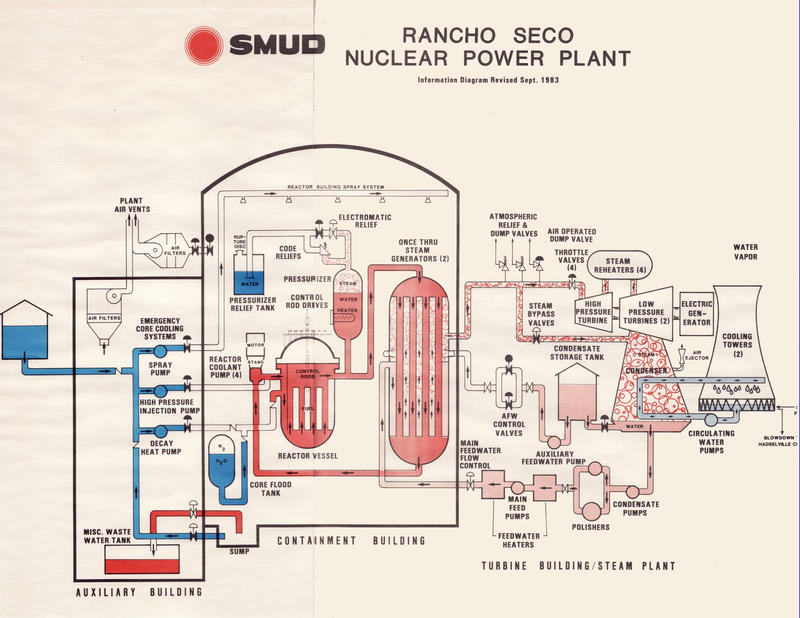
Yet our speaker yesterday, while not making light at all of what happened at Fukushima, didn't seem to see it that way. With all the redundant safety precautions built into the plant, and with the unexpected severity of the earthquake and tsunami, the plant had performed very well under the circumstances, the explosions that occurred were "just as designed", and the release of toxic nuclear material was minor. The only plant workers who died, he said, died as a result of the tsunami, not from release of radiation or toxic nuclear material. More people, he said, were at risk in the evacuation than from the plant itself, and up to a thousand actually died in the evacuation, he said. Given the 25,000 dead and missing from the natural disaster, the losses due to the nuclear accident were minor. Perspective, people!
He showed charts and graphs that demonstrated just how minor the release of nuclear radiation and toxic material was and is, and how workers at the plant have never really been exposed to high levels of radiation, as they were, for example, at Chernobyl. The Chernobyl meltdown was orders of magnitude worse, he said.
Most of those in attendance seemed to accept his assessment -- he is a world-renown nuclear expert after all -- but some were quite disturbed by it. Or rather, by the implications of it. I asked at one point whether -- since according to him there are no health risks from the destruction of the plant -- whether the residents of Fukushima Town and the rest of the evacuation area had been allowed to return. He danced around an answer, saying he thought maybe people had been allowed to return to their homes in the outer evacuation area, but he wasn't sure, and that in Fukushima and closer in, he thought people were allowed day trips in -- to get their things and whatnot -- but he didn't think they were allowed to stay. I asked if he could estimate how close to the plant people are allowed to live; he said he couldn't. One other attendee said she thought it was 20 kilometers (12 miles). He didn't dispute it. In other words, the evacuation zone is still in effect, despite the lack of ill-effects from radiation and contamination -- according to Knief -- due to the Fukushima disaster.
He said it would easily take 40 years or more to complete the clean up of the plant, while clean up at Three Mile Island "only" took ten years. This is rather striking. Of course we were told there was no significant radiation or toxic leak from Three Mile Island, either, yet it took ten years to clean it up. We are now being told that there have been no significant radiation or toxic leaks from Fukushima Daiichi, and it will take a minimum of 40 years to clean it up.
Great.
Another attendee said (all quotes in this post are paraphrases), "You've pointed out that 'nobody could have anticipated' the severity of the earthquake or the height of the tsunami, yet any graduate student could easily have done so given the fault lines near the site and the history of tsunamis in Japan, some of which have been a good deal higher than the one that overwhelmed Fukushima. Any graduate student could have predicted what happened. Yet the government of Japan and the experts at TEPCO couldn't?"
Knief said, "They might have, I suppose, but they didn't. They designed for the worst they thought would happen, and they were wrong. But their design worked very well until the plant lost power, and there was nothing they could do about that..."
According to what we were told, the plant lost power because the reactors themselves shut down automatically when the earthquake hit. The transmission lines for power from other sources were knocked out by the earthquake as well. The diesel generators at the Fukushima site kicked in as they were supposed to when the power went off, but within half an hour, the unexpectedly high tsunami hit, swamping the generators and knocking them out of commission. The final back up was a series of storage batteries that only had a few hours' charge, and there was no way to recharge them. Once the batteries were exhausted, there was no power at the plant. A "station blackout." TEPCO attempted to get new generators to the plant but was unable to due to traffic and destroyed roads. The tsunami had also washed away the fuel storage tanks for the generators on site. So even if they had been able to get the generators to Fukushima, there was no fuel for them and they would have been useless.
So things followed their natural course. Three of the reactor containment buildings exploded -- as they were designed to do we were told -- due to the build up of hydrogen vented into the containments from the reactors as they heated up from lack of cooling water. One of the reactors' cooling water toruses was breached and contaminated water was released into a holding tank below. There was a fire in a few of the spent fuel rod tanks, but the fire was contained, and there were few/no toxic releases. On and on.
The plant is in cold shutdown now and clean up is proceeding. Nothing to see here, please carry on for the next 40 years or so...
All the other nuclear plants in Japan have been shut down as well, and alternative fuels are proving to be very expensive, so he thinks that the undamaged nuclear plants should be returned to service; there may be a slight risk, but there is a trade-off in that the cost of running electric plants on natural gas or oil is so high that the risk may be worth it.
One attendee questioned the validity of Knief's charts and graphs showing no health risk at all from radiation and toxic materials released from Fukushima. "Has the media been hyping the situation over there?" He said, "Yes, it has." "How?" she asked. The response was essentially that there have been no adverse affects to the health of individuals near the plant, and that experience from other instances of radiation exposure (including Hiroshima and Nagasaki, which he said are really the driving psychological events behind the hype and the fear of the Fukushima event) indicates that a certain level of low dosage radiation could be healthful.
By this point, some people were getting pretty annoyed, so the open discussion was shut down, but Knief stuck around for private consultation.
We took the opportunity to tour the museum, which we found to be in its own way quite as annoying as the Science Cafe speaker. Well, "annoying," is that the right word?
Perhaps not. Evocative. Aggravating. Propagandistic. Stomach churning.
Anyone who grew up under the threat of instant incineration from nuclear annihilation like we did is going to be... moved, and quite possibly sickened, by the accumulations and displays of bombs (at least their casings) and missiles and planes and all the other panoply and mechanisms of nuclear war housed at the museum.
Worse, at least in my view, was the justification of it.
"We did these things and had these weapons because of the threat from the Soviet Union, and anyone who questioned that threat (such as J. Robert Oppenheimer) deserved what they got. Shut up."
I'd seen many B-52s in flight and on the ground in my time (you couldn't escape them living near an Air Force base, especially during the Vietnam War) but I'd never been that close to one. The one on display is set up as if it were being loaded with nuclear tipped guided missiles, and when you think about it, you can't help shuddering.

In the background by the fence it looked like there was a bomb casing such as the one Slim Pickens rode down in "Dr. Strangelove."
There were all kinds of missiles on display including put-together and dismantled ICBMs, which again, I'd never seen close up. There were random parts of a B-47 stacked up on the ground, and the conning tower of a nuclear submarine which they are raising money to restore and put on display. There was the obligatory nuclear cannon. There was a B-29 next to the B-52, looking quite diminutive and modest by comparison.
Every size and type of nuclear device, from The Gadget of 1945 and the Trinity test, to the tiniest hand-carried bomb (57 pounds, launchable from a bazooka-like apparatus), to the most hideous looking hydrogen device, to a couple of the "broken arrows" -- nuclear weapons, whoops!, lost from planes or otherwise gone astray... was on display, and in a corner was an old teevee playing a loop of Civil Defense films from the 1950's, in a mock up of a fallout shelter from the era, stocked with barrels of "Drinking Water", and cans of "Food". Only one cot, though.

Yes, well.
Propaganda posters, nuclear cars, trains, planes, and nuclear medicine were all highlighted. In the "lounge" -- decorated with Mid-Century furniture and other items -- was playing one of the Frontline videos of the Fukushima disaster. How about that.
I noted that young adults wanted to have their pictures taken with the bombs, especially the Fat Man and Little Boy mockups. Older people were... either quiet or trying to laugh off what they were seeing.
Was it real? Did we really go through this?
Trinity Site functions as a memorial. There isn't even a hint of celebration there. When people approach the site in a celebratory or expectant mood, they leave in solemnity bordering on depression. As they think about what began there, there is no escape from the psychological horror of it.
Despite his obvious enthusiasm for nuclear power Knief did seem to recognize the severe psychological effects of the various disasters that have accompanied the development of nuclear power and nuclear weapons, and to his credit, he didn't try to dismiss them.
Then we went to yet another literary event...
[I'll try to provide some links later... right now, we're getting ready for another literary afternoon...]
Saturday, April 27, 2013
CT Every Which Way
It's not unusual for traumatic events to give rise to conspiracy theories of one sort or another, and so it has been with the Boston Marathon Bombing, though it seemed to take a bit longer for them to be generated than in some of the previous instances I can recall.
If we go back to the JFK Assassination in 1963 -- which I can still remember pretty well, and which seemed to have started the line of conspiracies and lies and government reformations, failures and breakdowns we've been subject to ever since -- we can see how easy it has been to induce the common people to believe something that simply may not be true. This goes for both the Official Story and the various alternative conspiracy theories as well.
Ever since then, I've been convinced that 1) the Official Story is a lie; 2) many, if not all, of the conspiracy theory alternatives to the Official Story originate from some of the same sources as the Official Story.
In other words, the conspiracy theories form part of the process by which most of the public is convinced of the "truth" of the Official Story while simultaneously providing those who are not convinced or convincible with plenty of distracting and generally false leads to consider and argue over indefinitely.
So it has been with the Boston Marathon Bombing, as it was with so many other traumatic events of the last several decades.
All we, the plebs, need to understand is that we are to live in persistent fear of arbitrary threats from sources we can't know or understand and we are to obey the commands of Our Betters -- for our own safety and security, of course.
This is the consistent message conveyed to us from on high: fear the unknown but always present threat; obey official orders (or, in the case of Boston's lockdown, what has been euphemistically and propagandistically called "requests to stay indoors.")
Seems to have worked pretty well...
If we go back to the JFK Assassination in 1963 -- which I can still remember pretty well, and which seemed to have started the line of conspiracies and lies and government reformations, failures and breakdowns we've been subject to ever since -- we can see how easy it has been to induce the common people to believe something that simply may not be true. This goes for both the Official Story and the various alternative conspiracy theories as well.
Ever since then, I've been convinced that 1) the Official Story is a lie; 2) many, if not all, of the conspiracy theory alternatives to the Official Story originate from some of the same sources as the Official Story.
In other words, the conspiracy theories form part of the process by which most of the public is convinced of the "truth" of the Official Story while simultaneously providing those who are not convinced or convincible with plenty of distracting and generally false leads to consider and argue over indefinitely.
So it has been with the Boston Marathon Bombing, as it was with so many other traumatic events of the last several decades.
All we, the plebs, need to understand is that we are to live in persistent fear of arbitrary threats from sources we can't know or understand and we are to obey the commands of Our Betters -- for our own safety and security, of course.
This is the consistent message conveyed to us from on high: fear the unknown but always present threat; obey official orders (or, in the case of Boston's lockdown, what has been euphemistically and propagandistically called "requests to stay indoors.")
Seems to have worked pretty well...
Thursday, April 25, 2013
Strange Connections
 |
| The Oaks, residence of J. Parker Whitney, Spring Valley Ranch, Rocklin, CA, c. 1889 |
Yesterday, I was tootling around the place trying to figure out whether spring was actually ever going to settle in and when I would be able to plant without fear of a late season hard freeze killing the seedlings. Our neighbor, Kathy, says it's not really worthwhile planting before Mother's Day, because there is almost guaranteed to be more freezing weather before the end of spring. And besides, the monsoon rains don't start until summer anyway. She thinks I started seedlings way too soon (at the beginning and middle of April, after all!) and that I should have waited.
Well, I get antsy. The landscape strangely looks like late summer California: dry yellow grasslands dotted with dark trees and grayish shrubbery. Of course the species are different, but the visuals are similar.
While puzzling all this out, I got to exploring some of the historical material about this area, and it is quite a tale. This area wasn't opened to homesteading until about 1900, though there were some pockets of squatters and interlopers before then. This area was subject to competing landgrant claims prior to 1900 as various factions sued and countersued in territorial and federal courts and Congress dithered the way they do.
Interestingly, the later claims were fought between a prominent New Mexico family, the Oteros who were intermarried with the Lunas, an even more prominent New Mexico family, and the Whitneys, a very prominent California family (though in these parts, they are attributed to Boston.) Indeed, Whitney is an inescapable namesake in parts of Northern California, particularly in the Rocklin area outside of Sacramento, where physical remnants of his 30,000 acre Spring Valley Ranch can still be seen amid the suburban sprawl that has engulfed the western end of Placer County.
I knew the Whitney name was associated with the history of this area of New Mexico, but until yesterday, I didn't realize it was that Whitney, of Spring Valley Ranch in Rocklin, California. The name used here in New Mexico is commonly Joel Whitney (and his brother, James); in California, Joel Whitney was known as Parker Whitney (I don't think I ever ran across the name "Joel" as he went by his middle name "Parker".) James didn't really figure. And Joel Whitney is almost always referred to as a "Boston" businessman or capitalist, not a California rancher. Any mention in New Mexico of his California connection tends to be fleeting and often confusing.
Well, (Joel) Parker Whitney was born in Boston, but he went out to California in 1852 at the age of 17 to make his fortune in the gold fields. Of course by then the gold fields that hadn't already been worked out were already claimed, so there wasn't much opportunity for individuals to get rich from panning gold in California. Instead, Whitney made his fortune from "market hunting" -- which sounds dreadful, but very American on the Frontier -- and once he'd made his pile (by 1856 at any rate) he began acquiring the land around Rocklin that would become the immense Spring Valley Ranch.
In California, a lot of effort was put into "scientific" farming and ranching methods as everything was new, at least to the Anglos, and there was no point in trying to recreate the traditional farming and ranching methods utilized back east. Everything was different, particularly the weather, and farming and ranching practices of other regions turned out to be disastrous in California. Other means and methods had to be developed -- which they were at places like Spring Valley Ranch, which farmed scientifically and scientifically raised [sheep and] cattle.
California may still have been something of the Frontier in the later part of the 19th Century, but New Mexico was a backwater, or at least it was thought to be by the Anglos who were trying to make something of it. The odd thing was that New Mexico was the parent of Spanish colonial California, and the two stayed closely connected until the American seizure of the territory from Mexico, and even then, the Spanish connection throughout the Southwest was maintained under American suzerainty.
Whitney was Anglo to the max, of course, and in Rocklin, he had a free hand to do pretty much anything he wanted, and he did, as there were no prior European-American customs and traditions in Northern California to be overcome. That wasn't so in Spanish California, where very different traditions and customs were maintained, nor -- he would find out -- was it true in New Mexico where he attempted to establish and maintain an elaborate cattle empire on lands that had been granted to and were already in possession of Spanish descended (and locally prominent) sheep herders.
The details are somewhat complicated and obtuse, as legal and land ownership matters tend to be, but the gist of it is that Whitney purchased the greater part of the Baca land grant in the East Mountains of New Mexico, but the Baca grant had not been confirmed by American authorities by the time Whitney came around, and the Baca grant and some of its parts were claimed by others, including the Oteros who had bought it from the heirs of Bartolomé Baca, who had received it as a grant from the Spanish Crown in 1819. The portion that Whitney purchased came from the Antonio Sandoval grant of 1845, a grant that seems to have been made by Mexican authorities without either knowledge or reference to the previous Baca grant. Sandoval sold his grant to Gervacio Nolan. Whitney bought the interest of the Nolan heirs in the Sandoval grant in 1878.
It's possible Whitney had no knowledge of the Baca grant -- which encompassed about 1.5 million acres essentially the entirety of the Estancia Basin together with the eastern slopes of the Manzano Mountains. Whitney had only purchased the Nolan heirs' interest in the Sandoval grant which encompassed about a third of the entire Baca grant but which made no reference to that grant. It was Whitney's objective to run cattle on that portion of the Baca grant, and to that end, he sent his brother James to collect 25,000 head in Texas and move them to New Mexico.
At the time, perhaps unknown to Whitney, Manuel Otero was running 45,000 sheep on the same property, along with some cattle and horses. Manuel Otero had purchased the Baca grant in its entirety (but for those sections granted to the towns of Manzano, Torreon, Tajique, and Chilili previously) from the heirs of Bartolomé Baca -- who had essentially come upon the grant documents by surprise when they opened a chest belonging to Bartolomé after his death. Apparently, in about 1833 Bartolomé ordered the abandonment of the ranch he had established with headquarters at Estancia Springs, due to repeated Indian raids that had resulted in the loss of nearly all the livestock and the deaths of several of his shepherds. The remaining Baca ranch staff was urged to move to the town of Manzano for protection.
Otero purchased the Baca grant in 1877 and promptly set out to run sheep on the land once again, and once again to utilize the Estancia Springs hacienda as headquarters.
Manuel Otero attempted to gain American confirmation of his ownership of the Baca grant but failed to do so, as the presiding judge determined that the grant was incomplete. This ruling would be appealed, but before it was, Manuel died, and his son, also Manuel, took over the Otero properties, including the Baca grant.
Manuel Otero the Younger had been educated in Germany, and upon his return to New Mexico, he married Eloisa Luna, easily one of the richest heiresses in the territory. The story of the Lunas and the Oteros is one of New Mexico's chief legends of the Rio Abajo -- which is not really part of this story, but it does help to show how strangely connected everything is.
Manuel the Younger had Jesus Chavez running the sheep ranch out at Estancia Springs, where one day, James Whitney came to call accompanied by some cowboys and perhaps his herds. James demanded that the ranch and the hacienda be turned over to him forthwith. Jesus put up little resistance, but he sent word to Manuel at his place called "La Costancia" near Belen. Manuel saddled up along with several of his vaqueros and set out for Estancia. Along the way, he met up with his brother-in-law, a doctor, and they proceeded to pay a call on James Whitney and his men who were in occupation at the Estancia Springs hacienda.
According to reports, the meeting was tense -- or perhaps it was cordial, accounts differ. At any rate, Otero demanded some sort of court order or other documentation from Whitney to prove ownership of the ranch and grant, but Whitney couldn't produce anything. Therefore, according to Otero, Whitney had no legal right to the property, though Whitney was in possession of it at the moment. Some reports say that Whitney and Otero got along quite well, despite the dispute over ownership, and in the course of the evening commenced to drink and play cards. But at some point, guns were drawn and fired. Both Otero and Whitney were wounded in the shootout, while one of Whitney's men was killed. Otero's vaqueros then took over the hacienda and property while Whitney's men retreated, loading the wounded James Whitney onto a wagon for the long and arduous trip to Santa Fe where he would be placed at St. Vincent's to recuperate.
Meanwhile, at Estancia Springs, Manuel Otero died of his wounds, despite the heroic efforts of his brother-in-law to save him. Manuel's death caused enormous outrage in the territory, as he and his family were among the most prominent New Mexicans. Whitney was considered a murderer and interloper, and he was put under arrest in his hospital bed at St. Vincent's.
Whitney's brother, Parker (called Joel in New Mexico), informed of these unfortunate events, made his way by rail out to New Mexico several weeks later. He was intent on liberating his brother from the New Mexican savages and taking him back to California. This task was accomplished by strategy and clever equipment, including ropes and pulleys and such like, that allowed the wounded James to be hoisted out a window at night. James was hauled away from St. Vincent's by carriage and placed on Parker Whitney's private railroad car at Lamy, then called Galisteo Junction, 18 miles from Santa Fe where the rail depot was (one assumes that's where James made his escape by rail, as there was no rail depot in Santa Fe at the time). When James was discovered missing from the hospital in the morning, the governor was informed, and he sent a telegram to the sheriff in Las Vegas (NM) to halt the train and arrest James.
The train was halted just outside Las Vegas, and there was an encounter between Parker Whitney and Miguel Otero in which a gun was pulled. Parker Whitney's private car was decoupled and re-attached to a train headed for Albuquerque, and events took their course. At Albuquerque, a brief hearing before a judge was held on Whitney's private car, at which bail for James was set at $25,000 and he was released to the custody of his brother to return to California.
It was grumbled at the time, and it was probably true, that Parker Whitney had bribed the judge to grant bail, and it was widely assumed that this was the last that would be seen of the Whitney brothers in New Mexico.
But no, they returned the next year for the trial, which their attorneys successfully had moved from Valencia County, seat of the Oteros and Lunas and site of the gunfight, to Colfax County, where almost incredibly, they were able to empanel an all-Anglo jury, who acquitted James of murder, citing self-defense.
James promptly died.
Parker returned to his Spring Valley Ranch in California, but he pursued his claim to the Nolan interest in the Sandoval grant while Eloisa Otero -- now remarried -- pursued her late husband's claim to the Baca grant. Both claims went all the way to the United States Supreme Court, and both claims were ultimately denied as neither party could produce complete (enough) land grant documents to satisfy the court.
The final resolution of the Whitney claim was handed down in 1901, and in 1903, what became the New Mexico Central Railroad was laid through the Estancia and Galisteo Basins to connect the southern Santa Fe tracks to the Santa Fe tracks in the north. Homesteaders flocked hither, though there were already plenty of squatters.
Pinto beans and cattle became the primary crops of the region as hundreds of people settled on the rather bleak high plains to try their luck at last of the Frontier farming and ranching. Ultimately, there never would be a large population in the area. The land and weather are really too hard to support many people. Water is too scarce. The growing season is very short. Forage is slight.
In the 1930's and the 1950's this area suffered severe drought -- as it is suffering once again -- and unfortunate farming practices caused mini-versions of the Dust Bowl of the Great Plains. And once again, residents are experiencing extensive dust storms. It's not as bad -- yet -- as old timers remember, but just the chance that it might get that bad again is disturbing to people with long memories. Farmers have changed their practices, but still the dust rises.
So far as I can tell from what we've been told and the remaining signs of what used to be, our place was set near the southeast corner of what was probably a 160 acre spread. I can pretty much trace the former boundaries of this place by noting the locations of other old adobe houses and the present boundaries of surviving ranches which seem to have bordered this place when it was originally laid out.
It doesn't appear that this place was ever used to grow crops though there are signs that it may have initially been a horse or cattle ranch.
This house was originally two rooms, self-built of adobe manufactured on the property. In fact, there's still a pit near the house where I suspect the adobe came from. There were several additions over the years, mostly of adobe, but some of wood frame, that ultimately made the house fairly large -- well, large for us, at any rate, though it is no larger than a fairly typical suburban house today. The house we left in California was about half the size of this one, but it was quite tiny as California houses go.
Most of the land that once surrounded this place seems to have been sold off and subdivided in the 1950's when the last additions were made to this house. We've been told stories -- that we don't believe -- about who the place once belonged to, and we've heard some interesting stories about the lesbian couple that lived here and grew herbs and flowers before leaving the place abandoned about five years before we bought the wreck from an elderly woman who lived in Oklahoma.
While there is a lot of history here, and it's a lengthy history, it's not so complicated that it can't be unraveled. The surprising connections I've just now discovered between the old families of New Mexico and California's Whitneys is very intriguing. Before I retired, I did a lot of work in Rocklin and followed and documented the intense suburban development of what had once been (Joel) Parker Whitney's Spring Valley Ranch closely. For a time at the height of the real estate bubble, Rocklin was the fastest growing community in the nation. Suburban developments metastasized overnight. It was insane.
Now we're in a far calmer place.
Waiting for spring to settle in....
-------------------------------------------------------------------------------------
I've been looking into other aspects of the histories of (Joel) Parker Whitney, Spring Valley Ranch, and the historical connections between the Whitneys and the East Mountains and the Estancia/Galisteo Basins of New Mexico, and I may be revising this post in the by and bye. There is more to the story to be sure. But there are also many variations on the story, as each teller of the tale tells it somewhat differently. Sometimes the stories are radically different. Further, the biographical information about the Whitneys, the Oteros and so on differs almost as much -- depending on who is telling the tale.
In some ways, it's like an old time oral history that has been passed down through the generations, but which is told differently depending on who is recollecting and telling the story, and where the story is told. For example, I've found no mention at all in the California histories of the Whitneys' misfortune in New Mexico; it's as if it never happened (though there are a number of references to Parker Whitney's Colorado adventures, including some misfortune.) On the New Mexico side, there is almost no mention of the Whitneys' California holdings and operations, and there is no apparent recognition by the story-tellers in New Mexico that the Spring Valley Ranch in California was the Whitney headquarters (as opposed to Boston, say). The Whitney's New Mexico episode went on for more than 20 years -- at least in litigation -- so I would think there would be some recognition of it in the Whitney histories, but I have yet to come across even one word about it in any California-based history of the Whitneys -- though there is still a great deal I haven't read. On the other hand, the New Mexico histories of the events that took place as the Whitneys and Oteros competed for the properties are so varied it's all but impossible to know what really happened.
It's a mystery...
Subscribe to:
Posts (Atom)