Thursday, July 21, 2022

A Day and A Night in the ER

 Welp, it's happened again. After waiting longer than I should have, I called the advice nurse about my increasingly uncomfortable condition. She said I needed to be "seen" within the next four hours; I should go to Urgent Care or the ER. Mkay? The nearest Urgent Care run by my HMO was 47 miles away. There is a Primary Care run by another outfit in my little town, and as it happens they take my insurance, so I've been able to go there for immediate care, but not this time. They wouldn't be able to see me for at least 24 hours. Low on staff, high on patients. Mkay? 

So the choice was the Urgent Care way out there. They could see me in a couple of hours.

I got there and was informed they were running behind, but they'd get to me as quickly as they could. It was only about an hour later (c. Noon) when I was called in to the examining room. BP and temp were OK; I was alert, coherent, ambulatory -- with some difficulty. Described symptoms and problems.

"Dude, you need to go to the ER, stat."

Oh fuck. I hate the ER. Nothing but turmoil, stress and strain, lack of care, waiting and waiting and waiting while the place fills up with more and more suffering, disease, madness and pain. What is the point. 

The nearest ER as it happened was another 15 miles or so away, and the Urgent Care said they would call over and let them know I was coming, and they said it would probably be less of a wait there because they would probably have fewer patients.

Mkay. We get to this ER, and truth was there were hardly any patients in the waiting room. Five, maybe six. Most had already been triaged. Some had been seen and were waiting for test results.

It was calm. Very little obvious suffering. Quite a few people came in while I was waiting for triage (c. 30 min). Nearly all were members of one family there to see their relative who was being treated inside. They were allowed in two by two. 

Triage was straightforward, and I was told to wait in the lobby. They'd see me inside as soon as they could. 

More patients came in while I waited. More visitors came to see the one special patient as well as other patients in treatment. Some of those who arrived were in really bad shape. Extreme pain, unable to walk, one couldn't even sit and her wheelchair ride was torture for her. Some appeared to be having strokes or heart attacks. 

And believe it or not, all of those I saw in serious distress were treated promptly and compassionately by the very young staff, none were left to linger unattended. Some were treated directly in the lobby, others were wheeled or ushered into the ER treatment areas, but none were neglected.

This was astonishing. I have never been in an ER where staff did not neglect the patients, ignored their suffering, even disparaged those who sought treatment. I have never been in an ER where prompt treatment of severe conditions was the rule. I have been in ERs where staff had no interest in or consideration of patients waiting, and where patients died while waiting without any care at all. The cynicism and contempt for patients in some ERs I've been in has been off the charts, and it's happened so often, in so many different ERs in California and New Mexico, I took it for granted as just the culture of these places. It's outrageous, but there you are.

This was an entirely different situation altogether. I didn't need immediate treatment, though I would have appreciated the pain medication I eventually received had it been administered while I waited. I got an xray within an hour of arrival, but had to wait to be "seen." My distress was minimal compared to some of the patients who sought care, and everyone who needed immediate care received it compassionately. Those of us who had to wait mostly did so with equanimity; so many others were in much worse shape than we were.

After about 5 hours waiting in the lobby, I was called in to the treatment area and assigned a room where I was introduced to the nurse and CNP who would be treating me. Both were kind and positive. As it turned out, the nursing staff would have a shift change in an hour, but the CNP stayed with me throughout. 

Treatment would take just about 8 hours.  During that time, I received a CT scan, pain medication, Ringer's lactate, anti-nausea and anti-inflammatory medication, and two different treatments for the condition I was there for. Neither was fully effective while I was there, but I was discharged with a prescription for another medication to take if the ER treatments didn't work within the next 6 hours or so.

When I read the after visit summary, I noticed that the CNP had missed a finding on the CT scan -- I had a hernia -- which which was probably a contributory or precipitating cause of the problems that sent me to the ER. Oh. I suspected the hernia, and I pointed out the odd swelling and pain in my groin, but it was not recognized by me or anyone else for what it was at the time. The CNP said it was "gas". And I saw on the CT scan report that there was considerable build up of "gas." But missing a hernia with obvious symptoms (I realized later) was odd. 

The treatments that were administered in the ER did work effectively the next day at home, so that part of the problem was taken care of, thankfully. The hernia has not been addressed yet, though the swelling and pain are not as severe.

It seems to me, I've had this condition before -- a hernia, that is -- and after several weeks, it self-repaired. We'll see. It's not fun, but it's bearable. Primarily it limits my movement. 

What I can say about the overall experience in the ER this time is that it was worlds better than any ER I've been in (for myself or on behalf of others). Even though part of my problem was missed by the staff, or perhaps not missed but dismissed as not that important, I was treated with consideration and respect, was given needed medications and treatment, was tested and imaged to a fare-thee-well, and discharged with explicit instructions and medication prescriptions with orders to return promptly to the ER if none of it worked.

Well, it did work, and I'm grateful.

Now to deal with the hernia... 🤪


Monday, July 11, 2022

Another Memory Exercise. Some Things About This House

There are lots more memory aids now than once there were. It's easier to remember but also easier to get confused. One of my memory aids for the house in the San Gabriel Valley I've posted about several times is Google Street View. It's become something of a historical record because it records the appearance of the house and neighborhood over time, in this case from 2008 to 2022. A major change -- to me -- took place after 2011. 

This is a screenshot of my house and the house next door (where the Vegas lived when I lived in the neighborhood) taken in October 2011:


Several things: The Vegas' house is light brown, which it was when I lived in the neighborhood. The house where I lived is painted yellow -- which it wasn't when I lived there. But it was yellow the last time I saw it in person in 1969. When I lived there, the house was painted white with dark green (Hunter Green) trim. 

There's a heavily cracked blacktop asphalt driveway, the only one still remaining in the neighborhood. That was put down some weeks or months after we moved in in 1954. All the driveways in the neighborhood were blacktop initially. Before the driveway was installed, it was just graded dirt which turned muddy when it rained. My mother was livid about it. But the house itself wasn't finished when we moved in. There were still parts needed stucco and plaster, some plumbing fixtures weren't installed in the shower, trim still needed to be applied on the interior and exterior, and the house hadn't been painted. 

Part of the problem was that our house was the last one on the street to be built and finished. This was the Post War housing boom, and houses were being built all over the Los Angeles Basin at a furious clip. This neighborhood was being developed so fast that Life Magazine did a feature on one family that moved from Connecticut to California and faced the dilemma of the New and Incomplete Reality of Los Angeles -- and this particular neighborhood --  at the time.

What had been essentially wild country -- hills and pasture, hills and oak forest, etc -- was turned into housing overnight. Initially, there were no curbs, gutters, sewers, or other amenities that would come later. Finishing the neighborhood, to the extent it ever would be finished took years. 

The curbing you see in the picture didn't arrive until long after we moved out in 1959. I'm not sure curbs were there in 1969. And I've noticed on Street View that the sections built on street extensions later (in the '60s and '70s) have street lights while the sections built in the '50s do not.

In the picture you see a rusty rural mailbox. That was put in by my mother after a dispute she had with the post office. It was probably 1956 or so. Initially, she'd mounted a fishing creel on the wall beside the front door to collect the mail. One day she got a notice stating that her mail receptacle was not regulation and must be replaced or US Mail would no longer be delivered to that address. If I recall correctly (ha!) there was no indication of what would be acceptable. So I suspect she marched down to the post office (I don't remember where it was) and demanded to see the regulations, and she found that a rural mailbox would be... fine. 

She went to the hardware store and bought one with a metal stand. She painted the box with flowers and vines and such, mounted it on the stand and put the whole apparatus in the ground (may have had help from a neighbor) beside the driveway. With a note that said, "Put Mail Here."

Later she found out that a rural mailbox in a suburban neighborhood like ours wasn't regulation either,  and she got a British iron letterbox at an antique store and mounted it where the fishing creel had been, and that was where the mail was deposited until we moved. I think she took that British letterbox with her when we moved, but I'm not entirely sure. I seem to remember it turning up in several later houses but it may have been another one.

There's a large tree next to the mailbox in the picture up top. That's an oak (madrone?) that I planted between 1956 and 1958. It was a seedling that sprouted up in the hills beyond the end of the street. I dug it up and carried it down the hill in a can of some sort and planted it in the front yard when I got home. It grew. It's somewhat unusual because oaks don't like being disturbed especially as seedlings. But this one did fine. It was maybe two-three feet tall when we left.  Sadly, the oak tree and the mailbox are now gone (a/o 05/22). But they had quite a long run.

Saturday, July 2, 2022

The Odd Persistence and Absence of Memory

Note: there has been much editing since I first published this post. And a discovery or two.

-------------------------------------------------------------------------

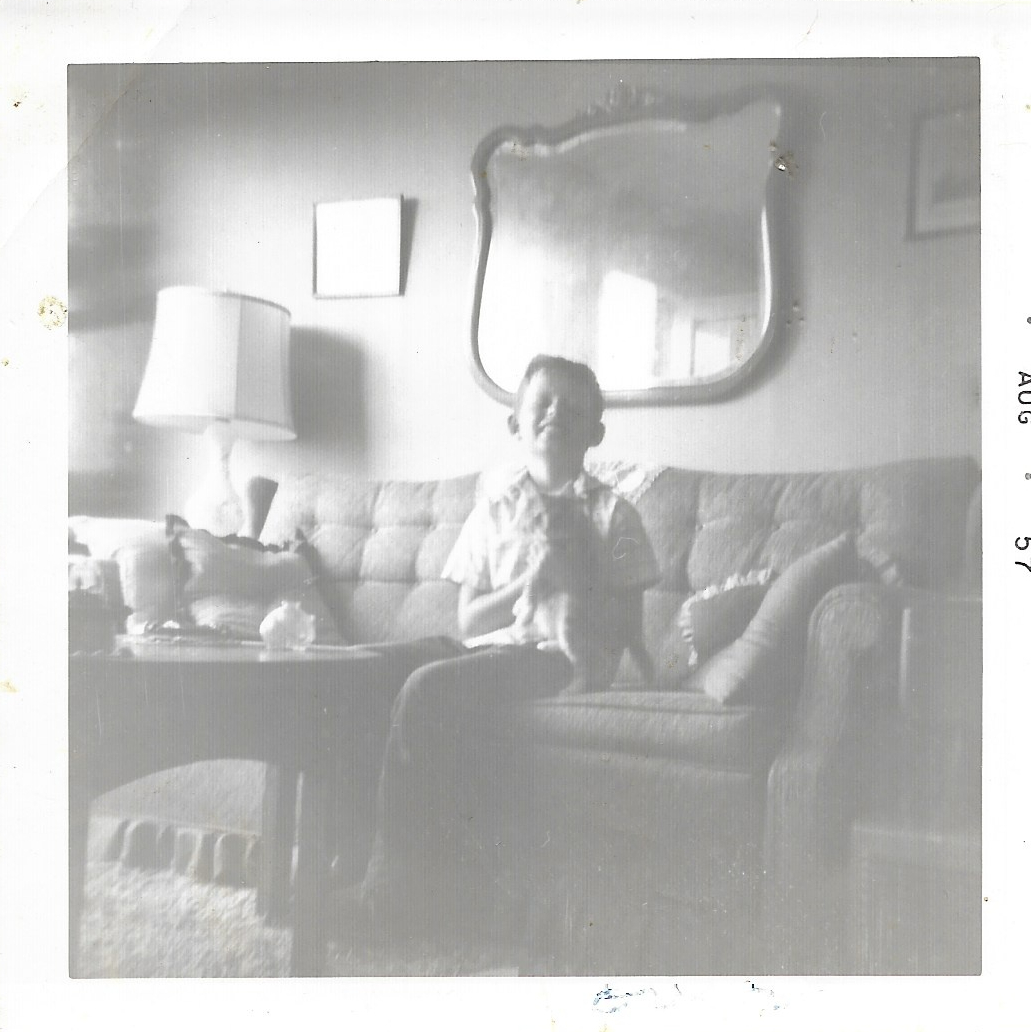
This goes back to that picture haul I was gifted with on Father's Day. One picture in particular sticks in my mind, but there were several taken on what I think was the same day in the summer of 1957 (I was 8 or 9), and while I focus on one, the others might be referred to from time to time for context.


The photo in question is one of me sitting on the couch in the living room of my house in the San Gabriel Valley of California on a sunny but probably smoggy day. There's a sort of misty quality to the photo which I find intriguing. It's probably due to a dirty lens, but when I think of that, I also wonder who took the picture. The picture appears to be taken from the level of the seating, and I suspect the camera was placed on the seat of a wing chair that faced the sofa (a sofa that was actually a sofa-sleeper.) I'm holding a fluffy cat whose name I don't remember. I don't recall the picture being taken -- nor do I recall ever seeing it before. This makes me wonder. 

I don't recall having a camera of my own at that time of my life, but maybe I did. There was a dual lens reflex camera I remember using frequently a few years later after moving to Northern California, and it is at least possible that I had it much earlier and that the picture in question was taken with it -- or one like it. I say that because I have a vague memory of more than one such camera.

But the problem of who took the picture -- or the series that day -- is vexing. I have the feeling that I took them with a shutter-timer. But I have no memory of having a camera with a shutter timer until much later in the '60s or even the '70s.

So I think the camera was placed on a chair, the timer was set, and I got in position -- with a cat -- before the shutter was tripped. If there was someone else there, who could it have been?

I had quite a few friends in the neighborhood, but they rarely came over to my house. I usually went to their houses, and I remember many games of canasta or Monopoly at friends' houses, but hardly any at mine, and when we did play cards or Monopoly at my house, we sat on the front porch, never that I recall in the house or backyard. The rarity had to do with the fact that I was there by myself while my mother was at work at the hospital, and she was quite clear that she didn't want me to bring other kids over to our house while she was not there. Could she have taken the pictures? Perhaps, but I don't think so.

These pictures were taken at my house in the living room and the back and side yards of me and my pets and there appears to be no one else there. Which would be right -- it would be very rare for one of my friends or another adult to be there when my mother wasn't.

This is one of the many oddities of memory, though. I could be misremembering. There were times, I know there were times, when a friend, a neighbor, or another adult came over when I was there alone, I just don't remember it happening as part of taking these pictures, nor do I remember my mother taking the pictures, and there is nothing in these pictures that indicates anyone else was there.

And I don't remember these pictures being taken or ever seeing them before Father's Day this year.

The sight of a much younger me sitting in my living room in 1957 holding a cat is somewhat jarring. I remember the room quite well and its furnishings. I remember what that couch upholstery felt like (rough) and look of the round oak table we used as a coffee table (it had been a tall mission style "center table" that my mother had cut down). I remember the antique mirror hanging above the couch and the Currier & Ives prints on either side. I remember the white cotton shag rug under the table -- and how glad I was when my mother bought it and brought it home. If I remember correctly -- and I may not -- the walls of the room were painted gray-green. There was a huge picture window at one end facing the mountains to the north and I remember the light from that window being very bright despite its northern exposure.

The story of the rugs in that house is kind of important to my memories of living there. The house was not quite finished when we moved in in 1954. There was still stucco-ing and painting going on and there were bits of trim being applied and plumbing fixtures being installed (if I recall correctly, the shower wasn't finished when we moved in). There was no landscaping; the lot was bare and dusty. There were no sewers, no curbs, no gutters. Initially the driveway wasn't finished, and one day the asphalt pavement was put down, but we had to be careful not to walk or drive on it for a time. The absence of sewers meant that the plumbing drained into a cesspool -- not even a septic tank -- in the front yard, and I remember it had to be pumped out from time to time. The sewer line was installed the year after we moved in.

We had a few braided rugs that had come with us from other houses, but they were small and didn't do much to muffle the echoes of footfalls in the house. Oh yes, I remember the house being very echoey due to the plaster walls and hardwood floors. The white cotton shag rug in the living room probably appeared some time in 1957 -- my mother also got a new car that year -- and even though it wasn't all that big (probably 6x9 though it may have been 9x12) it made a big difference because it was soft and sound absorbing, and I remember the echoey-ness of the house diminishing greatly once that rug was put down.

By the time these pictures were taken the back and side yards -- and the front, too but there were no pictures of that -- had been planted with grass and bougainvilleas and roses and there was a water feature in the backyard ringed with bricks and lattice fencing put up to hide the incinerator (which I think we couldn't use after 1956) and to mask the side yard where the clothes line was.

I had asthma and the smog was bad in the San Gabriel Valley, so being outside (or inside for that matter) could be difficult for me. I had attacks fairly often until we moved to Northern California in 1959. But oh well. It was what it was.

I remember the house was painted white with hunter green trim, quite different from other houses in the neighborhood which were mostly brown, beige or gray with white trim. I remember my mother insisted on white and dark green trim. She said there was a reason, but I don't remember what it was.

I'm 8 or 9 years old in these pictures, and I'm surprised at how skinny I was. I don't remember being skinny until I was a teenager. In fact, I remember being kind of pudgy up until the age of 14 or 15 when I started getting taller. So seeing how skinny I was at 8 or 9 is a revelation.

There's an exercise I'm supposed to do prior to a Zen workshop coming up: describe yourself from the point of view of the Earth.

From the point of view of the Earth, of course, these descriptions of myself as skinny or chubby or alone or with friends or my age in these pictures or really anything are silly, irrelevant, laughable. From the point of view of the Earth, I don't exist as an individual at all. The minuteness of humans in the context of the whole wide world -- which itself is minute in the context of the Solar System -- is striking. There is no "me" in that context; there is no "we." Less than a mote of dust. 

And yet from the point of view of the Earth, I and the aggregate of humanity of which I am a infinitesimal part are in the process of "killing the planet." Perhaps like a disease organism might do to me or someone else at human scale.

The planet, the Earth, is responding. Cranking up an immune response against which I and the aggregate of humanity have no real response.

In thinking about these matters of scale and existence/non-existence, past and future, I recall the teachings of Vimalakirti  and all the Buddha-realms beyond our ken. Perspective is hard to obtain. Once obtained, it may be hard to maintain, and memory may fade. But what is is no matter whether we see or know it or not. 

---------------------------------

Silly me. I looked on the back of the photo and found a note written in my mother's handwriting stating that the "we" took the picture in the house, and the flash didn't work. Note says, "How was I to know it needed batteries!" 


Tuesday, June 21, 2022

A Most Astonishing Thing

For Father's Day, my wife gave me a photo album of pictures she came across a day or two before, she said in a K-Mart photo envelope. They must have been randomly put there for safekeeping or something, and it must have been thirty or even forty years ago, maybe even fifty years ago, since we hadn't used K-Mart photo processing any later than the early '70s.

These pictures were far older than that.

The oldest one probably dates to 1910 or so and I think it is a picture of Mamie or Maggie, the maid/nanny in my grandfather's house in Iowa. There's another old one of what looks like a town somewhere in the Midwest or West. Not any place in Iowa I'm familiar with. Based on a car in the picture, it was taken in the 1930's or '40s.

Then there are a lot of pictures of me taken between the ages of a few months to 16 or 17. There are some of my nephew from the time he was a few months old to the age four or five. One of my sister a year after my nephew's birth.

There are some pictures of household pets from the 1950s and 60s. I remember the dogs' names but not the cats.

Some pictures of my mother in the 1950s and '60s. 

And some Polaroids of a dog and a shopping center at Christmas time from the 1960s.

Some came as a shock because I don't remember ever seeing them before. 

I would say with some confidence that I haven't seen any of them in fifty years, and some I may never have seen before though I probably did and forgot.

I've spent some time putting them in more or less chronological order and making notes about what/who they are pictures of. But there are some I have no idea of. Or only the vaguest idea. 

It's fascinating and a little creepy.


Saturday, May 28, 2022

Yet Another Massacre -- The Uvalde Thing

Nineteen kids and two teachers shot and killed at an elementary school in Uvalde, TX the other day. Just another day in the killing fields of the Good Ol' USofA. The number of injured is overlooked in most of these incidents so I'm not clear about how many were actually shot by the gunman -- who himself was supposedly shot and killed by an LEO marksman after more than an hour -- they now say -- "waiting."

For what?

Well, that's the question, isn't it? 

Massacres have been part and parcel of the (North) American Experience at least since the initiation of European, primarily British, settlement in the 1600s. The practice of massacring the previous residents -- Natives in the case of America -- so as to protect the newcomers seems to have come over from Britain as a sort of cultural marker. It's what they do. They were doing it in Britain and Ireland for hundreds of years before they came to America. Europeans in general seemed quite comfortable with massacres of their enemies -- or really anyone who got in their way. And of course the notorious Black Legend of the Spanish conquests in the New World was full of massacres of the Natives, sometimes simply because they could.

The bloodlust of the newcomers was insane. Is insane.

Because the massacres in this country have never really ceased -- although in most of Europe, Britain and Ireland, they've almost disappeared. The exception right now of course is in the Ukraine, where apparently "Slavs" and "Aryans" are having it out one more time, renewing a conflict from WWII.

Young men seem to be triggered time and again to go on killing sprees, generally of innocents, strangers they don't know going about their ordinary lives in schools, churches, shopping centers and markets, movie theaters and so on. Wherever ordinary people might gather, say at a concert as in Las Vegas a few years ago, some trigger-happy man (almost always a male, almost always white) will go on a shooting spree. 

A shooting spree made easier and more effective by the easy access to military style rifles and tons of ammunition -- access jealously guarded and made ever easier by politicians who seem to find the whole thing -- all the carnage, terror and bloodshed -- little more than a minor inconvenience in their quest for everlasting power over anyone they don't like.

It's so ingrained and the resistance to doing anything to curb it is so rigid that Americans in general are frustrated and bewildered. Angry and yet powerless to do anything about it.

Their lives and those of their children obviously mean nothing to their rulers, regardless of supposed political party. Even when members of the ruling class are targets (which is almost never) nothing is done to curb the killing; in fact, in many cases gun laws are loosened following a massacre on the bogus theory that "good guys with guns" will protect against the next massacre. 

Well, no. They don't.

But that seems to be the point. Proliferate firearms, make it ever easier for those on a quest to kill to do so and let the chips (and blood) fall where they may.

We can say it's a sickness, a mental illness, but that only goes so far. It's a cultural fault. One that isn't really seen as a problem by those who might do something about it.

It's like the Corona virus response. More than a million dead so far -- mostly met with a shrug by the Overclass who, since they are relatively well protected (as they are from mass murder) simply don't think about, and don't care about, what happens to the rest of us.

I've long said that our system of rule is the primary problem. It's a system that resists change for the better because the system itself is presumed to be best. When change comes on behalf of the downtrodden, it may be only after hundreds of years of constant agitation, and it is always beset with efforts to backslide, some of which will be successful.

In other words, it's a constant struggle to be better, a struggle that often fails.

That's built in. It's systemic.

So we'll go through the usual posturing over this massacre; soon enough there will be another, and the ritual of nothing will repeat ad infinitum. Something from outside may change the cycle, but what that will be, who can say.


Friday, May 20, 2022

The Genocide(s) on the Horizon

I made a comment on another site recently that it appears a good deal of the "left" of this country is working itself up into a genocidal rage at Russia for crimes real and imagined and not limited to the Russian invasion of Ukraine. In an earlier comment, I suggested that Russia's invasion, aka "Putin's War", may indeed prove to be his fatal error.

Marching to Moscow, burning the Kremlin and hanging Putin seems to be one of the animating fantasies of the Azov-Nazis defending Ukraine-Kiev. Where does this come from? Well, of course, Hitler failed in his great march across the steppe to Moscow as did Napoleon before him. The Grand Imperialists never seem to be able to conquer Mother Russia, but the urge to do so seems implacable among a certain sort, and so, apparently, here we go again.

The Ukie-Nazis are doing the fighting and largely losing against Russia, but all the USandNato players are doing their part to fund them and supply them and keep the fighting going "to the last Ukrainian." So then my question is "what is the purpose of depopulating and destroying much of Ukraine? Cui bono as it were?

I've noted that the Ukrainian population declined some 30% after the fall of the Soviet Union, and since the invasion, another 25% or so have fled to other parts of Eastern Europe, and some back to Mother Russia itself. Parts of cities and villages have been destroyed. Planting and harvesting has been disrupted. There is no going back to the status quo ante, and it is my suspicion that many of those who have fled the fighting won't go back to Ukraine, either. 

In the meantime, genocidal forces are let loose. Zelensky claims (constantly) that the Russians are committing genocide in Ukraine. There is no evidence that this is the case. On the other hand, Putin has made the claim that Ukraine has committed genocide against Russians and Russian speakers in Ukraine. The eight year Ukrainian war against the Donbas oblasts (and now republics) is cited as evidence, together with the appalling massacres in Odessa and Mariupol in 2014 following the coup against the government of Viktor Yanukovych. Russia, on the other hand, has vowed to "denazify" Ukraine, with particular emphasis on liquidating the Azov Regiment and other neo-nazi elements  of the Ukrainian state. The threat is not to Ukrainians per se, but to groups within the Ukraine who espouse Nazi and neo-Nazi ideology -- and presumably who take action to violently enforce their will.

Which then leads to revenge.

A good many of our overlords seem to like it that way.

We see genocidal rage building in many other areas of the world as well. The United States is no exception. The urge to kill The Other in the US has long been paramount. One could say it is foundational. Now we have a situation where practically everyone is The Other to someone else, a level of alienation and lack of community that may be unprecedented. The internet provides a refuge of sorts, and the simulation of community, which has, from time to time led to extraordinary acts of violence int the real world, acts that by their nature can be characterized as genocidal -- and would be considered so but for the relatively small numbers of targeted groups murdered by the killers.

The internal stresses and tensions could metastasize at any time into generalized mayhem. What then? It seems we've been conditioned to accept it. "Nothing can be done." And our lords and masters are fine with it. So long as it doesn't touch them.

For now, crises compound without much mitigation. Society pretty much everywhere is enduring a stress test. Some will survive. Many won't -- possibly including our own. 


Friday, May 6, 2022

"Longtermism"

 So let's ponder this arising cult of "Longtermism". Haven't heard of it? Well, I think we've been living with the consequences for some time now.

Apparently, "Longtermism" is a philosophical belief system, an ideology if you will, manifest widely among our overlords and their minions, particularly in Silicon Valley and its offshoots and in higher order academia. It's an ideology that posits human value in the Future, distant Future in many cases, and effectively devalues humanity in the present. One's vision, supposedly, should be on the Future, longterm benefit, wherein, it is thought/believed that there will be trillions of humans living all over the Universe, happy and wise, and descended from the Good People of today.

Those Good People, of course, are the few and favored oligarchs and their closest servants. They and only they are to be protected at all costs no matter what happens in the present and near future, because they and only they will be the progenitors of the Wonderful World of Tomorrow, filled with joy and ease and Happiness.

There are far too many people on the earth today and thus their cull through disease and war and the effects of climate change and so many other crises is meet and just and should not be effectively interfered with -- so long as the overclass is protected from the consequences of these crises. 

Whatever happens in the political realm is irrelevant; the economy is irrelevant. What's relevant right now is holding on to power over the safety of the overlord class. So long as they -- and only they -- survive, Future Joy will be assured for their trillions of descendants.

Which is the sole point of "Longtermism."

Maintaining a polite distance from the rabble of today helps maintain the power of the overclass. This process was worked out long ago by royalty and the stars of the entertainment world. CEOs and such have a long history of rudeness toward the masses, but in the Brave New World of libertarian freaks who actually have power these days, polite indifference combines with exploitative interest to assure an unbroken continuation of power.

According to Longtermists, there won't be any rabble to contend with, exploit or oppress in the Wonderful World of Tomorrow. All the struggles we see today will be over. Everyone will be happy and content and will be as gods -- or would be in the context of today. In their own context, the very concept of "gods" would be unknown. Everyone would be a god, so no one would necessarily be better than any other.

We could go on all day filling out their fantasy, but let's instead focus on the consequences right now.

Why are we living in such bizarre, chaotic, and for many of us deadly times? What's going on? How did things get so badly out of whack?

The ideology of "Longtermism" provides at least a hint of an answer.

The question really is, "What can we do about it?"

Check it out:

https://www.salon.com/2022/04/30/elon-musk-twitter-and-the-future-his-long-term-vision-is-even-weirder-than-you-think/

https://aeon.co/essays/why-longtermism-is-the-worlds-most-dangerous-secular-credo

Monday, May 2, 2022

Odessa Massacre -- May 2, 2014

It's an event seared in my memory. On May 2, 2014, I was able to watch several livestreams from Odessa covering what was expected to be "something interesting" in Ukraine following the February Euromaidan coup in Kiev. 

Apparently two competing rallies were planned in the center of the city, one in favor of the Euromaidan coup and one opposed, and both were attracting young hooligans and soccer fans. Or so it seemed. One of the livestreamers at the rallies filmed the preparation of Molotov cocktails and showed some of the participants armed with pipes, bats and at least in one case a pistol. Militia members were part of the crowd. Police momentarily tried to keep the opposing groups apart, and then seemed to melt away, allowing -- encouraging? -- the groups to brawl in the streets.  

Some distance away, at the Trades Union House, a protest encampment had been built on a broad plaza in front of the building. It had been there for some time, occupied mostly by middle age and older Russian speaking opponents of the Kiev regime. At the time, Odessa had a majority Russian speaking population, and many were deeply opposed to what they saw as an American inspired and funded fascist/Nazi takeover of their country. 

This opposition was widespread in Eastern and Southern Ukraine, and it wasn't unknown in Kiev and other parts of the country. Most of the country had long been part of the Tsarist Russian Empire and later of the Soviet Union. Bits and pieces had been added over time, taken from Austria-Hungary and Poland-Lithuania. During WWII, the Ukraine had been overrun and occupied by Nazis, and Ukrainian collaborators especially in the West of the country were commonplace. Ukrainians participated in numerous massacres of Jews, Communists, Gypsies and other undesirables during the Nazi occupation, and notoriously volunteered as concentration camp guards. 

None of this history was mysterious prior to 2014, nor was it controversial in the West. Ukrainian Nazis and Nazi collaborators were a real thing. They survived after the War and became an internal destabilizing force against the restoration of Soviet power over the territory. As such they were apparently supported by covert forces in the West, much as former Nazis had been rehabilitated and been granted favors and asylum in the West including the United States.

Ethnic Russians and Russian speakers had deep roots and had long lived, worked and loved in Ukraine, primarily in what was called Novorossyia, New Russia, the region east of the Dnieper River absorbed by the Russian Empire during the reign of Catherine the Great (a German princess for what it is worth who married and later had assassinated the Russian Tsar... but that's another story...)

Russification was often ham-handed and could be brutal under both the Tsars and the Soviets. On the other hand, Ukrainians were included in the Imperial regime and were fundamental to the Soviet regime. Numerous Politburo members and even the Party Chairman Khrushchev were Ukrainians, and the Ukrainian SSR was a member of the United Nations even though it was at the time an integral part of the USSR.

Upon the dissolution of the USSR, Ukraine along with many of the former Soviet republics and Eastern European satrapies became independent, left to fend for themselves without central control or support from Moscow -- with interesting results.

Some maintained close ties with Russia; others became fiercely anti-Russia and tied to the West. 

And from appearances and all accounts, the West has been trying to capture Ukraine, or at least cleave it off from Russian influence, since independence. 

It hasn't gone well. The 2014 Euromaidan occupation and protests in Kiev were part of a series of color revolutions that sought the elimination of ethnic Russian political influence and control within the Ukrainian government, and once the Yanukovych regime was overthrown, that objective seemed to be complete. 

Nazi-descendant militias roamed free and some were incorporated into the Ukrainian armed forces with the upshot of the massacres in Odessa and Mariupol and the nearly total ethnic cleansing of Ukraine west of the Dnieper. Russians and Russian speakers were driven out or murdered. The objective was an ethno-state aligned with Nato and the US to act as a bulwark in opposition to Russia.

The point of a Nato cordon of allies along the western Russian border is the eventual dismemberment of the Russian Federation.

It's all very bizarre. 

The massacres were triggers for a civil war that has now become a general war in Ukraine between Russia and the West that has the potential to turn into a nuclear holocaust for no conceivable reason at all. The victims of the Odessa Massacre were among the first to feel the effects of the Nazi madness unleashed in Ukraine and by implication throughout Europe and soon, we can be sure, in North America and elsewhere. 

This truly may be the opening of Ragnarok. Longed for. Inevitable. Twilight of the Gods.


Friday, April 29, 2022

Ukraine Thing

 So that Ukraine Thing continues to fester like a huge open sore that can't heal. It shouldn't have happened to begin with, and once it did, it should have been quickly closed and heavy doses of antiseptic applied, but that's not what we're getting. Just the opposite, mostly. Let's see how much bigger the wound can get, eh?

Sure. Why not? Our rulers must be bored with themselves.

I've said here and in other fora that Russia has their reasons for the invasion of Ukraine and for going Grozny on the neo-Nazi resistance thereunto. I don't like what the Russians did and are doing, and I think they should stop and leave. But that's not going to happen as long as Ukies (oh dear, insults so soon?) are being supplied and re-supplied by the USandNato with mercenaries and materiel to keep the conflict going indefinitely -- and with an increasingly bloodthirsty urge to take the battle all the way to Moscow, burn the Kremlin and hang Putin no matter the risks or consequences to the whole wide world.

Whoever is running this thing, if anyone, doesn't care what happens to the rest of us. Certainly they don't care about the Ukrainians, so many of whom have fled the country so as not to "get caught in the crossfire."

I read a statistic that the population of Ukraine had fallen some 30% since the collapse of the Soviet Union, and with the advent of the war, another 20-25% had fled, many of whom will not be returning but will scatter and serve as a boost to the declining population of the rest of White Europe. Oh what a tangled web is woven.

It may be that Ukraine is headed to extinction as a viable state. In some ways it goes with the long-term depopulation of the American Heartland. It drives me nuts that so many of the hot-shot observers of American politics have no idea at all what's going on outside their fancy urban and suburban bubbles and could even begin to hypothesize that "rural America" elected Trump. Then do the diner tour to "prove" (ha) what they already believed. 

People. There simply aren't enough people in "rural America" (definition lacking) to elect anyone to national office, let alone a President. I believe the statistic now is that the population is 89% urban and 10% and change "rural." They think the election of 2016 was "so close."No it wasn't. Hillary won the popular vote in a veritable landslide, but she lost the election because of the Electoral College which awards votes by state. By this means, "rural America" won the presidency for Trump. But even that's not true. No, it wasn't "rural America." It was largely a matter of suburban votes for Trump and voter suppression in places like Wisconsin and Pennsylvania. But so what?

The point is that Rural America is largely depopulated, and depopulation seems to be the prime objective of the Ukraine War -- on both sides. The Ukrainian state ceases to exist except as an appendage to one or the other Sides. The Ukrainian people are left to flounder, suffer, and be exploited no matter who marches in the Victory Day Parade -- if there is one.

The risk of course is that this whole Thing is gonna blow up. It's getting very close, and it looks like the double-dog daring  stage has been reached, and half the world is on tenterhooks wondering how much longer it will be before the Nukes start flying.

Our Rulers clearly want that outcome. 

They are playing a very, very sick game.

And there's not a good gottdammed thing we can do about it.

Deplorable.


Sunday, April 24, 2022

Books

I've written about our household library before, I'm sure. It's still growing. As Ms Che was collecting her MFA in creative writing she bought dozens of books of poetry, but since they don't take up a lot of room, the bulk of them hardly groans on a single shelf in "her office." The rest of the books, numbering several thousand (I'd say 3.25) are scattered around the house, and some are still in the boxes we transported them in from California. They're in the garage and a couple of storage buildings in the back of the property.

As I've watched some of the renovation shows on TeeVee and looked at magazines and the internet for renovation ideas (our house is crying out for another do over, and we're getting the debt down so we can) I see that books are often used as "decor", props. They're turned spine to the wall, so you only see the page edges. They're covered with pastel colored paper, wall paper, white paper, cream paper, and they're arranged by color on otherwise bare shelves. Or on shelves with scattered bits of pottery or other collections. You don't see titles. There aren't any titles. Books made to be there but do nothing except take up space. They're not to be read, not to be browsed; they're to be looked at, glanced at, blankly stared at.

There was a period not too long ago when people with too much money and not much sense bought old leatherbound books by the yard, books in foreign languages that had beautiful bindings, books with no content just beautiful bindings, books ancient and decrepit that couldn't be read because the pages were falling apart, but the bindings were beautiful, and they filled their shelves with them. And then there was the fashion for hanging wall paper with images of full bookshelves instead of having the books on shelves take up valuable room. 

They say books aren't being published, sold, or read any more. "Almost all content is delivered electronically, digitally." That may be true. I don't know. I pulled out my somewhat tattered copy of Lost Horizon the other day and quoted from it on these (digital) pages. I did a quick digital search before doing so, and I could not find the quote I used from the preface of the 1936 edition. There were a couple of truncated versions, but none that gave the whole quote -- which is itself condensed (by the author) from a rather longer conversation between the main character Connolly and the High Lama of Shangri La. Consequently I reconfirmed the notion that the printed book continues to have value above and beyond whatever appears digitally in its place.

A lot of our books are old and not in the best of condition -- somewhat like we are! -- and some I know, like a 19th century Dickens collection, are almost unreadable because the pages have become so brittle. There are some Tom Swift novels in similar condition, as well as a bunch of Horatio Alger books that literally flake to pieces when you open them. It's possible, though I can't be sure, that most or even all of these works are available electronically. The physical book has a presence, a reason for being, but if it can't be read because it is disintegrating, what good is it, really?

Our oldest books, though, books of poetry from 1801 and 1802, are in surprisingly good condition (the pages anyway, the leather bindings not so much.) The pages are rag paper, crisp but not delicate, and the printing is handset and sure. These books will last long enough for the poetry style they present to come back into fashion, say another couple of hundred years.

We have a lot of art books, some of them becoming sought after like early Andy Warhol and David Hockney books. I've been watching The Andy Warhol Diaries on Netflix and oh my, talk about temps perdu. It had never occurred to me that Andy had become such a historical rather than contemporary character. The book of his works I'm thinking of (can't find it right now but I know we brought it here) is from the mid-'60s and contains images of much of his work up till then, including the advertising illustrations he did in the '50s and some of his "dirty movies" in the '60s. Acquaintances of ours in Sacramento owned a number of his works, including the famous Marilyn and Elizabeth Taylor silk screens, as well as other less well known Warhols. I don't remember now exactly how they acquired them. Some were from a gallery in New York, I think, but I remember vague references to direct dealings with the artist. It may have been in reference to some other artist though.

Many of our books will never be read again, I'm sure, and most of them, I have little doubt, will be discarded after we leave here. Maybe some will be used for "decor", cut up and used for wall paper, or as might need be, burned for warmth. 

Books are said to be out of favor. Unnecessary burdens on modern life. Well, if that's the case.... we might do well to question, again, the value of "modern life."


Saturday, April 23, 2022

Lost Horizons

I thought I'd just drop this here.  

 James Hilton condensed a conversation between Connolly and the High Lama (about the war to come) in his novel Lost Horizon, 1933, and put it in the Preface to the 1936 edition: 

"It will be such a storm as the world has not seen before. There will be no safety by arms,, no help from authority, no answer in science. It will rage till every flower of culture is trampled, and all human things are leveled in a vast chaos... The Dark Ages that are to come will cover the whole world in a single pall; there will be neither escape nor sanctuary, save such as are too secret to be found or too humble to be noticed ..."


How much happier one would be to dismiss all this as thoroughly out-of-date, than to admit, as one must, that in 1936 it has become more terrifyingly up-to-date than ever! 


The War to Come did come, of course, soon enough, and it was worse, much worse, than the previous world war, and yet most people survived, most of "civilization" endured, most of the ruins were cleared, most of the earth recovered more or less well, and we carried on. Hilton's vision was shared by many others at the time. They knew or sensed that the Great War had concluded nothing, that another round of the fight would be coming, and no matter the efforts to forestall it, the world would be plunged into darkness for the duration yet again. 

And here we are again on the precipice of darkness, chaos and annihilation of civilization. Many of us share the vision of absent future, destroyed by the vanities of the powerful and not very clever few who rule over us. They cannot seem to stop themselves. War-fever and bloodlust have spread so widely now that I don't see any way for the ruling classes to back away from the brink. 

Let's hope they do, but how many people hoped the same in 1914, 1939, and on and on and on. Only occasionally -- and almost accidentally -- did wiser heads prevail. This time around, I'm not seeing any wiser heads atop the rulers.

Wednesday, April 20, 2022

How Close Are We to Nuclear Annihilation?

I'm seeing more and more commentary opining that we are well and truly into WWIII, the War some were claiming Hillary was going to start with her no-fly zone suggestion over Syria c. 2016.

She explained, perhaps inartfully, that a no-fly zone over Syria would only happen via negotiation with Russia, and she was not proposing a unilateral declaration. But of course, as is the way with political campaigns, her clarification was ignored, as was, interestingly, Trump's proposal for a refugee "safety-zone" -- essentially a no-fly zone by another name. Oh well, water under the bridge.

The point, I think, about Hillary was that she was belligerent toward Russia. Trump was anything but.

Anti-Russia belligerence was part of US government foreign policy from way back, at least tracing to the depths of the Cold War, intensifying rather remarkably during the Obama regime. It was painfully obvious that Obama and Putin did not get along, but why was never entirely clear. At times it seemed like there was a deep seated racist component, one I may have noticed and written about at the time but I'm too lazy to look it up right now. 

For what it's worth, there has long been a foreign policy outline that involves the dismemberment of the Russian Federation -- already much smaller and weaker than the Soviet Union -- and essentially remaking the parts into Western satrapies for easy exploitation and control. Russia has resources, after all, and according to our rulers or those who rule our rulers, those resources are "ours."

An independent Russia must be destroyed. 

China would be next.

This plan goes back decades, and you can bet the Kremlin has been well aware of it. 

It wasn't implemented -- at least not fully -- because Russia is armed with nuclear weapons and was believed to be skilled and ready to use them if the Motherland was existentially threatened.

Well here we are.

The Russian invasion of Ukraine in February was quite a surprise to practically everyone. Many simply didn't think Putin was that stupid. Even Zelensky and his backers in Kiev didn't think it would happen, and when it did, they were caught on the back foot. That's putting it mildly.

I said at the outset that either Kiev would capitulate quickly, or Russia would "go Grozny" on their asses. Grozny is the Chechen capital that was leveled and its defenders annihilated by Russia in two Chechen Wars in the '90s. Tens of thousands are said to have perished. 

Kiev did not capitulate but become even more belligerent as the invasion proceeded. There is considerable evidence that Russia has experienced significant losses while inflicting considerable damage on Ukrainian targets. Large parts of several cities have been reduced to ruin, mullions have been displaced -- about 10% of the population has become refugees in other parts of Europe -- and in essence, the Ukrainian economy, which wasn't much to begin with except for the looting by Ukrainian oligarchs, has ground to a halt.

Nuclear saber rattling has been going on since the outset of the invasion; threats from Moscow, retaliatory threats from the US and Nato. 

Of course those of us who remember the history of Cold War saber rattling are aware that we came very close to nuclear war with the Soviet Union several times during the era, and the whole routine of preparing for and (possibly) surviving if the button should be pushed was part of conditioning the population "just in case." I still have a Civil Defense pamphlet, "Surviving Nuclear War," and there are a couple of old radios around the place with CONELRAD emblems ("tune to 640 or 1240 on your AM radio dial for news and information in the event of an emergency..."). Together with Duck and Cover drills, air raid siren tests, and the location of public shelters and the building of backyard shelters this was what people of a Certain Age lived with for decades of their childhood and adolescence. 

I remember calculating how far from likely Bomb targets I lived, and it was never more than a few miles. 

Most of that conditioning faded as the Cold War ended -- or we thought it did. 

The various invasions and attacks since 2001, however, revived some of the terrifying images of the past, and the relentless marches to war the US and Nato have engaged in against enemies real and imagined, far and near have been deeply troubling to many of us.

Why this constant drumbeat of War and More War?

And why war against Russia?

Of course, it's been the Plan All Along. One day it had to happen. 

And here it is.

So how close are we to nuclear annihilation? I'd say very.

The war in Europe is creeping beyond Ukraine, and there are growing calls for Ukraine to attack and march to Moscow, burn the Kremlin, hang Putin, blah, blah, blah. It's not likely, but war-fever does strange things to people, and there is some intense war-fever among certain political interests. Ukraine and Zelensky are way over the edge. Bloodlust seems to be their sole animating force these days.

As they say, this can't end well.

We live considerably farther from likely targets now, so there's that, but the prevailing winds will still blow, and we are still downwind. Oh well!

No is no perceptible anti-war/anti-nuke movement today. I think people are just weary of... everything. The pandemic, increasing precarity, inflation, war and rumors of war, climate catastrophe. There seems no end to it all, and no escape either. 

So what's to be done? 

I've said that the nuclear trigger won't necessarily be pulled by either the US and Nato or by Russia. There are other nuclear players in the world, and some of them are getting antsy. If, say, Israel or North Korea (among other players) decide the time is ripe to rock and roll with nukes, how will the major players respond? 

We think of ourselves as the center of the Universe, but things can happen at the margins (the butterfly effect) that can change everything in a twinkling. The US and Nato are playing with fire and gasoline in their proxy war with Russia in the Ukraine, but something might well happen elsewhere that could trigger a global war of annihilation that would actually result in a longed for (by some) population drop. And then...?

This roller coaster ride we've been on may be nearing the end. 


Saturday, April 16, 2022

The 1950 Census

So I looked up my infant self in the 1950 census. At first I was frustrated because the address I checked was listed as "No one home" and had a note: "see pg 70" or something and there were only 31 pages in the tract. Hm.

So I checked all the pages, and indeed I found the address and the listing on page 70-something -- which was one of the 31 pages. But at the address where I thought I'd lived I found another family. Husband, wife and 16 year old son. Oh. Well... how could that be? Unless I didn't live there in 1950, and my memory of where I lived was faulty. Wouldn't be the first time.

But there had to be a record somewhere. So I checked all the pages, and eventually I found my mother, sister and myself living at a different address just down the street. Hm.

So I did the Google thing, and sure enough, this was a little house a few doors down from the duplex where I thought I lived. And this little house was strong in my memory. I knew I had lived in a little house on this street, or thought I had lived there, but all the pictures I could find showed us living in the duplex. But then it occurred to me. Those pictures were all taken in 1951. So in 1950 I really was living in the little house I remembered. But I wasn't any older than two when we lived there. Where do these ancient memories come from?


I have a vague memory of a move around that time, but the move I am thinking of was to a different house in another part of town -- from the duplex to the other house. Or was it? Was the move from the little house to the duplex down the street, and then, a year or so later to the other house? A scrambled memory?

I remember the appearance of the interior and exterior of the little house. The duplex not so much, though the exterior resembled the little house (I assume they were built about the same time, c. 1930). I remember the exterior of the other house we moved to, but nothing of the interior. Which is odd because I do remember the interior of the house next door quite well. 

I've written before about how memories are tricky things, whether they are long ago childhood memories or more recent ones. I don't know how it works, but I was really surprised to find that for the census of 1950 my sister, mother and I were living in the little house where I thought, until I found pictures showing us living in the duplex down the street that resembled the little house. 

Well, well, well...

And ultimately, the question is how memories work and don't work, what we recall and don't recall and why. I don't know how I have retained so many childhood memories, some of them from Iowa when I was no more than a few months old. Other, more recent memories are just gone. Every now and then, Ms Che will ask: "Do you remember X, Y, or Z?" naming a person, incident or place that we had known or experienced. Sometimes my answer is yes, but often -- I think too often -- my answer is no. 

Where do those memories go? And why is her memory of these things and people so much sharper than mine? On the other hand, I have much sharper memories of my early childhood than she has of hers.

It's a mystery...


Wednesday, March 16, 2022

OK

So the Ukraine Thing is becoming very strange, turning inside out. Just what is going on, we don't know, partly because there is almost no non-narrative based on the ground reporting, no livestreaming, no embeds, no honesty, either. 

It's all propaganda, every bit of it, at least up to now. This is the ninth-tenth-thirteenth-fourteenth day since the Russian incursion. We've seen the same building blow up again and again, the same satellite still image of the same long-long convoy stalled outside Kiev/Kyiv, the same crying woman in the subway, the same neonatal unit in the bomb shelter, the same hospital bombed to smithereens, the same pregnant woman carried away from the ruins... well, it's the same over and over.

Now we're told that the assault on the nuclear plant wasn't quite what we were told before. The reactors were never in danger, there was no radiation leakage, the Ukrainian staff is still on the job, the Russians are in control of the plant, nothing to see here, move along. 

And so on. Again and again, "Move along."

One thing I've made note of repeatedly is that Putin's grievances have some basis in fact, and yet that does not justify an invasion. USandNato propaganda insists there is no basis for Russian grievances. No Nazis, no genocide, no oppression of Russian speakers, and furthermore Ukraine has always existed, and Ukrainians and Russians are totally different people. This is absurd.

Ukraine is a democracy dagnabbit! 

Uh. No.

But let's get some clarity, ok? If our rulers actually believe the bullshit they're spewing, then we've got to come to grips with some things and we better do it quick. I think it was DW that did one of the more interesting "fact checks" on Putin's grievances, declaring them all "false" and yet in the little explanations, admitting they were all at least partly true.

Let's see if I can find it.

Ja, here we go.  

First grievance and objective: "Denazify" Ukraine.

DW declares it "false" because someone in Sweden said that Zelensky is Jewish and was elected by an overwhelming majority (true)... therefore.... what? There are no nazis in the government and military of Ukraine?

Wellllllll, not exactly.

The entire propaganda apparatus in the USandNato uses the formula that because Zelensky is Jewish and was elected by an overwhelming majority, Putin's complaint about Ukrainian nazis is bogus.

Let's see what DW says further about it, tho: "there are far-right groups..." and during the Euromaidan uprising "individual far right groups" (whatever that means) were involved, but today, far-right groups like the notorious Azov Battalion are integrated into the Ukrainian National Guard, so.... what? Not nazis now? Or what? 

And while there have been scandals regarding the far-right in the Ukrainian military they were exposed, So... so...? Again, they admit a basis for the complaint but deny its validity because "Zelensky is Jewish."

This is absurd, but oh well. Let's go on.

Complaint: Nato troops advancing toward Russia's borders. Is this true? DW says it's "misleading" and then admits it is true, getting more true every day, only it's not in formation, so what's the problem, eh?  Ukraine is not (or was not) being admitted to Nato despite all the alliances, bases, and training with Nato that were in place and expanding prior to the Russian invasion. It wasn't just Ukraine. Oh no. 14 formerly Warsaw Pact countries have joined Nato, four of them bordering Russia, and they all have Nato troops and ordnance on their borders. 

Complaint: Russia must defend itself from Nato aggression and the independence of Donetsk and Luhansk under the UN Charter chapter 7 article 51.

This gets tricky. Russia launched a preventive war which UN charter allows under very limited circumstances which Russia has invoked but Nato denies. Russia claims that Nato activities and troops on its borders are a provocation and a threat; Nato's activities in Ukraine were explicitly a threat to Russia, and the Zelensky government made other explicit threats (including reacquiring nuclear weapons) which precipitated action by Russia against Ukraine.

This argument is essentially the same one the USandNato used against Afghanistan and Iraq, the first with UN concurrence, the second without. Does this constitute "justification?" Well, obviously, if the USandNato does it, yes. If Russia or any other nation (except Israel) does it, no.

Complaint: Genocide by Ukrainian nazis against Russian and Russian speaking civilians. Again, tricky. "Genocide" has a very specific definition in international law, and what the Ukrainian civil government, armed forces and militias have been doing since 2014 technically fits that definition, though the scale of "genocide" in Ukraine is debatable. And it is genocide against Russians and Russian speakers within the borders of Ukraine. Indeed, since the start of the Russian incursion, it's only gotten worse, with rumors of nazi-ish death squads activated to liquidate pesky-Ruskies who've not fled to Russia or the Donbas already.

There is no genocide according to DW because there haven't been any documented "mass killings" of Russians and Russian speakers -- despite the fact that there have been -- and even if there weren't, "genocide" is not at all limited to Babi Yar type mass executions of many thousands at one go or to Auschwitz type extermination camps. Of course DW -- and all the rest of Western propaganda media -- knows this, but what they know doesn't matter when the truth is to be masked no matter what in service to a narrative.

And that narrative says that Russia's behavior is bad -- it is. That narrative says that Ukraine's behavior is above reproach -- it isn't. That narrative claims that the USandNato are doing their utmost on behalf of enabling Ukraine to defend itself without going directly against Russia -- debatable. And that Ukraine and the USandNato have never, ever done anything to antagonize the Russian bear -- demonstrably false.

I've been an anti-war activist since Vietnam, and I'm not about to change my stripes now. I have no brief for any side in this conflict. They're all wrong and they're all doing wrong in a very dangerous Guns of August - Missiles of October manner for which there is no excuse, none. Our ruling classes are out of their minds, following urges that date back very far but which are invalid in the current circumstance. In fact, there are so many far more important things they should be dealing with but utterly refuse to. They want war and they will have it come what may.

We the rabble have no choice in the matter.

Welcome to Eternity.

Sunday, February 27, 2022

Puffy Putin and His Long-Long Tables

Note has been taken among the Western Propaganda Media -- and some others -- that Vladimir Vladimirovich is looking distinctly unwell with a very puffy face and an odd for him demeanor. His fury at Ukrainia is really uncharacteristic. Yes, I realize there's this whole "projection of strength" thing, but this guy has been around for practically ever, and most observers have taken his measure and got his number, and his recent appearance and actions are just "not like him." Something is going on. 

And then there is the whole business about those long-long tables in those gigantic white-white rooms in the Kremlin at which he has his meetings and conferences. He sits at one end and those who wish to speak with him sit yards and yards away from him. And then what? Yell? It's very odd. Commentary suggests he's paranoid of catching the Covid. But... why? We've seen Trump, Boris, and Bolsonaro among others get it and get it bad and come through with the kind of treatments that are only available to the rich and powerful, and so, Vlad should be fine even if he gets it. 

But then, there's the whole "puff-face" business. That is often a consequence of taking cortico-steroids like prednisone and such, and there are other meds that do it, like cancer drugs. So.... could there be something going on where his immune system is all bolloxed (such as with cancer treatments and other conditions) and thus his wariness of sitting near someone who might be a carrier? Has he been poisoned? 

And then there's the question about his behavior. I was certainly surprised when he ordered a full-on invasion of Ukraine. From the outside looking in, it was stupid, and he is not stupid. There is no clear objective -- "demilitarize and denazify" is all well and good, but this isn't even close to doing that. And why now instead of in 2014 when it was more doable if you will? And actually, it was expected then. 

Instead, he just sat back and watched.

Hm.

What gives? Dunno.

It's not just Putin, tho. Far from it. 

Paul Jay did and interview with Lawrence Wilkerson wherein they discussed some of the oddities of this latest round of conflict. They correctly see it as a contest of oligarchies -- American, European, Russian and Ukrainian. This is not, at all, about "Democracy vs Autocracy." Jeeze, whoever came up with  that one must have been on drugs. It's oligarchs against oligarchs. The working class has no say. Very much a la WWI. Which is not a good thing. Far from it.

There are strategic military objectives, but regime change in Kiev/Kyiv (the correct pronunciation of which  no one quite knows or agrees on... the best one seems to go something like "KREE-iv") isn't one of them. Occupation of the whole of Ukraine isn't one of them. Destruction of Ukraine isn't one of them. Strategic military action would focus essentially entirely on "Novorossiya", the east and south, and essentially ignore the rest ("Banderastan")

And yet from appearances, Russian troops are flailing around, sort of trying to "take" the big cities in the north -- Kiev, Kharkov -- and advancing on Mariupol and Odessa in the south without really defending Donetsk and Luhansk in the Donbas. 

We keep hearing about the Siege of Kiev/Kyiv, but that doesn't really seem to be happening. The airport was apparently taken by Russian troops. And every now and then a missile is lobbed toward the city hitting sort of randomly, but there doesn't seem to be a "siege." Same with Kharkov. 

In the south, there's little word, so it is not clear what the Russians are doing. It has been reported, maybe true or not, that the Ukrainians are fiercely shelling the breakaway republics and there is little or no Russian counter offense or defense. 

And now we hear veiled references to "nuclear deterrent" from Moscow. The USandNato have never disavowed First Strike with Nukes, so Moscow is understandably concerned, yet...

It reminds me a bit of all the people running around screaming that Hillary was going to start WWIII with her talk of a No-Fly Zone in Syria. Huh? No. Not gonna happen. All out nuclear war takes two to tango, and from all appearances what they were screaming about was that Putin would respond to a No-fly Zone with nuclear weapons, and there was no sign at all of him doing that.

So was the screaming just partisan bullshit? I think so, yes. But with current events in mind, I wonder. Was there something else going on?

Was there a plan in place to goad Russia into doing something.... erm... unwise (like a full on invasion somewhere) that would enable the implementation of the Russia-Project (ie: its dismemberment and de-nuclearization among other things) as a "defensive" measure, a plan to be executed with Hillary in the Oval Office?

A plan that was interrupted but not cancelled by the unexpected installation of Trump.

So now with Biden in office it is being executed "at last". Putin has done his part by invading Ukraine -- and flailing around and now by "talking nukes."

The point from The West is to destroy/dismember Russia. This has been a goal since the 1990s. Once that's done, move on China.

But the whole plan started with destroying the Middle East. Followed by Iran -- which still hasn't been done. Then Russia. Then China. With the idea that China would surrender rather than be destroyed.

Well. 

Here we are.

Spring's coming. So at least there's that...


Thursday, February 24, 2022

The Russian Invasion of the Ukraine -- or Something

I'm just catching up with some of the overnight news on matters Russian and Ukrainian. No, I really didn't expect what I've been seeing, and what I'm seeing is not (quite) the "all out invasion" that has been predicted in Washington, London, and Brussels for months. It's something else. A sort of Russian net thrown over the Ukrainian Republic (as it came to be styled in Soviet times) to be reeled in -- or not -- at leisure. In other words, it seems the Kremlin/Putin is seeking to control Ukraine from afar, but not to possess its rotten hulk.

Hmm.

Putin's recapitulation of Russian/Ukrainian historical connections seems pretty accurate to me. Revisionism is strong in the West, and the assumption of long time Ukrainian full "independence" from Russia is simply absurd. There never was such a time. Russia and Ukraine are so intimately intertwined historically that it is all but impossible to disconnect them. 

But the Kagan clan (including that Horrible Nuland Person) at State (and similarly minded colleagues in London and Brussels) together with a passel of NGOs (some funded by Pierre Omidyar) and a vicious cohort of Ukrainian Nazis (I mean the real thing) and fascists have been hard at work trying to do just that. 

Why?

For the Horrible Nuland Person, it seems to be very deeply personal. I don't know what the deal with her is. She has Ukrainian Jewish ancestry, and I can well imagine that her Russophobia comes from ancestors who faced pogroms during the fading days of the Russian Empire, but... damn all. Hooking up with actual Ukrainian Nazis to de-Russify the Ukraine? It doesn't make sense. The pogroms were horrifying, but the Ukrainian Nazis were loading Jews into the transport trains when they weren't machine gunning them on the spot. These people exterminated Ukrainian Jews in great numbers and way too recently to be "forgiven." 

The Russians in their Soviet garb did not. If anything, they were much rougher on the Orthodox Church; something not happening now.

It was pointed out in some post I saw recently that much of the current Ukrainian oligarchy and government including Zelensky is Jewish, and in effect, the Nazis and fascist militias and security forces have been operating to protect them and on their orders. Turn about? I don't know.

So whatever the Kagans and the Horrible Nuland Person are doing, it isn't (quite) out of an implacable historical need for revenge for things done to Jews in Ukraine and Russia. It's something else, something even darker. But I don't know what.

The Vindman Twins (also Ukrainian Jews) might have some insight, but they've been holding it close to their chests. I think they know what is going on and pretty much why, but for whatever reason, they stay pretty quiet about it. They are as anti-Russian as the Kagans, though not so belligerent.

Both Ukraine and Russia are effectively captive to oligarchs who managed to steal everything of value as the Soviet Union collapsed. They hold on to their ill-gotten gains very tightly. It is my (limited) understanding that though Ukrainian oligarchs and Russian oligarchs are rivals, they are also interrelated, and both sets of oligarchs launder their money in the US and Britain and elsewhere, and they are deeply tied into the Western looting and finance economy (and the Trumps as well as -- apparently -- the Bidens). In other words, they're all kleptocrats, and for some unknown reason (at least to me) they all expect to profit handsomely from this war, if war it is.

I won't say it's a Phony War, but it was really unexpected by me. I thought Putin was smarter than this. Russia and the United States and Nato do not need a physical (what do they call it? "Kinetic"?) conflict right now. There are too many other pressing crises. Or....? Are the other pressing crises the reason for this diversion? Is it a diversion?

Russia, Ukraine, Europe and North America (US and Canada) are all facing crises that could conceivably lead to disintegration. The underlying crisis is irreversible climate change forcing huge population and economic disruptions that can't be stopped or avoided. We long ago passed the tipping point, and there's no way out now. The West and Russia have not taken these matters seriously -- at least not for most of their populations. On the other hand, China among others in the East is taking it seriously and has been taking mitigation actions. 

Putin was mighty angry as he announced his intentions the other day. Mighty, mighty angry. He had his reasons, but still. What is this really all about at bottom?

One thing it obviously is is "catapulting the propaganda." The messaging war may be the most important factor. Detaching or reintegrating Ukraine from/to Russia seems the least of the interests. Who can tell the most compelling story, create the most believable narrative seems to be the underlying motivation. The Western version strikes me as simply revisionism,  but isn't Russia's story revanchist,? Are they tussling over territory or is it legitimacy? Or both?

I wish it weren't happening. There are too many other things that need to be addressed. Our political leadership chooses not to address those things and instead has decided that "warfare" is the most important thing. They're mad, quite mad. And that goes for Vladimir Vladimirovich as well. They need to back off, sit down and shut up.


Wednesday, February 23, 2022

The Ukraine Thing

I think back to what I witnessed via livestream in 2014 in Kiev and Odessa, and I have a hard time finding fault with Vladimir Putin's rage-speech declaring the non-existence of "Ukraine" -- well, at least without the intervention of Lenin and the Soviet Union.

Seeing him as angry as he was during the speech was startling, though, as his implacability has been one of his consistent characteristics. Commentators are having a hard time figuring it out as they've never seen anything quite like it from him before. 

Baiting the USandNato the way he has been seems terribly unwise, and yet there it is, the Bait, and where it leads, who knows. 

What was going on in Kiev and Odessa among other places around Ukraine back in 2014? I wrote considerably and passionately about what I saw going on in those places during and shortly after the Maidan uprising and coup. It was shocking to say the least.

Most of the many videos that I posted then of what was going on, the violence and the murders, the Right Sektor rampages, and so on are gone, but some are still available, and reviewing it now is disturbing. The parallels between some of the aktions of the Right Sektor and the insurrectionists and their fans in the US and elsewhere is remarkable. So, is there a "system" in play?

This is one of the posts from those terrible days. Most of the video links are now dead, but there is plenty of description of what they showed.

Another post from back then

A video summary of the events surrounding the burning of the Odessa Trades Union building on May 2, 2014 with English subtitles. 

There are many, many more. I was horrified and disgusted by what I was witnessing, and I furiously despised the Americans and Europeans who were encouraging it. 

It's a wonder Russia didn't intervene more than it did. On the other hand, it seemed that Putin wanted the whole world to see what these Ukrainian fascist thugs were doing. When they show you who they are, believe them.

The current anti-Russian propaganda mirrors what was going on then. Let's hope the outcome isn't as dire.

Monday, February 21, 2022

Ida Bailey Allen's Recipes (1952)

Let's have some fun.

Ida Bailey Allen's Step-by-Step Picture Cookbook (1952) has been sitting on our cookbook shelf for many years, and I just recently opened it out of nostalgia and curiosity. It brought back a lot of memories of the way families ate in Boomer times, and the way my mother cooked and we ate at my house in suburban Los Angeles too.

That way is not what's shown on the cooking shows on teevee. Far from it. Most of them seem to be obsessed with recreating at home the specialty dishes of various regions (a la Cook's Country) or high end restaurants that do crazy things (a la America's Test Kitchen).

That wasn't the approach in Ida's day.

Instead, most of her recipes are quick and easy, down to earth, using commonly and easily available ingredients, including things you would NEVER see on a cooking show (canned fruits and vegetables? Ack! Frankfurters? Get out!).

So here's one to begin: (I ate this when I was just a wee-sprout)

CREAMED FRIZZLED DRIED BEEF (aka "Shit on a Shingle")

Melt two tablespoons butter or margarine in a skillet.

Add a quarter pound shredded dried beef and slow cook about 2 minutes or until the edges curl

Sprinkle over 4 tablespoons of flour and blend. Remove from heat.

Slowly stir in 2 cups of whole milk.

Cook, stirring constantly over low heat, until smooth and thick. 

Serve on toasted English muffins, or squares of very thin "lightning corn bread," or on buttered toast.

I'm not sure you can even get dried beef (not jerky -- it came in glass jars) these days. But this meal was simple, quick and easy, and the result was filling and (usually) tasty.

Here's another:

BUTTER CAKES (something like English muffins, but a lot easier)

Ingredients:

 2 3/4 cups sifted enriched flour

1 teaspoon baking soda

1 teaspoon salt

1 1/2 cups buttermilk or soured milk

1 egg yolk

1 tablespoon melted butter

Combine flour, salt, and baking soda and sift together 3 times.

Make a hole in the center, add 1/2 cup buttermilk mixed with egg yolk. Add melted butter and remaining milk; stir till liquid is absorbed. 

Turn onto floured board. Knead with the hands until almost smooth. 

Pat 3/4 inch thick; cut into biscuits; cover with waxed paper. Let stand 2 hours. 

Slowly fry in shortening on a heated griddle; allow 10 minutes. Turn once. 

Easy peasy. One thing we don't do any more is to sift flour. Not sure why it fell out of favor but you hardly see it any more. Also, cup measure of flour is often replaced by weight measure. Assuming, of course, you went out and bought a kitchen scale.

Another:

CHILI TAMALE LOAF FOR LUNCH

(I know I said there were no Mexican or Asian recipes in this cookbook. I was wrong. This one is definitely "Mexican.") (And for what it's worth, yes, my mother fixed something like this from time to time when I was young.)

Ingredients:

1 cup cold water

1 cup enriched yellow corn meal

5 cups boiling water

1 teaspoon salt

1 (1 pound) can chili con carne

Mix corn meal with cold water; add to boiling salted water; cook and stir till thickened.

Reduce heat, cook 15 minutes.

Pour into a loaf pan and chill until firm.

Unmold in a shallow baking pan. Slice in half lengthwise. Spread chili con carne between layers and on top. 

Bake in a moderate oven, 375 ° F, for 30 minutes. Slice and serve hot.

As i say, my mother made something like this sometimes. On the one hand, she'd make the corn meal mush and serve it for breakfast, fried, buttered and drizzled with syrup. Loved it. On the other, she'd serve fried mush with canned chili for lunch or dinner. On occasion, she'd make what she called Tamale Pie, canned chili mixed with canned corn and black olive slices topped with corn bread mix baked in the oven. 

And then to wind up, an Asian dish. Or is it "Asian?"

PEPPER STEAK ORIENTAL

Ingredients:
2 tablespoons cooking oil
1 peeled section garlic, minced
1 pound round or flank steak cut in thin slivers
1 teaspoon Kitchen Bouquet
1 teaspoon salt
1/8 teaspoon ginger
1/4 cup minced onion
2 green peppers cut in strips
1/2 cup sliced celery
1 (3 ounce) can sliced broiled mushrooms
1 tablespoon cornstarch
1/2 cup well-seasoned chicken broth or 1/2 cup water and 1/2 chicken bouillon cube

Put oil in heavy frying pan. Add garlic. Place over moderate heat until fairly hot. Blend together Kitchen Bouquet, salt, ginger and sprinkle over meat. Add to frying pan and cook, uncovered, stirring frequently until the meat is brown, about 10 minutes. Add minced onion, green peppers, celery and mushrooms. Cover and simmer 10 minutes. Blend together and stir in corn starch and chicken broth. Cook, stirring constantly, until sauce thickens. Serve with hot, flaky rice.

Some thoughts about this recipe. It's much more complicated than most of them. Many more ingredients and more complex cooking techniques. Obviously trying to Americanize wok cooking without actually acknowledging it. On the cooking shows, you'll occasionally see wok cooking, as well as American kitchen adaptations using skillets. 

The use of Kitchen Bouquet (when was the last time you saw or used it?) instead of soy sauce is interesting. No mention of soy sauce at all. I remember going out to a Chinese restaurant when I was a kid. I always had chop suey. And always on the table was a bottle of soy sauce, one of those roundish ones with pour spouts on each side of the red cap. I would load up my chop suey with soy sauce until I learned you didn't have to. 

Come to think of it, Kitchen Bouquet is similar in flavor. It's sweeter and much stronger, but perhaps in this dish you couldn't tell the difference. 

The "flaky rice" is a method of cooking. Basically rice steamed with somewhat less water than you would think necessary (1 1/2 cups water, 1 cup rice, 15 minutes.)

Here are Ida's instructions for cooking pasta and noodles:

For 4 persons, allow 8 ounces high protein elbow macaroni, short cut spaghetti, or noodles broken in 2 inch lengthsl or use 8 ounces shells or fancy shapes. (This amount will measure from 2 to 2 1/4 cupfuls.) Put 4 cups water in a 2 quart saucepan. Add 1/2 teaspoon salt. Bring to a rapid boil. Stir in the macaroni product. Cover and boil until tender to your taste, from 14 to 18 minutes. Stir at the end of 10 minutes. Reduce heat and cook slowly the remaining time. The macaroni will absorb almost all the water. Do not drain. Just add the butter or spaghetti sauce or other ingredients and heat. This method saves all the nutrients and full flavor. Saves time and trouble, too.

The Chef adds:

Add a 1/2 tablespoon of salad oil to the cooking water for macaroni products so the pieces will not stick together. 

(Heresy!)


Saturday, February 19, 2022

To Cook: 1952 vs 2022

We moved to Los Angeles (County) in 1953 from California's Central Coast. It was culture shock for me, but when you're as young as I was, these sorts of shocks fade quickly. I remember the big black high-legged '30s stove we had at the old house but not any cooking done on it. That came later, in Los Angeles, on the Wedgewood stove my mother bought -- along with an old and wheezy Frigidaire, and a new Kenmore automatic washing machine. Before that, she'd used a countertop washer. I remember it, but not the clothes washed in it.

What I remember of cooking in the early '50s was a lot of fried food (chicken, steaks), some things done in a pressure cooker (stew and stuff), boiled vegetables, toast, canned food, mac and cheese made with Velveeta, bacon and eggs, etc. It wasn't fancy, but it was filling.

Recently I came across a cookbook I'd forgotten we had: Ida Bailey Allen's Step-by-Step Picture Cookbook, and I thought about how it presented pretty much the standard kitchen fare of the Post-War, suburbanite era, and how that fare differs from what is presented today.  I'll use the television cooking shows such as Cook's Country and America's Test Kitchen as examples.

Let's talk about stoves, first. 

In the early '50s, we had one of the Southern California standard gas stoves, a Wedgewood. The other and somewhat fancier standard brands were O'Keeffe and Merit and Gaffers and Sattlers. I'm sure there were others, but those were the ones encountered most often. They were white almost always. Later in the '50s, stoves came in colors, turquoise, yellow, pink and such, but in the early '50s no. I never saw a colored stove until I was practically a teenager.

Ours was white and 30" wide, not a common size in those days. Most were 36" or 40" wide, but today 30" stoves are standard and larger sizes are considered luxurious. 

Almost all the stoves I remember in the early '50s were gas; I can recall only one electric stove in a neighbor's house, and the reason why electric stoves weren't popular was that gas was much less expensive than electricity in Southern California. I would see almost all electric stoves in Sacramento in the late '50s because electricity was much cheaper than gas thanks to public ownership of the electric utility.

In the 1952 cook book, the stoves seen are all gas, and all similar to the ones I knew as a child, though they appear to be older, pre-War models. 

The standard cookware was Revere Ware copper bottom pots and pans and cast iron skillets. In the cook book a lot of glass pots and pans are used, but most people didn't have them. Bakeware was plated steel or aluminum as well as glass. 

There are no microwaves or toaster ovens. No convection ovens (actually they did exist but were considered eccentric). There are three types of coffee makers: percolator, vacuum pots and drip pots (not the Italian espresso pots). No Mr. Coffee and its ilk, no specialty coffee makers, no Keurigs. No food processors or individual serving blenders. Electric small appliances included toasters, percolators, and by the mid '50s there were Waring and Oster blenders, Sunbeam (and a few other brand) stand mixers, as well as electric frypans, corn poppers, and deep fryers, but they weren't really common. We did not have a blender or a mixer (a hand-operated egg beater was good enough), and we didn't usually have a working toaster, either. My mother would toast the bread under the broiler. 

I remember we bought unsliced bread and had the man slice it for us at the grocery store on this scary machine with dozens of fast moving blades. We also had meat ground before our eyes for hamburgers. The grocery store we shopped at was small, old, had a wooden floor that creaked, a long meat cabinet, very little frozen food, and a limited selection of fresh fruits and vegetables. I don't remember them ever having fresh fish. The most important thing for my mother was Coca-Cola in 6 oz bottles in an aluminum carrier. She loved Coca-Cola as her drink of choice as she didn't drink coffee (couldn't stand the smell, she said), and she didn't drink alcohol.

One of my favorite dishes as a kid was egg noodles with butter and bread crumbs. I've never seen it in a recipe book and it isn't in Ida's Picture Cook Book. Butter. We always used butter, never margarine. When I was out on my own, I bought margarine because it was so much cheaper than butter, but then by the time I got into senior citizen territory, I switched back to butter, no matter the cost -- and sometimes it's ridiculously expensive.

My mother would not use margarine for the reason that when she was first a housewife in the 1930s, margarine was sold in white blocks (looking like lard or Crisco) with a little squeeze tube of orange coloring that you were supposed to mix with the white stuff to make it yellow to resemble butter. It never really looked like butter and it never tasted like it either. So she always used butter even though it cost so much more. I just prefer it these days.

Gelatin salads were a thing during the '50s -- and well before that, too. We never had them at home, but green jello with carrot shreds was standard fare in school lunch trays. It always struck me as odd, to say the least. Ida has numerous recipes for jelled salads and aspics and various other loaf-pan concoctions that you're pretty much never see today. There's a chopped spaghetti loaf-pan recipe that is boggling. I'm sure it was delicious.

My mother did make Jello as a sweet with or without canned fruit cocktail. I liked the red flavor best.

One of Ida's "chef's tips" is to boil your pasta with a spoonful of oil in the water to keep it from sticking together -- something absolutely verboten these days. Her actual recipe for boiling pasta is interesting though and would probably cause an Italian cook's heart attack: for 8oz of pasta, boil four cups of water (with that spoonful of oil and a dash of salt), add pasta, boil for ten to twelve minutes until the water is all absorbed. No draining, no waste of nutrients. Never heard of it done that way. Similar to rice cooking, I guess.

There are quite a few "foreign" recipes, primarily European (French, German, Italian). No Asian or Mexican that I recall -- so this wasn't a cook book for West Coast and Southwest users -- but there are some Armenian recipes. Hmm. Interesting since Armenians were concentrated in California's Central Valley at the time.

There was no effort at all to duplicate high end restaurant fare at home. More likely, any restaurant you would go to -- even the high-end ones -- would try to duplicate or "elevate" home cooking. That would be their selling point. 

I think of the movie "Mildred Pierce" and how successful her restaurant was doing home-style cooking for fancy and ordinary people going out to dinner in Southern California both pre- and post-War. That was an ideal. 

One of the places I liked going out to eat at as a child was Clifton's Cafeteria. This was a Southern California institution, and to me, it was like food-heaven. So much variety, all good. All "home-cooking".

Another place I liked going to was El Encanto (I've written about it before) up in the San Gabriel foothills above Azusa. It was not really "home cooking" as it was a well-known road house featuring steaks, and yet what was served was not that different than what you would get at home on a celebratory evening -- steak nicely broiled, baked potato, vegetable (I remember green beans a lot) tossed green salad, shrimp cocktail, roll and butter, dessert (spumoni, often, but pie or cake too). 

Nothing fancy. There were fancy restaurants, of course, in Los Angeles (Chasen's and whatnot) yet even their famous dishes were not that exotic. Not difficult or finicky. The food wasn't necessarily fancy at a fancy restaurant in those days, it's was the atmosphere and service you were paying for.

That all seems to be turned upside down these days. 

Sometimes I'm astonished at what's being presented on the TV cooking shows, especially Test Kitchen and Cook's Country, as it appears that "standard cooking" has devolved into crazy and decadent specialty cooking in which recipes can take literally days to complete, require endless expensive, hard-to-get ingredients and equipment, and the completed product (thinking baguettes here) can usually be picked up at your local market for a dollar or so.

Just so you can say, "I made this!" Why?

One consistent thing about Ida's recipes and how-to pictures is that they are almost all stress-free, easy to follow and do, they don't take forever, many are very quick using canned or boxed foods combined in clever and easy-to-do ways, and generally speaking don't require exotic ingredients that you have to hunt all over town (or now the internet) to find. 

The one ingredient you won't see used today is monosodium glutamate. It was used pretty often back then, and I remember it used in my mother's cooking.

Ida doesn't have any pressure cooker recipes, but I have another '50s cookbook for that. She also doesn't have much in the way of blender recipes, but -- no surprise -- I have an Oster blender cookbook (and blender, too!) from the '50s for that!

She uses food mills (Moulis), choppers and grinders rather than blenders or food processors (which were not available for home use at the time.) Choppers and grinders were available attachments for Sunbeam mixers, but mostly they were hand cranked counter or table-top attachments. (I gave away a complete late '30s Sunbeam mixer outfit when we moved -- all attachments and the jadeite mixing bowls along with the mixer) but we still have a hand-cranked grinder/chopper. We have and use an ancient CuisineArt food processor, too. And several Oster blenders with different blade configurations. They can make some things simpler, but the truth is, they aren't used that often. 

There was no Saran Wrap cling film at the time Ida did her picture book. Cellophane was used. There were storage bags and rolls of cellophane wrap; it didn't cling, but could do a fair job of protecting food in the refrigerator or freezer. Various paper wrappings were also available. There was aluminum foil, but tin foil was more common in the early '50s. Aluminum foil was considered a luxury until mid-late '50s when tin foil essentially disappeared.

I think there are plenty of Ida's recipes that I would never try to make or eat. But one of the good things about her 1952 cookbook and others of the era is how down to earth and achievable most of those recipes are, and how creative she and others are with easily obtainable canned and frozen foods. There's no shame in using and cooking with what you can get, in other words. It wasn't that long after wartime rationing had ended after all.

These days, the cooking shows tend to require a major campaign just to acquire the specialty and often very expensive ingredients that you're probably only going to use once and may have to discard a good portion of. And then spend hours or even days in preparation for a dish or product like bread you might serve once and never again. That's why I call it decadent. When it's all for show, not really for eating, and it costs a fortune and takes forever... the point is exactly what?

I started this consideration with a bit about gas ranges of Southern California suburbia in the early '50s. The survivors are treasured these days. To find one and have it restored can be quite a quest -- and can be very expensive. But some of these ranges are still in really good condition and can be picked up for a few hundred dollars. If we ever get around to a major renovation of our kitchen, I'd like it to be '50s style, with one of those Wedgewood or other gas stoves from the era.

The gas ranges that are heavily marketed these days (Wolf, Fisher and Paykel, Le Cornue, etc.) are almost impossibly deluxe and expensive -- I've seen some Le Cornue models well over $100,000. I remember a neighbor woman in the 1990s who bought a restaurant range for home use. It cost about $1000, but she found out she had to have a larger gas line put in to handle the higher BTUs it put out and she had to protect her walls and floor from the extra heat, and she had to put in a more powerful range-hood, and when she'd done all that the cost was up around $3000, which she considered outrageous, but she was happy with the result, she loved the stove, and she cooked constantly. When people can afford to install a $50-100,000 range, though, I kind of doubt they ever cook themselves. They hire someone or they go out to eat.

The stove is there for show and nothing more. I'm pretty sure of that.

I remember one of the presenters on a cooking show saying: "Of course no one has a salamander at home." And I thought, "Well, that's silly. Of course you don't have restaurant equipment at home -- why would you? But guess what? If you have a toaster oven -- which many people do -- you have the home equivalent of a salamander. It doesn't get quite as hot, but if you set it on broil, it does essentially the same thing."

Oh.

A '50s style kitchen would be authentic to our house because what's now the kitchen was an open porch until it was enclosed and made into the kitchen and laundry room in the 1950s during one of this place's periodic remodelings. It needs renovation because of various things that weren't done well back in the day. 

Trendy-modern and super-expensive just doesn't fit with this place. So maybe the '50s ideal is the way to go. Just have to remember what it is!

I'll try to get into some of Ida's actual recipes in another post.