[OT: Oxygen! I got the small tanks yesterday. What relief. Couldn't deal with the big ones and the huge "portable"concentrator. Well, it's got wheels, so yah, it can be rolled from room to room, so there's that. Portability! The small tanks, about the size of a large wine bottle, can be carried about with a shoulder strap and the oxygen is dispensed in little bursts as you breathe. They last much longer than the big tanks that way, 4 hours or more as opposed to an hour and a half or less. I like it. And let me tell you, it is the simple things these days that make me smile... Oh my yes...]
Gold plated toilets. Damn, Dude has gold-plated everything. WTF? Why would anybody even want that?
But let's look back in our history. Do they teach history any more? They say that Civics isn't taught any more, so maybe they're not teaching history either.
Ms. Ché and I were yakking the other day about Our Day ("Why can't they be like we were, perfect in every way?") We've long been convinced that our years (1965-66) were the last high school graduating classes in California to get a comprehensive education. It was downhill from there, and we cite as evidence our nieces who went to the same high school I did. Things had changed radically from Our Day. And they, our nieces, did not get anything like the education we did. I wouldn't say they got an education at all.
We had to take six periods in class every day throughout three years in high school and one year (9th grade) in junior high -- it wasn't called middle school in those days. We took foreign language -- Ms Ché Latin and Spanish, me French all four years; science, history, math, social studies, civics, English, Ms Ché was also taking performing arts classes and performing in plays; I wrote a couple of plays in college prep English classes which were then performed by the drama students. Electives were few, and for me, there was almost no time for much besides regular college prep classes (it wasn't called Advance Placement until several years after we graduated and went on to higher education... another story entirely.) We had to successfully complete 250 units as I recall to graduate. In order to receive scholarships and other benefits to go to college or university, our grade points had to be above 3.2, which wasn't an easy challenge in those days. Our teacher worked us hard and expected excellence.
My senior English teacher was a Stanford graduate married to State University drama professor, and her standard for us was modeled on Stanford's English class requirements. It was her intent that whether or not we went to Stanford (I think only one of those in my senior English class did) we would be prepared for any college or university English class, and because we would be prepared for that, we would be prepared for any other college course as well.
My French teacher was a Columbia graduate who had been a student at the Sorbonne when Paris fell to the Nazis. She spent almost a year in Nazi controlled Paris before she was "miraculously" able to return to the United States. Her last name was Cohen, and when she told us about this, we thought "Oh my god, she's just lucky she wasn't sent to the camps for liquidation." She said she had friends who were rounded up, but that there was little chance she would be. Not only was she American -- and at the time, the US was not at war with Germany -- but she wasn't a Jew, she was a WASP from Long Island. She would marry a Jew later, but at the time, she didn't feel she was under any particular threat because of her religion or nationality, though she knew people who were, and it tore her apart. She was just glad to get out of there, and when she returned to Paris after the War, she said she was devastated. The city had survived more or less intact, but the people were so traumatized she wondered if they would ever recover from what they'd been through.
My chemistry teacher's last name was Tsuda. He was Nisei, and he was sent to the camps during the War. He was a teenager at Manzanar, and his experience there shaped his attitude toward the "America" as an adult. He graduated from UC Berkeley with high honors, but he had to wait until after the War, and until after some of the Anti-Jap agitation in California had died down before he could attend and complete his degree. All of the high school students he taught were white... go figure. He had no open animosity toward us, but I wouldn't say he liked us or gave a shit about us, either. I never did learn chemistry to speak of, and I doubt that more than one or two students in my class did.
When I was in high school, I lived next to the site of one of the transit camps for Japanese-Americans on their way to relocation. I knew there had been a military facility there called Camp Kohler. It had burned down-- I didn't know when at the time, but I found out later the fire was in 1947 when the camp facilities were being used to house returning US veterans and their families. All that was left of the camp were the concrete barracks pads, charred wood, fused glass, bits and pieces of metal, overgrown asphalt roads, and a spirit. A dark spirit.
I don't recall if Mr. Tsuda ever spent time at Camp Kohler before being sent to Manzanar (probably not, but who knows... ) What I do recall was his barely contained rage about what had happened to him and his family under the Stars and Stripes. I recall he mentioned being in Japan before the war and how beautiful it was, and he had returned after the war, I think he said in 1952 or 53 (Korean War? Was he a vet? I don't remember....) and it broke his heart. So much of Japan was still in ruins, of course. But it was the broken people that hurt his heart more. I don't recall him specifically mentioning Hiroshima and Nagasaki but it was very much on our minds given the nuclear tension we were all living under during the Cold War.
I could go on describing my memories of high school and my teachers, but these examples give an idea of the kinds of people they were and the kinds of experiences they shared with us. Wartime memories were of course very important because they had so strongly shaped our parents and our teachers, and WWII had completely transformed the world we came into as post-War Boomers.
There was a level of prosperity and well-being that Americans had never experienced before. There were also severe strains and the early stages of general social unrest that seemed to begin in California and spread outward from there. Of course it had not started in California, but it became focused there as the youth rebellion took hold and Hippies became a Thing.
Ms. Ché and I were on the cusp of all that.
No doubt we were rebels, but generally were not part of the Hippie scene -- which we saw for its self-evident commercial aspects more than its social importance. We would go to San Francisco from time to time during the hey-day of Hippiedom, but it was not necessarily an attractive thing. It was just another Thing, not the only thing. We had friends who moved to the City and became part of the Scene there, and we saw it as them being who they were, not as something we were compelled to emulate or necessarily wanted to.
We did attend the Monterey Pop Festival the summer after the Summer of Love, and we almost went to Altamont, but thankfully did not.
In 1966, Ronald Reagan was -- "impossibly" -- elected governor of California promising to bring an end to the student unrest, suppress the rebellions in the black ghettos, and ensure that nothing like that ever happened again.
Ever.
His methods were cruel and violent on the one hand, more subtly destructive on the other. He deliberately set out to wreck California's Progressive operating system, and he largely succeeded. After California's Progressive Era was brought to a screeching halt under Reagan, he and his cronies would apply the lessons learned nationwide.
And so here we are, Banana Republic.
Progressivism was itself the Enemy. Ripping it out root and branch was neither wise nor possible, but what the Reaganites did was set in motion its self-implosion and collapse, first by discrediting it, then by pushing on carefully selected pressure points -- including public education, mental health care, and "law and order" -- to produce desired results in time if not immediately. They knew what they wanted but they didn't always know how to get there.
What they wanted -- and largely got -- was a reversion to pre-Progressive California and ultimately a pre-Progressive America.
In other words, a Banana Republic ruled by caudillos, whose favor had to be curried or else. Corporate control of government would replace Progressive "experts" and public servants. Elections would be manipulated for desired results. Tax burdens would be lightened for the well-off (why should they be forced to pay taxes anyway?) and fees in lieu of taxes would be increased for everyone else. Government would be operated by and for the rich, and barely function at all for anyone else. Public education would be administered to death. There would be no more "free" higher education in California. Students would pay increasing fees and tuition until going to college at all would be too expensive to even think about. The quality of public education at every level would decline, to the point where high school students would graduate pig-ignorant, and college graduates would barely begin to comprehend what an average high school student understood in previous generations.
"All against all," "greed is good," and "There Is No Alternative" would become the new reality.
And so it was. So it is.
I have long been a critic of Progressivism for cause, but not necessarily the same cause as its Reaganite critics. It's racist and authoritarian at its core, even in decline, and those factors were in large part responsible for the uprisings that presaged the Reaganite reaction. Progressivism led to some good things to be sure, but the costs were very high, especially for marginalized populations. Progressivism could not mask its racism and authoritarianism, though in a late fight for survival, it tried to.
The argument was that compared to Reaganism, Progressivism was less racist and less authoritarian. The lesser of two evils, eh?
Besides, what are you going to do? You have a choice between the radical return to the Bad Old Days or continuing on a failing course of what was seen as public sector stupidity.
Nobody I know of in the political realm bethought themselves to come up with something better than either choice.
There was no alternative. "None of the Above" was not an option.
Nixon was elected president in 1968, and compared to Reagan, he was practically a Communist. He was a genuine California Progressive but on the dark side of the movement, and eventually he was driven from office, not so much because he was a criminal, but I believe because he was going bonkers and had become unstable and unreliable. His judgment was so severely impaired and his actions so arbitrary that he was seen as a clear and present danger to the survival of the Republic. That's something Our Rulers do not and cannot talk about. We the Rabble are not to know just how incompetent Our Rulers are. Please.
Incompetence is part of the package of public sector destruction that Reaganites set in motion in California and spread all over the country once they achieved the White House.
They didn't want competent public servants, and they saw to it that at the Rabble level, competence was often unavailable from government. This was actually a genius move because it destroyed confidence in government ("of the people and by the people") to get necessary things done. The only success allowed to government in the future would be police, prisons and jails, and in time, even that would be largely taken away with the substitution of private prisons, much like private schools would replace government schools.
They used some of the social strengths of the liberal-Progressives against them, and it worked.
I would say that initially the Reaganites were very weak, and they didn't really know how to do what they wanted to do. Progressives then offered them a helping hand to get things done. They set the stage and the standard model for their own destruction. They cooperated and collaborated. Oh my, we've seen so many examples of this throughout history, haven't we?
We see echoes of it in the actions of the few Democrats still in office nationally. I wouldn't call them Progressives, good doG no, but they act as the rump remainder of what used to be Progressives.
They are notorious collaborationists.
It is one reason among many they aren't elected any more. They offer no policy alternatives, only procedural and personality ones. Bless their hearts.
The Mini-Mes of Destruction. USA! USA!
You gotta elect me cause I'm not him! YAY Me!
Jeebus what a goon show.
Thanks to Jill Stein -- bless her heart-- we're finding out just what a fucked up scam this latest election was. Honestly, at this point there is no way to tell who the voters chose in the battleground states, as there is no way to accurately count or recount their votes in too many jurisdictions. There's no way to know.
We've been experiencing fucked up scam "elections" for so long that a lot of people seem to take it for granted and accept the announced results on faith -- because you can't do anything else. There is no way to show that faith results are right or wrong. They just are what they are.
Electoral fraud appears to be pervasive but unprovable -- by design.
Voter fraud is something else altogether and appears to be rare, but maybe not. Again, there's no way to tell.
And in the common perception manipulated by the media, there's no difference. The two are conflated all the time, deliberately and with malice aforethought.
It's becoming very clear that we do not know and we cannot know who the voters in the battleground/recount states actually chose to become president. And if we can't know the actual vote in those states, it puts into question the actual vote in every other state.
And that's not even considering the active voter suppression efforts that have been under way throughout the country for years.
Reports indicate that millions of otherwise eligible voters were prevented from voting or had their votes tossed out due to a wide variety of suppression efforts, and in at least some cases due to the whim of election officials. The suppression efforts during the primaries were highlighted -- and they were extraordinarily varied and frequent. By the general election, it was all but taken for granted that the same sort of suppression would occur on an even wider scale, and nothing would or could be done about it.
After all, There Is No Alternative.
How much longer this corrupt and corrupting system can endure is anybody's guess.
With the advent of Golden Boy to the White House (will he choose to live in his hotel, will he sell or rent rooms in the White House, say tuned campers!) the inherent instabilities may become so severe that it all collapses.
I'd say we're close to that point now.
I've thought for some time that Trump will not be inaugurated Jan 20, but if he is, he won't serve more than a year in office. This is based on instinct rather than any evidence, so I won't say it's a prediction, but because he is personally so unstable -- and is known to be -- it seems to me unlikely that the Deep-State/Permanent Government will allow him to rule as president or anything else.
On the other hand, I'm not seeing any effort at all to contain him.
So.... we don't know. We can't say. And for the moment, there is no alternative to his ascension.
As they say, We Are So Fucked. No matter what.
What a whirled, what a whirled.
------------------------------------------------
Meanwhile on the Standing Rock/Archambault front. Wow. As I expected, the announcement that everybody should go home, they weren't needed any more, was met with shock, outrage, and resistance. Chad Iron Eyes, a prominent Standing Rock Sioux, all but called Archambault out for this bullshit. But some people did try to leave in the blizzard and some ran off the road and otherwise wound up in dire straits. What was he thinking? This is crazy.
There have been many attempts to rationalized Archambault's statements as primarily a matter of "safety" -- but when so many people who tried to leave were caught in the blizzard and were stuck, the "safety" argument fell apart. Safety for whom, eh? Not the Water Protectors.
Most of those who stayed were obviously better off than some of those who tried to leave.
Apparently there have been some modifications since the "leave now" statements were issued. Realizing -- gee, ya think? -- that leaving under blizzard conditions is probably unwise, the tribe and (interestingly) Morton County and AoCE officials have extended their hands to "help" by opening shelters for those who don't have winterized camping facilities, and for those who would rather not travel in such weather. Morton County officials (the source of so much pain) have said they will respond to any emergency and provide assistance to anyone who needs it due to the weather. This after saying they wouldn't.
I've been around Indian politics enough to recognize or at least suspect what's going on, but I'd rather not get into it right now -- because I can't do anything about it, and it will have to be resolved one way or another by those on scene. I don't doubt it will be, and it might get pretty ugly.
Indeed, what a whirled.
Showing posts with label Progressivism. Show all posts
Showing posts with label Progressivism. Show all posts
Wednesday, December 7, 2016

Friday, November 18, 2016
Overturning Myths and Expectations
If nothing else, this election has kicked the complacent in the butt. The complacent have had a number of these kicks lately, but it's not entirely clear the lesson has been learned. This is quite a different country, it seems to me, than conventional wisdom would have us believe, and as all the hue and cry and schadenfreude and what have you over the outcome continue unabated -- no, no, they're redoubling! -- it doesn't appear that many observers or opinion leaders have the least clue to what is really going on. It's all about confirming bias and believing falsehood, in other words being willingly conned. And that goes for pretty much all "sides" in the "national conversation" about what happened and where we go from here. I'm as guilty of that as anyone, though of course I see myself as a font of wisdom and objective reasoning. Of course. Don't we all?
I've been through these kinds of elections many times -- going back to Ronald Reagan's California gubernatorial victory over Pat Brown in 1966. The shock then couldn't have been any greater than the shock is now, I didn't notice at the time, but I've heard that there was a similar shock nationally when JFK defeated Richard Nixon in 1960. The whole Nixon impeachment/resignation drama was certainly shocking at the time, but previously the shocks of the assassination of President Kennedy, and the undermining of LBJ's administration by anti-war fury among other things, followed by the multiple assassinations of 1968 acted as one shock after another. Nothing has been the same since.
Perhaps the most appalling shock of a presidential (s)elecction was the elevation of G W B thanks to the lawless intervention of the Supreme Court in 2000. Nothing like that had ever happened before. A naked power grab, quite simply, with the open connivance and participation of a faction of the sitting government. It was a coup, right before our eyes, and nothing was done about it.
The popular rebellion that tried to get going several times from the beginning of the Bush2 Regime fizzled out, partly because the media ignored it, being as it was fully in the tank with the usurpers. And the media was in the tank until the whole appalling mess unraveled when the economy collapsed.
The Obama elections and administration haven't been particularly shocking -- except to the white supremacists who never accommodated the notion of Negroes in the White House as anything but doormen and butlers and such -- it's been mostly a pause, a breathing space, before the next set of outrages and shocks, and here they come!
Oh yeah baby. Reversion time it will be. Reversion to America's Greatness, with White Men in charge the way they're supposed to be. You betcha. Hillary wouldn't have been a White Man (damn her all to hell!) and she wouldn't have undone the diversity progress that's been made in the government for a generation, but I have to agree with some observers that her administration, the permanent US government, and US society as a whole would still be dominated by White Men, and that white supremacy, while more or less subdued, would still be the dominant belief of many, perhaps most Americans.
Trump merely makes it explicit. Oh boy, does he.
Assuming he takes office -- and there is still some marginal doubt that will happen -- he will govern as a White Supremacist without a doubt in my mind. However, so would Hillary. And to a great extent, so has Obama.
They pretty much have to because it's baked into America's "Greatness." The US wouldn't be what it is and what it wants to be without White Supremacy.
A reversion to White Supremacy as it was as recently as the 1950s looks to be in the cards, and that's not a good thing in my mind. To many white people, the way White Supremacy operated outside the South in the 1950s was very benign and benevolent, and even in the South, as long as the colored didn't get uppity, it was tol'able.
As long as the colored and other inferiors didn't cause trouble, so the story went, they didn't get trouble.
Of course it wasn't true, but that's the myth of the era.
That's the era that Trump came up in. He's a little older than me, so he got a headstart. Of course he was born into wealth and raised in privilege (white privilege supplemented by the privilege of wealth) and was educated in private boarding schools at a time when the people who went to them were considered the offspring of the cream of the crop. He got in trouble, though, for misbehaving at one school and was then placed in a military boarding school connected with West Point to learn discipline and correct behavior. As far as anyone knows, the lessons didn't take, in part because the New York Military Academy saw his misbehavior -- particularly his bullying and "persuasion" -- as an asset rather than something to be trained out of him, and he was pretty much allowed his head.
I didn't have anything like that background. No. Not much. I was raised by a single working mother in California (who at one point said she wanted to send me to military school to train the rebellion out of me), and until I was ten years old, we always lived in lower or working class mixed race neighborhoods. When I was ten, I encountered middle class and upper middle class and then upper class "all white" society for the first time, and I recoiled -- still do, really.
It was crazy, and the beliefs that insulated white people had of their inferiors (and make no mistake, in all white society, the colored are most definitely considered inferior) were ridiculous and wrong. But since they only knew them as servants and field hands, how were insulated white folks to know that? They couldn't, right? And they didn't. And they had no better beliefs about lower and working class white folks, either. This was in the late 1950s, so I experienced it at its apogee before its fall. Or rather, its retreat. It never fell.
This is not to say that some of the white supremacists I encountered and knew weren't in many ways "good people." They were. some of them. They had no open animosity toward their inferiors -- but they didn't mix with them, either. Some employed Asians, Blacks, or Hispanics as servants, without any sort of conscious prejudice toward them, but many who had servants at the time only employed white people. Again, there was likely no conscious prejudice involved, it was just the way things were. They were following the precedent set by their parents and grandparents and the expectations of their class. That's all.
For the most part, these white-rightist-supremacists were ideological Progressives. I've tried to clarify the nature of Progressivism in other posts, but I don't think I've quite hit the spot. California was, until Reagan's terms as governor, as fully a Progressive state as there has ever been in the United States, and it still echoes some of that past, despite Reagan's successful efforts to dismantle Progressivism as California's governmental operating system.
Progressivism was a Republican innovation to counter the spreading threat of Populism that the Democratic Party was utilizing for political purposes. The basic Progressive theory was "rule by managerial elites" with the "consent" of the ruled. Experts in many fields would be called in, they would study problems and make expert recommendations regarding solutions, the public or their representatives would be given a chance to say yay or nay -- always under the assumption that they would say yay, which is what they usually did when allowed to opine -- and the expert cadres would be set to work. Previously intractable problems were indeed addressed and many were solved to the benefit of all. On the other hand, democratic principles were subverted, the "consent of the governed" part was often skipped in practice, and in operation, Progressivism was deeply intertwined with white supremacism. It was taken for granted without question. "Everyone knew" whites, particularly Anglo-Saxons and so called Nordics, were superior. Not only were they superior to the colored races, they were inherently superior to other whites, and they were meant to rule.
The reason for the withdrawal of consent for the continuation of Progressive Rule in California was simple enough to understand. By 1966, there had been numerous student rebellions in public colleges and universities (there was even a walk out in my high school) and there had been spectacular uprisings of the disincluded in urban environments, just then becoming known as "ghettos." And of course, the hated Hippies were arising.
Pat Brown, who had been a very successful Democratic and Progressive governor for two terms, was unable -- and perhaps unwilling -- to bring various rebellions under control. He was seen as feckless and ineffective against the urban blacks and rebellious white students. Both groups were seen by many Californians as "undeserving" of the privileges and benefits they had been granted by their Progressive overlords.
So the voters rebelled and installed a nonentity in the Corner Office, a nonentity who proceeded to crack down on the rebels as harshly as he and his cohorts felt necessary, to the cheers of many. Meanwhile he was instituting policies and programs to cripple public education, starting at the top and moving downwards, and insofar as possible eliminating the state hospital system for the mentally ill and insane. In the process his administration began the dismantlement of the Progressive operating system of government, substituting an advance on a prior form of government which was typical before the Progressive Revolution (essentially re-opening government to rule by corporate interests for their pecuniary benefit.)
Democrats, to their undying shame, largely went along with it. It was all based on a theory that government existed primarily to punish the lower orders and to reward the rich and powerful.
That set the pattern for what was to come nationally under Reagan when he became president, but under Democrats, too. And here we are.
Trump in some ways is the natural culmination of that theory of governance.
But Hillary, had she been able to capture the prize, wouldn't have been so much different. She wouldn't have the trappings and the glitter that Trump brings with him, but essentially their politics and policies are very similar, they just have different targets for their "wrath" as it were.
The key difference between them, I think, is that he was always sheltered and showered with the privileges of his wealth and whiteness, and she was not. He started out on third base, as they say, and succeed as a conman and gangster to reach the top of his field -- and then (apparently) become president. She worked her way up from next to nothing -- she wasn't poor, but she was brought up in a very abusive household -- and she made many indelicate compromises along the way.
What I've said about the two of them is that he is a crude and rude representative of his class, and she is the model of those who work for them.
Sigh.
I don't expect him to be any less destructive of the public good than his predecessors, but I wouldn't have expected much good to come from Hillary's reign had she succeeded. As I say, they had different targets, but in the end they both favor the already rich and powerful.
It's a complete myth that she would start WWIII; just as it's a myth that he will prevent it. It's one of the more pernicious myths of the election season, and it's unshakable among believers.
But there are many others. There's been a great deal of projection onto both candidates, most of which has nothing to do with them and everything to do with the unmet needs of the hoi-polloi. Neither candidate would actually meet those needs, however. Both would try to bamboozle their way along.
I believe the plug was pulled on Hillary primarily because she showed she was not much of a bamboozler when it came to the end when she might have turned Comey thing around. She didn't, she blew it.
Trump, on the other hand, showed himself to be 1) a master entertainer; 2) a master conman. Those are two absolute necessities in the Post-modern Presidency. Hillary just didn't come up to snuff.
Well, enough of that. We'll get through this one way or another.
I've been through these kinds of elections many times -- going back to Ronald Reagan's California gubernatorial victory over Pat Brown in 1966. The shock then couldn't have been any greater than the shock is now, I didn't notice at the time, but I've heard that there was a similar shock nationally when JFK defeated Richard Nixon in 1960. The whole Nixon impeachment/resignation drama was certainly shocking at the time, but previously the shocks of the assassination of President Kennedy, and the undermining of LBJ's administration by anti-war fury among other things, followed by the multiple assassinations of 1968 acted as one shock after another. Nothing has been the same since.
Perhaps the most appalling shock of a presidential (s)elecction was the elevation of G W B thanks to the lawless intervention of the Supreme Court in 2000. Nothing like that had ever happened before. A naked power grab, quite simply, with the open connivance and participation of a faction of the sitting government. It was a coup, right before our eyes, and nothing was done about it.
The popular rebellion that tried to get going several times from the beginning of the Bush2 Regime fizzled out, partly because the media ignored it, being as it was fully in the tank with the usurpers. And the media was in the tank until the whole appalling mess unraveled when the economy collapsed.
The Obama elections and administration haven't been particularly shocking -- except to the white supremacists who never accommodated the notion of Negroes in the White House as anything but doormen and butlers and such -- it's been mostly a pause, a breathing space, before the next set of outrages and shocks, and here they come!
Oh yeah baby. Reversion time it will be. Reversion to America's Greatness, with White Men in charge the way they're supposed to be. You betcha. Hillary wouldn't have been a White Man (damn her all to hell!) and she wouldn't have undone the diversity progress that's been made in the government for a generation, but I have to agree with some observers that her administration, the permanent US government, and US society as a whole would still be dominated by White Men, and that white supremacy, while more or less subdued, would still be the dominant belief of many, perhaps most Americans.
Trump merely makes it explicit. Oh boy, does he.
Assuming he takes office -- and there is still some marginal doubt that will happen -- he will govern as a White Supremacist without a doubt in my mind. However, so would Hillary. And to a great extent, so has Obama.
They pretty much have to because it's baked into America's "Greatness." The US wouldn't be what it is and what it wants to be without White Supremacy.
A reversion to White Supremacy as it was as recently as the 1950s looks to be in the cards, and that's not a good thing in my mind. To many white people, the way White Supremacy operated outside the South in the 1950s was very benign and benevolent, and even in the South, as long as the colored didn't get uppity, it was tol'able.
As long as the colored and other inferiors didn't cause trouble, so the story went, they didn't get trouble.
Of course it wasn't true, but that's the myth of the era.
That's the era that Trump came up in. He's a little older than me, so he got a headstart. Of course he was born into wealth and raised in privilege (white privilege supplemented by the privilege of wealth) and was educated in private boarding schools at a time when the people who went to them were considered the offspring of the cream of the crop. He got in trouble, though, for misbehaving at one school and was then placed in a military boarding school connected with West Point to learn discipline and correct behavior. As far as anyone knows, the lessons didn't take, in part because the New York Military Academy saw his misbehavior -- particularly his bullying and "persuasion" -- as an asset rather than something to be trained out of him, and he was pretty much allowed his head.
I didn't have anything like that background. No. Not much. I was raised by a single working mother in California (who at one point said she wanted to send me to military school to train the rebellion out of me), and until I was ten years old, we always lived in lower or working class mixed race neighborhoods. When I was ten, I encountered middle class and upper middle class and then upper class "all white" society for the first time, and I recoiled -- still do, really.
It was crazy, and the beliefs that insulated white people had of their inferiors (and make no mistake, in all white society, the colored are most definitely considered inferior) were ridiculous and wrong. But since they only knew them as servants and field hands, how were insulated white folks to know that? They couldn't, right? And they didn't. And they had no better beliefs about lower and working class white folks, either. This was in the late 1950s, so I experienced it at its apogee before its fall. Or rather, its retreat. It never fell.
This is not to say that some of the white supremacists I encountered and knew weren't in many ways "good people." They were. some of them. They had no open animosity toward their inferiors -- but they didn't mix with them, either. Some employed Asians, Blacks, or Hispanics as servants, without any sort of conscious prejudice toward them, but many who had servants at the time only employed white people. Again, there was likely no conscious prejudice involved, it was just the way things were. They were following the precedent set by their parents and grandparents and the expectations of their class. That's all.
For the most part, these white-rightist-supremacists were ideological Progressives. I've tried to clarify the nature of Progressivism in other posts, but I don't think I've quite hit the spot. California was, until Reagan's terms as governor, as fully a Progressive state as there has ever been in the United States, and it still echoes some of that past, despite Reagan's successful efforts to dismantle Progressivism as California's governmental operating system.
Progressivism was a Republican innovation to counter the spreading threat of Populism that the Democratic Party was utilizing for political purposes. The basic Progressive theory was "rule by managerial elites" with the "consent" of the ruled. Experts in many fields would be called in, they would study problems and make expert recommendations regarding solutions, the public or their representatives would be given a chance to say yay or nay -- always under the assumption that they would say yay, which is what they usually did when allowed to opine -- and the expert cadres would be set to work. Previously intractable problems were indeed addressed and many were solved to the benefit of all. On the other hand, democratic principles were subverted, the "consent of the governed" part was often skipped in practice, and in operation, Progressivism was deeply intertwined with white supremacism. It was taken for granted without question. "Everyone knew" whites, particularly Anglo-Saxons and so called Nordics, were superior. Not only were they superior to the colored races, they were inherently superior to other whites, and they were meant to rule.
The reason for the withdrawal of consent for the continuation of Progressive Rule in California was simple enough to understand. By 1966, there had been numerous student rebellions in public colleges and universities (there was even a walk out in my high school) and there had been spectacular uprisings of the disincluded in urban environments, just then becoming known as "ghettos." And of course, the hated Hippies were arising.
Pat Brown, who had been a very successful Democratic and Progressive governor for two terms, was unable -- and perhaps unwilling -- to bring various rebellions under control. He was seen as feckless and ineffective against the urban blacks and rebellious white students. Both groups were seen by many Californians as "undeserving" of the privileges and benefits they had been granted by their Progressive overlords.
So the voters rebelled and installed a nonentity in the Corner Office, a nonentity who proceeded to crack down on the rebels as harshly as he and his cohorts felt necessary, to the cheers of many. Meanwhile he was instituting policies and programs to cripple public education, starting at the top and moving downwards, and insofar as possible eliminating the state hospital system for the mentally ill and insane. In the process his administration began the dismantlement of the Progressive operating system of government, substituting an advance on a prior form of government which was typical before the Progressive Revolution (essentially re-opening government to rule by corporate interests for their pecuniary benefit.)
Democrats, to their undying shame, largely went along with it. It was all based on a theory that government existed primarily to punish the lower orders and to reward the rich and powerful.
That set the pattern for what was to come nationally under Reagan when he became president, but under Democrats, too. And here we are.
Trump in some ways is the natural culmination of that theory of governance.
But Hillary, had she been able to capture the prize, wouldn't have been so much different. She wouldn't have the trappings and the glitter that Trump brings with him, but essentially their politics and policies are very similar, they just have different targets for their "wrath" as it were.
The key difference between them, I think, is that he was always sheltered and showered with the privileges of his wealth and whiteness, and she was not. He started out on third base, as they say, and succeed as a conman and gangster to reach the top of his field -- and then (apparently) become president. She worked her way up from next to nothing -- she wasn't poor, but she was brought up in a very abusive household -- and she made many indelicate compromises along the way.
What I've said about the two of them is that he is a crude and rude representative of his class, and she is the model of those who work for them.
Sigh.
I don't expect him to be any less destructive of the public good than his predecessors, but I wouldn't have expected much good to come from Hillary's reign had she succeeded. As I say, they had different targets, but in the end they both favor the already rich and powerful.
It's a complete myth that she would start WWIII; just as it's a myth that he will prevent it. It's one of the more pernicious myths of the election season, and it's unshakable among believers.
But there are many others. There's been a great deal of projection onto both candidates, most of which has nothing to do with them and everything to do with the unmet needs of the hoi-polloi. Neither candidate would actually meet those needs, however. Both would try to bamboozle their way along.
I believe the plug was pulled on Hillary primarily because she showed she was not much of a bamboozler when it came to the end when she might have turned Comey thing around. She didn't, she blew it.
Trump, on the other hand, showed himself to be 1) a master entertainer; 2) a master conman. Those are two absolute necessities in the Post-modern Presidency. Hillary just didn't come up to snuff.
Well, enough of that. We'll get through this one way or another.
Wednesday, November 6, 2013
Are We Nearer The Point of Rethinking the Apparatus Which Rules Us?
From time to time, I still run into the online meme of the "end of empire" -- referring to the United States and its faltering dominance in the world. I have long challenged that premise.
The American Empire is by no means ending; if anything, it's been revitalized since the disintegration of the Soviet Union, and today the Imperial USA is as strong or stronger than it has ever been. It has shown itself to be remarkably adaptable to a changing world and has taken advantage of the changes to extend its influence, power and reach without necessarily putting more boots on the ground (though there is no lack of them).
What we've been seeing instead is the "end of the Republic" -- such as it was. It was a pretty anemic Republic all along, riven as it was with factionalism and dominated by the interests of money. Oh. Well.
The American Empire is by no means ending; if anything, it's been revitalized since the disintegration of the Soviet Union, and today the Imperial USA is as strong or stronger than it has ever been. It has shown itself to be remarkably adaptable to a changing world and has taken advantage of the changes to extend its influence, power and reach without necessarily putting more boots on the ground (though there is no lack of them).
What we've been seeing instead is the "end of the Republic" -- such as it was. It was a pretty anemic Republic all along, riven as it was with factionalism and dominated by the interests of money. Oh. Well.
Wednesday, May 15, 2013
OT: The Frontier Progressive Bungalow
 |
| Albuquerque Bungalow, Needs Work... |
Not long ago, Cocktailhag (one of the best writers on the internet bar none) posted about his recent renovation project, a huge old Portland (OR) bungalow that he rightly compared to a "beige four-door" -- referring to the stripped down car models that are plain as can be, like Jerry Brown's 1974 Plymouth, and were once intended to make a statement: "I (myself) lack the gene for ostentation... you see."
It was a huge house, enormous by every measure (at more than 7,000 square feet), but plain as an Amish elder -- at least compared to the typical bungalow style house of the era -- and lacks many of the features that bungalow fanatics treasure.
I got to thinking about that house, and thinking about it in the context of the Reform Progressive Era. Initially, I thought that the house was as stripped down (and basically unfinished) as a "beige four-door" because the cheapskate who had it built didn't want to pay the Lower Orders to do a proper job, but in talking about it with an architect friend, I learned that no, it probably wasn't like that at all. The house was probably built the way it was and was "finished" as plainly as it was because the (likely) cheapskate owner wanted to make a statement: "I (myself) am not an ostentatious SOB like most of the 'businessmen' and would-be aristocrats around here."
Part of the ethic of the Reform Progressive Era was a lifestyle change, a change to a far simpler, cleaner, purer, and obviously Better way of living that included living in the plainest possible house with the fewest possible furnishings (preferably Mission oak, -- as back-breakingly uncomfortable as possible) and the elimination of everything superfluous and ostentatious.
The American Bungalow itself was intended as such a statement, though some of the bungalows that were put up in the early part of the 20th Century were quite lavish by any standard, cf: Green and Green's Gamble House in Pasadena as archetype of the Lavish Bungalow Style. But there were many thousands of other bungalows that were very modest by any standard. My mother (who was born in 1911) lived in a number of them in California.
I have a certain fondness for the style, but I'm not altogether sure I'd want to live in one.
Bungalows are fairly rare here on the New Mexico frontier. Oh, there are some, especially in the little settlements along the railroad routes, but many of them have been skimmed with stucco, painted brown or beige with white trim, and made to look vaguely "territorial" so as to fit the local vernacular -- even though they were built to resemble whatever the Bungalow Style Book said, or in some cases were shipped in a rail car in pieces to be erected on site, complete with doors, windows, shingles, bathtub and sink.
The New Mexico vernacular is the cubical neo-Pueblo style in much of the state (like this:)
 |
| Neo-Pueblo Bungalow |
 |
| Fancy Territorial, Santa Fe |
whereas the peak-roofed Northern New Mexico style (which more strongly resembles the Bungalow) predominates in the snowy-cold mountainous areas, something like this:
 |
| Northern New Mexico Style |
But back in the day, way back, when New Mexico was being first overrun by its Norte Americano conquerors, a kind of early style, pre-Bungalow you might call it, was built for officers at the various forts around the state, distinctively at Fort Marcy in Santa Fe, where the New Style contrasted sharply with its mud brick surroundings.
 |
| Fort Marcy Officers Quarters, Santa Fe, c. 1873 |
Compared to the typical Santa Fe streetscape at the time, they were striking indeed:
 |
| Looking toward Fort Marcy, Santa Fe, c. 1873 |
Despite the fact that the Bungalow was intended to be a modest contrast to the ostentation of the High Victorian era, it was actually quite a fancy style compared to the spare simplicity of the Frontier Adobe house that was the norm in New Mexico and elsewhere in the Southwest at the time. (At the time of the photo above, for example, Los Angeles didn't look much different.) The Frontier Bungalow seemed almost palatial compared to what the locals were used to. It had all sorts of fancy woodwork, big and fancy glass windows that went up and down (instead of opening out the way the tiny windows in New Mexico had always done), porches instead of portals, steam heat, indoor plumbing, hardwood floors, and even linoleum in the kitchens. Fireplaces were made of burned bricks instead of adobe.

All this was akin to ostentation on the Frontier. For one thing, it could be very difficult to get all the necessary lumber to build a proper bungalow in the wilds of New Mexico, even long after the railroads came. And if you tried to build one of adobe, the typical local material, you would be bound to ask, "What's the point of this exercise again?" If you're going to build of adobe anyway, why not build the way the locals have been building for hundreds of years?
If you could get all the lumber you needed for a proper bungalow, then you'd have to get all the gas and plumbing and electrical piping and wiring and gizmos and accessories that were part of an up-to-date bungalow, and then you'd have to figure out how to hook it all up, since there weren't any proper gas or electric or public water services, at least not like you'd find Back East.
So why bother?
Stick with the tried and true.
Our house is something of a hybrid. It's was built (mostly) of adobe, starting with two dirt-floored rooms around 1900, then adding two more in the 1920's or early '30's, then two more again in the 1950's, while subdividing some of the original rooms and adding luxuries like an indoor bathroom and such, rather like a traditional New Mexico ranch house would expand over time. Stylistically, though, it rather resembles the Cape Cod officer housing at Fort Marcy pictured above, even more strongly since being clad with aluminum siding and shutters in the '50's -- which we haven't had taken off yet.
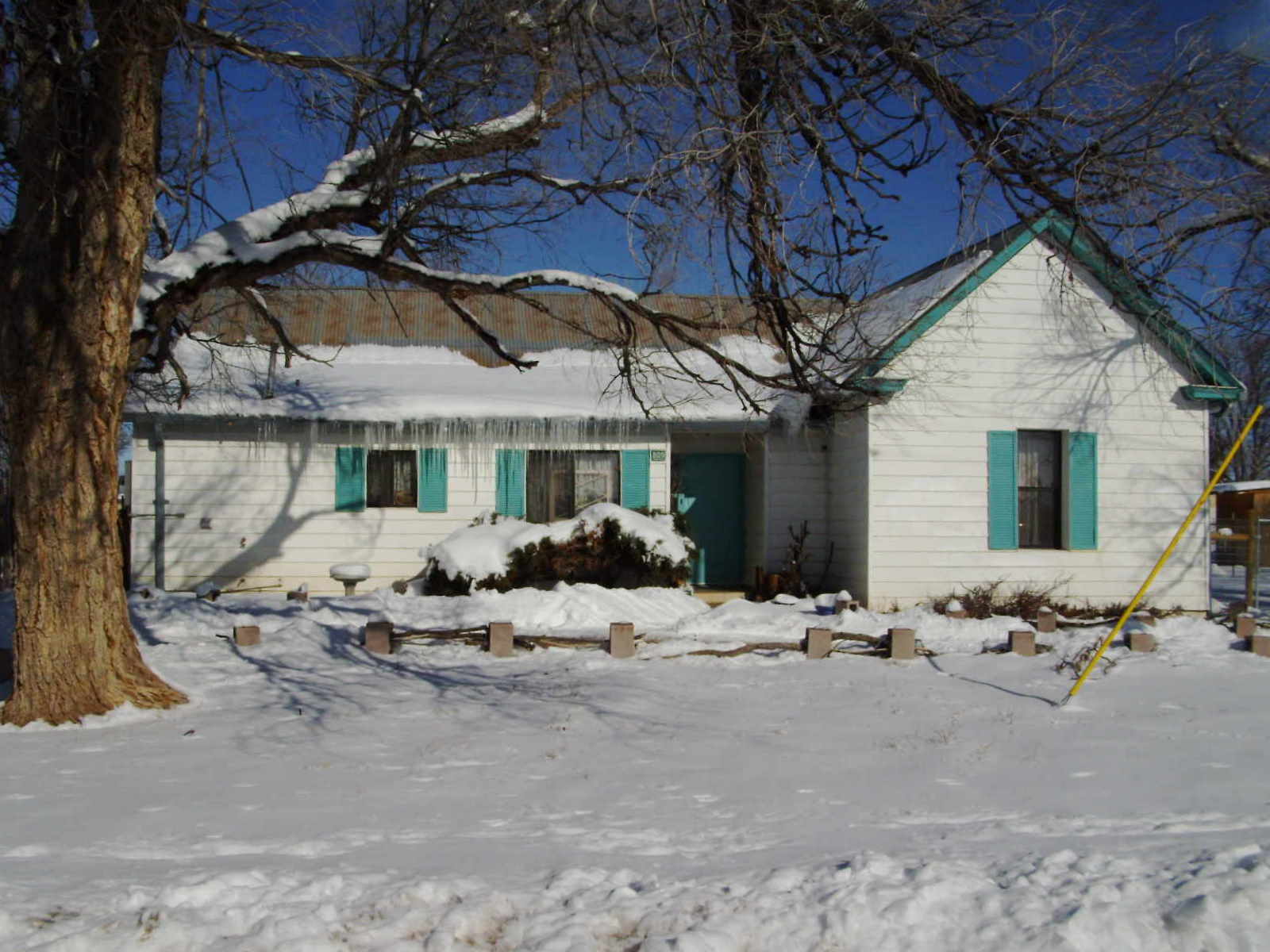 |
| Our Place in Snow |
I had filled the closet with random stuff we didn't have any other place for and left it like that until yesterday, when I took out the objects stored there and started to get it ready receive clothing (what a concept). We've been keeping our clothes in dressers and out on various improvised racks until the closets were available.
Well, there I was fussing with this and that unfinished aspect of the North Bedroom closet (once I got all the stuff out), and I made several discoveries. First, the wood floor is nicely scraped and sanded, but the sawdust was never vacuumed up, and the floor in the closet was never sealed or finished. I didn't realize that, partly because there is no light in the closet, and so its unfinished state isn't that noticeable.
I put down a hall rug that had been rolled up in the other bedroom as a temporary expedient, but I'm thinking of doing some fairly extensive renovation, and not just in that closet...
Meanwhile in a corner of the closet, I noticed that though there were wide baseboards, the wood flooring did not actually reach it. The gap was close to half an inch, and there was another vertical gap where the baseboard of one wall met the baseboard of the other wall. This was in the darkest corner of the closet, and so I had never noticed it before. It was part of the original construction of this wing, which I think was added in the 1920's or 30's, for the specific purpose of being fancy and up-to-date, with electricity and all that, and here is a corner of what had been the fanciest room where nothing actually meets at any angle, let alone a right angle.
It's very New Mexico, and it made me laugh. I stuffed the gaps with cardboard and piled up some bags of spare table cloths and curtains to seal out any likely drafts for the time being and was done it for now. No sense getting all worked up about it. Then I installed an air conditioner in the bedroom window. What with climate change and all, last year -- for the first time -- the summer heat started getting to me, and fans weren't enough to cool things down. Signs are that this summer will be even hotter.
(Aside: I'm still puzzling when electricity was first installed in this house. I've read a report prepared in 1937 when there still was no electric utility in these parts, but the report recommended that the rural electric co-op be extended this far. There are signs, however, that this place had electricity well before then. Some of the wiring appears to be very early. Much earlier than the late 1930's. So this place may have had its own generator at one time...)
When I lived in Sacramento, I knew some of the old-line Progressives, a couple of whom lived in vast old bungalows, not unlike the one Cocktailhag was renovating up at the top of this post. The size of their houses knocked me out -- they seemed to go on forever, with dozens of rooms, crooked hallways that led who knew where and flights and flights of stairs. They were dark as caves, despite all the windows. The huge rooms echoed, in part because they had so little furniture, and what they had was very uncomfortable. There were no rugs, no drapes. Instead, if a room needed something on the floor (such as in the dining room or the kitchen) it was likely to be oil cloth or linoleum; if there was anything at the windows, it was plain muslin, possibly with a stenciled border. The finish was typically worn off the oak floors, and the floors themselves creaked and squeaked wherever you walked. These people were for the most part very well off, and they could easily have afforded to live in luxury. Instead, they chose to live in Spartan, almost monastic conditions, as a very conscious lifestyle choice.
Today's Bungalow aficionados may or may not understand the consciousness that informed the early Reform Progressives who lived this Spartan lifestyle in their own (sometimes enormous) bungalows back in the day. I know some who do understand it and try to emulate it, but some of the more recent efforts at recreating the bungalow style and lifestyle as it was in the Progressive Era seem to me to be far too luxurious. The rugs are too thick and too expensive. Not that many bungalows were furnished by Stickley or Roycroft back in the day. There's too much furniture in the rooms, and often too much light. (These houses were dark, dark, dark.) The floors are too shiny, the brass too polished, the bathrooms and kitchens too deluxe. And it seems to me there's too much effort put into living the style too well, when those who actually lived it at the time didn't look at it as a style so much as they saw their way of life as a mission. I won't get into the details now, but there was nothing casual about the early Progressive Era. It was launched and practiced as a mission -- a mission to move past the tired opulence of the immediately past era and enter onto a path of righteousness and progress and equality.

New Mexico became a state in 1912, at the height of the Reform Progressive Era, and there are plenty of aspects of Reform Progressivism in its ways and means to this day, perhaps the most apparent part of it is the widespread sense of civic duty and participation. Much of it grows less out of the style of the era as it is part of the fabric of the place and its people. It's simpler, more direct, and I'd like to think it is kinder, but I'm not sure I can go that far yet. This is a harsh land for the most part; it's not that the people are harsh, by any means, but many live a hard life, and that hardness can overwhelm natural kindness. Something like the Cowboy Code.
At any rate, I often get (delightfully) distracted by houses and their origins and styles -- as well as by notions of Progressivism and the Progressive Era. The Bungalow was part of the Progressive Movement in the early part of the 20th Century, and its image will stay with Americans for a long time to come.
What seems to be missing today, however, is an appropriate ideal of Reform.
Monday, July 16, 2012
From the AntiFa Trenches, c. 1938 (contd)
 |
| Spanish Anti-fascist poster, c. 1938 |
This is likely to be the last installment of excerpts from "The Peril of Fascism" by A. B. Magil and Henry Stevens published in 1938 by International Publishers of New York.
I'm not a historian, but history fascinates me, and I have learned quite a bit from this volume. If you can find a copy of it, I highly recommend it as something of a prism through which to view -- and possibly understand -- the march of Neo-Fascism today.
Among the things I've learned from reading this book is that the same sorts of people and in some cases the descendants of the same people, the same corporations or their successors, and the same kind of financial chicanery (called "free markets" and "capitalism") are involved in today's economic catastrophe and the modern rise of fascism as were involved in the economic catastrophe and the rise of fascism in the 1920's and '30s. Today's forces are the same, but there is no ideological counter to them now while there was one then.
The final chapter of the book, written in 1938, remember, deals with the prelude to war, another world war, which at the time seemed inevitable due to the constant aggression of the Italian, German, and Japanese fascists in their openly declared march to world domination. The fact is, at the time the whole world was falling under fascist domination (except for the Soviet Union) with or without wars of aggression. Fascism was fashionable -- for one reason because it was successful, or at least it appeared to be. Much of Europe was already fascist-ruled, same with Latin America, same with large swathes of Asia. Fascism was well-established, though not completely ruling, in most of the English-speaking world as well. Yet it wasn't enough for Hitler and Mussolini and Hirohito; they would not be satisfied until they had shattered the Soviet Union, destroyed Communism and ruled the entire world either directly or through their puppets.
Surely we don't face anything like that today... or do we?
There is no Soviet Union, for one thing; and "Communist" China is perhaps the most successful and dynamic managed capitalist nation in history. What is being battled by the neo-fascists of our own time are the pitiful remnants of the social democracies in the West and rival sort-of fascists in the Muslim
East. It doesn't take a global war, nor even more than a handful of aggressive invasions for the Western Neo-Fascist forces to impose their will (if not outright conquer) on targeted nations.
Magil and Stevens argue that fascism -- as they knew it and presumably as it is currently conceived by the modern heirs to the fascist legacy -- is the natural consequence of unbridled capitalism especially when facing an existential crisis as it once again is today. Fascism is the necessary consequence, for it is the means by which otherwise rebellious peoples are to be kept in check.
Today's conditions differ in many ways from those of the 1930's, however. In those days, global war was less than a generation in the past, and part of the consequence of that war was the global financial collapse that began 10 years after the Armistice. It's been almost 70 years since the end of World War II, and it is not likely (at least in my view) that there will be another global war similar to either of the World Wars in the near -- or even distant -- future. Such rivals as there are to the rule of finance capital and neo-fascism are politically and economically weak and rather easily compelled to yield. Governments, by and large, find the fascist operating system to their liking. Iran is not a rival state, no matter the propaganda out of Jerusalem about it. China could one day become a rival, yet on the other hand, it is looking more and more like the Chinese will ultimately be the ones in charge, and China will once again be the Middle Kingdom of lore and legend. There is no need to fight China; China is showing the way forward.
None of this was even imaginable in the 1930's. So we've come a long way. Or have we?
Today's excerpt:
Those isolationists who fear lest sanctions provoke Japan to a military attack against the United States are panicky indeed. It is hardly likely that Japan, either alone or in combination with Germany and Italy, would dare challenge a coalition of the nature described. [The authors proposed that the United States, France, Britain and the Soviet Union could through their united and collective efforts essentially quarantine the fascist aggressor nations of Germany, Italy and Japan by imposing economic and other sanctions against them. This proposal was based on a speech regarding collective security and quarantining the fascist aggressor nations made by President Roosevelt in Chicago on October 5, 1937.]
The United States, the Soviet Union, Britain, and France are far stronger in men, military equipment, industry, resources, and financial reserves than the fascist alliance. Not even the megalomaniacs who rule Germany, Italy and Japan would dare to challenge the democracies if they are firm and united. The real danger of today lies in disunity of the democratic nations and in their capitulations to fascism. It is on this disunity and weakness that fascism thrives, and by piecemeal conquests may reach the point where it will be sufficiently strong to wage successful war against the strongest democratic states.
Foreign Commissar Litvinov of the Soviet Union put the matter succinctly in a speech before the League of Nations Assembly in 1936. He warned:
The aggressor who is basing all his policy on superiority in brute material force with only threatening demands, bluffs, and menaces and the tactics of the fait accomplis in the arsenal of his diplomacy is accessible only to a voice no less firm than his own, and to a cold calculation of the relative strength of forces. Any exhortations and entreaties and still more concessions to his illegal and senseless demands and economic bribes offered to him merely produce on him an impression of weakness, confirming his consciousness of his own power and encourage him to further intransigence and illegalities.
Yet the aggregate power of the peace-loving countries, both in the economic and in the military sense, their total resources in manpower and in the war industries, considerably surpass the strength of any possible combination of countries which the aggressor might rally around him. I am deeply convinced that it would be sufficient for these forces in some way to combine, to display merely the possibility of joint action, for the peril of war to be averted and for the aggressor to be obliged to ask, sooner or later, to be admitted himself to the common system of collective security.
The alternative to collective security is continued chaos and ever more destructive wars. No nation is safe from the fascist firebrands; no one is certain where the war-mad dictatorships will next strike. Hitler seeks to lure his starving people into a crusade against the Soviet Union by promising them that Germany "will swim in prosperity" if he can seize the Urals and the Ukraine; but at the same time Hitler attacks Spain and builds up his military and propaganda machines for possible action against Czechoslovakia, France, and even Britain. Japan threatens to strike northward against the Soviet Union and then swiftly moves into the Yangtse valley, where British and American holdings are concentrated. The fascist threat is in all directions; everywhere where there is territory to be conquered, booty seized and people to be enslaved. And in this lies the logic of collective security, of common action against a common danger.
The obstacles to such a change v[from traditional American isolationism] are great, but by no means insuperable. Open fascists like Hearst and Coughlin, Trotskyist allies of fascism who conceal their reactionary program under pseudo-left jargon, blind and vociferous pacifists of the isolationist school are actively at work perpetuating the illusion that the United States is unaffected by the fascist offensive. But there are signs that increasing numbers of Americans are becoming aware of the reactionary character of "neutrality" and turning towards collective security as a means of strengthening American peace and democracy.
...
The Crisis of American Democracy
American democracy is threatened in as real and as compelling a sense as was German democracy in 1930-32. Whether the United States will succumb, as did Germany, to the black legions of fascism or move ahead toward a broader democracy is the question at stake. The one certain thing is that it cannot stand still. In the life-and-death struggle between the forces of democracy and fascism, the one or the other must advance. Secretary Ickes indicated the issue in his radio address of December 30, 1937:
Underneath the unchanging words of the Constitution, underneath the unchanging appearance of our public institutions, there is happening here, as truly as in Europe and Asia, a struggle for power, for the control of lives, labor and possessions of whole peoples -- a struggle between the many and the few, a struggle between those who would live and let live and those who want the thrill of the power of ruling others.
Here in America it is the old struggle between the power of money and the power of the democratic instinct. In the last few months this irreconcilable conflict, long growing in our history, has come into the open as never before, has taken on a form and an intensity which makes it clear that it must be fought through to a finish -- until plutocracy or democracy -- until America's 60 families or America's 120,000,000 people win.
This is the nature of the American crisis. It is a crisis which permits of no neutrality, and which increasingly divides the American people into two huge warring camps, progressive and reactionary.
The 1936 elections marked the first large-scale battle between the gathering hosts of progress and reaction. Since then, the struggle has grown in scope and intensity.
For a brief moment after the 1936 elections there was a lull in the struggle. Reactionary organizations momentarily withheld their savage attacks against the Roosevelt administration and suggested that the wounds of the election battle be healed and an "era of good feeling" inaugurated -- suggestions based on the hope that Roosevelt, having won re-election, would abandon his reform policies and veer sharply to the right.
... If reaction is victorious it will move along the fascist path already indicated by the pronunciamentos of the employers' associations and in the writings of big business spokesmen like Walter Lippmann and Dorothy Thompson, who learnedly prove by the inverted logic of reaction that "majority rule" means tyranny and that true liberty lies in the unrestricted right of the monopolists to exploit and plunder as they please. It will annul the right of collective bargaining, slash unemployment and farm relief, reduce wages and living standards, and extend on a national scale the system of corporate overlordship which it long exercised in the company towns. It will further whittle down the scope of democracy until nothing remains but the open terrorist dictatorship of big business. [My emphasis.]
Already the army of incipient fascism has attained enormous proportions.
At its head of course are the economic royalists, the small handful of financial oligarchs who control the means of production upon which depends the livelihood of the American people. Statistics of the Bureau of Internal Revenue reveal that in 1935 less than five percent of the corporations owned 87 percent of all corporate assets in the United States; and this group of giant corporations was controlled in turn by a small clique of financiers. As President Roosevelt clearly recognized in his monopoly message to Congress on April 29, 1938, the monopolists and the oligarchs of finance, maintaining a stranglehold on the American economy, constitute the source of the fascist danger. They have used their vast powers to build up black legions of reaction which penetrate deeply into every sphere of American life.
... The progressive movement, although still largely inchoate and unformed, has been described with considerable reason by Thomas Woodlock of the Wall Street Journal and other discerning reactionaries as an embryonic People's Front movement. The nature of this trend has not been widely understood, however, because it assumes forms completely different from those of the People's Front movements in Europe. These distinct political forms are determined by the peculiarities of party politics in the United States, by the weight of American tradition, and by the size and complexity of the country.
...Here we have no large workers and farmers or other middle-class parties. The Republican and Democratic Parties, both equally dominated in the post-war years by big capital, and both embracing within their ranks the vast majority of the oppressed and exploited, have hitherto practically monopolized American politics. The growing democratic movement cannot, therefore, assume the form of a clear-cut alliance of class parties, but instead develops in the complex form of progressive movements within the old parties and to a lesser degree, in the form or regional independent labor, farmer-labor and progressive parties. A national farmer-labor party, representing an alliance of all progressive strata, appears to be the most likely American form of the People's Front. But this stage of development has not yet been reached. At the moment, the democratic movement consists of scattered progressive groups and tendencies, developing toward greater cohesion and unity. It represents the embryo of a People's Front, but is not yet the People's Front. The coalescence of the scattered progressive groups and currents is, therefore, better described by the term democratic front.
And there we'll leave it for now, because, to all appearances, "progressives" are still scattered, inchoate, and "embryonic."
Isn't that something....
Tuesday, September 13, 2011
Richard Klein Explains It All For You

Why Progressives Fail
Those active for social reform have to forget about the electoral cycle. They have to forget about what the lunatic Right is doing as much as possible and concentrate on what they themselves are in process of accomplishing. They need a compact reform agenda (yes, bullet points and not more than ten of them). They need a defined activist strategy, no matter how large the difficulties or time horizon appear. They need to build genuinely activist organizations with specific plans to achieve a core set of goals. And they have to reclaim militancy as a word, and deed, of pride. If they do those things, they will make real progress, and moreover they will be ready when the moment comes for breakthrough amongst the wider society.
There you have it. That's it in a nutshell, but please read the whole thing. I don't agree with everything Klein has to say, but on the whole, he has defined and clarified the basic problem of "progressives" -- especially on the internet -- and in the section above he provides exactly the necessary remedy (which I conveniently paraphrase):
Focus less on electoral politics (and the media maelstrom surrounding it) and more on what one is trying to accomplish. Focus less on maintaining the status quo and more on developing and working toward a vision for the future.
It's simple, it's direct. And unfortunately, it's as distant from 'progressives' today as it has been for ages.
We know what to do. Why don't we do it?
October can't come soon enough.
Thursday, September 1, 2011
Redefining... Everything

It's become clear that the Obama Administration intends to play the redefinition game to the hilt. They have long been asserting that their favored conservative Hooverite economic policies are somehow "progressive," just like their social policies.
It is "progressive" in their world to accommodate their political foes and to denounce and denigrate their political allies. It is "progressive" to maintain historically high unemployment rates month after month, year after year. It is "progressive" to continue the wars abroad, to maintain the National Security State apparatus at home, and to call for the kind of tax reform that increases the tax burden on the overburdened working and middle classes while lightening the tax paying obligations of the Highest of the Mighty.
"Progressive" in their view is Left Neo-Liberalism. "Progressive" in their view is Post-Modern language manipulation. "Progressive" in their view is whatever will please the Owners and Sponsors.
"Progressive" is conceding without a struggle.
"Progressive" is whatever you believe it to be.
"Progressive" is not the Other.
I used to make quite an issue about the need for the Rectification of Names -- because words and concepts, the most basic tools of understanding -- were being constantly redefined to suit some powerful interest or other, to the point that only an adept could figure out what a word or concept meant any more. The need for Rectification is based on the Analects:
Tsze-lu said, "The ruler of Wei has been waiting for you, in order with you to administer the government. What will you consider the first thing to be done?"
The Master replied, "What is necessary is to rectify names."
"So! indeed!" said Tsze-lu. "You are wide of the mark! Why must there be such rectification?"
The Master said, "How uncultivated you are, Yu! A superior man, in regard to what he does not know, shows a cautious reserve.
If names be not correct, language is not in accordance with the truth of things.
If language be not in accordance with the truth of things, affairs cannot be carried on to success.
When affairs cannot be carried on to success, proprieties and music do not flourish.
When proprieties and music do not flourish, punishments will not be properly awarded.
When punishments are not properly awarded, the people do not know how to move hand or foot.
Therefore a superior man considers it necessary that the names he uses may be spoken appropriately, and also that what he speaks may be carried out appropriately. What the superior man requires is just that in his words there may be nothing incorrect."
(Analects XIII, 3, tr. Legge)
When basic words and concepts mean different things to different people, depending on their class primarily, then Rectification is a necessity. But that can only come after the Revolution comes.
Akhenaten was one of the earliest absolute rulers who faced the necessity to rectify the names of things (in the broadest sense) after his Palace Revolution; and yet as soon as he was gone, there was a counter-revolution and a re-rectification that took meanings back almost to where they had been... but not quite.
We see the phenomenon over and over again, whenever an idealist revolutionary movement runs into the brick wall of reality. If the movement is inchoate, as most revolutionary movements are by their very nature, a counter revolution will arise, and yet even if successful, it cannot entirely undo the works of the Revolution itself. No, it carries on with many of the Revolutionary elements intact.
From my perspective at more than 6,000 ft elevation (You think that has no effect on someone acclimated to sea level? Think again) we are getting closer and closer to the counter-revolution. But against what?
The Bourbon Restoration (as an example) did not restore the Ancien Régime. By that point, nothing could ever do that.
And so it will be should there ever be a backward looking counter-revolution in this country.
I would just make note of the fact that in RT's retelling of the events of 1993 in Moscow, when the Yeltsinite Neo-Liberal faction sent tanks to fire on the elected parliament of Russia -- the Soviet Union having dissolved in 1991 -- the Congress of People's Deputies that was being fired on was called "conservative," even though most of the elected members were Socialists and Communists. The Left, in other words, became the "Conservative" party largely because they were stridently opposed to economic "reforms" that would harm the People.
Meanings of words and concepts were reversed by the counter-revolution.
We do indeed live in interesting times. Come to think of it, when haven't we?
Friday, August 26, 2011
Update: Still in Limbo, the CDP and the CDPPC

More sleuthing around has produced some interesting though not conclusive information regarding the flap in the California Democratic Party over their uppity Progressive Caucus and the resolution to explore primarying Obama.
I'm not necessarily a quick study about these things -- I chose to step back, way back, from party politics after Howard Dean was elected chair of the Democratic National Committee -- but I do try to study enough to keep up appearances.
I learned some things just the other day, and some today as well, regarding the Players in this psycho-drama. Such as the fact that David Atkins is not just sub-chair of the Ventura County Democratic Central Committee -- which everyone knows -- but he is also a member of the Progressive Caucus of the California Democratic Party, AND he is a member of the executive board of said Party and he has therefore been involved in this brou-ha-hah from the get go. And he doesn't want to talk about it and he doesn't want anybody else to talk about it, either. Rather, he claims that the resolution passed by the CDPPC was "stupid," there's no point in even mentioning primarying Obama, and he believes the Progressive Caucus will be recertified by the executive board in November, despite their stupidity.
This comes from an exchange he had with Seneca Doane over at dKos on Monday. I read SD's lengthy post about the matter, but I didn't look at the comments, so I missed the exchange until recently.
It went something like this:
Seneca: Feel free to take issue with me as strongly as you'd like; that's politics. But don't even try to silence me; I can write this sort of diary as many times as I think I need to. Dissent will be heard. Some of you may not get it, but victory depends on it.
Spoon:the prog caucus will almost certainly
be recertified. Tabling the recertification prevented a floor fight at this latest e-board meeting until cooler heads could prevail.
Spoon:you have to understand--this was a room
of 200 people when this came up. The leader of the African-American Caucus--who happens to have run for state senate in a district that is partly in my county where I'm 1st vice chair and state e-board rep--made a motion to decertify. Given the sentiments in the room, that motion might just have passed.
I'm a member of the Progressive Caucus, though I wasn't present for the vote on the resolution in question.
But keep in mind that a big portion of the base, especially the African-American base, has great love for the President and takes strong offense at these kinds of maneuvers.
By tabling the motion, CA dem leaders probably saved the caucus from decertification until peace could be made.
Seneca: What consequences has the leader of that caucus
(whom I've taken pains not to identify, but let's presume you're right) faced for that action? (Let's not count whatever I've stirred up with this diary out in cyberspace.) So far as I know: none. The attempt to chill speech has, so far, worked.
Whatever the sentiment in that room, the responsibility of the voting members of the E-Board was to stand up to them, right then, right there. I understand why party leaders negotiated a delay in the vote. But let's not pretend that that was primarily to the benefit of the Progressive Caucus; it was to the benefit of the Party. Karen Bernal should be thanked by the Party for accepting some humiliation on the part of the Progressive Caucus to save the Party from doing something extremely foolish. Frankly, in her place, I might well have taken the decertification and the headlines, because what happened was outrageous.
Had the E-Board gone ahead and decertified under pressure, they would have had to spend the subsequent three months cleaning egg off of their face -- rather than this diary being the first that most people here had heard about it -- and the Progressive Caucus would have been recertified in November anyway.
With great and deserved respect to the African-American base of the party, they are simply not entitled to shout down a primary challenge, period.
Seneca: As I state in the diary, I am not in the [Progressive] Caucus
and I didn't discuss this diary with anyone representing it.
To me, the damage is done. It's not about the Progressive Caucus gaining recertification, it's about E-Board members not realizing that they should not have allowed this shot along the Caucus's bow to be so successful to begin with.
I've spoken to small groups about my own take on "how to primary Obama in the least damaging way possible," as well as posting here, but it's not an idea that belongs to any organization at this point. I will continue to push it though, largely because if we don't have this sort of challenge I think we'll see a worse one.
Spoon: if the motion had gone to the floor it
might have passed. and if it hadn't passed, you'd have almost half the e-board going home furious.
Tabling was the right thing to do.
Seneca: And half the E-Board going home furious
at being stymied in their effort to suppress any hint of dissent is a bad thing why?
Spoon: because it would be an official
sign of disrespect to the Democratic President and the first african-american president. it's important not to get too caught up in the obama wars and take a broader perspective sometimes.
Seneca: So tell me this:
Would someone actually running against Obama in 2012 be -- or let's say "have been" -- a "sign of disrespect to the Democratic President"? Is his being African-American the thing that protects him from facing the sort of challenge that Johnson and Humphrey did, or Carter? What's the reasoning here?
Tell me further: if some serious candidate had run against Obama, would it be the responsibility of the CDP E-Board, out of "respect to the Democratic President and the first African-American President," to do what it could to hamper such a challenge? What is your current position on intra-party dissent?
If you'd prefer to take this discussion to e-mail -- and I would, were I you -- you know how to reach me.
Spoon: i'm am e-board member and prog caucus
member. i was there. you can just ask me.
Just Bob: Have you put up a diary?
Or would you rather elaborate here?
Spoon: no, i really don't want to give it
more attention. the prog caucus shouldn't have made the resolution. a primary challenge is a dumb idea, always has been.
they should have known a move to decertify would follow.
when it did, the cdp e-board did the right thing to have everyone chill out rather than risk a close vote that would likely have decertified the caucus. the votes were there to do it.
Nada Lemming: Well it HAS more attention now.
And I find it refreshing that you admit you stand on the side of blind allegiance to power. Well played, sir.
"Blind cheerleading of the president will create jobs and get him to stop droning on and on about deficits no one cares about to the point that his numbers have tanked among independents?" -kos
Just Bob: Thank you for your reply, but
I can't say I'm not disappointed in your position and the Democrat Party of California.
One of the few remaining reasons I'm still a Democrat is that Florida has closed primaries and I want to vote for a progressive Democratic candidate.
Seneca: I didn't know that you were E-Board
I thought that your brother was. Please do weigh in further if you wish.
Spoon: i was elected as the male ventura rep
several months ago.
This is admittedly a somewhat truncated exchange and it may be difficult to follow, but you can read the whole thing at the link. What we find here is interesting. Seneca Doane, who is a CDP Central Committee member but not a member of the Progressive Caucus, nor a member of the executive board, takes issue with the decision of the executive board to table the issue of whether to renew the certification of the Progressive Caucus. Spoon, who is a member of both the Progressive Caucus and the executive board (something Seneca didn't know, neither did I) agrees with the suspension of action on decertification until "cooler heads" prevail.
Meanwhile Karen Bernal is continuing to give interviews about this, and more and more people are expressing just how fed up they are with the continuing Hooverite policies of the White House -- not to mention the continuation of the Bush foreign and domestic "security" policies -- and nobody is planning to shut up about it. Even though it appears that Spoon and/or Digby have no intention of writing about it at Hullabaloo, and have been using their ban-hammers to ensure that there is no mention of it in comments. (Along with all the other unmentionables...)
Meanwhile, Karen Bernal was interviewed by the Black Agenda Report, and I'm posting a link to the whole radio broadcast because there is mention of the confrontation between Maxine Waters and a loud and very very unhappy-with-Obama largely black audience, and Karen points out in her interview that the African-American Caucus objection to the Progressive Caucus recertification was not all it's been cracked up to be, and that the DNC has had something to do with what's going on.
Black Agenda Radio on the Progressive Radio Network, with Glen Ford and Nellie Bailey – Week of August 22, 2011
This may all seem like Inside Baseball internal Democratic Party squabbling, but I think it is really important for the future of the Party and for the country.
Realistically, Obama is in the political fight of his life. His approval is tanking, and more and more Progressive Dems (regardless of color) are speaking up and speaking out about how barely distinguishable he is from a Republican in the White House, and how they are fed up with being dissed and kicked around by the White House and the DNC. While I don't really think the California Democratic Party is going to split over this matter, it's a matter of consciousness raising and standing up for yourself and your values in the face of what appear to be anti-democratic forces in the Party itself, led by Team Obama.
What do you do under those circumstances? If you are a stalwart Dem (called a Yellow Dog) you've either got to continue fighting from within -- and making a stink about it -- or give up and go somewhere else.
Karen and the Progressive Caucus are fighting from within, where supposedly Progressives need to be if they are to take over the Party and win. I've argued that Progressives not only took over the Party and won, they revived it from the dead, and the thanks they got was a kick in the nuts and a boot out the door.
Seneca seems to understand at least the outlines of that story -- and certainly sees it happening in the case of the Progressive Caucus certification struggle; regardless of whether they are eventually recertified, they have been told in no uncertain way that they are not appreciated. There will be blowback.
But David acts like he either has no idea of any of this, or if he does have an idea about it, he doesn't want to talk about it and he doesn't want anybody else to either. It is not a matter for public scrutiny.
I think it is. Enough is enough. Of course given my current immersion in the Russian Revolutionary period, I may be a bit biased!
[PS: unlike some of the players in this psycho drama, I have been in touch with Karen Bernal regarding this issue.]
Saturday, August 20, 2011
"Faux-gressives"

Defining terms is a nice thing to do when utilizing labels as shorthand for points of view, philosophies, ideologies, and the ways and means of getting things done.
The term "progressive" has been bandied about kind of willy-nilly -- and more and more incoherently -- on the internet as both a term of endearment as a denunciation as well as a means of identifying like-minded travelers on the pathways of life. It's used as a dreaded "tribal" marker.
Years ago, I started a series of essays on the Progressive Movement fully intending to get from its origin in the Republican Party to its present day locus largely within the Democratic Party as an answer to a former brand of Republican Conservatism, but I had to stop about midway because I really couldn't get from there to here. What passes for "progressive" today doesn't have much to do with any political philosophy or ideology, nor is it an operating system for government, nor does it have much to do with progress in a general or abstract sense.
Progressives and Progressivism are still around, of course, but many of those who claim to be "progressive" on the internet either know nothing about what Progressivism is or has been in this country, or they don't care, because they are now declaring themselves to be the "progressives" and whatever their particular desire might be is what "progressive" is.
Most of these people, as I've said many times, are some variety of Libertarian, which is not even remotely a Progressive political philosophy. Libertarians who try to mask their political interest and point of view by claiming rights to some other philosophy or point of view, such as those who claim to be liberals or progressives are what I call "faux-gressives."
False "progressives", in other words. They are trying to con liberals and progressives into buying their Libertarian snake-oil, and when they are exposed -- as they often are -- they screech and scream like naughty children who have been caught pulling the wings off flies.
But now I'm seeing the term "fauxgressive" used to describe any Democrat (who claims to be "progressive") who disagrees with the White House. Thus, in a form of ju-jitsu, the White House is trying to re-claim "progressive" for itself and its policies and deny it to all the others who claim to be "progressive," even the genuine ones.
In my view, the Democratic Party has long been the Conservative Party in the United States, not a Progressive Party or a Liberal Party. It is Conservative because it is primarily concerned with maintaining the status quo and with stability. The Republican Party is both Rightist and Radical, primarily concerned with forcing a very reluctant nation into a kind of twisted up modern version of a highly predatory past of depredation, exploitation, imperialism, and constant war -- in other words, instability and overthrow of the status quo -- whatever it may be, it doesn't matter, because the Republican Party has become akin to an Institutional Revolutionary Party constantly seeking to overthrow or overturn just about anything the Institutional Stability Party values.
Internet "progressives" find themselves left out of this uber-contest that goes on constantly way above us. With the White House claiming the "progressive" mantle, thus in effect denying it to others, the term seems to have little meaning at all.
A case could be made, I suppose, that the White House and its operatives and fans are re-claiming more of the original meaning of Progressive, which was a highly process oriented yet authoritarian way of doing things. It was highly organized and directed, too, and I don't see that from the White House at all. They seem to have no real direction of their own. They appear to be the pawns of other interests... the dreaded corporate sector.
Who are the Real Progressives? From my point of view, they are mostly the government drones and institutional operatives who do the real scut work to keep the system going at all. There are seemingly fewer and fewer of them all the time, inside the belly of the beast, if you will. They have largely been replaced by... well, con artists, whose primary belief system is based on falsifying facts to market fraud. They are everywhere in government, its bureaucracy and in institutions today, and they are simply overwhelming remaining Progressives inside the system.
Real Progressivism is a way of doing things, an approach, intended to yield positive material and social results -- ie: "progress", which over time is supposed to improve the lives of everyone. It is a way that relies on extensive regulation and control with an almost Puritan rejection of uncontrolled impulse. It is a way that relies heavily on the advice and often the rule of experts, on research, and on experiment.
It was at one time imperialist and racist to the core. (And that's part of how it has become conflated in the minds of some Rightists with Fascism and Nazi-ism.)
Eugenics and Social Darwinism were at one time accepted "Progressive" scientific points of view.
That's the Progressivism I grew up with and my parents came of age believing in. It was not necessarily socially "pretty," but it was a highly successful means of material progress for the many. It's hard to overestimate the material progress made during the 20th Century under Progressive leadership and ideals. But at the same time, there was a tremendous amount of destruction at home and abroad, some of which was corrected (such as through the agencies of soil conservation and pollution controls) and some of which ended in cataclysm (WWI. WWII. The various other wars of the era, etc.)
Those outside the White House who claim the Progressive mantle today seem to want specific items on a fairly extensive menu of Things That Ought To Be, but in many cases their desires and their heroes look kind of whack from a distance. WikiLeaks style doc dumps and Bradley Manning style security breeches do not a stable governmental operation make. Someone like Russ Feingold, who speechifies real pretty but doesn't actually do anything for better or worse hardly seems like the kind of hero to follow. Ron Paul should not even be remotely considered in a Progressive pantheon. Please.
Real Progressivism is neither "left" nor "right" on the political measuring rod. It was at one time considered strictly non-partisan though its advocacy started within the Republican Party and only shifted over to the Democratic Party during the FDR period (and many old line Progressives stayed with the Republicans up to the era of Reagan.)
I tend to be far more "leftist" in my point of view than most Progressives these days, or historically for that matter. So it is with many who claim a "progressive" tribal affiliation, but many more who do so have no "leftist" sentiment or cred at all. To confuse actual Progressivism with "Leftism" is a fundamental category fault in my view. Progressivism is an operating system, a way of doing things, not a political ideology.
But as the political sector deteriorates and reconceives itself to serve the New American Imperial State, concepts of "left" and "right" have almost as little relevance as accurate descriptions and definitions. Post-modernism rules.
It is what you think it is.
Some recent uses of "fauxgressive:" [Courtesy of Teh Google Machine]
And so on...
Wednesday, August 17, 2011
BLOGSWARM!!!!!®

Here we go.
Jeebus.
Jane got her panties all in a wad because of an email that got sent out from the New Mexico OFA operation that linked to a blogpost at The People's View that got posted at Huffpost that called out some critics of the Debt Crisis Crisis Deal such as Paul Krugman and the "Firebaggers" and oh my has the shit been twisted and turned and hurled with furious abandon.
BLOGSWARM!!!!®
Of course damn few of those swarming have read the offending post in question, fewer still must have received the email from Ray Sandoval at New Mexico OFA HQ. Nor, I'm sure, have more than a few Swarmers read the follow up post at The People's View titled:
Too Bad for Huffington Post, but the "Dumbest Motherfuckers in the World" are Fighting Back
in which the author, Deaniac83 (who I seem to recall from times gone by, but who knows) doubles down and waxes quite wroth his ownself:
But Terkel did get something right. I mean, you know, credit where credit is due. She patiently explains to her readers - who I suppose she assumes are even more political novices than Krugman - what the term firebagger could possibly mean."Firebagger" is most likely a combined reference to the liberal blog FireDogLake, founded by Jane Hamsher, and "Tea Bagger," a less-than-flattering term for Tea Party activists.Almost right. So close. Except FireDogLake is not a liberal blog. It's a Pseudo-Left-Libertarian extremist ideologue blog. But other than that, on the money. Why, yes, Sherlock, Firebagger is a term that combines FDL's hair-on-fire ridiculousness with Teabaggers (for example, opposing things just because President Obama supports them) - whom the FDL rah-rah types act like, only from the Left. It's a characterization that fits them perfectly - they are more interested in tearing things down than building a country up, more interested in ideological podium-pounding than pragmatic solutions. The bagger (both tea and fire) mentality is the reason our politics is in a rut. If one side was busy spreading hatred and propaganda to increase wingnut turnout, the other (firebaggers) side was busy spreading hatred and propaganda to subdue Democratic turnout. Oh, also, as John Cole points out, it's a name the Firebaggers gave themselves.
As if that weren't enough, he goes on to hurl his own incendiary brand of blog-insult by asserting:
Speaking of Firebaggers, her Majesty the Highness of FDL, Jane Hamsher, picked up on Terkel's article and went nuts with it. You know, the usual.
By the way, Ms. Terkel, you seem very upset about the OFA state director in New Mexico sending out an email pointing out the political and policy merits of the debt ceiling deal, an article that also calls out the firebaggers, but for some reason I cannot find our outrage article about Jane Hamsher - the Firebagger in Chief - calling Obama supporters the "dumbest motherfuckers in the world." Am I missing something or is your reporting just not objective?
Ou. Nasty. Meanwhile, the there's this throw-down to complete the sequence:
Let me send a message to Huffington Post, FDL, and all the ideologue havens in the Firebagger Lefty Blogosphere (that's right, I said it again): You have been propagating your anti-progressive, pro-dysfunction political message without accountability for too long. In President Obama's words, Enough! Count on us in the pragmatic progressive blogosphere to stand up and fight back. You do not represent progressivism or liberalism, and we are done letting you hijack it. You wanted a fight, didn't you? Well, you got one.
Eek. Scary.
All the supposedly lefty blogs have exploded in OUTRAGE!!!!!™ at this blogospheric INSULT!!!!™ from the OFA. They have DEMANDED!!!!!™ the immediate termination of Ray Sandoval, and the abject groveling and submissive apology to all the "Firebaggers" and their ilk who were DISSED!!!!™ by this no-account OFA apparatchik in fucking New Mexico, for chrissake. Doesn't he know who he is messing with?
God. The chins are pushed out, and RAGE!!!!!™ has gripped the entire Left-o-sphere. Everyone -- just everyone -- is posting on it, and at dKos (where Jane is not popular at all) there are at least four or five posts right now stirring the pot and intensifying inchoate rage at OFA, Obama, Ray Sandoval, and anyone who dares to support Obama (May you DIAF!!!!™) and defending Blog-Daughter Jane (misguided though she may be) -- and practically everything else on the face of the earth, such as the California Democratic Party's efforts to purge its Progressive Caucus for getting uppity, is being ignored.
I've posted on the Blogswarm phenom before, and I don't like it. Blogswarms tend to be ugly, vicious, and largely useless exercises in group affinity and mindless loyalty. Compared to the "tribalism" that many of the swarmers typically denounce -- as they are expressing their mindless loyalty to an individual or a blog that has been WRONGED!!!!™ -- swarmers are demonstrating the exact behavior they are so eager to denounce and condemn in others. The glaring hypocrisy of it all of course never, ever enters the consciousness of the swarmers until after their RAGE!!!!!™ is spent, and even then, the idea that they might have behaved inappropriately (heh) is often set aside in order to press some other demand elsewhere.
Oddly enough, it is from behavior like this that many on the "left" are considered to be tantrum throwing children who can be safely ignored. But I would venture to say that very few of those who participate in Blogswarms are leftists by any rational definition of the term.
They are, for the most part, "Internet Leftists and/or Progressives" -- which all too often means some variety of Libertarian.
And I note with interest that Deaniac83 calls out Jane and others for being exactly that.
On the other hand, I've made quite a stink over the California Democratic Party's apparent decision to purge the Progressive Caucus from its midst, and I do it in part because I know Karen Bernal, Chair of the Caucus quite well (though I haven't been in contact with her directly over this issue) and I know she is a genuine Progressive, not some variety of Libertarian trying to pass as "Progressive". She is deeply involved in labor and social justice issues, civil liberties, healthcare for all, gender equality, immigration reform, peace activism and on and on, as she has always been as long as I have known her. None of these issues are casual interests to her, not has she developed an interest recently. This is who she is. Her speeches have electrified the Party at their State Conventions, and she has built a very strong Progressive activist base within the Party that has successfully recruited and elected Progressive candidates and has pressed inclusion of Progressive agenda items in the California Democratic Party Platform.
And the Big Wigs apparently want to get rid of her and disband the Progressive Caucus (again, apparently) because they resolved to explore supporting a primary challenge to Obama -- for cause.
To me, this is a far more important and pressing issue than insults and dissing of "Firebaggers" from a blogger.
Priorities, people!

Sigh....
----------------------------------
My my my. All of a sudden, literally within an hour or so of Deaniac83's throw down challenge, the Swarm stopped.
This is a good thing in my humble estimation as there are far more important things to concern oneself about than the perceived insults to whomever on the internet.
Really.
Subscribe to:
Posts (Atom)