Showing posts with label Sacramento. Show all posts

Thursday, June 7, 2018

On Returning to Sacramento for the First Time in Almost Six Years

What an adventure.

Strange as could be, though.

Both Ms. Ché and I have deep roots in Sacramento -- she was born there, I became a resident when I  was 10 or 11.

After being away for so long, though, much was still familiar, some was not. And one thing we both said was "this is not 'home'". And it isn't. It's a very important place in our lives, but it's not "home."

Sitting outside  of Gunther's having ice cream on an extraordinarily beautiful day
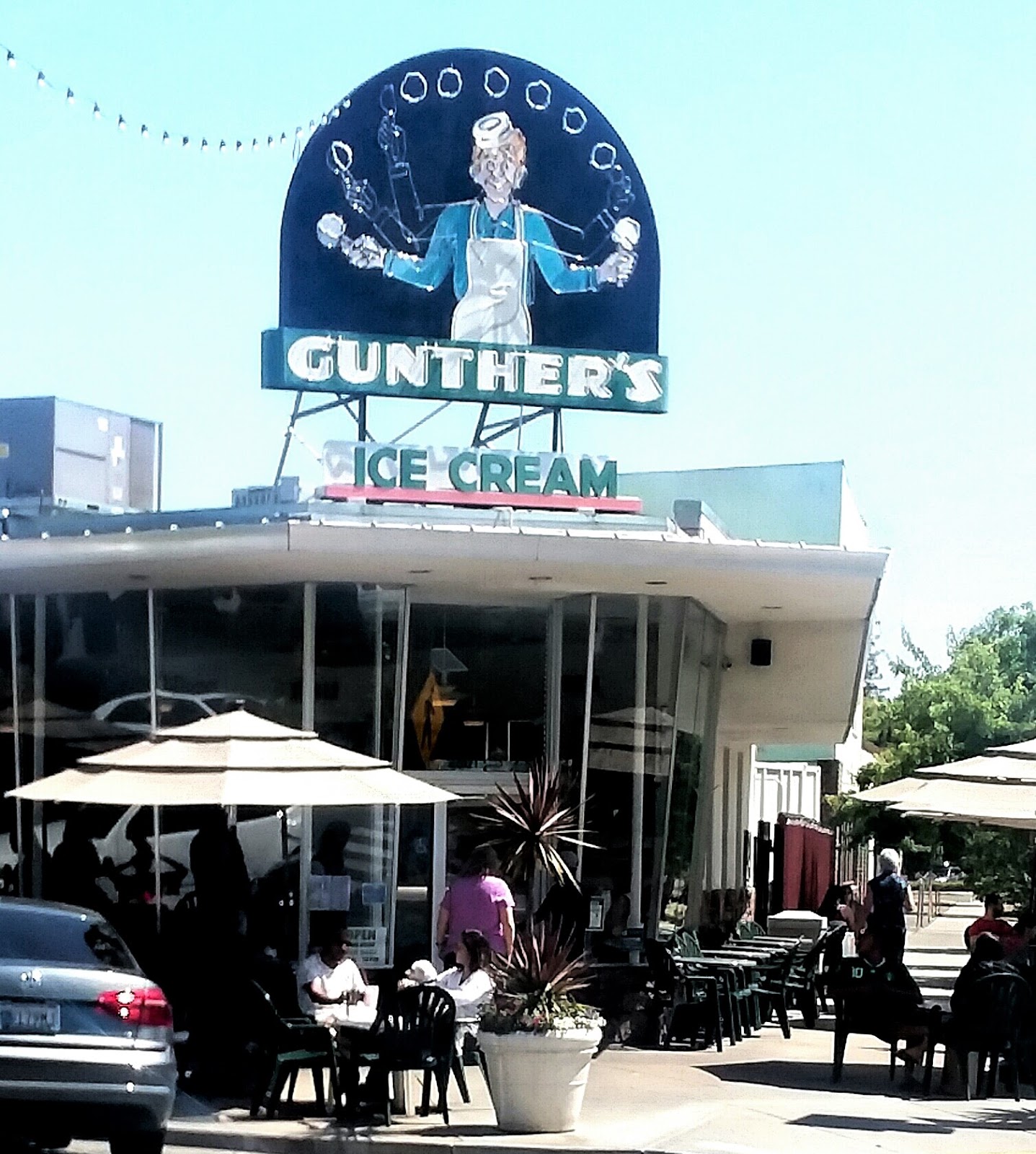


we thought that if we did live there, we'd have compensations.

Gunther's is an iconic neighborhood ice cream place that's been in Curtis Park for decades and decades. It's always been popular, but it seems to have become a fashion destination for the whole city in recent times.

We lived a few blocks south in this house


Small by today's standards, it was considered more than adequate when it was built in 1940. Two bedrooms, one bath, a living room with fireplace, dining room, kitchen, laundry room and hall, that was it. There is a porch behind the overgrown shrubs in front, and a two car detached garage at the rear of the lot. We lived there for over twenty years, and truthfully it was a very warm and welcoming home for us at the time. When we checked it out this time, it hadn't changed much since we moved. It looks like there have been a few interior renovations (kitchen at least) and central air conditioning has been added, but that's about it.

Across the street, this place still commanded the block.


I'm sure it's not the biggest house in the neighborhood, but it's close to it. Dorothy lived there as a widow with her two standard poodles until she died in the mid '90s. There was a big sale of her things and then the house was sold to a doctor and his boyfriend (I think they got married as soon as same sex marriage was legalized in California.) It's a beautiful house, no doubt about it, and like most of the others in the neighborhood, it's been largely preserved intact through the years. Occasional redecoration and infrequent kitchen and bath renovation are about all that happens to most of these places.

Nearby, one of Ms. Ché's work colleagues lived here:


This house had quite a history.  One day in the late '90's the housekeeper found the owner shot dead in a pool of blood in front of the fireplace. A few things of value had been taken from the house. At first it was assumed that a burglar had broken into the house and killed the owner before absconding with whatever it was that was stolen. 

However, soon enough, suspicion fell on the 16 year old boy the owner had taken in some weeks prior. Exactly what was going on with the two has never been entirely clear, but the boy was found in possession of some of the man's things at his grandmother's house not far away, and shortly he confessed to the murder, saying he had killed the man because he was being molested by him. Whether it was true or not could not be determined, but if I recall correctly, the boy was not tried as an adult and I believe was released from juvenile custody when he was 21. 

This is where my sister lived from 1956 to (about) 1963.

It was built by her then-husband's grandparents in 1924 from plans they apparently got from House Beautiful magazine. I know of at least two other examples built from this house  plan, one in upstate New York (I believe in Scarsdale) and one in Connecticut (Greenwich?). 

Until about 1961, my sister's then-husband's widowed grandmother lived in the house with my sister and her then two children. Though the house is large, it was becoming cramped and crowded what with all the children and their things as well as three adults, two of whom needed special care. My sister's then-husband was legally blind and his grandmother was in deteriorating health. 

Eventually, Grannyma went to live with her daughter in the Bay Area. As it happened, she outlived her daughter and died in a care home. The house (and another one she owned at Lake Tahoe) was put up for sale, and as I recall the Sacramento house was purchased by a doctor whose fancy house a few blocks away had become somewhat notorious for his over the top French decorating scheme. 


The houses are somewhat similar, though I believe the one above was built in 1928 or 29 and is actually smaller than the one he purchased from Grannyma's estate.

The house where my sister and her then husband and children lived with Grannyma was in remarkably original condition when they lived there; everything was from the '20's except for the kitchen which had been modernized after WWII with a six burner electric range, a built in dishwasher and an enormous built in refrigerator -- which didn't work and was supplemented by a newer, normal sized fridge on the service porch. I thought of the house as Spanish revival -- due to its tile roof -- but it was actually Norman French revival, and when the doctor bought it, he went whole hog with a rustic French theme, painting much of the interior white including some of the heavy oak woodwork, and adding crystal chandeliers in practically every room. 

We went downtown while we were visiting Sacramento last week, and we walked around some of our old haunts. Surprisingly little had changed. Except for traffic -- which was horrendous. Well, it was horrendous everywhere we went in California. I can't believe it was this bad before we left, yet I could be misremembering, and I've been spoiled by the relative lack of traffic in New Mexico.

McCormick & Schmick's is now Claim Jumpers -- which is kind of sad as McCormick's was one of our favorites in Sacramento, San Francisco and Seattle.  We tried Claim Jumpers. It was... adequate though it seemed to take forever for us to be served our main course, and by the time we got the plates, some of the food was tepid. 

The space where we had our theatre is now a (ahem) talent agency. On the other hand, the space also  hosts an art exhibit area  with large windows on the sidewalk. There was an angel-figure in the window that we found quite charming. 


Homeless wanderers were everywhere in Downtown Sacramento, many more than we remember when we lived and worked there. I asked a friend what if anything was being done about homelessness, and he said that the problem of homelessness was national, and until something is done about it nationally nothing can be done about it in Sacramento. I told him that was bullshit. But apparently, even some of Sacramento's most influential "progressives" believe it.

We only stayed two days and spent four days driving to and from Sacramento. Traffic on Highway 99 through the Sacramento/San Joaquin Valley was sometimes terrifying. Drivers didn't think twice about going 90 miles an hour bumper to bumper, weaving in and out of slower traffic, and causing wrecks and near-wrecks all along the way. The Highway Patrol seemed only interested in stopping truckers and cleaning up after wrecks. 

The weather was surprisingly sunny and cool. The temperature never rose above about 75° in Sacramento, and it was barely above 90° in parts of the Mojave Desert. 

Unfortunately the car had an unanticipated problem on the return trip. The Check Engine light went on just after we crossed into New Mexico from Arizona. As soon as we could we stopped to try to figure out what was going on. Turns out the crank case was bone dry. No oil. We'd had the car serviced including oil change only a month or so before, and as far as we know there are no leaks, so the absence of oil in the crankcase was a puzzlement. I suspect the oil was never replaced or never fully replaced when the oil was changed in April.

I put oil in the car, and it seemed to be fine for the rest of the way home (about 160 miles). It's going back to the dealer where the service was performed to figure out what happened.

It was a decidedly quick and focused trip to start the process of clearing out our long-held storage unit. When we moved, we didn't have time to sort everything and get rid of things we didn't need, so we just packed the leftovers into a storage unit and said we'd deal with it later. It's been almost six years, and this is the first time we've been back. We loaded the car with things we had forgotten or thought were long gone: family photos, Ms Ché's mother's rolling pin, a few books and so forth. The rolling pin was especially important because Ms Ché was certain it had gone to Goodwill or the dump with other excess stuff we got rid of before we moved. She'd written a story about it and the memories she had of her mother making donuts when the thunder roared, and how important that rolling pin was to her memories of her mother. When she found it in the storage unit, she cried. It was almost overwhelming. So it was with a number of other items we brought back with us.

There is perhaps one small truckload of stuff remaining in storage, some pieces of furniture, boxes of photos and books, a mattress and springs and bed frame, a few other things, but we've reduced the accumulation by about half, and one more trip to Sacramento is being contemplated for October. And then? Who knows.

Ms. Ché leaves on Sunday for three weeks at Naropa in Boulder, CO, where she'll be studying with the "Jack Kerouac School of Disembodied Poetics." I told her I hoped the surviving Beats, like Allen Ginsberg, Gary Snyder and such -- I think Ferlinghetti is still alive too -- would show up just because. And I've been re-reading the original scroll version of "On the Road" to get myself in the right frame of mind for her departure. It's been interesting, too, because Kerouac trod many of the same paths we have, including mad dashing up and down the Sacramento/San Joaquin Valley back in the day. I think there must be a psychic link there.
-x----------------------------------------
Of course Allen Ginsberg (1926-1997) died some years back, but in my mind, he lives forever. 

Tuesday, May 8, 2018

Houses Again

This is the sort of-somewhat Mid Century Modern house in suburban Sacramento that I grew up in. Well, "grew up..." Maybe it's a "coming of age" story. Maybe not.

My mother bought the house in 1962 when I was 13 and I moved out in 1968 when I was 19. I moved back in 1973 (with Ms Ché) when my mother went to work in Stockton, and moved out again in 1975 when Ms Ché and I moved to San Francisco.

The house looked a lot like this when my mother bought it (for something like $17,500).


It looks like this now:


In between time, I painted the exterior avocado green. I planted the Japanese maple trees in the front yard. Most of the shrubbery, though, was there when we moved in. The people who bought the house from my mother in 1985 painted it white and it's been white ever since. They also made some slight landscaping adjustments and replaced the garage and entry doors. Other than that, it's pretty much the same as when I lived there. As far as I know, the address board I made in 9th grade shop class is still over the garage door.

The house had three bedrooms and two baths, built in electric range and oven in the kitchen, hardwood floors in the main rooms, a used brick fireplace in the living room as well as a wall of floor to ceiling windows with a sliding glass door to the backyard, but not much else. It was plain to the point of Spartan. There is just over 1250 square feet of living area.

The house was built in 1957 with a vaguely "Japanese" exterior, but there were dozens of other houses with the same floor plan in the neighborhood, and there were three exterior designs to choose from: contemporary, Japanese, or farmhouse. The interiors were all the same; the exteriors were actually more similar than not.

Every once in a while, one of these houses goes up for sale, generally listing between $270,000 and $300,000, and so far, none of the ones I've seen listed has undergone a gut renovation. In fact, most have had only normal repairs and replacement updates. Floors and appliances have been replaced in the kitchens, maybe a built in dishwasher has been added and the original sink replaced. Sometimes the kitchen cabinets and countertops have been replaced along with the appliances, but just as often, the original cabinetry remains. Bathrooms have had vanities installed and perhaps bigger mirrors and better lighting, Central air conditioning has probably been installed. The original aluminum windows have likely been changed out for vinyl. Roofs have been replaced. Decor has changed a bit from the 1950s. But otherwise the houses with this floor plan that I've seen listed were very similar to the one I grew up in.

This kitchen, for example, is almost exactly the same as the one in our house -- but for the newer appliances and the lighter stain or wash on the cabinets.


Even the countertop appears to be the same as in our house or very similar to it. Ours was this pattern Formica (Skylark):


And about that countertop, though installed in 1957, it featured something that's become ubiquitous on the home remodeling shows: a breakfast bar.


Though it doesn't show very well in this picture, the "breakfast bar" was about a 12" extension of the counter with an 8" overhang.

Though there are no barstools in the picture, we had two rattan and wrought iron ones (very popular back in the day) and from time to time we would sit at the counter having... ta da... breakfast. Note, there are no pendant lights over the counter-bar. There wouldn't have been in those days!

The cabinets were oak veneered plywood and had a sort of butternut finish. In this house, it looks like the finish was stripped and a pale yellow wash or bleach was applied. They're not painted. But they are the same cabinets. The hardware is hammered copper and is original. The tile pattern flooring appears to be vinyl and would have replaced stone pattern linoleum -- yes, real linoleum which was still widely available and very popular back then.

The problem we found with this linoleum was that the finish wore off rather quickly. We replaced the linoleum with vinyl asbestos tiles within a few years of moving in. Also a note for those who have pets and would like to have real linoleum floors today: think about it long and hard. Pet urine will destroy the linoleum surface in a twinkling. It cannot be restored. Word to the wise. Pet urine on hardwood floors can be even more destructive though repairs are possible.

The light fixtures don't have the original "space-the-final-frontier" globes, and just like us, the householder has replaced them with plain white spheres. I noted that some houses listed for sale had the original light globes, which I'm sure delighted Mid-Century fans and probably disgusted HGTV fans. The whole kitchen would throw them into a tizzy of horror and disgust. Sixty year old Formica?! Ewww! Must have granite! Marble! Quartz! What is that sink? Must have farmhouse apron sink! And that built in range and oven must date from the '70s! (Can you imagine what they'd think of the original appliances from the 1950s??) Who could stand to use them? They must be gross if they work at all. And electric???! Horrors! Rip it out and put in a Wolf or one of the other high end "dream" free-standing gas range. Those cabinets are soooooo dated. Rip them out too. Subway tile and open shelves are much better above the counter, and those lower cabinets are soooo ugly! How could any body live that way! Need recessed lighting, crown molding, and PENDANTS!!! over the breakfast bar! Stat!

Then the HGTV fan realizes the kitchen is really tiny, barely 10'x10' and there's no room for an island. How can you cook in it! Rip it out to the studs and incorporate the adjacent space (originally called a "family room" but it's only 10'x10' too) to make something at least potentially...something!

Here's a view of the kitchen and "family room" from another angle:


Yes, those false beams were in our house too. There's a built in dishwasher in the picture which would have been added later -  whenever the rest of the appliances would have been replaced. Our range and oven went out in the '70s.  We had a portable dishwasher. The picture makes the kitchen and "family room" look much larger than they are. No, I recall they were very cramped especially when we had parties.

Rip it all out right away! You have to! Can't live like this! [Per HGTV, This Old House, etc.]

The problem is there's no place to expand these rooms without taking space from others. Beyond the double window in the "family room" is a side yard that's barely 6' wide if that. Out the door on the right is the garage. Some homeowners expanded the "family room" into the garage space by six feet or so, but that's about as far as you could go without making the garage too small to accommodate autos. 

There's a laundry area in the garage on the kitchen side of the door in the picture. It was interesting. The electric water heater was on family room side of the door. On the kitchen side, there was just enough space for a washer and dryer, but nothing else. There was no vent for the dryer if you had one (but there was a 240v plug to plug one in on the assumption you'd get one.) The dryer location was on the door side of the space rather than the exterior wall, so a vent had to be installed by the washer, and a vent hose had to be run behind the washer. Once that was done, the dryer vented into an alcove by the front door. Not exactly best practice, I would think.

On the other side of the house was the living room. The picture of this living room is remarkably similar to our own:


The wall by the fireplace wasn't paneled in our house and the far wall in the dining area featured various wall papers over the years. It also had a high capacity room air conditioner punched through the wall high up. 

Sacramento is notorious for hot summers ("But it's a dry heat!" Feh.). Temperatures above 110° are not unusual. Some people got by in those days with swamp coolers, but when the temps were above about 104° they didn't do much of anything; likewise when humidity was above about 25% they ceased to have much effect on temps.  So for about half the summer, the swamp cooler would simply blow hot, wet air around... 

We got a room air conditioner (from Sears, I believe) for our previous (rental) house -- which we left there -- and got a much larger one for this house. A handyman installed it together with the appropriate 220v electric connection. 

Well, it cooled the living room, "family room" and kitchen reasonably well, but it could not cool the bedrooms. Eventually we got another window air conditioner for the master bedroom, but the other two bedrooms had to make do with fans. I remember being unable to sleep some summer nights because of the heat. Often, however, by early morning a sea breeze would come in from the Bay Area and cool outside temperatures down to tolerable levels. Of course  that could cause problems for the air conditioners. They would ice up if outside temps fell too low and would cease working. It could be a constant struggle to balance outside heat and inside cooling. Over time, most locals shifted to central air conditioning -- which was very expensive to install and operate in those days and I imagine still is -- but we never did. In fact, though I've lived in many different houses in lots of warm climates, I've never lived in one with central air conditioning. Hm. How about that? [It can get warm in the summertime where we are now in New Mexico, sometimes over 100°, but we make do with a couple of portable air conditioners and one window unit.]

Monday, October 3, 2016

Cops Who Shouldn't Be On The Street

While I'm all but certain that Keith Sandy and Dominique Perez (executioners of James Boyd in Albuquerque in March of 2014) will be acquitted of murder, it's unlikely either one will go back to policing. The behavior of Albuquerque police has changed for the better since that killing, and neither one of them would be given the kinds of assignments they had on chilly hillside in March. For one thing, crisis intervention would be allowed to continue without the necessity of cover (as those engaged in negotiations would be a safe distance away from their subject), SWAT or other heavily armed response teams would not be visible, perhaps not even on site, and threats of bodily harm, expressed or implied, would not be made to Mr. Boyd.

Meanwhile, we have seen situations all over the country in which black men in crisis have been gunned down by trigger happy police who seem eager to bag them a trophy. It's insane. In some of these cases, the cops are clearly crazier than the men they kill.

One of those incidents happened in Sacramento in July when two crazed cops shot and killed Joseph Mann on Del Paso Boulevard in front of witnesses and cameras. As I reported previously, the Sacramento Police Department issued a narrative filled with lies and fabrications on the day of the killing, and it has only been through persistent pressure by Mann's family and the Sacramento Bee that something closer to the truth has come out. SPD was determined to withhold video of the incident, for example, in order to "protect" the "investigation," but as long as video was unavailable to the public, the SPD was free to spin the incident narrative to their advantage.

Their (false) story was that an erratic, disobedient Negro armed with a gun and a knife was reported by residents of North Sacramento who were scared. SPD said that this crazy Negro refused orders to drop his weapons and charged officers with his knife. One officer was injured in pursuit of him. This officer had to be hospitalized. Mann was pursued on foot by two other officers and was shot and killed when he lunged at them with his knife.

Almost none of this story was true.

A citizen video, taken by a witness, was released by Mann's family's attorney in August. It did not show the shooting itself, and some of it was shaky and difficult to decipher because it was taken at a distance, but it strongly indicated that the SPD narrative was false. Throughout this video, Mann attempts to get away from cops, he does not lunge at them or charge them. He does not obey them nor does he threaten anyone. Police issue "commands" via loudspeaker. A number of police vehicles arrive on the scene and they attempt to corral Mr. Mann as he attempts to elude them. They do not get out of their vehicles, nor do they pursue him on foot until just before he is killed. Officers on foot are seen to come from somewhere unknown, rushing up to Mann, and shots are heard. The camera pans away as the witness appears to duck; the next visual is the body of Mann lying on the sidewalk quite a distance from the witness and police rushing up to the victim.

It's not entirely clear from this video what happened, but it is clear enough that the police were not entirely truthful in their account of the incident.

The family demanded to see dashcam and any other video in police possession, but SPD adamantly refused and continued to stick with their largely false narrative of events.

Then the Sacramento Bee obtained and released surveillance footage that much more clearly showed the shooting itself. (This footage was released before the family saw it, and they were somewhat annoyed.)  This video footage showed Mann running down a sidewalk on Del Paso Boulevard, stopping as police cars come ever closer, then trying to get away again, stopping again as two officers on foot approach. Mann raises his arm but does not "lunge" at officers -- who are approximately 30 feet away -- as they open fire. Mann falls to the sidewalk, and officers approach his body, one apparently kicking him.

Shortly after release of this video, SPD released three dashcam videos which showed different parts of the incident from different viewpoints. None of the dashcam videos clearly showed the shooting itself, but taken together, they showed a fairly comprehensive overview of the situation and the scene. They demonstrated the falsity of the police narrative and when combined with surveillance video and witness video, they confirmed that the police had simply lied about what happened, and in a perverse twist, they continued to lie, citing one dashcam video in particular as evidence that Mann "charged at" officers.

In fact, it showed the opposite of what police claimed it did. On initial release, there was no sound with this video, so the conversation between the officers in the car was not heard. Nevertheless, it appeared the car was rushing to the scene traveling west on Del Paso Blvd at high speed. When it arrives near Mr. Mann, the police narrative was that Mann "charged" the car, but it looks like the car is actually 'charging' him, and he's trying to avoid getting hit. As he passes by the car, the driver turns the car around and continues pursuit on Del Paso Blvd, stopping when it reaches the median. Mann crosses the street, and shortly two officers appear on foot following him. Within seconds, shots ring out (so there was sound after all!) and other officers rush up to the obscured scene.

Two days ago, the Sacramento Bee re-released this dashcam video with officer conversation in the car -- which had been muted in the original release by SPD. This conversation clearly indicates that these officers rushing to the scene intended to hit Mr. Mann with the car, and when they were unsuccessful, they were the ones who rushed up to him as he stopped on that sidewalk and they were the ones who shot him dead from almost thirty feet away.

Here's the story as it appears in Newsweek.

Here's the original story as it appeared in the Sacramento Bee.

And here's the video with sound:


This is actually quite shocking because it demonstrates intent. These officers are intent on gravely injuring Mr. Mann by striking him with their vehicle at high speed, and when they are unsuccessful, they exit the vehicle and rush to within thirty feet of him and shoot him dead. This is obviously intentional homicide, voluntary manslaughter at the least, murder 1, more likely.

There can be no "fearing for my life and the safety of others" defense, though I'm sure it will continue to be offered. There was no threat to these officers at all; they were the ones threatening great bodily harm, not Mr. Mann. In fact they attempted twice to run over Mr. Mann, and when they were unsuccessful, they ran from their car and shot him. They shot him from a distance where they were not objectively in any danger from Mr. Mann who, in any case, did not threaten them. Nor were any other officers in any objective danger from Mr. Mann at that time, as they were all still in their vehicles.

There were a few people on the street, and some observers have tried to make the case that Mr. Mann was a danger to them. That argument is weak due to the fact that Mr. Mann is never seen threatening anyone on the street, and further, the initial calls to 911, while falsely claiming Mr. Mann has a knife and a gun, do not in any way indicate that Mr. Mann is threatening people. They say he is throwing his knife in the air and catching it, and claim falsely that he is taking out his gun and putting it back in his waistband. That is all.

At no time in any of the videos is Mr. Mann able to be an objective threat to officers in their vehicles, nor is he seen to charge or lunge at officers with his knife (the only weapon he actually has.) At no time is Mr. Mann seen to threaten bystanders or pedestrians. The only things Mr. Mann is seen to do is try to elude police (not very well as he stays on sidewalks and streets) and he appears to tell them to go away/leave him alone. At one point he throws what was later said to be a mug or a thermos at a pursuing police car. That is literally all he is seen to do that might be interpreted as a "threat" to anyone.

Until the two cops who kill him arrive, the other officers are safe in their vehicles and are relatively patiently trying to corral Mr. Mann with their vehicles in an effort to contain him prior to disarming him. He is able to get away, but not very effectively. He never actually threatens police or bystanders.

Police officers in their vehicles have him almost contained when the other officers on foot rush up and kill him.

Under the circumstances -- and given all the other police killings of black men recently -- these officers should be held to account; they should be arrested and charged with murder an the lesser included voluntary manslaughter, and they should be put on trial.

I don't know whether they would be convicted, but the death of Joseph Mann should not be allowed to fade into the background noise of police killings. This one, perhaps more than the others (except for the execution of Terence Crutcher in Oklahoma), should be seen for what it was, an intentional and egregious killing, a murder in a word, of a man in crisis, without so much as a moment's hesitation.

Let's see what happens...


Monday, September 26, 2016

An Absence of Empathy

The National Conversation that has been roiling for years now over the constant litany of police killings of so many black men and others seems to be getting us nowhere. The killing continues like clockwork, three a day on average, day in and day out, year by year. Bam! Another one dead, another family loses their father, brother, son. Another grieving widow. Another question, "Why?"

And so it goes, over and over. Americans become desensitized to the killing. It's normalized for the most part. The narrative is already written, the sequence of events laid out. A disobedient Negro refuses to follow this or that command by police. The police see a gun, whether there is one or not, and they fire as the Negro attempts to comply. Or the Negro is running away. Or he's standing still and confused. He may be mentally ill or on drugs, or maybe he's just been in a car wreck and is injured and disoriented. Doesn't matter. If he doesn't obey -- or even if he does obey -- he's a dead Negro because cops are scared witness and mindless by the sight of or even the report of a Bad Negro -- or sometimes any Negro -- on the lose.

He is axiomatically a "threat to be neutralized" -- even when he's no threat at all. (I don't mean to leave out the many women who have been killed by police during this period of National Conversation. Black males are the iconic emblem of police killing, and they die in numbers far out of their proportion of the population. Too many women die at the hands of police as well.)

The common thread that runs through almost all these killings is an absence of empathy.

Police are rigorously conditioned to have no empathy for those they encounter, harm or kill. Those who fail conditioning and maintain some empathy for those they encounter are weeded out or placed in positions where their empathy will not interfere with its absence elsewhere.

"De-escalation" is one of the buzz-words we hear a lot in this National Conversation over Race and Policing (and Other Matters), and in so many of the cases that come to National Attention, the police are not de-escalating, they're deliberately escalating the situation.

It happened in the case of Joseph Mann in Sacramento where police are seen to be escalating the confrontation from their first encounter with him.

It happened with Terence Crutcher in Tulsa, where the officer who shot him is yelling at him and threatening him with her gun, while he calmly walks to his vehicle with his hands up. He is in no way threatening her, and when her back up arrives, she shoot him. It's almost unbelievable to witness but it happens more often than we realize.

In Charlotte, once again we see the police escalating a situation, yelling and screaming at Keith Scott, threatening him with their guns, while he sits apparently quietly in his car, until slowly and carefully, he gets out of the car, while police continue shouting at him. He looks around, sees multiple men with guns drawn, and slowly takes a step or two backwards with his arms at his side. Bam! He's shot four times from behind. He may not even have seen the officer who shot him.

He may or may not have had a gun in his hand. Whether he did or not, he was not visibly threatening the officers or anyone else. He was not being aggressive. The officers were threatening him. They were aggressing against him. And they escalate their threats and aggression as more officers arrived on scene.

In these and so many other instances, there was no rational cause for police to kill their subjects. There was no objective threat to officers or anyone else -- or in the case of Joseph Mann, the potential threat was largely contained, and I'll try to get into that in a bit. All the escalation was done by police in an essentially misguided effort to gain dominance and control of a person or situation, regardless of the outcome -- which in each of these cases was the death of the subject. How often this happens each year is really anybody's guess, as not all of these encounters end in death. Those that don't go largely unreported.

The common theme is a total lack of empathy on the part of police, and lack of empathy leads directly to the tragic outcome. Over and over and over again.

I'll try to use the Joseph Mann case as a teaching tool. There have been many similar cases, so it's not an outlier.

Joseph Mann was a 50-something homeless black man suffering from mental illness that was described a bit like schizophrenia. He also may have been under the influence of an illicit substance. He was reported to police by residents of an apartment house in a fancy neighborhood in north Sacramento who said he was acting strange and had a knife and a gun. They said they were scared for the children in the area. They did not say he was threatening anyone. They said he was acting strange. This is important.

A police cruiser arrived within minutes and residents told the officer that Mann was just down the street. Sure enough, there he was. The officer, through the loudspeaker of the cruiser ordered Mann to "drop the knife." He did not comply. Instead, Mann crossed the street and walked away. The officer followed, continuing to order Mann to "drop the knife."

At one point on his leisurely stroll, Mann engages a telephone pole with karate moves. Clearly this fellow is not in his right mind, a clue -- if any were needed beyond the prior statements of residents -- that Mann was mentally ill and possibly under the influence.

During his stroll, too, Mann comes close to encountering several pedestrians. He threatens none of them. This was observed by the officer following him in the police car, and it should have been another clue that even though Mr. Mann (apparently) had a knife in his hand, he was not threatening others. Indeed, in the calls to 911, residents described him as "throwing the knife in the air" and catching it, not directing it at anyone else. They also said he had a gun -- but that was false. I'll try to get into false reports like this and their consequences before the end of the post.

Shortly, Mann reaches the main street, the police cruiser still following him and orders still coming at him from the loudspeaker to "drop the knife." Mann finds an object in the median and throws it at the police car. The object, later identified as a mug, strikes the car -- though it was initially reported to have struck an officer.

Mann runs from the police car as others start arriving. He comes within a few feet of pedestrians but makes no threatening gestures toward them. He is pursued slowly by several police cars as they attempt to corral him. He runs away and in doing so, he runs toward a police car, gesturing toward it as if to say "get out of the way!"

He runs across the street and along a sidewalk as police cars continue to follow. He stops at one point, apparently to catch his breath, and the police cars converge, attempting to corner him, but he runs away, and makes it a few dozen feet down the sidewalk, still followed by police cruisers, when suddenly two officers run up on him and from about 20-30 feet away shoot him dead.

Until that moment, it appeared that the police had the situation well in hand. Mr. Mann was eluding them and was being disobedient, true, but he was not threatening anyone, and he was not so elusive as to be un-apprehendable. It may have taken time to tire him out enough to make apprehension possible, but his actions were not those of someone who posed a serious threat, nor were they ones of someone trying to hide from police.

The sudden appearance of officers on foot who shot and killed him was a shock. Where they had come from and who had directed them to shoot -- if anyone -- is still a mystery. If it had not been for the Sacramento Bee finding and publishing surveillance video of the shooting, we would not have known this had happened, as the SPD were refusing to release any video of the incident and had already fabricated lies about what happened (detailed in a previous post.)

Their false narrative essentially blamed Mr. Mann for his own death, which is Standard Procedure in almost all cases of police homicide. The victim is always and completely at fault.

Victim-blaming is so routine it almost goes unnoticed. The public takes it for granted, no matter what happens or how much the visual evidence contradicts the police narrative.

"If he had just obeyed, this wouldn't have happened." We know that's not necessarily true, but it's beside the point as well. Not every suspect or subject is capable of obedience either immediately or at all. When that's the case, police too often resort to summary execution, not as a last resort but as an expedient one.

That appears to have happened in this case.

It appears to have happened in the case of Keith Scott. He was said to have suffered a traumatic brain injury in an accident the previous year, he may have been smoking marijuana and he may have been taking other medication that made it difficult for him to comprehend what was happening and may have made it impossible for him to immediately and completely comply with shouted orders from gun-wielding police. At any event, he was not threatening police or anyone else, even if he had a gun -- which is not at this point established or certain by any means.

It appears to have happened in the case of Terence Crutcher as well. According to reports -- and we don't know how true or false they are because they come from police -- Mr. Crutcher stopped his car in the middle of a more or less rural road in Tulsa, got out and was wandering around apparently bewildered when confronted by the officer who eventually shot and killed him. She ordered him to show his hands and get on the ground, but he did not immediately do so. When video of the incident emerged, however, he had his hands high over his head and he was slowly walking away from the gun-wielding officer toward his car (which was reported to be idling with its front doors open, but in the videos, the doors are closed, and it is impossible to tell whether the engine is running.) When Mr. Crutcher  reaches the car, he puts his hands on the car and appears to be waiting to be searched or arrested. The officer apparently continues screaming at him to do something or other as her backup arrives. Mr. Crutcher starts to put his arms down, perhaps in an attempt to comply -- after disobeying -- and he is immediately shot with both a taser from the backup officer, and a bullet from the initial officer.

He falls to the pavement while the officers who shot him and other arriving officers back away slowly. The two officers who fired on him eventually hide crouched behind a police patrol car while other officers take over the scene, and two of them begin to render first aid to the dying Terence Crutcher.

Mr. Crutcher was unarmed and he is not reported to have threatened the officers in any way. He simply did not obey sufficiently fast enough to satisfy the officers who shot him with a taser and a bullet simultaneously. Given the fact that he was later said to be impaired by an illicit substance -- whether true or not, we don't know -- it's likely he could not obey directly, but from the available visual evidence he appears to have attempted to obey indirectly, only to be shot and killed for his efforts.

As in the case of each of the other incidents detailed here, the police initially issued false narratives about what happened, narratives which essentially absolved the officers involved of any culpability and placed all the blame on the victim.

Those narratives were contradicted by video evidence. Tulsa's PD promptly released video evidence which showed their initial narrative to be false. As they corrected the record, an arrest warrant was issued for the officer who shot Terence Crutcher to death.

In the cases of Joseph Mann in Sacramento and Keith Scott in Charlotte, police departments issued false narrative (ie: lies) about what happened and adamantly refused to release any police video of the incidents citing "integrity of the investigation." This is nonsense because they have already compromised the integrity of the investigation by issuing lies about what happened.

In the face of this kind of stonewalling in both instances, other video was produced which demonstrated that the initial police narrative was false. Both police departments held to their refusal to provide evidence from police cameras as long as they could -- in Sacramento's case, it was months, in Charlotte's it was days -- but in both cases, police eventually yielded at least partially and produced video evidence which showed that their story was not... what happened.

It became obvious that police escalated situations which were otherwise under control, or at least were not threatening to them or others. The "fault" in other words lies at least as much with the police as with the supposed culprits. The police were the threatening parties in all three instances. The police were aggressive while the supposed culprits were simply disobedient.

Of course the fact that they were black factored into the police aggression.

In all three instances, the police who fired the fatal shots displayed no empathy at all with the plight of their victims. Some of the other officers on scene interestingly did show traces of empathy, however. First aid was rendered by other officers in Tulsa and Charlotte (so unusual as to be remarked upon as officers routinely do not render first aid to those they have shot). It's not clear whether any officers in Sacramento rendered first aid to Mr. Mann. From the video evidence and the later narrative provided by SPD -- which corrected some of their initial lies -- officers waited for the arrival of EMTs some five minutes after Mr. Mann was shot 14 times. But prior to the shooting, apart from yelling at Mr. Mann over their loudspeakers, the officers arguably behaved appropriately in trying to corral Mr. Mann rather than harm him. While they weren't completely successful, they were were able to tighten the cordon gradually.

Experts in the control of mentally ill or substance impaired individuals could easily have advised other methods that might have worked better, but they were not consulted or on scene. People who work in the field know how to do it without harming or killing their patients/clients. Police do not, or they have those skills, their firearms skill too often overrides their other means and methods.

It's an empathy and a priority issue. The "sanctity of human life" is not a priority for many police officers and police departments. Asserting command and control is, regardless of the consequences to human life.

In our ongoing efforts to change the situation, the Conversation needs focus on the purpose of police and a definition of their primary objective. Right now they believe it is command and control, self-protection, and the protection of property, when in fact it should be -- must be -- the preservation of human life and protection of public well-being, including the lives and well-being of suspects and subjects.

They must be sensitized once again to empathize with people who aren't like them, maybe don't like them, and who perhaps cannot obey them instantly or at all.

It's not an impossible task but as the National Conversation continues, this task must come to the fore.


Friday, September 23, 2016

"As Is Standard In Police Involved Shootings..."

Sacramento Police Department issued a false narrative -- a series of lies in other words -- in defense of two of their officers shooting and killing a homeless mentally ill man named Joseph Mann on a main street in North Sacramento last July.

Citizen video contradicted the police narrative almost right out of the gate, but the clincher was the recent release of surveillance video that clearly showed two officers running up to Mann -- and executing him on the spot, from about 20-30 feet away, in a fusillade of bullets, while he was standing still, not "lunging" at them at all, but seeming to question why they were running up to him.

The Sacramento police lied, and they have maintained their lies until today, insisting that their narrative is correct and one should not believe one's lying eyes. Nevertheless, the police chief has announced his retirement (effective in December), and I'm told the two officers who ran up to and killed Mr. Mann are (supposedly) going to be fired.

I would recommend that these officers be fired and prosecuted for murder 2 or manslaughter, but that's unlikely to take place due to the many layers of legal protection police have in performance of their duty.

Apparently part of the duty of modern police is the summary execution of disobedient Negroes, homeless or mentally ill men in crisis, and/or any "armed" Negro whatever. Whether actually armed or not. Doesn't matter.

It is then part of their duty to lie about what they have done, and it is part of the duty of their commanders to back up the lies to the bitter end if need be.

The lies in this case are stark and obvious, while they are not quite so clear in other instances of police killing.

This is the tissue of lies SPD spun on July 11, 2016, the day of the incident, as published in the Los Angeles Times:

A man was fatally shot by two Sacramento police officers Monday morning after he acted “really crazy” and charged the office[r]s with a knife, police said.
The man, who was in his 50s or 60s, was spotted about 9:25 a.m. waving a knife in the 1100 block of Lochbrae Road when police were called to investigate, according to Sacramento police Sgt. Bryce Heinlein. 
Callers complained to a police dispatcher that the man was not making sense and was behaving irrationally. 
When the first officer arrived on the scene, the man charged at him, prompting the officer to lock himself in his police cruiser. The officer called for backup and tried to leave the area, but the man walked around the police cruiser and blocked it with his body.
When two backup officers arrived, the man with a knife took off running. The officers began chasing him on foot, and one of them suffered a non-life-threatening injury to his lower body during the pursuit, according to police. 


Heinlein said the man refused to comply with the officers’ commands and acted “really crazy.”
When the officers approached the man, he turned around and charged at them, Heinlein said. At that moment, both officers fired their weapons, striking the man. 
The man was taken to an area hospital, where he died later Monday morning. The injured officer remained in the hospital for treatment. 
The officers have been placed on paid administrative leave. The Sacramento Police Department, Sacramento County district attorney’s office and Office of Policing Accountability are investigating the shooting. Police recovered a knife at the scene, officials said.
Heinlein said the incident happened rapidly.
“This is a very quick evolving situation that occurred,” he said.
The officers were not wearing body cameras, but their police cruisers were equipped with dash cams, which filmed the incident. Officials were reviewing the video footage on Monday, Heinlein said.
So far, only 30 officers who work bike patrol in downtown Sacramento have been fitted with body cameras as part of a pilot program, he said.
Although body cameras haven’t been made available to all officers, the police department hopes to expand the program.

I've highlighted the lies. As shown in the videos which were later released from a civilian, from dash cams, and from a surveillance camera, Mr. Mann never "charged at" police during the entire incident and pursuit. He instead tries to get away from them, or failing that, tries to make them go away. He is clearly having a mental health episode, perhaps aggravated by illicit substances, and he does act "crazy" at various times during the pursuit.

The officer in the first patrol car is not "blocked" by Mr. Mann from leaving the area although Mr. Mann does cross in front of his vehicle (in a crosswalk no less!!). The officer does not try to leave the area. Instead, he follows Mr. Mann at a discreet distance, shouting at him through the loudspeaker to "drop the knife." Whether Mr. Mann has a knife or is brandishing one during this slow speed pursuit is difficult to tell from the video, but assuming he did have a knife in his hand, he is not threatening anyone with it. He is clearly attempting to get away from the officer pursuing him.

At this point, it is necessary to note that the first dashcam video starts out in a very fancy neighborhood of Sacramento called Woodlake where Mr. Mann is walking on the sidewalk near some very expensive and fashionable real estate. It's as if he were strolling around Beverly Hills or Bel Air.

Apart from being black and possibly carrying a knife and acting "strange" Mr. Mann shows no threatening behavior during the initial contact with  police. He does not, however, obey.

There is no "foot chase" at all. Instead, officers arrive in some numbers following Mr. Mann's attempts to get away from the initial officer following him at a discreet distance and issuing orders over his loudspeaker. All the arriving officers stay in their vehicles. Mr. Mann picks up something from the median of Del Paso Blvd. and throws it at the first police car, but what it is is impossible to tell.

Other police cars attempt to surround and contain Mr. Mann as he darts from one side of the street to the other. Finally, he runs along a sidewalk on the south side of Del Paso Blvd (I'm familiar with the area because I lived there at one time), stopping to catch his breath at one point, then continuing on, as two officers on foot, guns drawn, confront him beside a brick building. They do not chase him, they run up to him. They  are at least 20 and possibly 30 feet away. Mr. Mann stands still, raises his arm as if to say "go away", and the officers open fire. Mr. Mann falls, they continue firing, striking him 14 times.

Other officers then arrive on foot. One appears to kick the body as Mr. Mann lay dying on the sidewalk.

If any officer was "injured" it's not visible in any of the video released, and later stories did not mention any injured officer.

The incident does not unfold rapidly. In fact, it takes several minutes, and unfolds quite slowly and deliberately -- that is until the point that the two officers run up and shoot Mr. Mann to death. That occurs within seconds.

The police narrative was filled with falsehoods. False narratives are Standard Protocol in police involved shootings all over the country, however, as we've over and over and over again.

Here is some video which contradict SPD's lies:

1) Video taken by a witness released August 5, 2016


This video contradicts the police narrative, but because it's shaky and distant, it is hard to be sure what is going on.

2) This is a surveillance video obtained and released by the Sacramento Bee on September 19, 2016

It clearly shows two officers running up to Mann and shooting him within a second or so of arrival


3) This is the first of three dashcam videos of the incident released on September 20, 2016 by the Sacramento Police Department


It demonstrates the lies in the initial police narrative

4) This is the second dashcam video released by SPD


5) And this is the third dashcam video released by SPD


Police all over the country lie with impunity about many things, but because of all the attention focused on police killings especially, it is a wonder that they continue to like about the killing of black and brown men in particular, when the truth is so relatively evident in so many videos.

SPD felt forced to release these videos, despite the fact that they contradicted the official story, in part because of the early release of the surveillance video which showed the execution of Joseph Mann with little or no filter.

Whether justice will eventually be served, who can say. But for now at least some of the public interest is being served.

Sunday, October 26, 2014

So. Why The Difference?

A black man, unarmed, reportedly surrendering, is shot down and killed by police in the streets of Ferguson, MO; a black man, standing still, holding an air rifle from the store shelves and talking on the phone to the mother of his children is shot down and killed by police in the Walmart in Beavercreek, OH; a black man in custody and handcuffed, lying prone on the ground is shot and killed by police in Los Angeles, CA; a white man, surrendering to police after an hours-long stand off, "armed" with two pocket knives, is shot by police and mortally wounded in Albuquerque, NM; and on and on like this all around the country, day in and day out, to the number of a thousand or more year in and year out.

In Sacramento on Friday, a sheriff's deputy was shot and killed by a suspect who was in the driver's seat of a car which was (apparently) under suspicion by deputies. The deputy's partner fired back at the suspect and may have wounded him, but the suspect and his accomplice successfully fled, attempted one unsuccessful carjacking in which the driver of the other car was shot in the head and wounded, attempted another successful carjacking, then took the pickup truck of a gardener which they drove to Auburn, CA, where another deputy was shot and killed and a third was wounded.

Both suspects were eventually arrested and are now in custody. Apart from the initial returned fire in Sacramento, no other shots were reportedly fired by law enforcement during the massive hours-long manhunt and eventual capture of the suspect and his accomplice -- who turned out to be his wife.

Why the difference?

Since I learned about this incident in California yesterday, I've repeatedly asked myself that question, "why?" So many suspects are simply shot and killed by police execution-style, yet in this case, it didn't happen when it well might have, especially while the police in Auburn were in the process of capturing the suspect in a home they had entered.

A key may be in the statement of Placer County Sheriff Ed Bonner, 
“The suspect is in custody, as you know,” Bonner said quietly. “I think there’s those people who would say, ‘Well, you know what, I wish you’d killed him.’
“No, that’s not who we are, we are not him. We did our job..."
That's stunning really, given the widespread street justice dispensed by law enforcement all over the country, leaving so many dead, many of them innocent of wrong-doing, most of them no threat to police or others.

Yet here is a case in which two deputies were killed, another and a civilian wounded, and suspects are taken into custody without killing them. How... odd.

I've thought about why, and I've wondered, "Did they think the suspects were white?" Yes, so often, race enters into the equation, with black and brown men subjected to "street justice" by police far more often than white men are (though it's wrong to assume white men are immune. They are not.) "Were the suspects white?" The man involved has been identified as a Mexican national, but no pictures have been released (apart from a distant one as he is being transported to the hospital for assessment and treatment of his wound(s). It's impossible to say from that picture whether the suspect appears to be white. But being a Mexican national does not automatically mean he is brown. It's not clear what race his wife is, but it's likely she is white (the Salt Lake City origin of the couple indicates as much, but again, there is no certainty as yet.)

Would perceived whiteness have been a reason not to kill them? Perhaps, though I doubt it.

The man was reportedly armed with an AR-15 which he was not particularly hesitant to use, and the woman was reported to have a pistol in her purse. Whether she ever brandished or used it, I don't know, but she is charged with carjacking and attempted murder, so possibly she did use her gun, if only to show it.

Were police hesitant to use lethal force against them because they knew that at least one of them was armed with an automatic rifle and would use it? I doubt it, but it's possible. The fact that a suspect can and will shoot offensively and shoot back, as had already been demonstrated by this suspect, is sometimes enough to cause a bit of hesitation and trepidation by law enforcement. But just as often or more often, they will kill armed suspects, or suspects they think are armed, using concealed snipers if necessary, without a sign of hesitation or trepidation. This seems to have been an instance in which officers in Auburn knew where the suspect was hiding and tightened the cordon around that house while a team prepared to enter it, which apparently they did and and when they did the suspect (apparently) promptly surrendered.

How often have police entered a house -- on a no-knock warrant, say -- and shot dogs and people without a moment's hesitation? It happens all the time. Not this time, though. Why?

"That's not who we are."

Maybe that really is the key to understanding the difference between what happened in Sacramento and Auburn on Friday and what seems to be happening every day of the week somewhere else in the country.

Maybe the officers of the Sacramento and Placer County Sheriff's Departments are not Killer Kops -- unlike so many of their colleagues around the country.

If they're not, why aren't they?

Still more to ponder.

Saturday, October 25, 2014

Two Deputies Shot And Killed in California. Suspect Apprehended and In Custody After Multi-County Chase.

Two deputy sheriffs were killed in California yesterday, one in Sacramento, one in Auburn. I was alerted to this news by a friend's email, otherwise I might not have known about it.

The suspect allegedly shot and killed a Sacramento County sheriff's deputy outside a Motel 6 in suburban Sacramento yesterday morning when the deputy approached the suspect's car. The deputy was shot and killed before he could reach the car to ask the occupants what they were doing. The car, containing the shooter and a female passenger sped off. Before they did, the officer's partner opened fire on the car and its occupants, apparently without effect.

According to the Sacramento County sheriff's office, the shooter and his passenger, who may be his wife, then tried to carjack a driver's vehicle a couple of blocks away, but the driver apparently resisted and was shot in the head. They then drove a short distance where they carjacked another vehicle which they drove some distance away to another residential area where they took a gardener's truck at gunpoint -- after detaching the gardener's equipment trailer.

The couple were spotted some distance away at a county park; police were dispatched but the couple had already driven quite a distance farther on, to I-80, which they drove to Auburn, another twenty five miles or so from the scene.

In Auburn, Placer County deputies spotted the truck and pulled it over. As they approached the vehicle, the driver opened fire, killing one deputy and wounding the other. From that point, the story is somewhat confused. Apparently other deputies arrived on the scene and arrested the female passenger while the driver/shooter escaped the scene on foot to a house nearby where he hid for several hours while heavily armed officers patrolled the area searching for him.

They entered the house where he was hiding and arrested him. Apparently he surrendered without incident. He was apparently wounded in Sacramento when the car he was driving at the Motel 6 was initially fired on, but he was not badly injured.

My account is taken from the Sacramento Bee's report of the day's actions. The report is fairly coherent, though it is not at all clear why deputies were approaching a car in the parking lot at the Motel 6 in the first place. The fact that the driver, Marcelo Marquez, was apparently able to kill two deputies, wound another, as well as wounding a civilian, elude capture for hours and yet was apprehended and taken into custody alive and apparently relatively unharmed is... little short of astonishing given the litany of individuals who are killed by police day in and day out all over the country, too often for little or no reason.

Placer County Sheriff Ed Bonner had this to say yesterday:

“The suspect is in custody, as you know,” Bonner said quietly. “I think there’s those people who would say, ‘Well, you know what, I wish you’d killed him.’
“No, that’s not who we are, we are not him. We did our job. I’m incredibly proud of the men and women who go out there every day and put their life on the line, and today this organization, this family, has suffered a horrific loss.”

What he's saying goes against so much routine police dogma and doctrine, however. By contemporary policing standards, every civilian is a potential enemy illegal combatant -- especially if they are brown or black male -- a threat to be neutralized, neutralized with as much force as the officer deems necessary.

But that isn't quite what happened in either Sacramento or Placer County yesterday. A man who was clearly a threat -- who had allegedly killed and wounded officers and a civilian, was pursued and apprehended without killing him or even (apparently) severely wounding him. Civilians in Auburn especially were put through a very difficult situation when schools were locked down and checkpoints established, manned by heavily armed police who seemed to have no problem implicitly threatening them, putting much of downtown Auburn under a hostile occupation.

The questions I would ask about yesterday's events in Sacramento and Auburn start with "Why the difference" between that and, say, almost any of the more than 1,600 police killings since May 1, 2013 -- some of them in Sacramento and Placer Counties. What was it that allowed or required police and sheriff's deputies from city and county agencies throughout the area (one I'm very familiar with having once lived in that general area of Sacramento and Placer Counties for decades) to apprehend the suspects without killing them whereas in so many, many, many instances documented over and over and over again, police use lethal force all but instantly in confrontations with civilians.

What made the difference this time?

I don't know. I have some ideas, but I'll have to think about it a bit more and ask other questions along the way.

There's a followup story in the Bee that's also interesting, pointing out that Marquez and his wife were apparently from the Salt Lake City area, and that there was "nothing unusual" about them.

I would also point out that the killing of law enforcement officers is EXTREMELY RARE in this country, vastly fewer than the number of police killings of civilians. That two were killed and one was wounded yesterday in Sacramento and Auburn is remarkable, especially given that the alleged shooter is still alive, and according to reports is willing to speak with the media -- though he is not being allowed to while the investigation continues.

I grieve for all those killed and wounded yesterday in Sacramento and Auburn. It shouldn't have happened, ideally it wouldn't have. It's remarkable that law enforcement officers were able to apprehend the suspect and his wife/accomplice without using lethal force.

It's a story that needs to be told more fully. There are many lessons to be learned...

Saturday, August 9, 2014

"We Had No Money."


Another excerpt from the Scroll version of "On the Road:"
Neal hadn’t mentioned money. “Where are we going to stay?” We wandered around carrying our bundles of rags in the narrow streets. Everybody looked like a broken-down movie extra, a withered starlet, disenchanted stunt-men, midget auto racers, poignant California characters with their end-of-the-continent sadness, handsome decadent Casanovish men, puffy-eyed motel blondes, hustlers, pimps, whores, masseurs, bellhops, a lemon lot and how’s a man going to make a living with a gang like that. Nevertheless Louanne had been around these people -- this is O’Farrell and Powell and thereabouts -- and a grayfaced hotel clerk let us have a room on credit. That was the first step. Then we had to eat, and didn’t do so till midnight when we found a niteclub singer in her hotel room who turned an iron upside down on a coathanger in the wastebasket and warmed up a can of pork & beans. I looked out the window at the winking neons; and said to myself “Where is Neal and why isn’t he concerned about our welfare?” I lost faith in him that year. It was our last meet, no more. I stayed in San Francisco a week and had the beatest time of my life. Louanne and I walked around for miles looking for food-money, we even visited some drunken seamen in a flophouse on Mission street that she knew; they offered us whiskey. In the hotel we lived together two days. I realized that now Neal was out of sight Louanne had no real interest in me; she was trying to reach Neal through me, his buddy. We had arguments in the hotel room. We also spent entire nights in bed and I told her my dreams. I told her about the big snake of the world that was coiled in the earth like a worm in an apple and would someday nudge up a hill to be thereafter known as Snake Hill and fold out upon the plain, fifty miles long and devouring as it went along. I told her this snake was Satan.
This was Kerouac's version of San Francisco (aka "'Frisco" -- obviously not from around there) in 1949 or 50 when he managed to write this part of the Scroll after returning to the World or New York, Queens where his mother lived.

Oh, I know those streets very well, O'Farrell and Powell, Larkin, Hyde and Geary, and down into the Mission and wherever you might want to go on Market Street; Columbus and Broadway and Mason and Grant, too.

I lived in San Francisco for a while, not long, a year or so, but I found that I reacted poorly to the urban-ness of it, the tight-packing of people, the poverty of so many, the jangling noises of the streets, the hubbub of it all. So as soon as it was feasible, I was gone, with a pretty loud "whew!" and commenced traveling all over the country, never staying anywhere for more than a few months at a time until much later in my life.

San Francisco, though, was in my blood, and even if I didn't want to live there again, it became a routine destination stop, a day trip, a Place to go. Our friends who lived there would very rarely venture out of it, and as was the case with Angeleños down the Coast, or Manhattanites back East, they were fiercely and proudly ignorant of anything outside their tight and right little peninsula or plain or island. Beyond the borders of their ken, there was no there there, as Gertrude Stein so apocryphally but truly wrote about Oakland across the Bay. It simply wasn't a Place. Not to a San Franciscan, not to someone who hardly ever traveled beyond the Ferry Building and may never have even been there, at least not before the Earthquake and the destruction of the Embarcadero Freeway which cut off the iconic survivor of the 1906 Earthquake from the City.

When Kerouac arrived in San Francisco the second time, with Neal Cassady and Neal's wife Louanne, he was -- according to his account in "On the Road," which should be taken with a grain of salt -- confronted with the starkness of the City, and it is a stark place to be when you have... nothing or at least no money. It was even then, in 1949 or 50, an expensive place to be, merely because it was a city, and for constantly broke people like Kerouac and Cassady, it was even tougher. The area where they wound up, the Tenderloin, was then as now filled with bums and hobos and con-artists and police, with sharks and their prey.

In "The Dharma Bums" Kerouac writes about being homeless a lot, using that term "homeless" almost as we would use it today, though he doesn't mean "the homeless community to be served by NGOs" and such as is the case now. He wasn't actually homeless, in that he could and did return to his mother's place anytime he wanted, but he had no home of his own. In "The Dharma Bums" his homelessness, staying with others, is one of the points of the novel and the quest for enlightenment he is on. As a bhikku, he cannot have a home of his own in any case, only "resting places," mostly found through the kindness of friends and strangers.

So it is in his magnum opus, "On the Road," except there's no pretense of a Dharmic adventure. That is to say, Kerouac wasn't aware of it at that time. He and Neal and all the rest are on the road without money or with so little money they might as well have none, and they have their adventures on the down low in the multiple senses of the phrase cruising the underbelly of America picking up hitchhikers and stealing much of what they need at a time when that underbelly was largely ignored by most Americans, basking as Americans were in PostWar VictoryGlory, and setting out to settle down in spanking new suburbs with a DeSoto in the driveway and crisp frills on the daughter, rough denim on the boy playing in the dusty yard with the dog.

"On the Road" was written or drafted before widespread television acquisition, but what would come is prefigured. There were enough televisions by the late '40s and early '50s to start making a dent in the mindset of Americans, and by the time "On the Road" was published after several revisions in 1957, television was ubiquitous.

One of the unintended effects of television was that it kept people at home. They didn't go out as much; they didn't go anywhere as much as they used to, so a story like "On the Road," when it came out in 1957, was exotic and peculiar and worrisome and wonderful to people who had never even imagined much beyond what they saw on the idiot box and in their own yards and neighborhoods.

Those without homes, the bums and hobos and Dharmic wanderers as well as the con-men that preyed on them, and the Beats as Kerouac and his set came to be known, were hardly considered at all, but when they were, it was as images rather than as people. The Beats were made into A Thing. Commercial. Movies and publishing and underground coffee houses and bars. Poetry that puzzled and howled. Jazz. Bebop. Then the Thing became another Thing.

And "On the Road."

The images are now permanent psychic messages. The subjects of entire libraries of scholarly research. Pilgrimages by devotees and acolytes on quests to find the Dharmic Truth of Kerouac's life, or of Burroughs or Ginsberg or Cassady or whomever. The Beats became a Lifestyle and then there would be a paradigm shift when the Rucksack Revolution that Gary Snyder anticipated became a reality in the 60s, and nothing would be quite the same again.

Now that I'm old and have settled down somewhat, I look back on my years of traveling, my peripatetic wanderings on the road, back and forth, back and forth, here and there, vanishing, appearing, darting from place to place, with a kind of awe and wonder. I did that? Most people never do. I say I lived in Sacramento for 50 years or more, but thinking back, I realize I was on the road constantly, peripatetic wandering even when supposedly settled down. I wasn't settled down. Not at all.


We lived in this house in Sacramento for 20 some-odd years, longer than any place else in my whole life by far, and yet thinking back, I wasn't there all that much because I was traveling so often for work or for pleasure or just because, and one of my constant destinations -- at least after 1982 -- was New Mexico.

Kerouac noted on his own wanderings that New Mexico had been the site of the first atom bomb test. And he saw a vision as he passed by Alamogordo:
"This Is the Impossibility of the Existence of Anything"
Channeling Oppenheimer?

We've made it a point to go out to Trinity Site where Kerouac never was to pay our respects.  

But that's about as far as we get these days. An occasional day trip within New Mexico to some location with meaning or amusement, then back to rest up for the next one. We go to see the cranes out at the Bosque del Apache, even though they've been coming around to see us, roosting just down the street in the daytime. The Bosque and Socorro and Las Vegas and Trinity... not to forget Santa Fe and Albuquerque.

But not so much anymore.