Showing posts with label photos. Show all posts

Saturday, July 2, 2022

The Odd Persistence and Absence of Memory

Note: there has been much editing since I first published this post. And a discovery or two.

-------------------------------------------------------------------------

This goes back to that picture haul I was gifted with on Father's Day. One picture in particular sticks in my mind, but there were several taken on what I think was the same day in the summer of 1957 (I was 8 or 9), and while I focus on one, the others might be referred to from time to time for context.
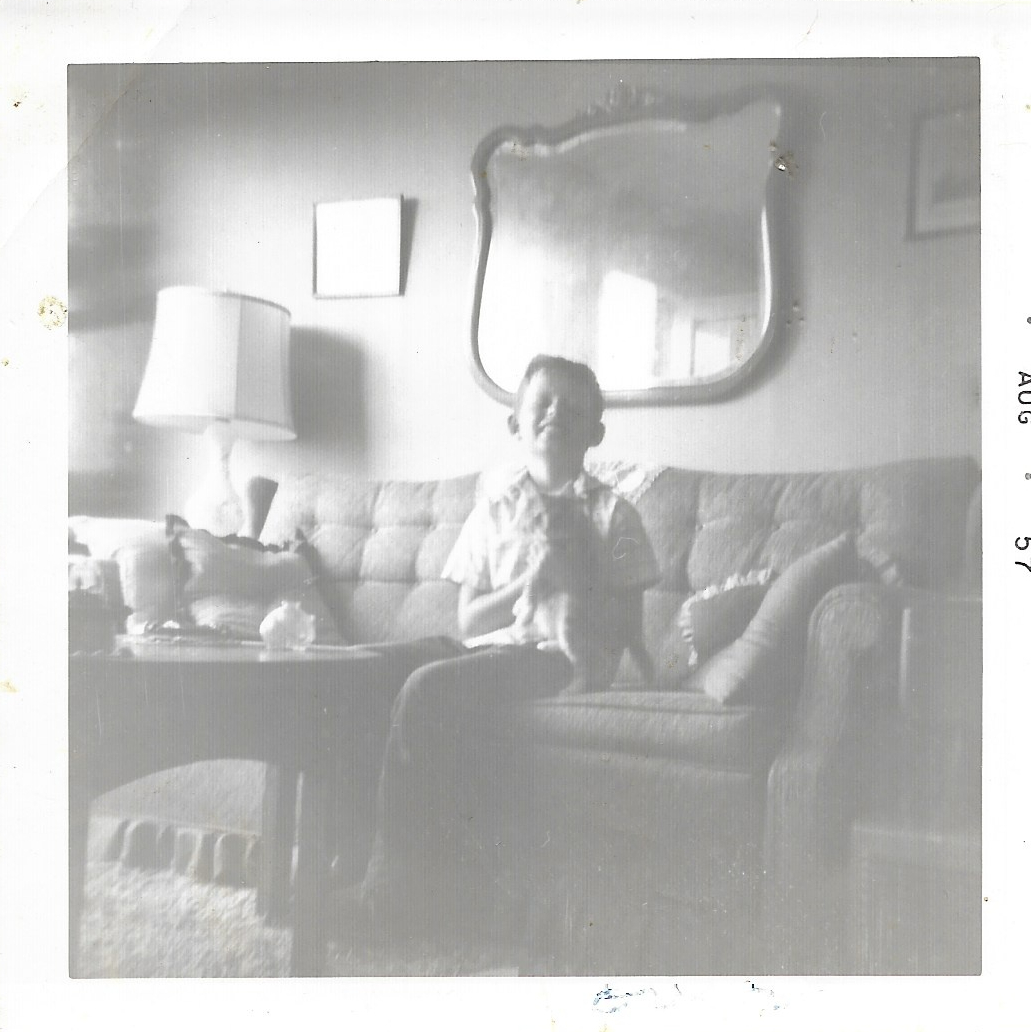


The photo in question is one of me sitting on the couch in the living room of my house in the San Gabriel Valley of California on a sunny but probably smoggy day. There's a sort of misty quality to the photo which I find intriguing. It's probably due to a dirty lens, but when I think of that, I also wonder who took the picture. The picture appears to be taken from the level of the seating, and I suspect the camera was placed on the seat of a wing chair that faced the sofa (a sofa that was actually a sofa-sleeper.) I'm holding a fluffy cat whose name I don't remember. I don't recall the picture being taken -- nor do I recall ever seeing it before. This makes me wonder. 

I don't recall having a camera of my own at that time of my life, but maybe I did. There was a dual lens reflex camera I remember using frequently a few years later after moving to Northern California, and it is at least possible that I had it much earlier and that the picture in question was taken with it -- or one like it. I say that because I have a vague memory of more than one such camera.

But the problem of who took the picture -- or the series that day -- is vexing. I have the feeling that I took them with a shutter-timer. But I have no memory of having a camera with a shutter timer until much later in the '60s or even the '70s.

So I think the camera was placed on a chair, the timer was set, and I got in position -- with a cat -- before the shutter was tripped. If there was someone else there, who could it have been?

I had quite a few friends in the neighborhood, but they rarely came over to my house. I usually went to their houses, and I remember many games of canasta or Monopoly at friends' houses, but hardly any at mine, and when we did play cards or Monopoly at my house, we sat on the front porch, never that I recall in the house or backyard. The rarity had to do with the fact that I was there by myself while my mother was at work at the hospital, and she was quite clear that she didn't want me to bring other kids over to our house while she was not there. Could she have taken the pictures? Perhaps, but I don't think so.

These pictures were taken at my house in the living room and the back and side yards of me and my pets and there appears to be no one else there. Which would be right -- it would be very rare for one of my friends or another adult to be there when my mother wasn't.

This is one of the many oddities of memory, though. I could be misremembering. There were times, I know there were times, when a friend, a neighbor, or another adult came over when I was there alone, I just don't remember it happening as part of taking these pictures, nor do I remember my mother taking the pictures, and there is nothing in these pictures that indicates anyone else was there.

And I don't remember these pictures being taken or ever seeing them before Father's Day this year.

The sight of a much younger me sitting in my living room in 1957 holding a cat is somewhat jarring. I remember the room quite well and its furnishings. I remember what that couch upholstery felt like (rough) and look of the round oak table we used as a coffee table (it had been a tall mission style "center table" that my mother had cut down). I remember the antique mirror hanging above the couch and the Currier & Ives prints on either side. I remember the white cotton shag rug under the table -- and how glad I was when my mother bought it and brought it home. If I remember correctly -- and I may not -- the walls of the room were painted gray-green. There was a huge picture window at one end facing the mountains to the north and I remember the light from that window being very bright despite its northern exposure.

The story of the rugs in that house is kind of important to my memories of living there. The house was not quite finished when we moved in in 1954. There was still stucco-ing and painting going on and there were bits of trim being applied and plumbing fixtures being installed (if I recall correctly, the shower wasn't finished when we moved in). There was no landscaping; the lot was bare and dusty. There were no sewers, no curbs, no gutters. Initially the driveway wasn't finished, and one day the asphalt pavement was put down, but we had to be careful not to walk or drive on it for a time. The absence of sewers meant that the plumbing drained into a cesspool -- not even a septic tank -- in the front yard, and I remember it had to be pumped out from time to time. The sewer line was installed the year after we moved in.

We had a few braided rugs that had come with us from other houses, but they were small and didn't do much to muffle the echoes of footfalls in the house. Oh yes, I remember the house being very echoey due to the plaster walls and hardwood floors. The white cotton shag rug in the living room probably appeared some time in 1957 -- my mother also got a new car that year -- and even though it wasn't all that big (probably 6x9 though it may have been 9x12) it made a big difference because it was soft and sound absorbing, and I remember the echoey-ness of the house diminishing greatly once that rug was put down.

By the time these pictures were taken the back and side yards -- and the front, too but there were no pictures of that -- had been planted with grass and bougainvilleas and roses and there was a water feature in the backyard ringed with bricks and lattice fencing put up to hide the incinerator (which I think we couldn't use after 1956) and to mask the side yard where the clothes line was.

I had asthma and the smog was bad in the San Gabriel Valley, so being outside (or inside for that matter) could be difficult for me. I had attacks fairly often until we moved to Northern California in 1959. But oh well. It was what it was.

I remember the house was painted white with hunter green trim, quite different from other houses in the neighborhood which were mostly brown, beige or gray with white trim. I remember my mother insisted on white and dark green trim. She said there was a reason, but I don't remember what it was.

I'm 8 or 9 years old in these pictures, and I'm surprised at how skinny I was. I don't remember being skinny until I was a teenager. In fact, I remember being kind of pudgy up until the age of 14 or 15 when I started getting taller. So seeing how skinny I was at 8 or 9 is a revelation.

There's an exercise I'm supposed to do prior to a Zen workshop coming up: describe yourself from the point of view of the Earth.

From the point of view of the Earth, of course, these descriptions of myself as skinny or chubby or alone or with friends or my age in these pictures or really anything are silly, irrelevant, laughable. From the point of view of the Earth, I don't exist as an individual at all. The minuteness of humans in the context of the whole wide world -- which itself is minute in the context of the Solar System -- is striking. There is no "me" in that context; there is no "we." Less than a mote of dust. 

And yet from the point of view of the Earth, I and the aggregate of humanity of which I am a infinitesimal part are in the process of "killing the planet." Perhaps like a disease organism might do to me or someone else at human scale.

The planet, the Earth, is responding. Cranking up an immune response against which I and the aggregate of humanity have no real response.

In thinking about these matters of scale and existence/non-existence, past and future, I recall the teachings of Vimalakirti  and all the Buddha-realms beyond our ken. Perspective is hard to obtain. Once obtained, it may be hard to maintain, and memory may fade. But what is is no matter whether we see or know it or not. 

---------------------------------

Silly me. I looked on the back of the photo and found a note written in my mother's handwriting stating that the "we" took the picture in the house, and the flash didn't work. Note says, "How was I to know it needed batteries!" 


Tuesday, June 21, 2022

A Most Astonishing Thing

For Father's Day, my wife gave me a photo album of pictures she came across a day or two before, she said in a K-Mart photo envelope. They must have been randomly put there for safekeeping or something, and it must have been thirty or even forty years ago, maybe even fifty years ago, since we hadn't used K-Mart photo processing any later than the early '70s.

These pictures were far older than that.

The oldest one probably dates to 1910 or so and I think it is a picture of Mamie or Maggie, the maid/nanny in my grandfather's house in Iowa. There's another old one of what looks like a town somewhere in the Midwest or West. Not any place in Iowa I'm familiar with. Based on a car in the picture, it was taken in the 1930's or '40s.

Then there are a lot of pictures of me taken between the ages of a few months to 16 or 17. There are some of my nephew from the time he was a few months old to the age four or five. One of my sister a year after my nephew's birth.

There are some pictures of household pets from the 1950s and 60s. I remember the dogs' names but not the cats.

Some pictures of my mother in the 1950s and '60s. 

And some Polaroids of a dog and a shopping center at Christmas time from the 1960s.

Some came as a shock because I don't remember ever seeing them before. 

I would say with some confidence that I haven't seen any of them in fifty years, and some I may never have seen before though I probably did and forgot.

I've spent some time putting them in more or less chronological order and making notes about what/who they are pictures of. But there are some I have no idea of. Or only the vaguest idea. 

It's fascinating and a little creepy.


Saturday, December 1, 2018

Who Are These People?

My great-grandmother Carrie with three of her grandchildren, George, David, and Florence, c. 1910
Yes, who are these people?

While checking my Ancestry.com profile the other day, I came across pictures posted by someone descended from my mother's father's family tree. I don't know who it is. I'd seen one of the pictures before, but the rest were new to me. The one above was particularly interesting.

Carrie and three of her grandchildren... She had at least one other grandchild at the time, but it was complicated. There may have been others. Some she may not have known about.There was a boy living in Wabash with his mother. His father, Carrie's son  Clyde, had been killed in a hunting accident shortly before the boy was born. There would be other grandchildren later, including my mother. But these three were interesting to me for who they were.

George, David and Florence were the three children my mother's father sired with his first wife Maud. By 1910, Maud and my mother's father (Lawrence) had divorced and by the time this picture was taken, Lawrence and my mother's mother (Edna) were married. Maude, so far as I've been able to figure out, had moved to St. Louis and become a housemate/companion/wife? of Lawrence's brother Hal. The boys were sent to live with their grandparents. Florence, on the other hand, was sent to live with another of Lawrence's brothers, Frank and his wife, a different Edna. But exactly when that happened, I can't say.

So what I see in this picture is my great grandmother, two of my uncles, and an aunt. Though these children were my mother's half-siblings -- and there would be others -- they are my grandfather's children and thus are my uncles and an aunt, without a half-measure.

George came to visit my mother and me in the mid-Fifties, I believe it was 1956 or 57. My mother had tracked him down by calling everyone in the LA phone book with her father's last name, and sure enough, she located George. I'm not entirely sure that he knew of her or she of him beforehand. But they got together, and I remember him as a rather jolly fellow though I can't say that he seemed like any kind of relative at all. So far as I knew at the time, I didn't have aunts or uncles (later I would find out I had quite a few of them). I didn't have grandparents. My father was far away. My (half) sister had moved away when I was three and I very rarely saw her. I didn't even know she was living in Los Angeles the first few years my mother and I lived there, for example. She was a student at LA City College.  And trying to break into show business.

Through relatively recent research, I found out a bit about George. He had quite a life. When I look at the picture above, I see a striking resemblance to his father. What I remember seeing when he came to visit was a rather distinguished middle aged man, salt-and-pepper hair, wearing a suit and tie, polished shoes, smelling of Old Spice. I think he drove a black Buick. He smiled and laughed a lot while I was around, but my mother wanted to talk to him privately, so I went in the other room and watched TV while they talked. It seemed serious.

They no doubt talked about their father. George was born in 1898; my mother was born in 1911. There was quite an age gap. Another half-brother was also born in 1911, but I doubt either George or my mother knew of him. A half-sister would be born in 1914, and my mother certainly knew about her as she mentioned her to me by name (Helen) as someone she had seen/met at her father's funeral in St. Louis in 1916.

I wonder if George and David and Florence and Carrie went to Lawrence's funeral. The pater familia, D. H., probably didn't go, as he didn't look well in a family portrait taken the year before at the 50th wedding anniversary of Carrie and D. H. Given that Lawrence had established yet another family in St. Louis it was obvious things could get ... complicated.

George and David both went to Arsenal Technical High School in Indianapolis, a rather prestigious technical school, but I have found no record that either of them graduated or even made it to senior year. If that's the case, it would be sad, to say the least.

Florence seemed to flourish in the household of her aunt and uncle, and died in Florida 92 years old. The boys didn't live so long. David died in San Diego at 55; George died in Los Angeles at 65.

Carrie died in 1918, I suspect she was one of the hundreds of thousands of Spanish flu victims in the United States. Her husband, D. H., died in 1921. By then, the boys were grown and one assumes they were on their own. Lawrence was dead. Maud moved back to Indianapolis.

Marie, Lawrence's wife in St. Louis, married the yard boss of the rail yard where Lawrence was killed and she died there in 1987, two days after my mother died in Butte County, California. Marie's daughter Helen committed suicide in 1940 on the anniversary of her husband's death from cancer.

I'm sure there are amazing stories for all  of these people, but for the most part, I didn't know anything about any of them. I wish I could have asked George about his stint in San Quentin when he came to call. But no.

Surprising how many records, though, turn up on Ancestry.com.


Tuesday, December 10, 2013

Taking Pictures, New Mexico Photography as Art; New York, New York, It's A Hell of A Town!


A corner of the Casa Ché Camera Collection

On to the next talk at the Museum, this one featuring Kathrine Ware, Curator of Photography, discussing the Growth of the Galleries, starting with Stieglitz in New York. 

Wha????

  • November 18: Growth of the Galleries
Curator of Photography, Katherine Ware, will chronicle the impact that Photography has had on New Mexico art history, from photographic surveys to commercial galleries.
While Kathrine gave quite a nice presentation, it focused practically not at all on New Mexico, and as always, it left out Carlos Vierra, who -- as The First [Anglo -- though he was actually a "Portagee", from California, no less] Artist in Santa Fe -- made his living as a photographer, and who had a studio directly across the street from the Museum wherein we were meeting... sheesh.

I don't know why there is such a blind spot about Vierra at the very Museum that he himself practically caused to come into being and that he graced with murals and that he photographed over and over, and that he was part of practically all his life in New Mexico, but there you are. If I didn't bring him up, I doubt he'd be mentioned at all.

There is a story there, but I don't know what it is.