These are two videos of the press conference that members of the Oakland City Council attempted to hold yesterday while demonstrators from Occupy Oakland had other items on their agenda. They were rude. I like it.
Part the One:
Part the Two:
This thing is going to get a good deal tenser...
(In Sacramento, there are weekly Occupy presentations before the City Council; the members of the Council are sooooo bored with all the yapping of the rabble. Sooooo bored. They get lectured nonetheless. My preference would be for Occupy Sacramento to send no more than one representative to the Council -- or not even that -- just camp out at the City Hall, outside the chamber. There are windows, big ones, through which they (the council members) can see the Occupiers. Not that they would look up from their texting, understand.)
Showing posts with label Occupy Sacramento. Show all posts
Showing posts with label Occupy Sacramento. Show all posts
Thursday, November 10, 2011

Monday, October 24, 2011
The New Model Revolution -- Sunday's Reformation

The explosive events of Saturday night's aborted General Assembly at OccupySacramento led to a remarkable level of reconsideration and recommitment to The Cause that took place Saturday night and into the morrow.
In talking to people on the scene and online -- quite a few who aren't in attendance in person are witness to the struggles thanks to Livestream -- it's clear they were dismayed, upset and angry at what happened, yet many understood that these explosions are a natural part of the development of this sort of Revolutionary effort. It's happened pretty much consistently throughout the movement during the early stages of development of each Occupation, including New York's.
And it's OK. Some would say it is necessary.
Because what happens afterwards is that Solidarity is reconfirmed. Yes, some of the angriest and loudest voices against what is going on may leave the Occupation and the Movement -- it's happened here, and it's happened elsewhere. It is to be expected. They may or may not come back after a suitable cooling off period. It's OK.
People have a right to their feelings and their emotions, and they have a right to make decisions for themselves. They have a right to be wrong. They have a right to their anger and to their pain.
Trying to suppress it or cover it up merely leads to greater difficulty down the road. Let. It. Out. And Let. It. Go.
It was obvious by yesterday that many, many people associated with OccupySacramento had done just that. I arrived at the Plaza just before 4:00p after spending most of the day preparing for a workshop on OWS General Assembly practices. There was a surprising number of people already there, engaged in all kinds of productive and nonviolent discussions and seminars and conversations and actively listening to one another. Ideas were popping, identifying and offering solutions to various problems was being hammered out. Focus was on particularly important issues and a growing disinterest in those issues that weren't so important.
For example, The Mayor and the City Council were no longer seen as a focal interest; they were peripheral at best, irrelevant to many participants. The internal problems of authority and transparency were being worked out as productively as possible in a large group that was tasking itself with finding solutions rather than piling on more layers of problems. I don't know what the result was because I had to go off to the OWS GA workshop, but from what I could tell, there was essentially no animosity involved in what they were doing; there was an active effort to come up with consensus solutions, and after that meeting broke up, there was no sign I could see of continuing animosity or anger at one another in the group.
In fact, cohesiveness was growing all over the Plaza as small groups and large ones explored how to rather than whether to move forward in collaboration and solidarity rather than try to continue to go forward in disharmony and rivalry leading to more and more anger and distrust.
What I saw happening was the process of learning to trust one another.
The OWS GA workshop was intended to provide information -- specifically for people interested in learning to facilitate GAs -- on how the process works in New York. It was a surprisingly large group, twice or three times the size expected, and all of them were intrigued to learn that there really is a way to do General Assemblies that works and works well on behalf of all the participants and the Occupation in general. It reinforced the general spirit that we will get through this difficult period and we will be stronger for it.
Sunday's General Assembly followed immediately after the workshop, and some of the principles and practices we had just discussed in workshop were presented to the GA for consideration and adoption on the spot; sure enough, they were so moved and adopted. This was out of order according to our previous practices, but it was realized through the workshop on OWS practices that there really is no ultimate rule book and that the GAs are quite capable of overriding previous practice by adopting new practice by consensus, and that's what happened.
To say that the transformation was immediate and startling is an understatement. It was remarkable -- and very rewarding -- to witness. The General Assembly became "owned" by Occupation as a whole, it was no longer some annoyance going on off on the side, run by "little dictators" and alienating its participants. There was intense discussion of proposals, yet always with respect for one another's positions. Remarkably innovative proposals were offered for development or adoption on the spot, and some were adopted. Others were sent back to the proposer -- respectfully -- for further development and resubmission. Everyone who had something to say about proposals under consideration was heard, respectfully, and new ideas were welcomed.
There were no blocks but not every proposal was adopted, nor should they have been. Nothing was discarded out of hand. Nothing was accepted mindlessly. People really thought about what they were doing and about the decisions they were making, and from my observations and talking to people afterwards, they felt that they were in charge for the first time. They weren't being led or forced or cajoled into doing something or adopting something that they didn't understand or that was potentially not in the interests of the Occupation. They decided based on their best assessment of the matter before them.
And that produced what used to be called "process buy in."
Some of us have been hoping for this to happen, but there is no way to force it. It has to happen organically. And it did. Some of those who have been so frustrated by the way things have devolved over the last few days were very moved to see the transformation.
Hizzoner is supposed to report back to the Assembly today. Whether he will show or not is unknown, but I doubt he will be allowed to hijack tonight. He won't be shouted down, but he won't be given the floor for more campaigning either. Should be interesting....
Also, finally, there is supposed to be a press conference this morning to announce the filing of a civil rights lawsuit on First Amendment grounds, though no details have yet been released.
Things should get very interesting indeed...
Sunday, October 23, 2011
Last Night At The Revolution...

Oh man.
Well. It got kinda intense. Again. When the GA was hijacked. Again. Internal dissension this time, not a featured speaker, over something that was never entirely clear, though I get a real strong sense of what the issue was.
It has to do, mostly, with the way things have been run at OccupySacramento, not organized, run. The general idea of autonomous self organization by committee/working group has been mostly doing well with a glitch here and there primarily due to lack of or mis- communication, the kind of thing that is typical for most newly hatched Revolutions.
But these autonomous self-organized committees/working groups can become outposts of ego, and when ego trumps everything else, watch out.
One explosion after another has been the result, as various interests collide, go into furious battle with one another, and their battles royal hijack everything else.
Last night, those facilitating the GA knew something was up, but not what form it would take. Soon enough, we all found out. The GA was hijacked right at the outset by four or five members of a committee who were fricking furious, their anger -- we found out later -- having marinated overnight after their plea to... those who run this show... fell on deaf ears. They took their issue to the GA, demanding what exactly nobody quite knew, but they wanted to be heard and for their anger to be validated. Anger at the "lack of transparency." At being brushed aside. At being... forgotten?
It was quite something. As more and more interests joined the fray, the lead facilitator for the General Assembly tried his best to broker a deal between the warring factions -- he tried everything he could think of -- and then, when nothing worked, he tried to call for a 5 minute break to let the temperature cool down a bit and maybe let people discuss the issue on the side. "No break! We want action NOW!" But on what? Another half-hour was spent negotiating a 5 minute break, and then everybody broke into affinity groups or listened to more of the complaints or defenses, insults, screaming, and on and on, while the rest of us discussed how, really, it is better this is happening now rather than three weeks from now, and you know, this is what happens when so many conflicted people get together, but don't quite gel.
In fact, during the next couple of hours (the GA never resumed), whole new alignments of people emerged, and there was a good deal of "jelling" of common interest and affinity. It was remarkable. People who had only nodded to one another if that got to know each other and found, if not life-friends, at least others with whom they could associate proudly. Ad hoc spontaneous work groups were formed to pursue all kinds of previously neglected aspects of the Occupation. Love was in the air, as one of the fellows who comes to the Revolution in his tie dye went around the tumult with his sign reading "Love here. Hugs free!" On the other side: "Free Therapy, Inquire within." A fellow who had been watching the scene on the Livestream raced down to the Plaza from his home to see how he could help get things back on track.
Dinner was served.
I have no idea whether those screaming the loudest last night got what they wanted, but those of us who saw the other side of this coin were just amazed. There is a really deep, fairly broad level of not simply interest but outright skill available from people who say they can let go enough to just "let it happen" and let it grow "organically," and not let incidents like last night's or the previous several nights derail the whole thing.
I was laughing ruefully at one point. There were several mediators on hand, professionals in the field, and not one intervened. And it's good they didn't. It's too soon to get over the pain, the anger, the betrayal so many people feel so deep in their souls they don't even know where it's located any more.
No, that anger is from the Heavens.
As soon as it is directed at the right targets... I don't think you want to be in the way!
Staying sane in the midst of it isn't easy. But neither is Revolution. I've mentioned similar scenes in Austin, and I saw something not unlike last night's events taking place in Richmond on their first day of Occupation. Then I was reminded of David Graeber's observations about what it was like at the very beginning for Occupy Wall Street.
We're doin' good. And we're right on schedule.
Saturday, October 22, 2011
OWS History Lesson

This is quite good. I tend to be something of a history nerd anyway, and Graeber's outline of what happened back in the early days -- it seems so long ago now -- and how it became what we see today is illuminating.
A tasty morsel of the kinds of things I like:
On August 2, I showed up at a 7 PM meeting at Bowling Green, that a Greek anarchist friend, who I’d met at a recent activist get together at 16 Beaver Street, had told me was meant to plan some kind of action on Wall Street in mid-September. At the time I was only vaguely aware of the background: that a month before, the Canadian magazine Adbusters had put out the call to “Occupy Wall Street”, but had really just floated the idea on the internet, along with some very compelling graphics, to see if it would take hold; that a local anti-budget cut coalition top-heavy with NGOs, unions, and socialist groups had tried to take possession of the process and called for a “General Assembly” at Bowling Green. The title proved extremely misleading. When I arrived, I found the event had been effectively taken over by a veteran protest group called the Worker’s World Party, most famous for having patched together ANSWER one of the two great anti-war coalitions, back in 2003. They had already set up their banners, megaphones, and were making speeches—after which, someone explained, they were planning on leading the 80-odd assembled people in a march past the Stock Exchange itself.
The usual reaction to this sort of thing is a kind of cynical, bitter resignation. “I wish they at least wouldn’t advertise a ‘General Assembly’ if they’re not actually going to hold one.” Actually, I think I actually said that, or something slightly less polite, to one of the organizers, a disturbingly large man, who immediately remarked, “well, fine. Why don’t you leave?”
But as I paced about the Green, I noticed something. To adopt activist parlance: this wasn’t really a crowds of verticals—that is, the sort of people whose idea of political action is to march around with signs under the control of one or another top-down protest movement. They were mostly pretty obviously horizontals: people more sympathetic with anarchist principles of organization, non-hierarchical forms of direct democracy, and direct action. I quickly spotted at least one Wobbly, a young Korean activist I remembered from some Food Not Bomb event, some college students wearing Zapatista paraphernalia, a Spanish couple who’d been involved with the indignados in Madrid… I found my Greek friends, an American I knew from street battles in Quebec during the Summit of the Americas in 2001, now turned labor organizer in Manhattan, a Japanese activist intellectual I’d known for years… My Greek friend looked at me and I looked at her and we both instantly realized the other was thinking the same thing: “Why are we so complacent? Why is it that every time we see something like this happening, we just mutter things and go home?” – though I think the way we put it was more like, “You know something? Fuck this shit. They advertised a general assembly. Let’s hold one.”
So we gathered up a few obvious horizontals and formed a circle, and tried to get everyone else to join us. Almost immediately people appeared from the main rally to disrupt it, calling us back with promises that a real democratic forum would soon break out on the podium. We complied. It didn’t happen. My Greek friend made an impassioned speech and was effectively shooed off the stage. There were insults and vituperations. After about an hour of drama, we formed the circle again, and this time, almost everyone abandoned the rally and come over to our side. We created a decision-making process (we would operate by modified consensus) broke out into working groups (outreach, action, facilitation) and then reassembled to allow each group to report its collective decisions, and set up times for new meetings of both the smaller and larger groups. It was difficult to figure out what to do since we only had six weeks, not nearly enough time to plan a major action, let alone bus in the thousands of people that would be required to actually shut down Wall Street—and anyway we couldn’t shut down Wall Street on the appointed day, since September 17, the day Adbusters had been advertising, was a Saturday. We also had no money of any kind.
After the explosive events on Thursday, thanks to the appearance of hizzoner KJ and his hijacking of the General Assembly, things calmed considerably by Friday, though there was still a lot of angst and hostility to work through during the day. By the evening, I was chatting with an oooooolllllllldddd comrade from the long ago, an artist and a constant advocate for social justice, whose works adorn this and many other cities, and whose work -- especially on behalf of United Farm Workers, but including many, many other activities -- is simply brilliant. It was wonderful to see him again.
At one point during the evening's festivities, there was a moment of tension when it was determined that the General Assembly and the time of my old comrade's discussion group were in conflict. This is a constant problem with the local Occupation; there still is no real consideration, and often seems to be no consciousness, of anyone or anything else except one's own specific activity or interest. I find that both fascinating and troubling. Anything that gets in the way of what someone wants NOW is subject to swift and sometimes brutal denunciation.
Well, of course my old comrade took it all in stride. He said to me, "You know we've been through all this before. Many times." I nodded. "And it's best just to take it as it comes, we don't have to make it a fight on the inside."
Sure enough.
---------------------------------------
Note: word has it that hizzoner KJ went to watch the arrests in the Plaza tonight; he was incognito, sitting in the dark, apart from the hullabaloo across the Plaza. Someone spotted him and gave him a shout out, asked him to come join the demonstration; he declined. Then he was apparently challenged on the issue of the First Amendment rights that were being violated nightly by the continuing arrests of peaceful demonstrators.
At that point, according to reports, he fled, surrounded by police.
There were reports that at Thursday night's arrest drama, some of the officers (or maybe only one officer) were threatening and intimidating some of the witness/supporters of those arrested, apparently basing their attitude on specific things posted on the Facebook page, claiming threats were made toward the mayor.
This is bizarre in the extreme.
But then tonight, reports started coming in of police following demonstrators when they left the Plaza and some being pulled over by police on "suspicion" or being cited for minor infractions like flicking cigarette ash out of their car window.
Of course it could all be coincidence.
Couldn't it?
Friday, October 21, 2011
Disrupting OccupySacramento -- "Diversity of Tactics" as Practiced by the Mayor

When you operate in the public square, disruptions are a fact of life. OccupySacramento has faced all kinds of disruptions on an ongoing basis, including having to break camp every night and prepare for arrests for failure to disperse that are a nightly occurrence at Cesar Chavez Plaza.
Live video of these arrests is streamed on the internet every night. Thousands of people around the world watch these arrests as they happen. They watch the arrival of dozens of police vehicles, the assembly and deployment of scores of police officers in riot gear, the busy to and fro of police commanders and assistant commanders and police videographers within the Plaza. They watch the march of a double column of riot police through the Plaza and they hear the orders to the Occupiers to disperse. They watch the riot police surround that night's volunteers for arrest -- anywhere from one to 20 or so, each night -- as the volunteers sit on the pavement, holding signs saying "People's Need Not Corporate Greed" and the like, and they watch as brothers and sisters in Occupation stand in witness, chanting now familiar slogans ("We. Are. The 99%! You. Are. The 99%!" among others) of solidarity.
They hear the volunteers for arrest speak out at the officers as they prepare for the arrests: "Your rights and pensions are in as much jeopardy as anyone else's. You're being robbed of the future just like everybody else. Why are you doing this to us? You are our brothers and sisters, we are your sons and daughters, we are your cousins, your aunts and uncles, we are you mothers and fathers, we are you, and you are us. Why are you doing this to us? Who are you serving? What are you afraid of? We are peaceful people."
They may hear a chant go up from the crowd of witnesses: "Where's the riot? Where's the riot?"
The volunteers preparing for arrest may continue to speak out to the police who are surrounding them: "Why are you arresting us for exercising our constitutionally guaranteed right of peaceful assembly? Why are you arresting us for exercising our constitutionally guaranteed right of freedom of speech? Why are you arresting us for exercising our constitutionally guaranteed right to petition the government for redress of grievance? Why are you arresting us? Why?"
And then the Livestream viewers around the world will see the demonstrators arrested -- gently to be sure -- one by one, lifted from the ground by two officers, placed in plastic restraints, hands behind their backs, marched away for processing and transport to the jail. Some of the volunteers may shout at this point, "I am a criminal! I am a criminal for exercising my rights as an American citizen! I am a criminal! I am a criminal!"
And sometimes the police -- who are both actors and audience in this nightly drama of disruption -- will be brought to tears by what they are witnessing and what they are doing.
Night after night, it's the same. Night after night.
But there are other disruptions as well. Some are simply part of the chaos of urban living, such as the police officer who got dogbit the other day, or the homeless wanderer whose incoherent ranting even he can't fathom. There is always a police presence in the Plaza, and there are occasional arrests of people passing through the Plaza whose presence is "suspicious" in the eyes of the officers. They will ask for ID and run the person's name for warrants. Often, they will find their target has missed a court date and will take him or her into custody. These events are so common, they're almost not disruptive any more (although perhaps they should be.)
Sometimes the disruptions involve actions by Occupiers themselves. A young man in the Plaza has been on a hunger strike for many days. He is becoming thinner and weaker and more delirious, and sometimes he has agonizing outbursts of despair that affect everyone. This is not the ordinary chaos of urban life; this is purposeful direct action, mindful of the man whose name graces the Plaza and whose image in bronze watches over us. This is Cesar Chavez Plaza, after all, named, as many civic plazas in California and throughout the West are named, for the farmworker organizer who brought hope and strength and determination to the people whose work in the fields of the West is the foundation on which empires of agriculture and commerce have been built.
Sometimes, like yesterday afternoon and evening, the disruption is due to the visitation of "dignitaries." The Mayor came to call, along with a troop of staff, and several council members in train. We knew he was coming. He said on Tuesday he would cross the street to the Plaza sometime later this week to visit and watch and listen and learn. And he said on Tuesday that he would work with our representatives to craft a Resolution that he would take to Washington with him when next he traveled to the seat of national power.
So he arrived. An Occupant greeted him. "Hello. Stop the arrests, drop the charges, open the Plaza 24/7." His smile couldn't have been bigger, "How are you? Good to see you. Yes, I'm here to hear your concerns. Thank you." He moved on to the next knot of Occupiers. And the next and the next and the next, shadowed by staff and joined by a television crew. Some of the Occupiers turned their backs or continued with their business as if there was nothing out of the ordinary going on. Others were expressing more and more dismay at the Mayor's clearly disruptive intrusion into the life and work of the Occupation. He went all around the Plaza with his staff and the television crew, while many Occupiers followed along. He spoke to everyone who came up to him, he was always smiling, always pleasant, always gracious, "reaching out."
The people he spoke with were disarmed. The Mayor knew what he was doing.
General Assembly was called, somewhat late, but it was called, and though the Mayor continued to hold court off to the side, with perhaps 25 or more people surrounding him, a sufficient number of Occupiers were assembled to begin the GA. All went well for the first few minutes, and then the Mayor and his staff and the council member for the Downtown district joined the Assembly. Announcements were being made, and as a courtesy, the Mayor's presence in the Assembly was announced as well.
He was offered an opportunity to speak. An opportunity he took full advantage of. He spoke at length about why he was at the Plaza: to "dialogue" with OccupySacramento. To listen to concerns. To take them back to the council and to have his staff follow up. Were there any questions? He started calling on people. The GA facilitator said, "Wait. Please. We have a procedure. We will open stack. [To the Assembly:] Please, if you would like to ask the Mayor a question, join the stack over there." And so a score of people "joined stack" and the Mayor took their questions one by one. Periodically he would say, "I would like to learn. I don't want to interfere with your process. I am so impressed with what you are doing." Then his disruption would continue. He was asked many questions having to do with how he and the council and the Occupation could work together to improve services and conditions for the least among us. He was always ready with an answer. He was asked a few questions about how to end the nightly arrests, questions which he did not answer, he launched into a campaign speech instead -- about how proud he was of this endeavor and so on and so forth, blah-ba-blah. He was challenged several times, "You haven't answered the question." Ba-blah-ba-blah-blah." Someone spoke very firmly to him, "You say you're here to listen, but you haven't heard us tonight any more than you heard us on Tuesday. Stop the arrests. Open the Plaza for our continuing use."
He smiled his biggest smile. "I hear you. I understand that you want the camping ordinance overturned, and I have pledged to you that I will work with staff and the council to see what can be done."
The crowd murmured. "We are not camping! We are occupying!"
"Stop the arrests!"
"The city has already made accommodations for you by extending the park hours, and we are working with staff to see what else can be done. We hear you."
"Stop the arrests!"
"We understand that you want to be able to camp here overnight..."
"We are not camping!"
"Occupy, occupy, that's right. We understand you want to stay here overnight. I understand that. We are working to see what can be done. There is a process. The process is under way. It's just begun. Please give us a chance to dialogue with you and see if we can come up with a solution."
"Stop the arrests!"
Someone got up and said, "What makes you think the city has any authority to interfere with citizens' rights to assemble, to speak freely and to petition. Is the city really prepared for the lawsuits that are inevitable? Do you realize the city attorney gave you very bad advice on Tuesday and demonstrated she has no idea of the case law involved? Do you realize the legal jeopardy she and you are putting this city in?"
The Mayor, for once, lost his aplomb. He claimed that he has to rely on the city attorney's opinion, and as far as he knows, she was offering her best assessment of relevant law. But clearly was made aware there... may... be a legal problem.
Another questioner asked: "When was the last time you or any other council member read the Constitution?"
"We are not camping!"
"I hear you."
"We want this park opened around the clock. We've been told many different stories about how to do that. We should go through Parks, we should go through the Council, we should go through the City Manager, we should ask the Police Chief. What should we do?"
He called up another council-member to answer.
"There's never been an official request to use the park around the clock, so the procedure is somewhat difficult to determine. Ordinarily a request would go through the Parks department, and they can issue a permit. But in this case... since there's never been a request, Parks can't act to grant it."
"Who has the direct final authority to make the determination of whether or not the arrests will continue? "
For once a direct answer from the Mayor: "The city manager."
"The mayor and council have no authority to make that determination?"
"That's right."
Murmuring in the crowd. Apparently, it was the first time many of the Occupiers had heard or realized that.
He was asked if he thought he was a member of the 99% or the 1%. "I like to think of myself as part of the 99%.... I pulled myself up by my bootstraps..." Kevin Johnson, multi-millionaire from professional sports, real estate investments, and privatizing public schools (among other endeavors). He was challenged on his privatization of Sacramento High School, with his private company, St. Hope, now running it as a charter school. "It's a public charter school!" he said defensively. "I'm very proud of the accomplishments of the school and its students."
"Yes, you are. That's because the teachers have no defined benefit pensions, they are paid less than public school employees, and they have no protection from arbitrar..." and he was cut off.
He was asked to take his money out of banks like Chase, Citi, or BofA, and put it in local banks or credit unions. Disingenuously, he asked: "Which ones are they?" He was asked again to take his money out of predatory banks, and he said that people have a choice in this country and he doesn't choose to do that.
He was challenged on the cost of the preliminary studies for the new arena the NBA is demanding be built for the Kings, especially given the fact that the city is always crying poor about social services. He said the new arena will bring 4,000 jobs. He was called a liar for that. (Net, there would be essentially no new jobs, and conceivably, given the proposed location in the Railyards, there could be fewer jobs than the current arena in the northern suburbs. And yet the project is slated to cost $350,000,000 just to construct an arena.) "No public money is going into this project," he insisted -- after conceding spending half a million dollars of public money for a consultant's report.
By this time, it was getting late, people were getting crankier and crankier, and so Question Time with the Mayor concluded, but as he went off into the night, practically everyone followed him, pestering him with more questions, personal statements, unresolved issues, and he continued to hold forth at the side of the Plaza while the GA facilitators tried to restart the aborted meeting. There were only a handful of people remaining for the GA, though, and many of them were very angry at what had just transpired.
Some were clear about what had happened. The Mayor got what he wanted: he successfully disrupted the Occupation and shifted attention from the purposes of the Occupation to his own wonderful self. And he kept the attention on himself no matter how much the GA facilitator tried to get things back on track.
There were many tears and much fury in the next few minutes. Accusations were flung willy-nilly, loud and very angry voices were raised. All this while the Mayor and his staff held court, surrounded by supplicants. Pleading their case. Kissing his hem.
At one point during Question Time, one Occupier asked, "Why are we on our knees before this man, asking, pleading with him? He works for us. We don't work for him."
When the Mayor wearied of treating with the rabble, he finally left the Plaza, and the tattered shreds of what was left of the GA were braided together into the semblance of order. The remaining items of business were covered as quickly as they could be. The anger and tears only partially defused.
He got what he wanted, the Mayor.
He's a master at it.
He will represent our voices. Make sure they are heard... Thank you. Thankyouverymuch.
Wednesday, October 19, 2011
A Real Effort At Co-Opting Occupy Sacramento
[Part of last night's city council meeting.]
Last night, there was a genuine effort to co-opt OccupySacramento, a blatant attempt by the Mayor of Sacramento, Kevin Johnson, former NBA star and close personal friend of the President of the United States of America, Barack Obama. He's also a corporate tool. Everyone knows it. He got elected during a period of "star worship" -- the kind that put Arnold Schwarzenegger into the Corner Office at the Capitol. A good deal of his luster has worn off. The former mayor whom he beat in a hard fought election has a tendency to snicker morbidly about it. She was bitter at first, but now she just takes it in stride.
KJ wants more than anything to build a new basketball arena in Sacramento as his Legacy, and he has committed a relatively huge chunk of civic time and money to see that it is done. (Truth to tell, the current arena sucks goat testicles. It is awful.) Much of the City Council meeting last night was about progress on the Arena and Railyards project. We're talking hundreds of millions of dollars -- I think it was at $350,000,000 for the arena alone at last report, and probably another $200,000,000 to $300,000,000 for improvements to the Railyards. All in a four or five year time line. This is really all Kevin is concerned about. There is nothing more important to him, and it would appear that there is little that is more important to the rest of the council. This is their baby. They want it so bad they can taste it. As always in Sacramento, the People are ambivalent about it. They like the idea; they don't like the cost and they don't like the fact that the project will further enrich the already filthy rich at the public expense.
KJ seemed to see the Occupation as a kind of plaything last night. An amusing diversion from his Important Work. He saw something that he wanted to take advantage of, and he moved quickly and surely to do just that.
All the rhetorical flourishes of the speakers were simply unheard by him -- and I would assume unheard by the other August Council Members as well. They had less interest in what was said than they had in the style and assurance with which it was delivered, the cuteness of some of the speakers, the quality of their delivery, or their personal knowledge of some of them. It was a hearing in which literally nothing that was said was heard by the Council, and certainly not by the Mayor. Well, except for once, when a speaker challenged the Mayor to say whether they were going to vote tonight, and KJ refused to answer until after the speaker finished his remarks. At that point, Kevin said that no, the Council was not going to vote. They couldn't. The Occupy Sacrament agenda item was not an action item (a misstatement which will have consequences for the city, but I'll get to that), so they couldn't vote on removing the camping ordinance -- which was not what was being requested -- or anything else. This was just an opportunity for representatives of OccupySacramento to be heard, and then the Council would discuss it, and then we'd see what would happen. The speaker KJ said this to replied, "That is unacceptable!" There was a good deal of murmuring among the multitude, but the Mayor's response was, "I understand you see that as 'unacceptable,' but that's how the Council has to work."
After the OS speakers finished and two of the Council members spoke on the issue, basically proposing a "compromise," the Mayor stepped in and "made an offer." He would agree to go over to the Plaza (across the street from the City Hall) sometime this week and meet with some of the leaders of the Occupation -- which he started to designate last night -- to work on a Resolution of the Occupation that he would then, he said, be able to take to Washington with him the next time he went to see the President, and he could give copies to anyone else who needed to hear from OccupySacramento. He would do this because he -- and all the rest of the Council -- believes in the aims and intentions of the Occupiers. He called forth one of the Occupiers whom he knew from previous appearances before the Council to serve as coordinator -- and putative Leader -- of his Visitation Across The Street.
Now. THAT was a direct effort at co-optation, and it almost worked. It was so unexpected. At first there seemed to be agreement among the Occupiers present that this was a good idea, but then some got to thinking about it and got angry. "What about the arrests?" they said. "Stop the arrests!" He said no. The camping ordinance would remain in place. They said, "Stop the arrests!" He just sort of grinned, and said he'd coordinate with the man he'd designated the time and place for dialogue with the Occupation leaders.
On to other business.
The mood in the room was very hostile by that point. The Occupiers trooped out, disgusted.
But that is the way this city works -- as many who have been through this process know and tried to warn the more naive among the Occupation. KJ -- and his wife Michele Rhee - are masters at manipulating people to get what they want.
And what they want, clearly, is to say to the White House -- and anyone else who wants to listen -- that they have found the way to Break the Occupation! No lie. That's exactly what they are setting up to do.
The absolute fury after the meeting was a wonder to behold. They knew they'd been had, but not necessarily why or even how.
The arrests re-commenced at 11:36pm. And they will not end until one or the other side gets tired of them.
Tuesday, October 18, 2011
The Arrests
[Note: this is from our local Fox station; initially, relations with the reporters from Channel 40 were... rocky. They were denied interviews, they were told, "Fox Lies!", and they were otherwise made to feel uncomfortable and unwelcome on the Plaza. That began to change, though, when they ran some surprisingly unbiased and truthful reports about the Occupation. Compared to some of the other local teevee news coverage, theirs and Univision's have been the least contemptuous and snarky. However, none of the television news operations are being allowed to interview or video anyone involved with the Occupation without being surrounded by Occupiers who are recording what the teevee people are doing and what the person being interviewed is really saying. That way, there is a record of what happened that is not solely that of the teevee editing room. This practice seems to have convinced the teevee "news" people to be more... careful.]
I'm watching on two Livestreams. There are now 60 volunteers sitting down in the Plaza. One is in full Navy uniform. There may be another 20 observes and supporters. There are 4 or 5 police in the Plaza, some on bicycles. There is a paddy wagon. More patrol cars are arriving.
Spirits are high. They are not afraid.
--------------------------------------
Order to disperse was issued at 11:24p. Most of those sitting in the Plaza got up and went to the sidewalk. 9 remain to be arrested including Russell who is confined to a wheelchair. The police are trying to figure out what to do. The crowd is chanting "Waste of Money! Waste of Money!"
-------------------------------------------------------
For some unknown reason, the Livestreamer with the camera on the arrests suddenly decided to fast-walk half-way around the Plaza (which takes up a whole city block) to get a different view after documenting the second arrest. People on the Livestream chat were saying, "What are you doing? GO BACK!!" over and over, but she kept heading around the Plaza in the opposite direct. People were virtually screaming in the chat, "'GO BACK!!!!" She kept going in the opposite direction. There was no explanation. She just kept going. The other live stream was focused on the processing point in the Plaza for the arrestees; it was outside a cafe in the Plaza -- which happened to be in the dark at the time. I'm sure it was light enough for the cameraman to see what was going on, but nobody else could.
After the first Livestreamer got about half way around the Plaza, the complete opposite corner from where the arrests were taking place -- it seemed she wanted to record the action at the police end -- she decided to head back the other direction. She got maybe half-way back to where she'd started from when the screen went black. Watchers thought it was temporary, as often happens with Livestream, but the screen stayed black. Someone in the chat said, "She dropped the laptop." Apparently the feed was dead. It did not return for the next ten minutes or so that I watched, and the other camera stayed on the processing point where no one online could see anything that was happening.
I'm sure some of this got sorted out in the by and bye, but I decided this was my cue to toddle off to bed. It's going to be a busy day after the sun rises.
-------------------------------------------------------
Some detail of the procedures employed:
These arrests took place at a different location in the Plaza than previously; the scene was very well lit -- what we saw of it before the camera people went elsewhere to record something else.
I'm going by my often faulty memory, so take this for what it's worth. The police officer in charge of the operation announced over her patrol car's PA that it was an illegal assembly, that anyone who stayed in the park after closing time would be subject to arrest. She made this announcement at the corner where previous arrests had taken place -- only the volunteers were assembled at a corner at the other end of the block, so she was mostly making her announcement to media. That was kind of funny. At her first order, the majority of those sitting in protest got up and left the group who were volunteering to be arrested. Most of those who got up then assembled on the sidewalk, chanting. A few additional people joined the group who were volunteering to be arrested until there were nine in total, and someone took information from them all so that the lawyers would be able to follow up on the arrests efficiently.
The command officer then walked around to the corner where the Occupiers were actually sitting, and gave her second order to disperse. She was accompanied by one other officer (also female, I think.) Daniel, the veteran in full Naval uniform who was volunteering for arrest, then began to shame the officers for what they were doing, much like the Marine in New York, and though I can't be certain since the camera was behind the command officer, it seemed to have an effect. At one point, the command officer turned her head to the side and the expression on her face was one of almost wretched despair. Daniel continued for a while, then went silent.
Shortly, two columns of officers more or less marched from their assembly through the Plaza, to the corner where the volunteers were sitting. There appeared to be at least a dozen officers in each column, all in riot gear. The chant went up, "Where's the riot? Where's the riot?" The officers surrounded the volunteers and formed a cordon beyond which the crowd (of maybe 100) had to stand. Another officer off to the side was directing the riot police. They looked really stupid, and I wouldn't doubt some of them were mortified, surrounding a handful of non-violent protesters, with their billy-clubs at the ready, helmets and visors making them look oh so tough, while other officers (who may not even have been in riot gear, I couldn't see clearly enough to tell) conducted the arrests.
The arrests started with Daniel, the man in the full Navy uniform. This caused an outcry in the crowd of course. And the shame of it must have been felt by any officer with prior military service. That, of course, was the point. "Diversity of tactics."
After the second arrest, the camera moved away, and I haven't found any additional information about what happened next except that Russell, the man in the wheelchair, was arrested and released fairly quickly afterwards (this was his second arrest at the Plaza, I think.)
The legal argument that was made at the Council meeting -- very well, too -- was that the city has no authority to interfere with exercise of free speech and peaceful assembly. To do so is a violation of the First Amendment and any ordinance that does so is unconstitutional on its face. The city attorney tried to argue that the city was within its rights to limit time and place of assembly and free speech, an argument that was demolished so thoroughly that the city attorney looked like a complete nitwit who did not know the law. [I was informed during the hearing that when the current city attorney was in private practice, her appearances in court were... less than stellar.] One of the most telling arguments was that the government does not have rights, it exists to protect them, and by performing these nightly arrests, the city is opening itself to severe liability on constitutional grounds. No one who has been arrested has gone to court yet (the first group is ordered to appear on October 26) so this argument -- among others -- has not been made in court yet. But the way it was argued at Council, it was devastating. By arresting at all, but especially by continuing these arrests after this hearing, the Council really has put the city in legal jeopardy on constitutional grounds -- which may be one reason why so many other cities are cooperating with their Occupations.
I Hate Politics

The Sacramento City Council meeting at which the issue of OccupySacramento's Occupation of Ceasar Chavez Plaza was discussed at length -- and very articulately argued by numerous OccupySacramento participants and supporters (I've decided most are law students or lawyers, but that's surely not true) -- because the council pulled their usual shit on the citizens. They heard them reasonably respectfully, then they turned the tables.
There would be no vote, the Mayor said. They couldn't vote on the matter, it wasn't an action item on the agenda. There was no way. They could only take testimony. The Mayor smiled broadly at his cleverness. But some of them knew the kind of thing that is typical in their dealing with -- ew-- "citizens." The crowd began to murmur. Then after all the testimony was taken -- and I think there were close to fifty speakers, though only forty were announced at the start of the testimony -- one of the councilmen, the most sympathetic of them, said he thought it might be possible, over time, to work out some kind of compromise that would allow the material and equipment to stay in the Plaza and perhaps a "protester" or two could stay in the Park overnight to make sure it was safe. Then the councilmember for the downtown district decided to claim that the occupation wasn't peaceful because a police officer was bitten by a dog in the Plaza. She was nearly roasted over a spit, and she demanded to be heard. She wanted a flood control levee for her district, but she couldn't get one because of Republican earmark rules, and the Occupation can help in that situation somehow. She had talked to the Occupiers for a while. She knew what they wanted. She would work with her colleagues on crafting a compromise.
The Occupiers demanded loudly that the arrests stop. The Mayor said no. He would spend two or three days at the Plaza in dialogue, and then perhaps something could be worked out, a compromise perhaps, in due time. Perhaps. They must dialog first. The Mayor then designated an Occupier as his point person with whom he would coordinate his visitations of the Plaza; some people were not happy with that arrangement at all. By that time, people were so furious, it hardly mattered.
They were played. This is how this council works, which is something they might have been told in advance by some of those who had been through that wringer (who, me? Well, I have said something, but there's a great unwillingness to believe won't work out for the best.)
The Occupation will not get what it wants. It probably won't get anything except "dialog" -- which could go on literally for years with no resolution, nothing. That's what the Safe Ground people discovered. The city will actually spend hundreds of thousands of dollars commissioning studies and running task forces and hiring people to write reports that will be presented by staff to Council and Council will direct some modest followup study and report and might even get so far as to have staff draft an ordinance or revision, and then it will sit, "dialog will continue" indefinitely. That's the course they've decided on.
Obviously, the Council is taking this episode as a really big deal, because what they are doing is attempting to defuse the protest by co-opting the Occupation through the selection of certain "players" with whom to "dialog." Apart from the fact that the Mayor is sitting down with a representative of the Occupation -- which is a basic splitting tactic -- nothing is happening. Nothing will be done beyond the "dialogue" apart from hiring consultants, who will produce glossy reports that will be ignored --or that may result in the establishment of, say, an "Occupation Commission" which will be an advisory body to Council, possibly even with staff support, though not any time soon. The whole point is to corral the energy of the Occupation and channel it into something productive for the Council. After all, the most supportive of the councilmembers wanted to be sure the Occupiers were shopping and dining at local small businesses. They need the support. As one of them said, "We would, but we can't afford it."
There are preparations under way for arrests tonight, but they are still sorting out volunteers. Cindy Sheehan was back to give moral support and to testify at the council hearing. She said she couldn't stay tonight, but she was planning to come back as soon as she could. OccupySacramento is her "home base" Occupation because it is closest to her home in Vacaville. She and the young folks get along great, by the way.
There is talk of bringing in Cornell West (he was raised here), but I doubt anyone will hold their breath. Meanwhile, word has come that Bay Area Occupations, especially Oakland's, will be sending representatives on visitations.
This is good. This is very good. The more contact between Occupations, the better. And it would be good to send OccupySacramento people to visit as many other Occupations as they can.
What I had been warned would happen (a unanimous negative vote) did not happen, and so the internal split I expected to result from it didn't happen either. Instead, the city is going to try to co-opt the Occupation by splitting it from the outside.
At this point, I doubt it will work, but my Magic 8 Ball has long been on the fritz.
They're packing up now, getting ready for the arrival of the police armadas. The police come in large contingents, 60 or 70 typically; there there according to the Livestream, and it isn't even 10:45. They're taking up positions around the Plaza, paddy wagons at the ready. They've had as many as three dozen patrol cars, two paddy wagons, 70 officers in riot gear, CSI vehicles, etc. etc., making the whole operation way overkill.
I'll watch the Livestream. The tension is rising.
Damn I'm Easily Amused
[via dKos]
"We need to sacrifice on behalf of our suffering brothers and sisters on Wall Street!"
City Council meeting in a few.
The scuttlebutt is that it will be a unanimous vote against a variance or exemption or special use permit for the OccupySacramento folks in Cesar Chavez Plaza Park. The Mayor has come out against any further accommodation, the Bee has declared the that the Occupation has "worn out its welcome," and something is being cooked up by some of the Occupiers for after the Council meeting. I have no idea what. Much secrecy and skullduggery all around. There was a rumor that Cindy Sheehan might come back today. Then again, we've heard plenty of rumors before.
And I've been getting some calls from people who know people and they say, basically, "Watch it..." ... sounds like somebody is prepping some kind of endgame, but who or what... don't ask me, I don't know. We've been hearing that sort of thing all along anyway, but now it seems to be driven by additional anxiety over an "official" refusal to accommodate the Occupation. Also, I'm hearing warnings about some of the individuals involved in the Occupation. But again, what's new with that?
A cop got dogbit in the Plaza yesterday, a dog that was tied to a tree but was guarding a demonstrator's tent while she went to the store for some supplies I'm told. A cop went to check her tent, the dog lunged at him (although no one actually saw this, but that's the current story as of last night). The cop pepper-sprayed the dog, and the dog bit him. Major to do in the Plaza, much Emergency Services, arrived, the dog was detained, the cop bandaged up, and the tension level in the Plaza went sky high.
The call went out not to volunteer for arrest last night. The dog-bite incident was one reason. There were others which will have to wait, cause I've got to get down there.
Things are changing. But for the time being, watch the Revolution Chant as performed in New York City.
"We need to sacrifice on behalf of our suffering brothers and sisters on Wall Street!"
City Council meeting in a few.
The scuttlebutt is that it will be a unanimous vote against a variance or exemption or special use permit for the OccupySacramento folks in Cesar Chavez Plaza Park. The Mayor has come out against any further accommodation, the Bee has declared the that the Occupation has "worn out its welcome," and something is being cooked up by some of the Occupiers for after the Council meeting. I have no idea what. Much secrecy and skullduggery all around. There was a rumor that Cindy Sheehan might come back today. Then again, we've heard plenty of rumors before.
And I've been getting some calls from people who know people and they say, basically, "Watch it..." ... sounds like somebody is prepping some kind of endgame, but who or what... don't ask me, I don't know. We've been hearing that sort of thing all along anyway, but now it seems to be driven by additional anxiety over an "official" refusal to accommodate the Occupation. Also, I'm hearing warnings about some of the individuals involved in the Occupation. But again, what's new with that?
A cop got dogbit in the Plaza yesterday, a dog that was tied to a tree but was guarding a demonstrator's tent while she went to the store for some supplies I'm told. A cop went to check her tent, the dog lunged at him (although no one actually saw this, but that's the current story as of last night). The cop pepper-sprayed the dog, and the dog bit him. Major to do in the Plaza, much Emergency Services, arrived, the dog was detained, the cop bandaged up, and the tension level in the Plaza went sky high.
The call went out not to volunteer for arrest last night. The dog-bite incident was one reason. There were others which will have to wait, cause I've got to get down there.
Things are changing. But for the time being, watch the Revolution Chant as performed in New York City.
Monday, October 17, 2011
Non-Violent Communications

Yesterday got kind of interesting for a while down at the Occupation. It's always interesting, but yesterday was somewhat exceptional.
After coming off the high of the day before, the much larger crowds, the marches, the rallies, the camaraderie and spirit that seems to infuse all these efforts everywhere around the country and the world, yesterday's get-together and gab-fests (yak-yak-yak all the time until nobody has any voice left any more!) was mellow and more sparsely attended.
The arrestees from the night before weren't released until almost noon. They are being kept longer at the jail, and while so far as we know they aren't being physically abused, some say they have witnessed physical abuse of other prisoners -- not Occupiers -- and they have been kept in conditions of extreme discomfort for many hours -- typically more than 12 now -- with no food or water. It's not a pleasant experience for anyone, and the fact that so many of our participants are volunteering for jail every night has been an inspiration to everyone else to keep going. Going to jail isn't cheap, either. I'm told that each Occupier/Prisoner is assessed $575 in costs each time they are arrested and jailed. But there is no lack of support. And they all have excellent pro bono legal representation.
The current sheriff used to run the jail, and he's well known for having made a number of important reforms while in charge of the jail. The number of suits for abuse was growing year by year, and the reports out of the jail about brutality, neglect, and generally appalling conditions were scandalous. It was costing the County a lot of money in settlements as well. The situation may not have been as bad as that which is now being exposed regarding the Los Angeles County detention facilities, but it was bad, and something had to be done.
And something was done, one of them being the replacement of the jail supervisor with one of the department's most capable officers. There were still problems at the jail due to the nature of the officers assigned there -- new officers, generally, just getting their feet wet in law enforcement -- and the fact that no institution in our society, especially not incarceration focused institutions, changes quickly, nor necessarily positively, but the number of complaints declined, and the outrageousness quotient was reduced.
One of the teach-ins I attended yesterday as an observer dealt with Conflict Resolution and Non-violent communications, attended by about 20 participants and two "teachers." One teaches conflict resolution at the community college, the other is a conflict mediator in the private sector. As a side note, as I've previously noted, I am a certified workplace conflict mediator and have been a meeting facilitator perhaps hundreds of times. One loses track after a while! I have not engaged in meeting facilitation for at least five years, nor have I mediated workplace conflicts for almost ten years, which is quite a relief in many ways, for it takes a great deal out of you to do it and do it well. And I think I have mentioned previously that I would not volunteer to facilitate any level of Assembly or working group activity at this or any other Occupation for the simple reason that I know all too well that my training and experience in the field is simply a wrong fit for this kind of participatory democratic endeavor. I even hesitate to offer advice. The kind of mediation/facilitation skills that I learned and practiced are something like riding a bicycle. You never forget them, and they kick in automatically when the environmental cues are there. I would revert to the way I used to do it without even being conscious of the reversion. Those ways are superficially egalitarian, but they are actually very hierarchical and authoritarian, and they have a tendency to reinforce the "dominant paradigm," of course without meaning to. Of course not...
So it was interesting to observe how these two teacher/trainers approached the topic of conflict resolution and non-violent communication in the context of the OccupyTogether movement. Which, in fact, they didn't. There was hardly any mention of it, and what there was had mostly to do with how its objectives aligned their concepts of non-violence and conflict resolution... except... they don't. It's quite different.
Luckily, before I had a chance to open my big, fat mouth about it, I saw a man striding down the walk into the Plaza toward me. It was someone I haven't seen in nearly 15 years, a man who wrote two of the plays our theater produced back in the day, and who is now living and writing in Oakland. It was a remarkable reunion. He was with a musician friend, and he said he was in town briefly for a poetry reading and an exhibition of some of his paintings, which was even more delightful. His musician friend was accompanying his poetry reading on saxophone. This was getting better and better. He said he'd come down to check out the Revolution. He said he'd been arrested at the protest in San Francisco, not an experience he expected or wanted to repeat. We were shortly joined by another old pal, an old chum from the anti-war movement, and we chatted and carried on for quite a while reminiscing and bringing one another up to date, and exploring the nature of the changes we were witnessing and were a part of right now. There are plenty of activists from the Old Days, and artists, and civil rights and social justice workers and supporters from the Old Days involved if only peripherally in this revolution, and I think to most of us, this is quite a different thing than we have ever known before; it is fully a creature of the young -- as it should be -- and yet it is consciously inclusive, not exclusive at all. Every one of us who can do so is welcome to become part of it, contribute what and how we can, even if it is only attention from time to time. Come see for yourself, get involved, join us! The Revolution is here!
I can get pretty emotional about it, as can others from my generation. Most of us recognize that no matter how far we thought we had come, we didn't come far enough. No matter how much we thought we had won, there was still an enormous amount to do, perhaps a greater mountain to move than any of us had ever consciously thought of. The youth are taking on the challenge absolutely fearlessly, and I have nothing but the highest admiration for them.
I want to help, and I do what I can, but I know they have to do it themselves, and they are doing it, day in and day out, and we should all be proud and confident that what needs doing will be done.
So we talked and chattered until it was time for General Assembly, and we went our separate ways, now knowing the connections between us are much stronger than ever before.
The GA was... difficult. I will not detail what happened, because it is still a work in progress, and there are a few more mountains to climb before it is working smoothly. It did demonstrate how non-violent conflict is actually a positive element in the whole Occupy movement, and how disagreement is as important as, if not more important than, consensus as the movement grows and the nature of this Revolution is clarified. Consciousness was raised. It was tough, but it happened.
And your correspondent wound up part of the Facilitation Working Group/Committee. Yikes! Well, hail, we do what we can. It was, perhaps, inevitable.
We need more facilitators who are willing and able to work with and through the General Assembly process. The same five people have been trying to do it all from the beginning, and quite naturally they are reaching their limit of endurance. Us old farts are amazed they can keep it up as well as they do. So I expect that my role, such as it is, will be to help recruit and accustom new facilitators to the General Assembly process. It's not really a matter of training. It is more a matter of watching and doing, and being willing to make mistakes.
And what I might have said to the Conflict Resolution and Non-violent Communications teach in is that "non-violent communications" is already being used by the power and money elites as a weapon against us and as a way to disarm the movement. Learn to recognize it when it is being used as a weapon rather than as an aid.
When the 1% starts talking to us directly, watch for their use of confidence and trust building language that actually serves as a mask for what they have in mind -- which may be quite nasty and potentially violent. Be alert to the use by the 1% of conflict resolution techniques. They will do it. They are already doing it in some cases.
The reason to watch out for it is that when they do it, it is a trap. Don't fall into it. They do not have our interests at heart. Hold out. Be firm. Do not yield to their blandishments.
Thank you!
Thank you!
Sunday, October 16, 2011
This Is Wrong and They Know It -- "The Whole World's Watching"

Last Night's Arrests
What a strange sensation to get up this morning and find the OccupySacramento Facebook page filled with extended arguments on the value of using precious police resources to get your ass arrested for some unfocused cause.
Up to last night there had been approximately 35-40 people arrested over the course of the Occupation for "failure to disperse" at the rather flexible closing time of the Plaza.
Last night, I'm not sure of exactly how many demonstrators were arrested -- these numbers always change after a while in any case -- but those who were arrested were not the Usual Suspects. They included Cindy Sheehan, Karen Bernal, and Russell (whose last name I forget, but he is in a wheelchair and is part of the internet committee/working group for the Occupation). There are reports that several officers were in tears as they conducted these needless arrests, carrying out orders from On High, but to what object?
Night after night, people in Sacramento get arrested -- voluntarily, let the record show -- on behalf of the First Amendment guarantees of free assembly, free speech, and petitioning for redress of grievance. They know the reason they are out there, why they are resisting, and they pretty much know the consequences for doing so (though, of course, Authority can and does change those consequences to suit itself.)
The arguments that seem to have become intense last night have to with the fact that so many people have been arrested over so many nights; it was a media circus last night because of Cindy Sheehan (who has been arrested many times for civil disobedience connected with the Imperial Wars of Aggression); and because some people believe it doesn't work to make your point.
That's the most interesting argument to me. How can people, many of whom say they are sympathetic with the movement, insist, apparently sincerely, that civil disobedience doesn't work to make your point? It boggles the mind. Aren't these people aware of any history of social progress at all? Is it even possible that any substantial portion of Americans do not know of the long tradition in this country and all over the world (thank you, Mahatma) to engage in civil disobedience when the other avenues of politics don't work?
Nobody who is doing this in Sacramento is doing it frivolously. This is one of the most mindful group of civil disobeyers I've ever personally witnessed. They know what they are doing. They know why. They are not following a leader into the paddy wagon. Most of them have no personal agenda at all; they are consciously doing this solely for the benefit (they hope) of all.
And yet, the argument rages: "It doesn't work, you're wasting resources, do it the right way..."
No. When the situation reaches the point where civil obedience no longer works, the Right Way is to resist. Engaging in civil disobedience is correct and at this point, it's necessary. It may or may not lead directly to some desired change in the status quo -- in this specific case, honoring the Constitutional First Amendment protections instead of trying to restrict civil rights. And while the distinction may be a fine one sometimes, these actions are on behalf of honoring civil rights as opposed to civil liberties.
I can't argue with that.
The underlying issue here is the Occupation itself. As I've said, the OccupySacramento is not yet an actual Occupation. It is what I call a "coming-and-going" because the bulk of the Occupiers do vacate the Plaza every night at closing time; they break down the camp and store it in a panel truck parked at the corner (with permission from the city) and then they set it up again every morning. The people who are most involved in this logistical process get very little sleep, they are very tired -- because it is physically exhausting to keep doing this -- and we all wonder why the city manager hasn't used his independent authority to waive the restrictions on access to the Plaza after some arbitrary hour. It is a simple thing. It could have been done at the outset (many cities are cooperating with their Occupations without any civil disobedience at all; others aren't); it could have been done at any step along the way. Instead, the City Manager continues to order the arrests, and so we have the startling sight of dozens of police vehicles, up to seventy police officers -- in light riot gear -- confronting a dozen or so sitting (or sometimes prone), absolutely nonviolent and often silent, passive resisters, who get relatively gently zip-tied, hoisted up, and escorted to the paddy wagons and taken to jail, where apparently they are "guests" in the tanks until they're released the following morning or afternoon.
Some of them have been arrested over and over, but others volunteer for the first time every night, and the police stand there with tears in their eyes, batons at the ready, wondering what the fuck they're being ordered to do this for.
Then there's the guy on the hunger strike -- into his sixth day.
Why can't they just leave the Occupation alone?
That's the question being asked of Authority and clearly internally by Authority everywhere.
Before I went to my comfy bed (talk about privilege!) last night, I was watching the preparations for clearing the Occupation in Chicago from Grant Park. Oh the memories, some of which I mentioned earlier. It was a similar scene but not the same scene as the DNC police riots of 1968. It's in almost the same location as the nighttime tumult of 1968, so the site itself is evocative. The police -- so far as I could tell from the livestream feed until it abruptly went dead -- were not at all inclined to riot, and the Occupiers were engaged in classic nonviolent resistance: they linked arms in a circle around the tent encampment, and then they sat down. "♫We will not be moved♪." The police then formed a standing line around the perimeter of the demonstrators. There were reports of preliminary arrests. But there were also reports of very positive relations with the Chicago police, nothing like the fury and animosity of the past. There was no sign of violence before the feed went dead, and I haven't had a chance to check the news yet for updates.
The arrests in New York yesterday at the CitiBank branch are looking more and more bizarre the more info and video is coming out. I watched the action on the Livestream as it was happening, but the camera was outside the perimeter established by the police which was quite a distance from the bank entrance. So the story of what happened is still being pieced together. What we saw was stupid in the extreme. People were literally being arrested and hauled away for nothing; that is, they had done nothing that would be wrong in any rational world. Whether they made any kind of ruckus inside the bank I don't know, but from what I've seen, they didn't. They were, for the most part, quiet outside the bank as well, at least until the arrests began. At which time they protested, loudly. From all appearances, the arrests were made because CitiBank customers were trying to close their accounts.
And people will ask, "Why are you protesting that way? Why don't you do it the right way?"
This will be a perpetual argument, I think. Everyone wants to be a critic. How well I know. And everyone seems to want to be the Authority.
And then there's the issue of direct democracy in the Occupations which is triggering a whole other layer of dispute. "It's a MOB!!!! Eeek, run away!!!"
---------------------
200 Arrests in Chicago over night:
Some pictures from Chicago last night (Facebook album link)
Santiago de Chile yesterday:

Saturday, October 15, 2011
Down at the Occupation
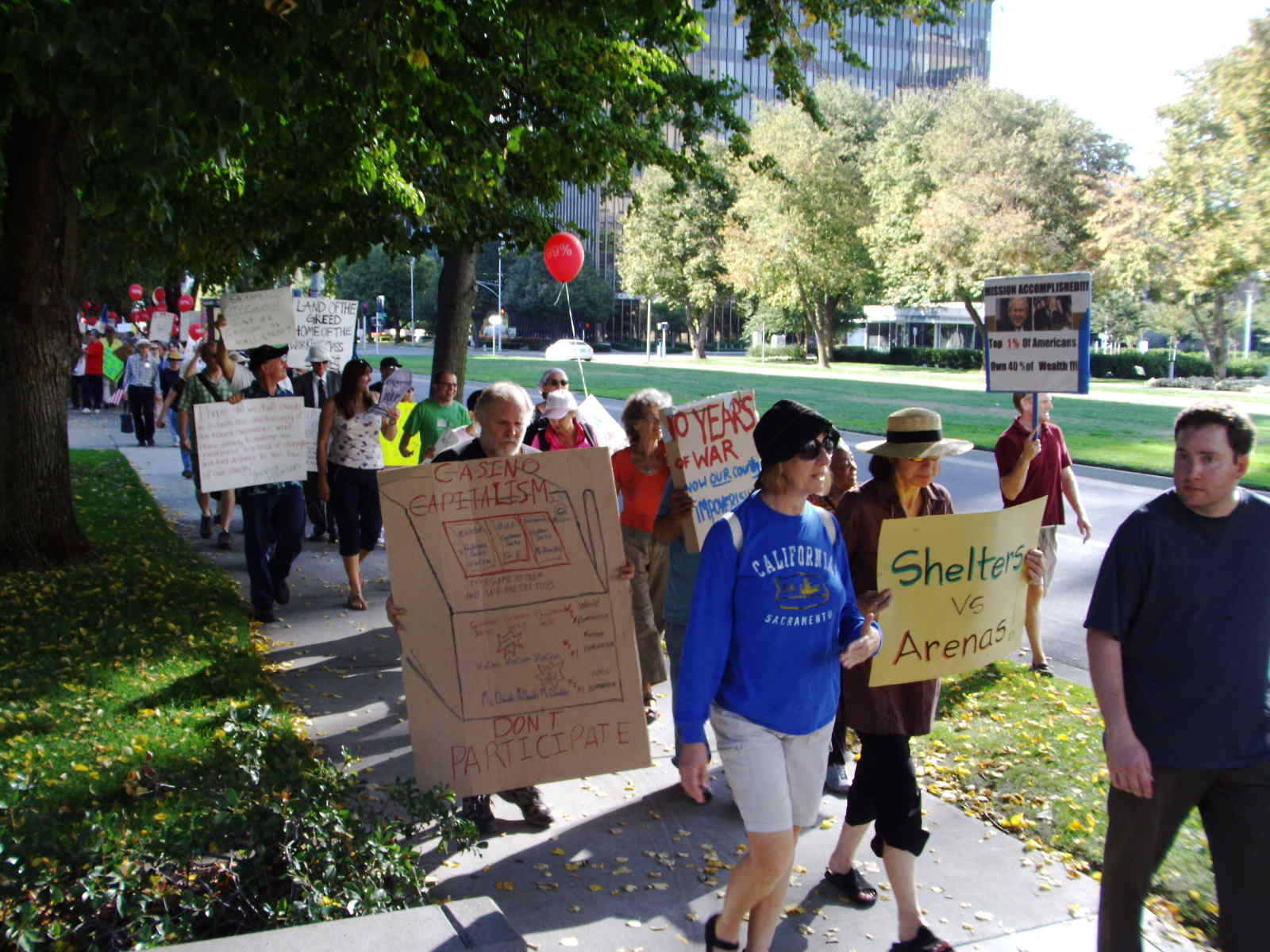

Today was Global Revolution Day, or as it was called around here "Global Occupation Day," and many, many events were planned throughout the day and into the night. They included a visit from Cindy Sheehan (she used to live in Vacaville, but I thought she had moved back east, Boston, I seem to remember, but I can't be sure any more.) She roused the rabble real good!
There was a snaking march through Downtown and onto the Capitol Mall -- to harangue at the bank towers (Wells Fargo and Bank of America), and then on to the Capitol grounds, for a rally on the north steps where we heard many local speakers, one of whom quoted from the Communist Manifesto, another who read the entire closing speech given by Charlie Chaplin at the end of "The Great Dictator," and others who brought up the social and economic justice aspects of the Civil Rights Movement, reminding people that Martin Luther King was assassinated in Memphis while he was there supporting an economic strike by garbage workers.
Earlier, I'd participated in a "Privilege vs Oppression" workshop at the Plaza that highlighted how privileged some of us are and how disadvantaged are others (an exercise I've been involved in or conducted myself many times in a social service context.) Afterwards, I asked the facilitator to think about whether this kind of exercise --- which really does work well in a social service or similar context -- is appropriate in the context of the Occupy Movement since the exercise tends to enhance the class and other divisions within the "99%" and in that way may be actually serving the interests of the 1% who rule. For example, I know I am very lucky and highly privileged compared to many other people, but the fact that I am relatively privileged within 99% is as nothing compared to the privilege (indeed, essentially total immunity and impunity) with which the 1% rulers are blessed. In other words, there is more in common among the 99% -- no matter how relatively privileged or disadvantaged one may be -- than there is between the 99% and the 1%. (And I use the terms not so much to refer specifically to income or wealth as to influence and power. They're sometimes the same thing, but sometimes not.)
He seemed to think the exercise was useful for helping to highlight the commonality of interest among the group no matter their status -- which of course is what it is designed for -- but in the context of the Occupation, the commonality of interest is widely assumed; status simply does not register. If you're there, you share common interests.
Yet interestingly, yesterday I had an online discussion with someone who saw a strong class bias in the Occupation and who wondered whether the truly disadvantaged had any hope to be included in the goings on. In our Occupation, they surely do because of where the Occupation is located, but I don't know if anyone would try to recruit at the shelters. He saw the predominance of well off white folk in some of the Occupations he had read about (I saw New Haven's first General Assembly today. It went very well. Almost everyone in attendance was well off and white. Gee. Class bias? Well, what about some of the other enclaves of privilege?) and seemed to assume that it was intentionally a well off white folks' movement. No, it isn't. I can see where he got the idea, and Bruce Dixon over at Black Agenda Report, while generally supportive of the movement, reminds the participants that there is more to think about and agitate over than their disappearing bank accounts. True enough!
I met up with a number of friends today who came out to the march and rally unbeknownst to me -- I haven't really done any "outreach," shame on me -- and their reasons for participating were kind of a treat. Old line activists were thrilled to pieces to see something this energized crop up out of nowhere and take control of the narrative so quickly and so well. I had no idea it made that kind of impression. Others were fed up with the real horrors that were being imposed on Americans and people all around the world because of the financial collapse and the failure of government to respond appropriately.
It may have legs.
Who'd a thunk it?
They say that 1700 all over the world cities were participating with occupations of their own today and that 500 cities in the United States were also having at least one event to show solidarity.
Now I'm watching the Livestream from Chicago, where apparently the police have ordered the thousands of demonstrators to disperse. I'm not sure exactly where they are, but I saw something last week that said they were meeting in or on the edge of Grant Park, and what I'm seeing in the choppy, pixelated video looks eerily like some of the scenes during the police riot in and around Grant Park in the summer of 1968. [UPDATE: Google is your friend, sometimes. They are on the edge of Grant Park, directly across Michigan Avenue from some of the scenes of riot by the police. "The whole world is watching." Again.]
Some of these scenes really do get me nervous, but then I think of the courage and determination of the mostly young people who are so very engaged in this effort, and I feel elated and uplifted. Even if there are very unpleasant reminders of past brutalities and worse, the words I hear repeated many times, "Be not afraid," relieve any sense of stalking dread.
-----------------------------------------
And if anyone is interested in "process" things, Sacramento's Occupation tonight adopted and for the first time used a version of the Quick Guide direct democracy model of General Assembly that is becoming the iconic aspect of pretty much all the Occupations. It wasn't perfect. First time, what do you want? But it worked, and participants felt far more involved and rewarded than in the past. Still some rough edges, oh yes, but it's getting there. We even used the People's Microphone -- also for the first time, though we didn't use it for the bulk of the Assembly (there was a proposal that we do so, though. Good deal!)
Friday, October 14, 2011
Why Outdoors, and Why Specific Sites to Occupy Outdoors?
 Occupation encampment at Westlake, Seattle WA.
I'm fairly familiar with Seattle, but I didn't know where the City Hall was, never having any reason to go there. But it turns out that the City Hall complex is directly across the street from the Key Tower -- now the Seattle Municipal Building -- where I was working nearly every time I went to Seattle from 1998 to 2006 or so. The Bank of America Tower also looms darkly in the next block, and all of it is connected with underground access passages, shopping areas and restaurants. At least that's the way it was.
It's quite a remarkable complex of buildings, shopping areas, restaurants and so forth, with a very heavy population of executives -- both civil and corporate -- including a few banksters, I'm sure.
As I say, the distance between City Hall Plaza and Westlake Plaza is about 10 blocks on 5th Avenue, which is the main artery in the Downtown, and which is lined with theaters, hotels, galleries, and many high end retailers.
In other words, it's a perfect marching route to Westlake -- the only problem being a very steep uphill climb to get from City Hall Plaza to 5th Avenue.
But why are the Occupations outdoors at all? I still hear that question. "Why don't you get an office? A board. Raise funds. Make your mark the way all the other interest groups do? Lobby."
I would think the question answers itself, but apparently it doesn't. When I got this question the other night, I replied, "Organizations that are set up like that are everywhere, and some of them have been dealing with some of the same issues we're trying to deal with and have failed miserably. We're trying a different organizational model; it may not work, but the standard advocacy model doesn't work either, except to provide a cushy living for a handful of executives. That's the opposite of what we want."
When people say, "Get an office." I say "No." When people say, "Incorporate." I say "NO!" When people say, "You need a board of directors and a proper staff," I say "No." When people say, "You need to conduct a proper fundraising campaign," I say, "Why?" When people say, "No one will take you seriously if you don't look and act like the rest of the interest groups and follow the rules," I say, "They're taking us seriously precisely because we don't follow the rules."
Why outdoors? It's a matter of claiming public space for the public purposes of expression, debate, and preparing for petitioning for redress of grievance. The public space in question is often the city's central square (as in Sacramento) or an urban park (as in New York), or a park adjacent to civic centers (as in Los Angeles). In Seattle, the occupation chose a park that is in the middle of the shopping district, while they have been offered one that is adjacent to a very busy civic and banking area. It seems to me that the city's offered space is actually the better one for the purposes of bringing attention to corruption of government by corporate interest and money, but there are a couple of major problems with it. First, it apparently faces 4th Avenue rather than 5th Avenue. 4th is busy but not as busy as 5th, and 5th is altogether fancier. Second, and more importantly for the philosophy of Occupation, the city has offered the space at City Hall Plaza, whereas the Occupation has claimed the space at Westlake.
It is considered very important for the success of the Occupation Movement that the Occupiers claim and hold public space rather than request and receive space from civic authorities.
The evictions last night and earlier this week were of occupations that had claimed and held public space, and in some cases they had refused to move to offered space. That was true in Seattle and San Diego. I'm sure it's true elsewhere.
The Occupation-that-isn't-quite-an-Occupation in Sacramento is a daily gathering in the central square, waiting on the city to provide it either a permit or an use exemption in order to spend the night.
In Austin, the Occupation took over the steps at the City Hall, with -- they thought -- the permission of the city, but without a permit. Suddenly, the city discovered they had to "clean" the space and evicted the Occupation. They folded up their camp and took it down or across the street to await the completion of the power washing and then moved back, but they were told (if I recall correctly) that they were not allowed to sleep there.
Why is it necessary to sleep on site? This is a matter of holding the space and making clear the Occupiers' determination to stay and persist in the important work they've set for themselves. Public work that they are (mostly) doing in public.
So much of what's gone wrong in our oligarchic republic has to do with the fact that public business is often conducted behind closed doors, with a remarkable level of contempt for the public and the public interest, and essentially complete impunity. Ordinary people are locked up routinely for the most innocuous crimes ("failure to disperse" ring a bell?) while the high and the mighty just get richer...
How then do the People reclaim their rights as actual sovereigns of the nation? By playing the political game? Or by going outside and around it? By making a ruckus. And by coming up with a model of what ought to be rather than succumbing to what usually is.
Being outside is an emblem of truth, because the 99% are mostly outsiders to the halls of Power, not even recognized by the Powers That Be.
This is the basic rationale behind claiming, holding and using significant public spaces in the public interest for the work of the People. It is the rationale for not accepting space offered by civic authorities, for that then makes the Occupation a dependent of the civic authorities, dependent on their good will and continued cooperation.
Thursday, October 13, 2011
Down at the Occupation

Every once in a while, someone gets upset about seeing Anarchy symbols at OccupySacramento, so much so that they are frightened enough to ask that they be removed before there is trouble. And I counter that Anarchists are the ones who have made the space for the Occupations to flourish. There is nothing to fear from them and there is much to praise.
Since we do not really have an Occupation here, but instead have been coming-and-going (with arrests each night), the camp has to be set up each morning and torn down each night and a GA scheduled at 10am is a little more than folks can handle at this point. So I made the recommendation that early morning General Assemblies not be scheduled -- not even tentatively -- if there is any likelihood that they won't happen. Nevertheless my morning at the Occupation was not wasted time at all.
There was a visitor just in from OccupySeattle, and he brought with him a fellow who had just arrived from San Diego who was a strong supporter of the Occupation there. They had not know each other before, met in the airport here, found common interest, and came over to see what was up, attend the General Assembly, and see if they could help with process or any other matter having to do with OccupySacramento. This is one of the really extraordinary things that happens in connection with these Occupations. It is really a network of Occupations, but not in a formal sense. Participants are traveling all over to see for themselves what other people are doing, offer to help any way they can, stay for a day or a week or whatever time they can, and then go back to report on what they found and say: "Here's an idea I picked up in (name your place), why don't we try this?" Or, just as often, "I helped the Occupiers in (the other place) through this problem they were having and learned that pretty much everybody faces the same challenges."
In itself, that's a kind of magical thing. People are always doing this sort of networking and information sharing on a professional level, all very scheduled and routinized, but this is very informal and essentially serendipitous. I went to the GA this morning to speak a bit on process, but the GA didn't happen. Shon arrived from Seattle and wanted to discuss process in great detail and make recommendations on best practices.
So we talked. And talked and talked. It's kind of what you do at these impromptu gatherings and consults. I was picking his brain a lot because he said he'd was in New York for the first week of OccupyWallStreet where he saw how they developed and adapted the General Assembly framework from the Spanish model (which is in the Quick Guide) and how difficult it was -- but how rewarding in the end when it actually started to click. Then he went to Seattle where he's been since -- until today -- helping to develop and implement an adaptation of the model suited to Seattle. And one of the most interesting things he shared with me was that he had been in Zagreb during the occupation of the University there in 2009, and that it was a very inspirational experience for him. It was when he realized how important occupying was -- persistence, insistence, refusal to be moved, constant agitation, organization and demand were the keys to success. And the student occupiers were successful. They were able to remove the corrupt and incompetent University administrators and now they are in charge of the university. It took time and patience and determination, but it was done, so don't anybody say that Occupations are futile. They are not. They are an essential tool for instituting real change, establishing social -- or in the case of the University, academic -- justice.
The Occupation itself is a first step. The Sacramento Occupation is not yet a "real" occupation in that the Occupiers pack up every night and most of them disperse at Plaza closing time. Those who don't disperse are arrested and spend the night in jail. So far, approximately 50 Occupiers have volunteered in Sacramento for arrest. It has happened every night since the Occupation began. The objective here is to raise the issue of first amendment rights of assembly, free speech and petitioning for the redress of grievance, and the persistent arrests seem to be raising some consciousness about how little the People's voice is heard and how little it counts in the halls of power and money.
Without a "real" Occupation, though, we don't have territory that we are defending. We are still in the process of acquiring it, through an almost baroque process of sacrifice and appeal. The matter of allowing the Occupation to stay overnight at the Plaza is now in the hands of the City Council and the City Manager. The City Manager is perfectly capable of acting on his own, as is the Police Chief. They have the independent authority and the discretion to decide not to arrest anyone and allow the Occupation without further incident. But they won't do it.
The situation in Seattle is quite different. In Seattle, the Occupation claimed a very public space, Westlake Park, in the heart of Downtown Seattle, pretty much the hub of civic life. They claimed it, they moved in with tents and tables and they refused to be moved. Thousands came out to support them. The police have repeatedly harassed them and have on occasion become violent, tearing down the tents, pepper spraying Occupiers, using physical pain compliance tactics in arrests and so on. There have been a number of arrests, but not as many as here in Sacramento.
The Mayor initially declared the Westlake Occupation had to go. In fact, he put his foot in his mouth many times, eventually declaring his support for the Occupation, but still insisting that the Occupiers had to leave Westlake -- in part because there were other things, like anti-war rallies, planned there. He seemed insistent on making himself out to be the fool. He did offer an alternative space at the City Hall, where, after much discussion, and repeated votes to stay at Westlake, about half the Occupation moved. Then I learned that the rest of them were dispersed from Westlake this morning by police, something Shon didn't know.
His main concern, in any event, was establishing and securing the direct democracy process in Seattle and anywhere else there are Occupations because it is the process that maintains the Occupation over time and that protects the Occupation from hijacking and co-option.
I absolutely agree with him on that matter. But it is proving to be almost as difficult to make that point as it is to establish an effective direct democratic process. It takes time, patience and much practice to establish an effective process, and Shon was very open about how difficult it was in Seattle, in part because there were so many people intent on disruption.
I found that interesting because the stories of disruption he told were very similar to the ones I've heard in Austin and read about in other places. And yet, they do not seem to be happening here. At least not among those who are participating in the Occupation.
Shon described well-dressed people who would essentially try to disrupt through demands at General Assembly that were inappropriate or off topic or simply daft. Initially, I thought he was talking about the homeless mentally ill that are denizens of Westlake Park just as they are here in Cesar Chavez Plaza, but he said they weren't. They had very little problem with them. It was these people in "Brooks Brothers suits." He suspected they were police (or even DHS agents?) sent specifically to disrupt the General Assemblies, make it impossible for them to function and force the dissolution of the Occupation; the way to counter it was to reinforce the Assembly process and maintain the procedures that focused on the needs of the Assembly as a whole and which devolved authority as much as possible.
It seemed to be working when he left, but he mentioned the split that happened over the requirement that the Occupation vacate Westlake, despite the votes to stay. I suggested that was an inevitable outcome and that not too much should be made of it. Resistance is fine for those who can do it, but many people are afraid of the official reaction to resistance -- especially in Seattle given some of the incidents associated with the WTO protests and afterwards.
It hasn't come to that in Sacramento. There are arrests, but there is no police harassment, nor is there any overt threat of force. There is an effort to maintain good relations with the city and with the police that so far has kept the peace. But at some point, I think the necessity of an actual Occupation is going to take hold, and what will happen then, who knows?
We're seeing the ratchet of authority tighten all over the country. Step by step. Whether it is about "cleaning" the Occupation space, or offering alternative sites, or juicing up the police to conduct raids and mass arrests, or what have you, Occupations are under increasing pressure to cease and desist -- or become absorbed by the Borg and serve as little more than any other grassroots (or astroturf, as the case may be) lobby. That's the pressure more and more Occupations are under. It's not co-option, it's conformity. The resistance to that is strong right now, but how long it can be sustained is anyone's guess at the moment.
I returned to the OccupySacramento site this evening during the General Assembly, which was essentially a freeform presentation by committee (Working Group) representatives, requests for information or help with duties, and public speakers with positions they wanted to press. I spoke on the need to establish a more participatory democratic process in Sacramento's Occupation and mention my discussions with Shon this morning. I proposed a Working Group to study and report on best practices; there was no objection. So.
That's my assignment.
I have resisted volunteering as a facilitator or moderator -- and at this GA it appeared that there wasn't one -- due to the fact that I am a trained mediator and meeting facilitator. Those skills are simply not right for the moderating or facilitating the process of direct democracy. But interestingly, the first person who spoke up about being part of the process working group was another mediator!
So, this is going to be interesting.
Subscribe to:
Posts (Atom)