[Apologies to Leo Tolstoy] (173 pg pdf)
Corrina Shoemaker's (Tenten's) talk at the demonstration last Saturday against yet another Killer Kop Kompetition in Albuquerque moved me more than I think I have been moved by any other testimonial I've heard during the decades I've been an activist against violent policing. She tore at my heart.
Tenten makes clear that she is not an abolitionist, that as a society we need the police, and we need them to be responsible. When they killed her brother they were not being responsible, they were being reactive -- as it happened to a non-existent threat. The Killer Kop Kompetition celebrates and reinforces that reactive tendency among police -- kill now, worry about the consequences later (or don't think about them at all). Thus, it's irresponsible, and it encourages irresponsibility among police.
On the other hand, I came to the conclusion some time ago, after witnessing too much police "reform" go nowhere or actually become an excuse for even worse forms of policing, that abolishing the police (or police departments, a distinction I'll get into in a bit) is the only responsible course at this point.
I say this even though I know that there have been serious efforts at reform of police departments, and I know that some of those efforts have resulted in significant decreases in use of lethal force by those departments (I often cite NYC, Oakland, and Albuquerque as examples.) It can be done, and it's not hard at all. Nor does it take forever.
Reducing the rate of police homicide can literally take place overnight. It doesn't require solving structural racism or economic inequality first. It takes changing the rules authorizing the use of force and an order from the chief.
Period.
It's happened in a number of cities, and it can happen all over once there is a will among police chiefs and city managers and mayors to reduce the killing.
That will is being developed, slowly, imperfectly, through agencies such as the PERF (Police Executive Research Forum) which produced the seminal "Re-engineering Training on Police Use of Force" Report (84 pg pdf) earlier this month. This is the direction police departments are going, but it is taking forever on the one hand, and there is so much resistance from certain elements such as police officer unions, DAs and courts on the other, that a reduction in the overall rate of police homicide seems constantly out of reach.
Nice talk doesn't really get you to the point you want to be.
So. What then must we do?
I say "abolish" -- abolish police departments, for that's where the problem lies.
In a sense, I agree with Tenten that we need police -- or at least a cadre of professionals that function to serve the needs of communities -- something like the police are ideally supposed to do. What we don't need are their departments that function as quasi-autonomous armies of occupation within -- but completely divorced from -- communities.
Police departments which are oppressive and destructive, lack transparency and accountability, and are unable or refuse to behave responsibly toward the communities they are supposed to serve need to be abolished.
I've seen an awful lot of blame placed on individual police officers for their actions, as if their actions take place entirely independently, and that's simply wrong. Police officers do not operate independently or autonomously; they are employees of departments which operate as enforcers of a system of oppression. They do what they are told and what is expected by their commanders in a hierarchical organization.
In other words, when they kill or brutalize individuals, police are doing what they believe they are supposed to do -- their "jobs" as it were.
While there have been far more charges against individual officers in the past year (since protests began in earnest) than previously for crimes including murder, it is still surpassingly rare for officers to be held criminally liable for acts while on duty. Two things account for that fact: 1) law protects officers from criminal liability in almost all cases of use of force while on duty; 2) DAs and courts are loathe to hold officers directly responsible for acts while on duty no matter the consequences to communities -- for DAs and courts rely on police officers to function as reliable enforcers and testifiers of fact in criminal cases.
So it is nearly impossible to hold individual officers criminally liable for acts while on duty. On the other hand, civil cases against officers often result in multi-million dollar awards to victims, indicating that in fact police misconduct, brutality, and murder are recognized and sometimes compensated by civic authorities and courts -- but not as criminal acts. In other words, civic authorities and courts acknowledge that police actions can be/are a fiscal liability, but haven't yet come to a realization that something ought to be done about it...
The payouts to victims, which cumulatively amount to billions every year, are simply the "cost of doing business..."
The destruction of individuals, families and communities that result from violent policing doesn't enter the perceptions of those authorities willingly paying out fortunes to victims.
They're not about to change. Why should they? As long as someone (else) is willing to pay for the misfortune caused by police...
Why indeed?
That's why abolition is the only real solution.
We need something like police in our communities -- but not an army of occupation or a slave-catching/Indian-killing militia. Those are the models for police forces in America, and they need to be set aside. The police as currently constituted and generally operated are an anachronism, and as such they have become an element of social and community destruction... In my view, they can't be reformed because the models they are following are antithetical to the needs of the communities and society they operate in.
Police departments need to be abolished.
"Reform," of course, will happen first -- as abolition is too radical a solution to the problems of American policing to be accepted right off. But "reform" won't work in the long run. The original impetus for police departments -- in the military conquest and occupation of the continent, in the militias sent to hunt slaves and kill Indians -- will always assert itself, no matter what else is done.
"Reform" can only achieve a somewhat milder form of occupation/oppression.
If we want the occupation and oppression to end, though, police departments need to be abolished.
I doubt we'll see it in my lifetime, but you never know....
Showing posts with label abolition. Show all posts
Showing posts with label abolition. Show all posts
Wednesday, September 23, 2015

Tuesday, April 1, 2014
Moar Uproar in 'Burque -- Tipping Point for APD?
I expected to hear more about the police-abuse-and-murder protests in Albuquerque yesterday, but there wasn't much in the news. There was a meeting at the Peace and Justice Center near the University, however, at which further strategies were discussed.
Nevertheless, the news yesterday was dominated by the protests on Sunday, and the reporting struck me as confused at best. The problem, of course, is that local media is everywhere deeply tied into the police and power structure, so it's difficult to report on matters affecting the police without falling into the typical support-the-police (whatever they do) mode.
The recent police killings of civilians in Albuquerque, however, have made that position less and less tenable. The killing of James Boyd was shocking to the conscience. There was no reason to shoot or wound him, let alone to kill him, and the release of the helmet-cam video made that abundantly clear. In the case of the shooting death of Andy Redwine on March 24th, the situation was less clear. According to police, Redwine was armed and firing a revolver at the police, but witnesses are divided on whether that is true or not. According to the one video which shows the shooting, Redwine was talking on the phone at the time he was shot, his other arm was down by his side, and it is impossible to tell whether he was armed or not.
Police have been known to lie, after all, and some of the witnesses claim that Redwine was not armed when he was shot and that he never fired at the police or anyone else during the confrontation. His family, is devastated.
The Boyd killing touched off a firestorm of controversy. The new police chief has a habit of inflaming the situation, at first calling the killing "justified," then backing off that assessment, then just yesterday, referring to the protesters as a "mob." The mayor has tried to maintain a sense of proportion and dignity, expressing how "appalling" he felt the killing of Boyd was, but reserving judgement on whether the killing was "justified" until there is a full "investigation." The Governor has thrown in her two cents, turning over evidence to the Justice Department.
V. B. Price is a long-time commentator on things New Mexico and particularly things 'Burque. He wrote a blog-post yesterday that sums up the situation rather well. I'll quote a bit from it:
Not them.
Not yet.
But there is movement to end the official summary execution scheme. Additional mental health provisions are among the current suggestions.
Abolishing APD may be necessary, however.
Nevertheless, the news yesterday was dominated by the protests on Sunday, and the reporting struck me as confused at best. The problem, of course, is that local media is everywhere deeply tied into the police and power structure, so it's difficult to report on matters affecting the police without falling into the typical support-the-police (whatever they do) mode.
The recent police killings of civilians in Albuquerque, however, have made that position less and less tenable. The killing of James Boyd was shocking to the conscience. There was no reason to shoot or wound him, let alone to kill him, and the release of the helmet-cam video made that abundantly clear. In the case of the shooting death of Andy Redwine on March 24th, the situation was less clear. According to police, Redwine was armed and firing a revolver at the police, but witnesses are divided on whether that is true or not. According to the one video which shows the shooting, Redwine was talking on the phone at the time he was shot, his other arm was down by his side, and it is impossible to tell whether he was armed or not.
Police have been known to lie, after all, and some of the witnesses claim that Redwine was not armed when he was shot and that he never fired at the police or anyone else during the confrontation. His family, is devastated.
The Boyd killing touched off a firestorm of controversy. The new police chief has a habit of inflaming the situation, at first calling the killing "justified," then backing off that assessment, then just yesterday, referring to the protesters as a "mob." The mayor has tried to maintain a sense of proportion and dignity, expressing how "appalling" he felt the killing of Boyd was, but reserving judgement on whether the killing was "justified" until there is a full "investigation." The Governor has thrown in her two cents, turning over evidence to the Justice Department.
V. B. Price is a long-time commentator on things New Mexico and particularly things 'Burque. He wrote a blog-post yesterday that sums up the situation rather well. I'll quote a bit from it:
Trained to See Some People as Scum that ain’t Worth the Trouble
If James Boyd had been a bear they would have shot him with a tranquilizer dart.
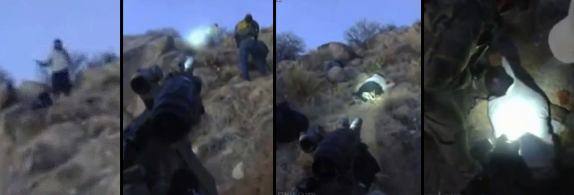
But Boyd was a different kind of animal. The police had been trained, it appears, to see him as a piece of trash, as vermin, as scum not worth the trouble to subdue.
And it’s all on video. A new snuff film from the Albuquerque Police Department. A minute or two of what the poet C.R. Lloyd called “pornographias del muerto.”
Watching it can be a nightmare experience, a peep hole into the Devil’s World. I felt obliged to view it numerous times, so I could be as accurate as possible writing about it. I don’t think I’ll ever forget it.
Such horrendous, gratuitous violence. It could have been a training film for how to be cowardly bullies.
It comes down to this. Six or so Albuquerque police officers and one 38 year old homeless hobo in the foothills of the Sandias. He had a history. Police said they thought he was a paranoid schizophrenic. He is said to have been obnoxious with the police before and once he reportedly broke the nose of a female police officer. And now he was disturbing the neighbors by camping illegally in the foothills.
And that’s what it takes to get unofficially executed in Albuquerque. No death row here. We prefer instant injustice.It's true about bears in the Sandias. They're tranquilized and hustled off to new quarters. Not homeless men, though.
Not them.
Not yet.
But there is movement to end the official summary execution scheme. Additional mental health provisions are among the current suggestions.
Abolishing APD may be necessary, however.
Subscribe to:
Posts (Atom)