I haven't written much about my favorite extraterrestrial planet Mars in quite a while -- primarily because there's not been much to say about it for quite a number of years. The problem -- at least in my estimation -- is the real reluctance of the planetary science community to go against established "knowledge" as promulgated by the Big Men of the Field. This has been true for decades, and one can assume it will be true for the foreseeable future.
But in advance of the release of the new Ridley Scott film, "The Martian," word comes that "flowing water" has been found and confirmed on the surface of Mars. Uhhh. Well....
Sure. Why not?
The streaks that have given rise to the current findings have been known and noted for nearly 20 years, and the "discovery" that they are presently active has been recognized for almost as long. The problem has been that their cause is mystifying. Because of a long-time consensus among researchers that the surface of Mars is too cold and the atmosphere is too thin for liquid water to exist at all, research tended to discount the notion that the streaks (known as linea) were the result of flowing water, or if they were that the water which made them had flowed recently -- which could be any time within the last few million years.
This tendency to discount what seems so obvious has been strong among Mars researchers for many a long year, and it continues today.
The idea that water can -- and does -- currently flow at the surface of Mars, at least intermittently, is still regarded with some suspicion. The idea that other substances may be liquid and flow at current Martian surface temperatures and pressures is generally dismissed entirely.
Myself, I was once a fairly strong advocate of current surface water on Mars as it seemed to me that the visual evidence* of what appeared to be geysers, springs, flows and so on was too strong to be ignored, yet it was ignored. Or the evidence was interpreted so as to preclude water or any other flowing liquid.
(* link is to a site which hosts thousands of images of the Martian surface acquired by the Mars Global Surveyor between 1997 and 2003, images that I and many others scoured intensely as they were posted for various interesting features, including streaks and other signs of current flows.)
After a time, I began to think about other volatiles on the surface that could mimic water -- look just like water but not be water and act almost identically under the current surface conditions.... what substance could do that?
It occurred to me that an aqueous solution of sulfuric acid -- which is stable in liquid form down to around -63C and .05mb atmospheric pressure -- would be an ideal candidate. It would appear to be liquid water, and it would act just like liquid water (apart from its solvent qualities), but it would not be liquid water. It would be battery acid. There would be no easy way to tell from a distance (such as an orbiting satellite or from Earth) just what the substance was. The only chemical difference between sulfuric acid and water is the presence of a sulfur atom and three additional oxygen atoms.
But at the time I was proposing sulfuric acid as a potential surface fluid on Mars, the consensus was that the likeliest fluid -- if there were current fluid flows -- would be water, probably water heavy with salt. Well, it would have to be because only brines can sustain a liquid phase under current Martian surface conditions. Even then, the period of liquid phase would tend to be brief unless the salt content was high.
When the Phoenix Lander exposed a patch of ice directly under the craft, the water scenario brightened considerably. Ice would indicate fresh water (although a brine could freeze at low enough temperatures). But there was a puzzlement: droplets of some fluid appeared -- and stayed -- on the landing struts for quite some time. It was at first assumed that these droplets were water liberated from the ice below by the heat of the retro rockets as the craft landed. But how could it be? The droplets were in shadow, and the temperature in shadow was well below the freezing point of even brines. These droplets appeared to remain liquid for... days, weeks, months. The atmospheric pressure was also low enough that when patches of ice were exposed during digging efforts they sublimated directly into gas once exposed to the air and sunlight. There was no observable liquid phase -- to water ice.
Some other fluid must have been seen on those landing struts, but what? It almost certainly wasn't water.
As analysis continued, salts were observed in the soil, one of the most interesting being perchlorate, used as a cleaning solvent on Earth. It was speculated that perchlorate in solution with water would produce a brine which could withstand surface conditions and remain liquid, and potentially, it could harbor microbial life.
This was actually a quite radical departure from previous "knowledge" about the surface of Mars. After the ambiguous life-detection results of the Viking Landers (c. 1976) a theory got going that suggested that the surface was sterile, and it was sterilized by a combination of some sort of hyper-oxide in the soil (substances which have never been observed) and the ultraviolet flux from the sun which is unimpeded by the Martian atmosphere. This theory was maintained for many years, and proposed that not only was the surface sterile, but it would be lethal to any living thing, including you and me. Simply breathing Mars dust might well be enough to kill you.
I never believed it, but it was the standard model of Mars for many years.
Just as a blood-red surface and brilliant orange-red sky were standard for so long. Though they were false renderings made for publicity, they remained the most frequently seen images of the Martian surface for decades despite repeated calls from the public for more accurate renderings.
The streaks that have caused all the buzz were first seen in the Mars Global Surveyor images in the late 1990s, though there were hints of them long before that. While much of the surface of Mars appears to be static -- except for dust storms and occasional small impacts -- there are areas that demonstrate considerable activity, including dust devils, some features that may be fluid geysers, active sand geysers, snow fall at and near the poles, possible glaciers, apparently explosive deflation of hillsides, land slides, and these streaks. They're found mostly in mid latitudes and equatorial areas mostly along the rims of craters and cliff faces. They tend to be a good deal darker than the surrounding terrain, but in some cases, they are quite a bit lighter. They have been observed to grow quite long and then they stop. Typically they fade away after a few months, and frequently they reappear in the same general areas once the surface temperatures warm up. Usually, they are seen when surface temperatures are between 250K and 300K -- in other words, somewhat cooler than to well above the melting point of pure water ice.
While it seemed possible to those with open minds that these streaks were the result of some kind of water flows, it was very difficult, indeed nearly impossible, to prove. Liquid water could not flow or persist at the Martian surface for any length of time because the temperature and pressure were in most places too low for too long. Thus even if there had been flowing water at the surface in the past, it would have been temporary unless the temperatures and atmospheric pressures were a good deal higher than they are today.
I'm one of those who tends to think that Mars is currently in a warm period, perhaps the warmest it's experienced in the planet's history. I doubt there was ever a warmer and wetter past, and I doubt there was ever an ocean as we would know one. There may have been a relatively heavy ice cover in some -- or many -- areas and there may have been intermittent lakes in many areas. But such water (or other fluid) which appeared at the surface for however long it may have done so came from below in almost every case.
Including those streaks. One of the problems with understanding them is that in most cases they begin at or very near the tops of crater rims and cliff faces. In many cases, their origin is a point source, really undetectable at the resolution of orbiting cameras, so it's impossible to tell just what the source of these streaks is. Somehow the fluid, whatever fluid it is, has to get up to the highest surface level before flowing downslope, sometimes for a kilometer or more.
I've often wondered why the streaks begin at the tops of cliff faces or crater rims rather than taking the easy route and forming at the bottoms where the fluid -- whatever it is -- might pool and be detected as a lake or pond even if ice covered for much of the time.
Actually, there are indications that that happens in various places at various times, but those who study the streaks don't seem to pay much attention to the indications of current ponds and lakes... ah, the division of labor...
Still, there is no explanation for the origin of the streaks at the tops of crater rims and cliff faces rather than their bottoms. The mechanism is thought to be hydrologic pressure from below which could be due to almost anything, Exactly why it manifests where and how it does remains a mystery.
The notion is that the streaks are underlain with a layer of permanent ice and that the flowing water which makes the streaks visible runs over the ice when temperatures at the surface are high enough. Interestingly, atmospheric pressure doesn't seem to play much of a role in the presence or absence of streaks, it's all about latitude and temperature.
There have been indications for many years that much of the surface of Mars is underlain with ice, not solely near the poles where it was expected but all over the planet. In some areas, this ice is very near the surface, essentially at the surface. In others it may be a few meters below. The indications come from hydrogen detection by orbiting spacecraft and the detection of widespread hydrated minerals. The belief is that only water (and ice) could cause these spectral signatures. And of course ice was found essentially at the surface at the Phoenix landing site.
So, there's no absence of ice on Mars, nor is there an indication that this ice is not water ice. I would imagine that it is water ice, and depending on where it is found, it is probably in a highly pure state. Meltwater from these ice deposits might well be potable. Whoo-hoo! Mission to Mars, here we come!
Well, that is unless it is filled with nasty microbes... Is that possible? Sure. There's no sign -- yet -- that such is the case, but it's worth noting that no orbiter or lander sent to Mars since the Vikings in 1976 have carried biology-detection instruments, not even biology inferring instruments. It's worth asking why not, but answers probably won't be forthcoming. Not only have there been no direct biology detection instruments, there have been no instruments which could analyse the soil for the hypothesized hyper-oxides which supposedly sterilized the soil at the Viking landing sites of any organic matter and thus of any biology. There weren't even instruments to measure the ultraviolet flux that was supposed to be a contributing factor in the complete sterilization of the Martian surface.
It seemed as if the hypotheses advanced to explain the failure of the Vikings to detect biology for certain in 1976 were being accepted on faith without even an attempt at verification. To me, as an interested observer, it was bizarre.
It occurred to me, though, that quite possibly the hypotheses of a sterile Martian surface were never accepted (13 pg pdf), and that was why there was no apparent effort at verification. Why verify something you know isn't true? On the other hand, it might have helped to falsify those sterility hypotheses, no?
What has been learned is a sideways falsification, I guess. There are organic materials in the soil, for example, materials which, for whatever reason, the Viking instruments did not detect. There are no signs of hyper-oxides sterilizing the soil. Instead, there are widespread peroxides and perchlorates and salts and significant regions of near-surface ice, all of which indicate the presence of water both historically and currently. The notion that the surface of Mars is dry and dead and sterile is slowly -- painfully slowly -- yielding to a more complete understanding...
The surface of Mars may somewhat resemble a terrestrial desert, but it's not much like the surface of the Earth at all. It mimics... but it isn't the same.
The surface has many signs of flowing and pooling liquid -- both historic and recent/current -- but just what that liquid is or was isn't certain. It is assumed to be water, probably quite briny, but again, it's not certain. It may have been water in some places, whereas something else -- such as sulfuric acid -- may have been the surface volatile in others. There are indications of sulfates and sulfur in various places on Mars, which in combination with hydrogen and oxygen -- both of which are in fair abundance -- can produce various strengths of sulfuric acid. As an aqueous solution, it would behave almost like water -- except that it would remain liquid at very low temperatures and pressures, though eventually it would sublimate away like water.
So. The breathless announcement last week that "flowing water" had been "discovered" -- or rather confirmed -- on Mars has to come with a caveat or two. Those streaks have long been known and have long been speculated to be caused -- somehow -- by water flowing downhill. But how or why the water involved would be pumped to the tops of cliffs and crater rims in order to be released to flow down the cliffs and into craters is still a mystery. It doesn't really make hydrological sense, but it seems to be what happens.
Hydrated minerals/perchlorate salts have been spectrally found in association with the streaks but only when they are dark, not when they are faded or light. I have a problem with that in that hydrated minerals and perchlorates appear to be commonplace on the surface, found nearly everywhere. If the fading or lightening of these streaks is due to evaporation/sublimation, then the presence of salts should be stronger not weaker when the streaks have faded or lightened. But not what's found.
There has apparently been no spectral signature of water found in association with these streaks, and that's interesting all by itself. Water is simply assumed. Not necessarily wise given the way Mars deceives and mimics.
I suspect that we will not actually know about the surface of Mars until and unless people go there to measure and test and explore, and somehow survive the encounter. That adventure has been long-delayed, but what with all these new findings of "flowing water" -- and the blockbuster movie opening tomorrow -- you never know.
Showing posts with label Space the Final Frontier. Show all posts
Showing posts with label Space the Final Frontier. Show all posts
Thursday, October 1, 2015

Sunday, December 22, 2013
The 6th World
 |
| The 6th World Screen grab |
I realize Ian grew up in a colonialist/imperialist household, as he says his father was a minor functionary in the British Raj as India threw off its colonial shackles at the end of the 1940's, when with considerable bloodshed and dislocation, Pakistan divorced from India.
Yes, well. From what I've read Ian say about it, I get the impression he -- or his father -- believe India and Pakistan would have been better off under continued British rule and it was a mistake for them to insist on complete independence from the Raj.
I've read many British colonialists and imperialists who claim essentially the same thing. To me, it's an utterly bizarre position, but to many of those most directly involved -- especially in the context of Pakistan's separation from India -- it makes perfect sense to assert that a better world was possible under a benign British rule than the jibbering natives could ever hope to have on their own.
We sometimes hear the same claim made about how the United States might be better off -- certainly more civilized! -- if it had not become independent of Britain, and we see the same premise expressed in Africa (with the singular exception of the Union of South Africa -- which serves as the counter-example) when the former colonial powers send their troops to "restore order" among the always restive Natives.
Colonialism and imperialism are the problem, and more of it is not the solution.
We attended a Navajo film festival in 2012 as part of the activities during Indian Market Week in Santa Fe, and one of the films we saw was called "The 6th World." I really liked it because it showed such a different approach to the question of establishing a human presence Out There, in this case on Mars. The pioneers may have used the terminology of colonial expansion and empire, but they were doing something else entirely. Something most Anglos can't even imagine.
Compare and contrast with the Zubrinite vision of Mars colonization...
Sunday, May 19, 2013
"Space Hoser, Eh?" -- Canadian Astronaut Chris Hadfield Does Bowie on the ISS
I don't usually post things that go viral (when was the last time you saw a cat video on this blog??), but in this case, the video is moving enough and the vicarious thrill of being in space is great enough that I'm happy to pass it on:
Monday, February 25, 2013
Mars (Still) Awaits
 |
| Mars! Bitches! |
Getting to Mars Edition -- Saturday was PBS Science Cafe Day at Los Poblanos in Albuquerque. We've been signing up for this event pretty much since we've been in New Mexico. It's a rather easy-going opportunity to get together with some like-minded coots and other space and science junkies (of which there are many in NM) and hear some talk about what's happening in the field.
Saturday, the field was "Mars and how to get there." Sending humans to Mars, it was confidently asserted, has been a Dream of Mankind for Centuries. Has it? Being the skeptic I am, I questioned the premise right off. Has Mars been a long-sought destination for Mankind for... centuries? I think not. The Destination factor of Mars has only been around since the age of rockets that made probing the Solar System and beyond a possibility -- if not always a probability. But the issue wasn't really how long Mankind has set its sights on the Angry Red Planet.
The issue was "Why Anyone Would Want To Go To Mars?" And once anyone decided to go, how would they do it?
These issues are being intensely wrangled at various sites in New Mexico as well as around the world. One of the visual aids brought by the speaker was the April 30, 1954 issue of Collier's Magazine featuring articles on Mars by Wernher von Braun, Cornelius Ryan and Fred Whipple, but mostly featuring the striking cover art by Chesley Bonestell seen above.
Well, yes. Without the cover art on popular magazines, and without the enormous number of science fiction movies produced in the 1950's, I sincerely doubt many of us would give Mars more than a passing thought. If that.
Because there was so much popular media focus on Mars when we were children, however, the planet has become a kind of ingrained Place In Space for a lot of people of my generation. But I've got to wonder: do younger people, especially much younger people, give a good gott-damb?
Plenty of spacecraft have visited Mars during my lifetime. The statistic we were given yesterday -- if memory serves -- was "Earth 15, Mars 24" (as in fifteen successful Mars-destination spacecraft, twenty four unsuccessful.) There have been many discoveries. But oddly there have been none that either confirm or refute many of the various theories about Mars and its potential to harbor biology that have cropped up over the years.
Especially, there has never been a direct effort to confirm (or refute, for that matter) the rather baroque theories of super-oxides in the soils which were offered to account for the failure of the Viking missions to discover life or even organics on the surface of the planet way back in 1976. Nor has there been any direct effort since 1976 to confirm or refute the supposed sterility of the Martian surface.
This has long struck me as very odd behavior by the planetary sciences. The Viking biology results were enigmatic and contradictory to say the least; however, the scientific consensus at the time was that the surface was sterile, and the theory offered was that a combination of soil super-oxides and ultraviolet light destroyed carbon compounds as they formed or arrived on the surface so that there were none to found. A priori, that meant there was and could be no biology on the surface. Case closed. Move on.
While this consensus may be correct, it has never been tested. No trace of super-oxides have ever been sought or found at the surface of Mars, and no measurement of ultraviolet flux has ever been made at the surface. The presence of liquid water -- or some liquid at any rate -- long confidently asserted to be impossible at the surface, has been rather dramatically confirmed in a little known series of Phoenix lander images that show droplets of something on the landing struts of the spacecraft.
Personally, I'm quite leery of asserting that it is "water" in the sense that most of us would recognize it. Due to the fact that the Phoenix landed on a patch of ice which appears to have sublimated and condensed in response to the heat of the landing rockets, the proposition that it is water seen on the landing struts makes sense; yet the behavior of the droplets -- appearing to remain on the strut and remain liquid throughout the mission -- is not the behavior expected of water at the surface of Mars. Any water that was released by the heat of the rockets striking the ice below the lander should have either sublimated immediately or if recondensed, it should have refrozen within minutes; there should have been no detectable liquid phase at all.
And yet, there those droplets are, and there they persisted. How could that be?
I proposed that it's not water. It is instead a brine or an acid that remains liquid at typical Martian temperatures and pressures, and that furthermore, many of the apparently water carved surface features on Mars were actually the result of flowing brines or even a strong solution of sulfuric acid. There may never have been much water -- as such -- on Mars throughout its entire history and there may be very little there now, and what there is may all be frozen as ice.
I could go on at great length about these matters, and have done so in other fora, but yesterday it was the turn of New Mexico Space History Museum Director Chris Orwoll to hold forth on the topic of how to get to Mars and why bother -- oh, and his own journey from submarining in the Navy to his current perch at the museum outside of Alamogordo.
Getting there is being worked out as we speak, the major difficulties being the hazards of cosmic rays and meteoroids, both of which have damaged near-Earth orbiting space satellites and laboratories, and the sheer amount of stuff that has to be carried on the voyage and will be necessary to pre-position on the surface of Mars to supply the needs of landing crews. It's much simpler just to send a robot, as of course has been done many times in the past and will continue to be done for the foreseeable future. Getting people to Mars -- even though it is quite feasible right now -- may be a long time in coming, in part because it is very expensive, there is little current impetus for additional manned exploration of the solar system, and public sector budgeting for space exploration looks rather dismal indefinitely. The private sector is not picking up the slack.
While it wasn't mentioned yesterday, there's a rather good two part teevee movie out of Canada that dramatizes some of the issues involved in manned expeditions to Mars called "Race to Mars" which I recommend as a primer. While I enjoy the many Mars movies made in the past, they tend to be locked in their own time period or to foster highly dramatic but not necessarily apropos story-lines.
Documentaries as opposed to dramatizations often leave out human nature and how people respond to crisis, focusing more on hardware than the people taking the risks and making the voyage. "Race to Mars" strikes an interesting balance and features relatively recent (well, up to 2007) discoveries and understanding of the Martian surface and conditions.
Getting there is almost the easy part. What to do once there is the hard part. The final scene in "Race to Mars" shows the establishment of a little colony in Dao Vallis, where the fictional pioneering Olympus expedition had struck water -- and lost a crew member when the water gushed out as a snow and ice geyser destroying the drilling apparatus.
Water, of course, is the prime necessity for any human colonization of Mars, but whether there is any currently available -- even deep underground -- in Dao Vallis is something of a mystery. Dao is an ancient outflow channel in the Southern Highlands, arising near the Hadriaca Patera volcano and debouching into the Hellas Basin, the deepest hole on the planet. There likely has been substantial water and ice in this region, but whether they are there now -- at least near the surface -- is doubtful primarily because these features are very, very old, dating back nearly to the origin of the planet.


There are much more recent "watery" features, and as noted above, the Phoenix craft actually landed in 2008 on near-surface ice and released something ("") that stayed liquid at the surface for quite some time. If there is water to be found on Mars today, it is likely within meters if not centimeters of such surfaces -- high in latitude, low in elevation.
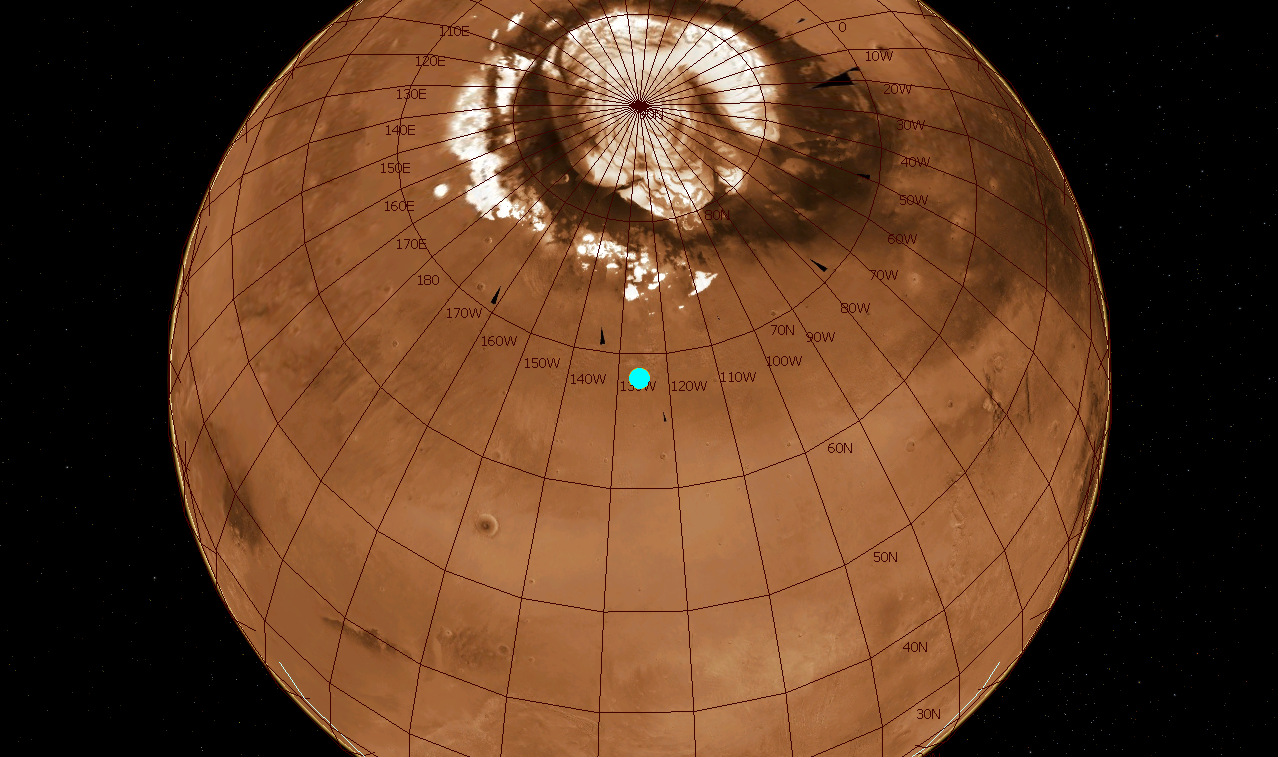
On the other hand, the Hellas Basin, Dao Vallis, and the surrounding terrain are relatively low latitude (ie: in places much nearer the equator than the pole) and low elevation (the lowest on the is planet found in the Hellas Basin) and are more likely to sustain liquid water near the surface than any other location in the Southern Highlands.
It was patiently explained to me by a planetary scientist some years ago that the Hellas Basin is unlikely to contain any liquid water today (though it may have done so in the past) because of an ongoing process of freeze-drying, similar to what happens in a frost-free refrigerator freezer. Evaporation and sublimation such as is likely to take place on Mars can maintain a frost and fluid free environment indefinitely even at relatively high temperatures and and atmospheric pressures.
The basic question remains, "why go to Mars?" And the answer is always the same: "It is human nature to explore and go where no one has gone before." Once the urge to explore fades, the progress of civilization is reputed to end.
Here's the problem, though. Too many times, those who are most intent on exploration of new frontiers are the very ones who threaten -- and often cause -- the extinction of the civilizations they encounter and/or the ruin of the pristine environment they claim.
I suspect Mars is such an inhospitable place -- whether or not it hosts native biology -- that any effort to colonize the planet from the Earth will be fraught with peril and failure to no apparent object. No one expects to find gold or jewels or a functioning civilization on Mars -- all of which were impetuses for exploration and conquest on Earth. There is no one to exploit. There are few or no resources to control. There is almost nothing that could sustain a modern expedition let alone a comfortable lifestyle on Mars. Whatever is found there in the by and bye, it won't be sufficient to sustain a viable human society. At least not as we know it.
The closest analogues on Earth to potential Mars colonies are the science outposts on Antarctica and the telescopes high on the Atacama Plateau in Chile. Neither is even remotely self-sustaining, nor could they ever be in the future. Such is almost certain to be the case on Mars should a colony ever be established there. The question is not so much one of getting there, it is more about maintaining a presence once there.
At one time, after all, it was widely believed -- or at least said -- that conditions at the surface of Mars were almost certainly almost instantly lethal to any and all carbon-based biology; even the slightest contact with the surface dust could be and probably would be a death sentence to terrestrial visitors. Surely the ultra violet flux and lack of protection from solar radiation and cosmic rays would take care of any survivors of Mars dust exposure.
The lethality of the Martian surface is yet to be proved, but it is still not a hospitable place no matter what.
Almost 60 years ago in the Collier's article linked above, Wernher von Braun, the father of (Nazi)German rocketry and the American space program predicted that it would take a century for Americans to prepare sufficiently to undertake a manned expedition to Mars. That was pre-Sputnik, when there was no American or international space program to speak of.
The space program has once again fallen on (relatively) hard times. NASA lacks focus and budgeting for major space exploration programs is not likely to be abundant for many years to come -- if ever again.
Sixty years ago there was no lack of imagination, however, and it seems to me that we've lost the ability to envision the future. Without that imagination and vision, progress as we have known it ceases.
So just what in tarnation is this thing on Mars, anyway?
 |
| Shiny Thing On Mars -- Dubbed The Faucet Handle |
Saturday, August 11, 2012
In Defense of Percival Lowell
I've spent some time looking at Mars in a telescope and looking at other people's pictures of Mars taken with their telescopes, and I've spent some time looking at Percival Lowell's drawings of Mars from which he derived his famous (or infamous) interpretations about canals and civilizations. I've also been to the Lowell Observatory in Flagstaff, AZ and heard the stories they tell there of his observational acumen.
No one claims there are canals on Mars now, but for some time it has been customary to denounce Lowell's observations as "optical illusions," and to declare that there is "nothing really there" where he said he saw canals. Carl Sagan was among those famous for doing it.
And I never felt it was entirely fair. Lowell was said to have been one of the finest planetary observers of his era, though he lacked academic training in the field. His observatory was located in one of the finest observing locations in the country, and Lowell Observatory is still one of the nation's premiere observatories and research centers.
In an earlier post, I juxtaposed an illustration of Lowell's freehand drawing of what he saw in the Solis Lacus region of Mars in 1896 with three telescopic views taken with a CCD camera in 2006, 110 years later in the UK. The similarities are striking.
There are differences to be sure. Especially the size of the "pupil" of the Solis "eye." Lowell's is small and discreet, the "pupil" in the CCD image is large and extended. But many of the other features correspond almost exactly. Those features we now know include dark-floored craters, "fossae," dark and light terrains, volcanoes, and clouds among other things. I was able to toggle easily between the images, so it was startling to see the correspondences and to spot more of them each time I toggled.
Among the most striking correspondences is the appearance of lines on the CCD images, several of them in remarkably similar positions to those delineated by Lowell.
Side by side comparison; features seen on the CCD image are marked with arrows on the Lowell drawing [Note: South is at the top of the images.]
If you are able to relax your eyes a bit, you will see many -- many! -- linear markings on the CCD image, both light-toned and dark, some of which correspond to Lowell's markings, some of which don't. The correspondence of spots between the drawing and the CCD image taken more than 100 years later is remarkable, especially given the differences inherent in the, telescopes, the techniques and the tendency of the eye and hand to diverge when attempting to record visual impressions. (Think of courtroom drawings.)
The faint linear markings on the CCD image are NOT "optical illusions." They are on all the CCD images from that sequence so they are real in the sense that the CCD camera was able to record them. But there are many other CCD images taken by others around the same time that do not show linear markings as this one does.
What gives?
The "optical illusion" argument tends to fail when CCD images show linear markings similar to those Lowell recorded 100 years before. So other arguments have been put forth proposing that the linear markings are actually a telescopic artifact. Something in the optics of the telescope makes them "appear." This argument was offered in part because other astronomers also reported seeing linear marking corresponding to Lowell's canals, and Lowell for his part reported linear markings on the surface of Venus and Mercury when he trained the telescope on them.
I'm more inclined to accept the optics argument than I am the illusion argument, but even so, it seems to me there's something about the surface of Mars itself that allows and requires the appearance of linear markings in some telescopes but not in others. Given the fact that Lowell's telescope was a huge 24" refractor, and most of the modern amateur CCD images are made through a much smaller reflector or Schmidt/Maksutov Cassegrain telescopes, the "optics" argument becomes difficult to fathom.
[Note (as of 9:30pm Friday, August 10, 2012): a huge limb just broke off a eucalyptus tree down the street, blocking the road, exploding street lamps and power transformers, and causing much to do in the neighborhood. Power went out briefly, but there are wires crossed all over, and the exploded transformer is a big problem. Will probably lose power again as repairs are made. That tree has been there since God was a boy, and it periodically drops fair sized limbs, but this time the branch that snapped was enormous. Good thing nobody (that we know of) was under it at the time. Another big tree on the same property fell a few years ago in a storm, destroying the garage and badly damaging a neighbor's house. A neighbor said he witnessed the whole thing tonight, and he thought it was the end of the world...]
The point I'm making is that Lowell was a very accurate observer who honestly recorded what he saw when he observed Mars. Many of his contemporaries saw similar features. And similar features can still be seen and recorded on the surface of Mars with much different telescopes. I have seen some of them myself. It has never looked to me like the surface is crisscrossed with canals, but it is quite possible to resolve straight lines -- both dark and light colored -- that appear to connect various dark and light spots.
It's not an illusion.
There is something which produces the appearance of these lines, and given the absolute abundance of linear features of all kinds on the surface of Mars -- some of which have never been adequately explained, especially the "searchlight" and other linear features that Mariner 9 revealed, many of which are no longer seen in orbiter images -- it seems worth investigating how the surface features, the Martian atmosphere, the terrestrial atmosphere and telescopic optics all interact to produce the appearance of "canali" as described by Giovanni Schiaparelli in 1877.
The image above is from Google Mars and shows some of the most prominent linear features on the surface, the Cerberus Fossae, a paired set of dark-floored trenches, some 1600 km from one end to another, that are still something of a mystery. I did a brief survey of "fossae" using Google Mars, and there are literally thousands of examples, dozens of them 1000km long or more.
The conventional wisdom is that relief on the surface of Mars cannot be detected with Earth-based telescopes even today, and that the various and numerous fossae on the surface are so narrow -- at most, a few kilometers wide, in the case of the Cerberus Fossae above, only about half a kilometer -- they cannot be resolved by Earth-based telescopes. While volcanoes and craters have long been seen on the surface of Mars, including the vast Valles Marineris canyons, they weren't recognized for what they were because it was impossible to detect surface relief. In fact, prior to spacecraft explorations, it was assumed that Mars had very little surface relief because none could be detected.
This is an unlabeled US Air Force map of Mars from 1962, which will give you an idea of how widely the linear features of Mars were accepted prior to the arrival of spacecraft:
I got the map from this site where the development of Mars mapping is explored. Lowell's maps of Mars are not nearly as sophisticated but they are not dissimilar.
Lowell's map of Mars, c. 1894 for comparison:
Some observers have seen surface features very much like those recorded by Lowell throughout the history of telescopic observations, and some of them can be detected by modern CCD cameras. The appearance of linear markings on the surface of Mars is quite real. They are well and truly there, and they are there at many different scales.
In another post, I may get into the scale issue, for in some ways it may be a key to understanding what is going on.
[Today and tomorrow are travel days....]
No one claims there are canals on Mars now, but for some time it has been customary to denounce Lowell's observations as "optical illusions," and to declare that there is "nothing really there" where he said he saw canals. Carl Sagan was among those famous for doing it.
And I never felt it was entirely fair. Lowell was said to have been one of the finest planetary observers of his era, though he lacked academic training in the field. His observatory was located in one of the finest observing locations in the country, and Lowell Observatory is still one of the nation's premiere observatories and research centers.
In an earlier post, I juxtaposed an illustration of Lowell's freehand drawing of what he saw in the Solis Lacus region of Mars in 1896 with three telescopic views taken with a CCD camera in 2006, 110 years later in the UK. The similarities are striking.
There are differences to be sure. Especially the size of the "pupil" of the Solis "eye." Lowell's is small and discreet, the "pupil" in the CCD image is large and extended. But many of the other features correspond almost exactly. Those features we now know include dark-floored craters, "fossae," dark and light terrains, volcanoes, and clouds among other things. I was able to toggle easily between the images, so it was startling to see the correspondences and to spot more of them each time I toggled.
Among the most striking correspondences is the appearance of lines on the CCD images, several of them in remarkably similar positions to those delineated by Lowell.
Side by side comparison; features seen on the CCD image are marked with arrows on the Lowell drawing [Note: South is at the top of the images.]
 |
| Side by side comparison of Mars Solis Lacus quadrant left drawing by Percival Lowell, c. 1896 CCD telescopic image by D. Peach, 2005 Correspondences noted on Lowell drawing |
The faint linear markings on the CCD image are NOT "optical illusions." They are on all the CCD images from that sequence so they are real in the sense that the CCD camera was able to record them. But there are many other CCD images taken by others around the same time that do not show linear markings as this one does.
What gives?
The "optical illusion" argument tends to fail when CCD images show linear markings similar to those Lowell recorded 100 years before. So other arguments have been put forth proposing that the linear markings are actually a telescopic artifact. Something in the optics of the telescope makes them "appear." This argument was offered in part because other astronomers also reported seeing linear marking corresponding to Lowell's canals, and Lowell for his part reported linear markings on the surface of Venus and Mercury when he trained the telescope on them.
I'm more inclined to accept the optics argument than I am the illusion argument, but even so, it seems to me there's something about the surface of Mars itself that allows and requires the appearance of linear markings in some telescopes but not in others. Given the fact that Lowell's telescope was a huge 24" refractor, and most of the modern amateur CCD images are made through a much smaller reflector or Schmidt/Maksutov Cassegrain telescopes, the "optics" argument becomes difficult to fathom.
[Note (as of 9:30pm Friday, August 10, 2012): a huge limb just broke off a eucalyptus tree down the street, blocking the road, exploding street lamps and power transformers, and causing much to do in the neighborhood. Power went out briefly, but there are wires crossed all over, and the exploded transformer is a big problem. Will probably lose power again as repairs are made. That tree has been there since God was a boy, and it periodically drops fair sized limbs, but this time the branch that snapped was enormous. Good thing nobody (that we know of) was under it at the time. Another big tree on the same property fell a few years ago in a storm, destroying the garage and badly damaging a neighbor's house. A neighbor said he witnessed the whole thing tonight, and he thought it was the end of the world...]
The point I'm making is that Lowell was a very accurate observer who honestly recorded what he saw when he observed Mars. Many of his contemporaries saw similar features. And similar features can still be seen and recorded on the surface of Mars with much different telescopes. I have seen some of them myself. It has never looked to me like the surface is crisscrossed with canals, but it is quite possible to resolve straight lines -- both dark and light colored -- that appear to connect various dark and light spots.
It's not an illusion.
There is something which produces the appearance of these lines, and given the absolute abundance of linear features of all kinds on the surface of Mars -- some of which have never been adequately explained, especially the "searchlight" and other linear features that Mariner 9 revealed, many of which are no longer seen in orbiter images -- it seems worth investigating how the surface features, the Martian atmosphere, the terrestrial atmosphere and telescopic optics all interact to produce the appearance of "canali" as described by Giovanni Schiaparelli in 1877.
 |
| Cerberus Fossae, set of deep troughs with dark interiors, about 1600 km long |
The conventional wisdom is that relief on the surface of Mars cannot be detected with Earth-based telescopes even today, and that the various and numerous fossae on the surface are so narrow -- at most, a few kilometers wide, in the case of the Cerberus Fossae above, only about half a kilometer -- they cannot be resolved by Earth-based telescopes. While volcanoes and craters have long been seen on the surface of Mars, including the vast Valles Marineris canyons, they weren't recognized for what they were because it was impossible to detect surface relief. In fact, prior to spacecraft explorations, it was assumed that Mars had very little surface relief because none could be detected.
This is an unlabeled US Air Force map of Mars from 1962, which will give you an idea of how widely the linear features of Mars were accepted prior to the arrival of spacecraft:
 |
| USAF map of Mars, c. 1962. Clickage will embiggen. |
Lowell's map of Mars, c. 1894 for comparison:
_-_Plate_24.jpg) |
| Map of Mars drawn by Percival Lowell, c. 1894 |
Some observers have seen surface features very much like those recorded by Lowell throughout the history of telescopic observations, and some of them can be detected by modern CCD cameras. The appearance of linear markings on the surface of Mars is quite real. They are well and truly there, and they are there at many different scales.
In another post, I may get into the scale issue, for in some ways it may be a key to understanding what is going on.
[Today and tomorrow are travel days....]
Saturday, April 21, 2012
Remember Where You Are
For Earth Day
NASA time lapse views of Earth from the International Space Station.
Music: "Walking On Air" by Howard Blake.
http://youtu.be/hWz5ltE_I4c
NASA time lapse views of Earth from the International Space Station.
Music: "Walking On Air" by Howard Blake.
http://youtu.be/hWz5ltE_I4c
Thursday, July 21, 2011
The End
It's Over. The manned space program called the Space Shuttle has ended. Something that meant so much to generations of Americans has ended, and there is nothing comparable to take its place.
It's hard to express how frustrating that is for so many people who looked to the Space Program as a means to further all our horizons. Now that it is over -- well, let's be honest, manned space flight has been outsourced to Russia or commercialized as a thrill ride taking off from New Mexico -- what will expand our horizons now?
I don't have an answer, but the missions that might have been will be missed.
Farewell Atlantis Landing:

Rocky Jones, Space Ranger (1954): (probably the first space show I saw on teevee)
And a version of the grand docking scene in 2001: A Space Odyssey, cobbled together from fragments of 1950's science fiction movies (including sequences of Willy Ley's famous rotating space wheel) set to the music of Strauss's Blue Danube Waltz. (Can't embed the actual scene from the Kubrick movie, but if you have a copy of it, go watch it.) What happened to the Future?
A link to Kubrick's master scene:
http://youtu.be/U8Q3X5Gw5I4
What ever happened to Pan Am Grip Shoes? What ever happened to Pan Am??!
Tuesday, February 15, 2011
Subscribe to:
Posts (Atom)