We spent the day in town yesterday, starting at a New Mexico PBS Science Cafe at the National Museum of Nuclear Science and History, a place we've been meaning to visit for years but never have.
The topic was the nuclear meltdown at Fukushima Daiichi some two years ago, and the speaker was Dr. Ronald Knief, Nuclear Engineer and Principal Member of the Technical Staff at Sandia National Laboratories (pdf link) and Associate Professor of Chemical and Nuclear Engineering at the University of New Mexico.
Yes, well.
He's been at most of the major meltdowns in the last few decades, including Three Mile Island -- where he said he spent ten years -- as well as Chernobyl, and Fukushima.
Just lucky, I guess.
He explained the process of nuclear power generation very well, though I suspect that most of those in attendance knew how a reactor worked as well as he did as there are a lot of attendees at these things from the nuclear labs and facilities that dot the area. You can't truly escape Nuclear Science culture here in New Mexico, any more than you can escape the Spanish, Indians and the artists, and the truth is, we don't try.
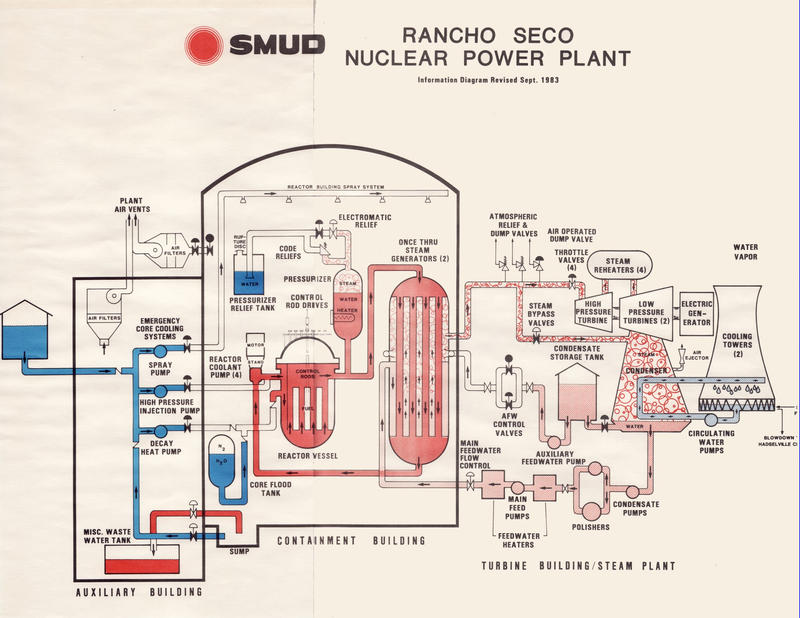
Having lived many years in California in the shadow of a nuclear power plant which was the twin of Three Mile Island -- and which ran into so many malfunctions and shutdowns and whatnot that eventually voters decided to shut it down permanently and decommission it, much to the relief of residents, and (perhaps surprisingly) much to the relief of their pocketbooks in the end -- I was fairly familiar with operations of a Three Mile Island kind of reactor, but Fukushima Daiishi was not designed like the reactors at Three Mile Island.
Instead, the Japanese plants were like the Oyster Creek reactor in New Jersey. It appears from the schematics that these are much more complicated plants than those at Three Mile Island (or Rancho Seco), and the Oyster Creek model appears to be more obviously -- I mean really obviously -- dangerous. Many more things can go wrong, and once they go wrong, whoopsy!
Yet our speaker yesterday, while not making light at all of what happened at Fukushima, didn't seem to see it that way. With all the redundant safety precautions built into the plant, and with the unexpected severity of the earthquake and tsunami, the plant had performed very well under the circumstances, the explosions that occurred were "just as designed", and the release of toxic nuclear material was minor. The only plant workers who died, he said, died as a result of the tsunami, not from release of radiation or toxic nuclear material. More people, he said, were at risk in the evacuation than from the plant itself, and up to a thousand actually died in the evacuation, he said. Given the 25,000 dead and missing from the natural disaster, the losses due to the nuclear accident were minor. Perspective, people!
He showed charts and graphs that demonstrated just how minor the release of nuclear radiation and toxic material was and is, and how workers at the plant have never really been exposed to high levels of radiation, as they were, for example, at Chernobyl. The Chernobyl meltdown was orders of magnitude worse, he said.
Most of those in attendance seemed to accept his assessment -- he is a world-renown nuclear expert after all -- but some were quite disturbed by it. Or rather, by the implications of it. I asked at one point whether -- since according to him there are no health risks from the destruction of the plant -- whether the residents of Fukushima Town and the rest of the evacuation area had been allowed to return. He danced around an answer, saying he thought maybe people had been allowed to return to their homes in the outer evacuation area, but he wasn't sure, and that in Fukushima and closer in, he thought people were allowed day trips in -- to get their things and whatnot -- but he didn't think they were allowed to stay. I asked if he could estimate how close to the plant people are allowed to live; he said he couldn't. One other attendee said she thought it was 20 kilometers (12 miles). He didn't dispute it. In other words, the evacuation zone is still in effect, despite the lack of ill-effects from radiation and contamination -- according to Knief -- due to the Fukushima disaster.
He said it would easily take 40 years or more to complete the clean up of the plant, while clean up at Three Mile Island "only" took ten years. This is rather striking. Of course we were told there was no significant radiation or toxic leak from Three Mile Island, either, yet it took ten years to clean it up. We are now being told that there have been no significant radiation or toxic leaks from Fukushima Daiichi, and it will take a minimum of 40 years to clean it up.
Great.
Another attendee said (all quotes in this post are paraphrases), "You've pointed out that 'nobody could have anticipated' the severity of the earthquake or the height of the tsunami, yet any graduate student could easily have done so given the fault lines near the site and the history of tsunamis in Japan, some of which have been a good deal higher than the one that overwhelmed Fukushima. Any graduate student could have predicted what happened. Yet the government of Japan and the experts at TEPCO couldn't?"
Knief said, "They might have, I suppose, but they didn't. They designed for the worst they thought would happen, and they were wrong. But their design worked very well until the plant lost power, and there was nothing they could do about that..."
According to what we were told, the plant lost power because the reactors themselves shut down automatically when the earthquake hit. The transmission lines for power from other sources were knocked out by the earthquake as well. The diesel generators at the Fukushima site kicked in as they were supposed to when the power went off, but within half an hour, the unexpectedly high tsunami hit, swamping the generators and knocking them out of commission. The final back up was a series of storage batteries that only had a few hours' charge, and there was no way to recharge them. Once the batteries were exhausted, there was no power at the plant. A "station blackout." TEPCO attempted to get new generators to the plant but was unable to due to traffic and destroyed roads. The tsunami had also washed away the fuel storage tanks for the generators on site. So even if they had been able to get the generators to Fukushima, there was no fuel for them and they would have been useless.
So things followed their natural course. Three of the reactor containment buildings exploded -- as they were designed to do we were told -- due to the build up of hydrogen vented into the containments from the reactors as they heated up from lack of cooling water. One of the reactors' cooling water toruses was breached and contaminated water was released into a holding tank below. There was a fire in a few of the spent fuel rod tanks, but the fire was contained, and there were few/no toxic releases. On and on.
The plant is in cold shutdown now and clean up is proceeding. Nothing to see here, please carry on for the next 40 years or so...
All the other nuclear plants in Japan have been shut down as well, and alternative fuels are proving to be very expensive, so he thinks that the undamaged nuclear plants should be returned to service; there may be a slight risk, but there is a trade-off in that the cost of running electric plants on natural gas or oil is so high that the risk may be worth it.
One attendee questioned the validity of Knief's charts and graphs showing no health risk at all from radiation and toxic materials released from Fukushima. "Has the media been hyping the situation over there?" He said, "Yes, it has." "How?" she asked. The response was essentially that there have been no adverse affects to the health of individuals near the plant, and that experience from other instances of radiation exposure (including Hiroshima and Nagasaki, which he said are really the driving psychological events behind the hype and the fear of the Fukushima event) indicates that a certain level of low dosage radiation could be healthful.
By this point, some people were getting pretty annoyed, so the open discussion was shut down, but Knief stuck around for private consultation.
We took the opportunity to tour the museum, which we found to be in its own way quite as annoying as the Science Cafe speaker. Well, "annoying," is that the right word?
Perhaps not. Evocative. Aggravating. Propagandistic. Stomach churning.
Anyone who grew up under the threat of instant incineration from nuclear annihilation like we did is going to be... moved, and quite possibly sickened, by the accumulations and displays of bombs (at least their casings) and missiles and planes and all the other panoply and mechanisms of nuclear war housed at the museum.
Worse, at least in my view, was the justification of it.
"We did these things and had these weapons because of the threat from the Soviet Union, and anyone who questioned that threat (such as J. Robert Oppenheimer) deserved what they got. Shut up."
I'd seen many B-52s in flight and on the ground in my time (you couldn't escape them living near an Air Force base, especially during the Vietnam War) but I'd never been that close to one. The one on display is set up as if it were being loaded with nuclear tipped guided missiles, and when you think about it, you can't help shuddering.
In the background by the fence it looked like there was a bomb casing such as the one Slim Pickens rode down in "Dr. Strangelove."
There were all kinds of missiles on display including put-together and dismantled ICBMs, which again, I'd never seen close up. There were random parts of a B-47 stacked up on the ground, and the conning tower of a nuclear submarine which they are raising money to restore and put on display. There was the obligatory nuclear cannon. There was a B-29 next to the B-52, looking quite diminutive and modest by comparison.
Every size and type of nuclear device, from The Gadget of 1945 and the Trinity test, to the tiniest hand-carried bomb (57 pounds, launchable from a bazooka-like apparatus), to the most hideous looking hydrogen device, to a couple of the "broken arrows" -- nuclear weapons, whoops!, lost from planes or otherwise gone astray... was on display, and in a corner was an old teevee playing a loop of Civil Defense films from the 1950's, in a mock up of a fallout shelter from the era, stocked with barrels of "Drinking Water", and cans of "Food". Only one cot, though.
Yes, well.
Propaganda posters, nuclear cars, trains, planes, and nuclear medicine were all highlighted. In the "lounge" -- decorated with Mid-Century furniture and other items -- was playing one of the Frontline videos of the Fukushima disaster. How about that.
I noted that young adults wanted to have their pictures taken with the bombs, especially the Fat Man and Little Boy mockups. Older people were... either quiet or trying to laugh off what they were seeing.
Was it real? Did we really go through this?
Trinity Site functions as a memorial. There isn't even a hint of celebration there. When people approach the site in a celebratory or expectant mood, they leave in solemnity bordering on depression. As they think about what began there, there is no escape from the psychological horror of it.
Despite his obvious enthusiasm for nuclear power Knief did seem to recognize the severe psychological effects of the various disasters that have accompanied the development of nuclear power and nuclear weapons, and to his credit, he didn't try to dismiss them.
Then we went to yet another literary event...
[I'll try to provide some links later... right now, we're getting ready for another literary afternoon...]