There is talk that New Mexico's economy is "turning around," this despite the continuing federal budget cutbacks due to the sequester and the various local and state government financial difficulties due to the Permanent Recession, the housing market collapse, and other more subtle -- and frankly more New Mexican -- factors; for example, The Drought.
But SpaceX signed a deal at the Spaceport the other day, so things are looking up. And Richard Branson isn't bugging out on the Spaceport like he seemed to be doing, so what's the problem?
Supposedly, private sector hiring and employment are up for the first time in a long time, and government employment is stable -- so long as you don't count the sequester. In our own neighborhood, two of the long time empty places seem to be occupied again, or they soon will be, and another one is possibly going on the market shortly. So may be...
Things are looking up.
I've been reading a novel called "Not As It Seems," by a local writer, Ed Chavez. In it, he describes a drought in this area that began in 1941 and didn't break for 16 years. Locals feel we're in that kind of drought again, perhaps one that will last longer -- who knows, what with Climate Change and all -- and just like before, there will be massive social changes because of it. Part of the likely change is impoverishment.
Things may be looking up in certain sectors and for certain people, but out here in the country, we see clear skies, or clouds that try but don't drop any rain, and we see parched and seer landscape all around and dust and grit filling the air, blowing off the plowed but still barren farm fields. The signs are there, and those who remember the 1950's drought are feeling the weight of history. They know what could happen.
The Rio Grande is already dry below Elephant Butte, and water tables are dropping along the valley limiting irrigation water. Much of Southern New Mexico's commercial farming will be impossible this year -- and for how many more years to come? Nobody knows.
Many people have long pointed out how unsustainable Albuquerque is even in good times, but the city keeps trying to grow. It must do so under the current economic and political regime, a regime that doesn't accept "sustainability" as a fundamental principle -- as opposed to a temporary fashion. "Growth" is the only principle recognized. And perpetual growth is unsustainable.
Albuquerque is actually a relatively modest example of civic unsustainability. Phoenix, Las Vegas (NV), even Los Angeles itself strike me as more fraughtful examples, but we may see a prelude in Albuquerque to what could be in store for many cities in the Southwest and elsewhere as a new weather regime settles in for the long haul.
But things are looking up!
Albuquerque has the advantage of being divided into sectors and ancient barrios and villages. What is now a bloated cityscape grew from tiny beginnings more than three hundred years ago, beginnings that were scattered along the Rio Grande in the shadow of a dozen abandoned Indian pueblos and bordering the two remaining pubeblos, Isleta and Sandia -- the presence of which strictly limits the growth of Albuquerque to the south and north. Those beginnings are still there, whether it's Barelas or Los Ranchos, or any number of others that may have been absorbed by the Albuquerque metroplex, but which still retain their independent character.
In other words, it seems at least psychologically possible to "go back" to the cores of the city's parts. It's not that long ago, after all, when there were still fields beside Old Town, and Rio Rancho, among other suburbs, didn't exist.
On the other hand, when the previous droughts have come, people have abandoned the country-side for the relative comfort and prosperity of the City. At least in the City, they believed, they had a chance, whereas out in the country, they didn't. Without water, without rain, there was no future to be found in the fields, and depending on motor traffic for sustenance, as was the case, for example, along Route 66, is risky at best. When the Drought settles in, that's it. Despite the of best intentions, one can't really ride it out. By the time the Drought breaks, you've long been dead.
What to do, then?
The Drought forces those who depend on the land for a living to consider -- and accept -- some alternative, because the land simply can't provide for them. If they recognize that the City alternative may actually be closed off to them (it's already apparent that Santa Fe, for example, has rolled up the welcome mat -- for some -- for the duration), then thoughts of escape out of the region altogether may be necessary. That's one reason why the Spaceport looms large in the imagination. What better escape than to space?
Well, except for the fact that you have to come back...
One of our neighbors actually works in California. It's a long haul back and forth, but he claims it's necessary, because of the lack of employment opportunity around here... he gets paid a lot more in California, too. They just don't want to live in California. They have an Airstream, the husband works for several months at a time, lives in the trailer, comes back for a few weeks, then he is off to California again. It's an... alternative lifestyle. And at least to my way of looking at it, it's an adaptation to reality. (Well, I should know. Like a lot of people, we've never worked in New Mexico. Almost all our current income is derived from California employment.)
As long as the roads remain open... this kind of alternative is open.
Because of the Interstate, there actually are some employment opportunities where we live now -- and more are coming due to the construction of another truck stop. But the local workers I've talked to are not that enthusiastic about their prospects. Pay is low. Poverty level low. And when you're working in a low-end store or shop where you can't afford to buy anything, it can be severely depressing. One of the workers I talked to the other day says she's going to school full time so she can have a career in the medical field, and she works two low-wage retail jobs so she can afford school and childcare. Thank god, she says, she'll graduate next spring.
Even if there were enough work for everyone who wants a job, this wouldn't be an uncommon situation.
She's poor and she knows it, but she believes her schooling and training should boost her at least one rung up the economic ladder -- so she can "breathe" she says.
I hope so for the sake of her sanity, her health and her kids....
But for so many others, there are neither opportunities nor a future. I've written many times that the Future -- as an image, an idea, a goal -- has been stolen from us by those who deem themselves Our Betters, and they have no intention of giving it back, under any circumstance. The Future -- as it used to be -- is now their sole possession, and their goal now is gaining immortality, so they can hold onto it forever.
The common people have no Future. And the young feel the loss more than any.
For many of the young, there is not only no Future, there is no chance for one.
What will they do?
We see signs of an explosion of anger and despair, even revolutionary murmurings, but not -- yet -- overthrow of the prevailing system of financializing, looting, extraction and rent-seeking by the Highest of the Mighty.
Can't "overthrow" the system without something to replace it with, né?
Well, yes, actually, "overthrow" doesn't require a pre-existing substitute, but will "overthrow" ever happen?
We don't know; no one can foresee well enough to predict the (non-existent?) Future. But we have seen preludes to Revolution, and if we use our peripheral vision, we might see the prefiguring of a Future, not only after the Revolution comes, but what happens then.
In part, the past of New Mexico may be a guidepost to the Future -- if we squint just a little and use our imaginations to visualize what once was and what could be again.
Drought is the ever-present reality we face right now, a drought that may linger for many more years to come. We don't know. Life seems to go on as it always has, the rhythms of the seasons haven't changed, the wind still blows, and we pray for rain as the ancestors have long done. The ancient social and cultural roots in New Mexico have weathered many, many persistent droughts -- and much worse -- and somehow the rootstock has survived. Even flourished.
In other words, there is a cultural/social pattern here that ensures the society as a whole gets through pretty much anything that comes along -- even when people have to move from rougher areas to more benign ones, and various parts of the whole are abandoned temporarily or permanently.
I've mentioned the prevalence of ruins in New Mexico, for example -- abandoned sites falling back into the earth from whence they came litter the place, yet many get reclaimed in the by and bye as other people come along to make do in what was once abandoned. It's a cycle, as natural as the wind.
In the meantime, many, many alternative living sites and intentional communities are inaugurated. Some of them persist. They all have their own quirks and individual characters, and yet they all partake of the spirit of place, so in some sense they're all united. If they depend on farming for survival, they may be facing existential difficulty due to the drought, but many don't rely on their farm fields and livestock to sustain them.
What I see happening, though I can't be certain about it, is that more and more New Mexicans are recognizing the unreliability of the various lifestyle props we take for granted and are shifting into another frame of mind about it.
One factor is the shift of economic expectations. This is as acute here as anywhere else. It's basically a matter of recognizing and accepting the fact that we don't really need all the devices and props we've become accustomed to in order to live well. Living well often doesn't require either material or financial abundance. A sufficiency will do quite nicely, thank you.
It can be confusing to shift expectations from over-abundance to sufficiency, however. That confusion leads to many missteps and misperceptions. So many of us are conditioned to expect more, more, more, more devices, more cars, insurance, cable, new houses, clothes, appliances, and so on. Few of us seem to know how to get by without them, or with fewer of them. So many of us assume that the lack of material and financial lifestyle underpinnings is the definition of poverty, and many assume that no one can live well without lots of money and lots of stuff -- new stuff at that.
The quest for lots of money and lots of stuff is what kept the overall economy going for generations. But now, apparently, that era is over. We might never go back to it, might never have the opportunity to go back to it.
There are now at least two distinctly different -- and quite separate -- economies, one that serves the rich with extraordinary, indeed obscene, abundance, generally through a combination of automatic payments (often called rent-seeking) from the masses, and what amounts to rounds and rounds of thefts from one another. It is medieval on an unprecedented global scale.
The rest of us, quite literally, have a completely separate economy that primarily operates to ensure the perpetual financial indebtedness of the masses to their Betters -- Betters who are becoming their Masters. More medievalism on an unprecedented global scale.
Then there are those who insist on separating themselves from all of it.
The fact that you can still do that is something of a wonder. As things solidify into neo-feudalism (but without the necessity of old-fashioned mutual responsibilities) I doubt that the opportunities for alternatives and intentional communities and so on will be widespread or endure. The point of neo-feudalism is to become universal, with no alternatives available or permitted. This is certainly how conquest was conducted by essentially feudal Europeans in the New World. The Natives could submit, or the Natives could die. Often, the consequence of submission was death in any case. There was no way out.
Right now, we still have alternatives if we choose to take them up, but how much longer that will be the case, I don't know.
There is likely to come a time when only a very special handful of people and communities will be able to withstand the pressure of becoming part of whatever social, economic and political future is being cobbled together for us.
But then, even at the worst of the previous feudal past, there was always resistance.
Things are looking up!
Showing posts with label debt. Show all posts
Showing posts with label debt. Show all posts
Saturday, May 11, 2013

Thursday, January 3, 2013
Stock Market Turbo Drive
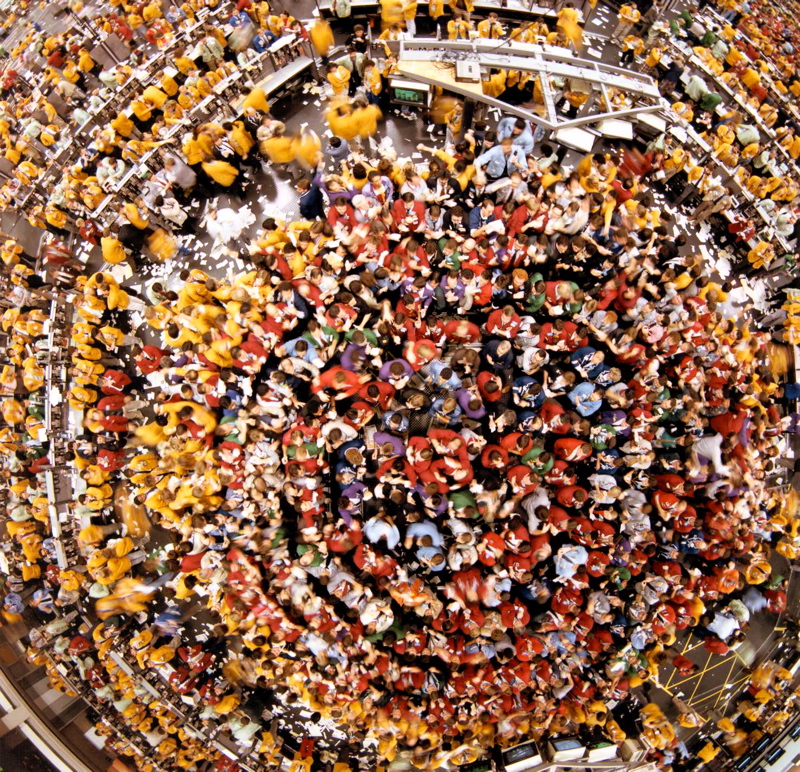
Once there was news of a Cliff Deal, the stock market shifted into Turbo Drive, running up the Average by double digits, on the promise of... what, exactly?
The "news" has been all agog about "certainty." LOL.
"Knowing what the tax rates will be" was all it took for the Market to fluff itself up and dance a little, it seems. If that's the case, why wasn't something done sooner? After all, everyone wants to see their stocks fluffed and dancing, don't we? High prices for stocks mean that our Retirement Funds have recovered, don't they? High prices for stocks mean that all is right with the world, regardless of whether God's in His Heaven, né?
"Certainty!"
Of course the certainty that most households are facing is that their take home pay will be ratcheted down by 2%, starting now thanks to the expiration of the Payroll Tax Holiday.
Initially as I scanned the "news" about the Deal, there was no recognition of this factor at all; it was as if the effects of the Deal were entirely a matter of the handful of people who would be experiencing higher income tax rates. Then, slowly, the millions who would continue to receive extended unemployment benefits were included in the mix (note: they pay income taxes but not payroll taxes).
Then yesterday, of a sudden and as if it were the dawn, there was some chatter on the "news" and in the blogosphere about that fact that "everyone's" take home pay would be lower by 2% -- well, up to the SS cap of $113,000 or so. This was, so the narrative aborning said, the result of the expiration of the Payroll Tax Holiday, and while nobody said anything about it during the Cliff Negotiations, it was well-known that the Holiday was only temporary and would certainly be expiring at some point. That point came. You see.
Consequently, most households will experience a diminution in their take home pay, the median being around $1,000 this year, the maximum being around $2,300. Per worker. For someone in the upper income brackets, that's a hardly noticeable hit.
For someone just getting by, it could be devastating.
Many "news" reports tried to make light of it, as if reducing household incomes further in this economy is going to have either no effect on the overall economy or will somehow make things better by enforcing thrift, don't you know. There was the cheery morning story that you could always go out and get a part time job to make up the shortfall. Ha ha. Right. There are no jobs, remember?
The commentariat which had been largely silent about it divided along predictable lines. The clearest division was the notion that so long as "I've got mine" (ie: continued low income tax rates, unemployment benefits, or what have you), the effect on you doesn't matter a whit, and you should have known this was going to happen anyway, too bad so sad.
Against this was posed the part of the commentariat that can do arithmetic and who pointed out that cutting household disposable income by 2% (even if it is to shore up Social Security, which is a whole other battle field) in this economy is an austerity measure that will have severe consequences to households in the short term and will do nothing to shore up the SS system over the long term, because as an austerity measure, it does nothing to improve the employment picture, in fact makes it worse by further tamping down demand.
"But but but but Social Security! You want to save Social Security, don't you!" Yes, well...
You can't "save" Social Security in this economy by further reducing the amount of money households have to spend; it's insane. It doesn't work.
Reducing household spendable income by 2% doesn't shore up Social Security; in fact it reduces Social Security finances by limiting or even reversing job growth due to the fact that households have less to spend and so demand is reduced. Job growth is what maintains Social Security's financial well-being, and Our Rulers have been doing everything they can to ensure that job growth is minimized and that salaries and benefits are reduced during this Perpetual Recession.
The whole struggle over the Chained CPI to figure Social Security (and other) benefits is a backdoor means of reducing Social Security benefits, which has additional negative effects on job growth and demand.
It's a vicious cycle that we've been going round and round on for years.
The economic effects of reducing household income while burdening them with ever greater levels of debt are plain to see. Yet because the stock market is in turbo drive, only a few seem to notice, and they can be easily dismissed as spoil-sports and cranks.
The White House, we're told, decided not to fight to further extend the Payroll Tax Holiday, and decided it wasn't worth the struggle to find some other form of replacement. The White House decided that reducing most household's disposable income by 2% was a small price to pay for raising the top income tax rate to 39.6% -- which will have the effect of reducing some top earner household's disposable income by something less than 1%. It's a bargain, innit?
We can expect more of this kind of thing as the various economic crises and cliffs baked in to this year's budget and economic struggles are reached.
The American People are going to get even poorer while the High and the Mighty get even richer.
That's the Real Deal, no matter how high stock prices climb.
Tuesday, December 4, 2012
Strike Debt Rolling Jubilee
David Graeber interviewed by Sam Seder re: Debt and Strike Debt Rolling Jubilee 11.14.12
Yves Smith over at Naked Capitalism has been having something of a peculiar and extended melt-down over the effort by the Occupy affiliated Strike Debt to commit financial/civil disobedience by buying up blocks of noncollectable mostly medical debt and forgiving the debtors from any further obligation to pay.
So far, they've managed to raise enough money to 'retire' around $9,000,000 in noncollectable debt; whether they have actually forgiven more than a small portion of that, I don't know. Exactly how they're going about their task is something of a mystery in that they say they buy blocks of debt anonymously (they don't know whose debt they have purchased, and their purchase of the particular debt is not publicized), then they forgive the debtors through direct contact.
Yves stridently believes that by doing this, Strike Debt is putting itself and the debtors it forgives at serious financial risk and that ultimately the program will be counterproductive.
Could be.
Given the level of overall American indebtedness and the amount of uncollected debt being marketed by the debt industry for bottom-feeders to go after (at about $.05 on the dollar), there's almost no way Strike Debt Rolling Jubilee can have more than a very marginal impact on the American debt problem and the industry that feeds on it. It's a scale issue.
Nonetheless, Yves is convinced that Strike Debt's Rolling Jubilee is the wrong approach to the problem and that it is or might be dangerous to its participants and their beneficiaries.
Her particular focus has been on potential tax consequences, though perversely (a term she used with regard to those who objected to her tax focus) she denies it. Further, Yves and Lambert insist that Strike Debt is guilty of failing to fully disclose the risks to debtors involved in their efforts.
Yves can and does go into great and stupifying detail over the tax issue. Lambert just acts like a bitter old man yelling at those kids to get off his lawn. And he gets even crabbier when they don't do what he says.
The video above is taken from a radio interview of David Graeber by Sam Seder in which the topic is addressed from the point of view of Strike Debt's interest in what we might call financial disobedience. Graeber of course is the author of "Debt: The First 5,000 Years" and is one of the prime movers of the Rolling Jubilee action. I've said that they are using the weaknesses in the debt-industry and the debt-system to throw a bit of sand in the gears that are grinding so many people into dust. They cannot have a huge impact directly -- which they seem quite aware of -- but indirectly, especially by highlighting the pervasive problem of household and personal debt in this country, they can have a tremendous impact.
Yves says "No, they're doing it wrong." After she tells them how she thinks they should be doing it, she then suggests that those behind Strike Debt have "another agenda" altogether, and implies that the project is somehow corrupt.
Having been more than peripherally involved with Occupy, I'm more than familiar with this argument regarding practically any project undertaken by or with or through Occupy. The idea that "someone with another agenda" is behind practically everything done with the Occupy imprimatur is unshakable and it has a certain kernel of truth to it, though typically not quite what the accusers believe. Because pretty much everybody who does anything has more than one motive for doing it, and often individuals are seeking to further "another agenda" simultaneously -- human nature and cultural conditioning tend to be darned strong -- the accusation that something done by or through Occupy or by someone or some agency associated with it is somehow tainted by self-interest (the typical charge) is relatively true. Sure. Just as it is true enough in just about any human endeavor. The notion that this is somehow corrupt doesn't scan, however, and there is no sign that any self-interest that may be involved in Strike Debt or the Rolling Jubilee is a priori corrupt or corrupting.
Yves and Lambert apparently want a debt project that plays by the rules, upsets no apple carts, does nothing on behalf of debtors directly, and employs squadrons of lawyers and tax experts to battle the bottom - feeders and the IRS.
Otherwise they claim that Strike Debt and the Rolling Jubilee puts themselves and their beneficiaries in dire jeopardy -- particularly of the tax man. Yves has personal horror stories that can curl your hair to support her case.
I don't doubt her sincerity, but it seems to me that she is vastly overreading the situation, and Lambert is just being stupid by demanding "full disclosure" and apparently condemning the project for not providing links to Yves Smith's extensive risk assessments.
None of the scenarios of potential horrors have played out, but if they do, it doesn't mean that no one associated with the Rolling Jubilee has thought about them before, or that no one is prepared to act to counter whatever takes place.
As an aspect of civil/financial disobedience, and as an "offshoot of Occupy", the project is bound to run into official disapproval and quite possibly cruel and brutal suppressive actions by Authority. Everyone should know that by now, given the outrageous overkill employed to suppress the Occupations. It's a given. Or it should be. The fact that it hasn't happened yet, however, is something to note and to take full advantage of. Strike while the iron is hot and all that. If suppression is going to come it will come, regardless of any efforts to avoid it.
It reminds me of the idea of avoiding any sort of confrontation with police, even to the wearing of bandanas, so as to avoid police crackdowns. I and many others pointed out it doesn't work that way. If the official intent is to crack-down or suppress (as it was with regard to Occupy actions and especially the Occupations themselves) there is no way to avoid it, there is no "making nice," and there is no action the demonstrators can take to prevent Authority from their chosen task. Thus, trying to avoid something that's going to happen no matter what you do can make the inevitable crackdown even worse.
As I pointed out at Yves' Place, it's unlikely that very many of the tens of thousands who were arrested or the thousands who were injured or had their stuff confiscated or destroyed during the Anti-Occupy crackdowns had "full disclosure" of what could happen even if they sat through some of the workshops presented by Legal. Some are still so traumatized by what happened and what they witnessed they can barely speak of it. There is no sign at this point that those who benefit from the Rolling Jubilee will be subjected to such official cruelty, but you never know. If word comes from On High to suppress Strike Debt, it could get very ugly indeed.
Has Rolling Jubilee failed because the participants haven't had adequate warning? Or because there are potential risks and pitfalls? Maybe. But from my perspective (well on the outside), it has a long way to go before it is even noticed beyond a relatively small circle of enthusiasts and nay-sayers...
Thursday, September 6, 2012
David Graeber Explains It All For You -- and Charlie Rose
I have a fairly high opinion of Graeber's thought, though one could say he doesn't really present well on the television machine.
(I remember one of the disputes I engaged in with another Occupy supporter was over teevee appearances by people who don't do television well; she was outraged that someone who was interviewed about a protest action against Monsanto that was going on at the time didn't speak well enough or in the appropriate and expected sound bites, and therefore wasn't communicating. I pointed out that the interviewee did touch on all the important aspects of the protest and said what needed to be said. Expecting everyone who goes on teevee to "speak in teevee-ese" is unproductive. Would the complainer suggest that everyone who doesn't do teevee well should refuse to be interviewed? How would she make that judgement? Needless to say, the person I was arguing with was offended. I pointed out that I know from bitter experience that I don't do television well, and so I personally refuse to do television interviews. But I don't think there should be a general ban on non-telegenic people granting interviews.)
Graeber makes his points -- perhaps a bit quickly and superficially -- in the video above with regard to Debt and Occupy, the nature of the struggle and the death knell of Capitalism (of course we've heard that before!) and he seems to make an awful lot of sense. The problem, of course, is that Our Rulers simply deny it all.
Thus the mess we're in.
Sunday, September 2, 2012
Some Additional Thoughts To Throw In The Mix
 |
| America's Favorite |
- Joblessness
- Debt
- Hunger
- Homelessness
- Stolen Future
- Endless Sacrifice
I've long been suspicious of any statistical report that claims rising income for Americans in general because it just isn't so. I've witnessed too many cases of household incomes remaining perfectly flat at best during the course of the Endless Recession, and too many cases, way too many cases, of household employment income falling by anywhere from 10% to 50% (and sometimes more) in the course of a few years.
The statistics have clearly been skewed by the fact that those at the top continue to amass gigantic fortunes from which they derive enormous income, though statisticians deny it.
Millions have been forced out of their jobs, and millions have been forced out of the job market altogether; labor force participation is at the lowest point in generations and it continues to shrink. Poverty is at the highest level in generations and it continues to grow. The two are related it seems to me, factors, you might say of one another. Duh.
But in his acceptance speech -- which I have still not seen any of -- the Would-be King Emperor, Shahanshah, declared that when $21.00 an hour jobs with benefits "went away," Americans rolled up their sleeves and took two jobs that paid $9.00 an hour without benefits and they forged onward, uncomplaining, happy indeed to be able to continue the March of Progress -- at least that's a paraphrase of a report I saw. "Only in America," right?
Americans are falling backwards rapidly, and this is due, as I have repeatedly pointed out, to the deliberate policie at the top of the Government which in turn are determined -- if not dictated outright -- by the desires of the Masters of the Universe who crashed the economy to begin with. Those few people still control the United States and they largely control the rest of humanity as well.
Should the RomneyBot and His Familiar succeed in their Pinky and the Brain plan to take over the world -- their plan after all is directly out of the Reaganite-Gingrichite playbook. I've long assumed that the models for the cartoon characters were Ronnie and Newty -- things for the average sod will only get worse, far worse, far more pervasively and far faster than anyone thought possible.
The so-called political "opposition" isn't even playing a rearguard action any more, it's now a rout. The Future -- at least anything resembling a Future as we once understood it -- is gone.
"There's nothing left."
Well, not exactly "nothing." What Our Rulers are attempting to engineer, and the ACA is a perfect example of it, is the subjugation of the American People, through a form of taxation, to corporate interests in perpetuity; it's a form of debt slavery. Whether it is precedented or not I can't say, but in the end it hardly matters whether it's been done before, what matters is that it proceed with as few impediments to those on the top who will benefit from these extractions as possible.
So far, so good.
The New Future of Universal Debt Slavery -- through what amounts to automatic extractions from the 99% on behalf of corporate interests via innovative forms of taxation -- will shortly become the New Normal in part because there is almost no conscious opposition to it. There is opposition but not so much at the root of the problem, the real issue as it were.
Somewhat tangentially, there is a remarkable review by Mike Beggs of David Graeber's "Debt" over at Jacobin that is quite a wonder in its own right, for it does seem to go on forever. These are the kinds of exercises I have long had a love-hate relationship with, for they often add to the consideration, even though ultimately they are as light as froth floating in the air. It's appreciable in its own evanescent right, though what it actually has to say about "Debt" -- apart from the nostrum that "anecdotes aren't enough" -- is lacking... clarity. In fact, Beggs seems to be quite taken with Graeber's anthropological and indeed anarchist approach to his topic, one that makes mincemeat out of economists (who deserve it of course), and provides a comprehensive and comprehensible framework for the woefully uninformed public to understand what is really going on.
But it's not enough for him, he wants something both grander and more granular, and cites a number of works that provide what he is looking for. Ergo, what? Yes, there are other works out there, and isn't it great? Anyway, I didn't mean this to devolve into another criticism of the critic -- one of my favorite pastimes when time was -- but Beggs' contribution to the discussion is something else again. Check it out if you have a few hours to spend on... froth.
Meanwhile, Mark Ames has put out a piece dealing with the nature of the shoot-to-kill kultur that pervades American Authoritarian Society these days and how it relates to both the propaganda culture and the "twerps" who so often are placed in positions to defend the indefensible. It's a rollicking ride than can make for substantial dot-connection. Ames is very good at that.
As is his former colleague at the Moscow headquarters of the late-lamented Exile, Matt Taibbi, who works his gonzo mangler into a perfect storm of revelations regarding RomneyBot and his devotion to loading companies with debt from which many never recover, while he collects fabulous amounts of free money. Automatically. That's what it's all about in our financialized supposed capitalist casino, getting to the point where "I win, you lose" is institutionalized and made permanent.
There's your trouble -- and there's your Future.
Let the Dixie Chicks make it all better:
Finally, from May, a piece from the Occupied Chicago Tribune regarding the Dreaded Black Bloc. Much virtual ink has been spilled on the topic (lord knows, I've done my share), but this is one of the better examinations of the phenom of the Black Bloc and just what it does and doesn't do. Recommended.
"Dance for that Anarchy" -- Po-Po Troopers getting out of the rain in Tampa on August 27 prior to the RNC, while the folks dance for that anarchy in the downpour.
Another Po-Po Troopers in Tampa video. This is actually pretty sad... it's from Indybay.org:
Subscribe to:
Posts (Atom)