Showing posts with label Community and Peace. Show all posts

Wednesday, December 28, 2022

Is A Fascist Future Inevitable?

Many of us have been losing hope for years that the slouch toward a Fascist future can be reversed or delayed. The West, as it were, has Fascism baked in in one form or another, and no amount of rebellion or resistance is enough to overcome it. We are on the path of descent and there's no way back.

And it may be true.

With the advent of Trump in the White House -- an existential mistake in my view -- we got a taste of what our Fascist future might look and feel like. Many of his defenders were ostensibly "progressive," but we found that their "progressivism" was limited to opposition to various individuals, personalities, and policies that were advocated, featured or implemented by The Government. There was and is no coherent ideology among these "progressives" except opposition a thing, person, or policy largely for the sake of opposition.

Trump upset a few apple carts, broke a few rice bowls, and introduced constant chaos into The System, and as such he was worthy of support and defense by people who should have known better -- and I believe did. But more important to them was shaking up The System, disrupting routines, and skewering ("pwning") institutional complacency.

Trump's behavior was one thing, but his intent was clearly to rule as an authoritarian, indeed Fascist, dictator, no less so than Nixon, and Bush I & II. They set the standard. Trump was too mentally deficient and chaotic to follow through very well, but he sure tried. And a good deal of what he set out to do is still in place, as are many of the people he put in office.

Our problem -- if we oppose Fascism -- is not so much Trump or his chaos as it is the sponsors who see their advantage in fostering this sort of thing. Their primary advantage is in keeping the masses (to the extent they are acknowledged at all) diverted and entertained. 

In other words, making it all but impossible for there to be an uprising against the corporate-fascist ruling clique, a ruling clique that intends to endure no matter which political party is ostensibly in power. Trump was great at keeping the hoi polloi outraged and entertained. So long as they were, they didn't have time or energy to do anything about their lot in life, and as it happened, in death as the COVID pandemic easily managed to eliminate something over a million "useless eaters" in the United States and God knows how many globally. That pandemic is ongoing, though the death rates have (temporarily?) declined. Other illnesses and wide-spread poverty exacerbate the problems of the masses.

Until recently, I was almost always optimistic about the future and about building a better future mostly via community. The individualism that was so heavily promoted by the libertarian right was in my view a passing phase not likely to outlast the numerous crises that seemed to be accumulating. It was only through community, I believed, that we as a society would be able to get through what was coming.

Well, I was wrong. 

The breaking point was the lawless interference of the Supreme Court in the presidential election of 2000. While I saw it then as a deeply erroneous ruling, almost worse was the acceptance of this monumental error by the Democratic Party and the electeds, including Al Gore who presided in the Senate over his own loss of the presidency. The only ones who objected were the Congressional Black Caucus. And they were promptly silenced -- by Al Gore. 

Something was very wrong at the very top of the governmental structure. It would lead -- inevitably? -- to the catastrophes of September 11, 2001, and the perpetual wars in the Middle East, South Asia and Africa. All of a piece.

Yet I thought and believed that the American People, indeed the people of good will throughout the world, would be able to overcome the worst aspects of the ruling clique that included both political parties and seemed to be spreading internationally. 

The War Party seemed to be universal.

After a certain point there was no more Peace party. Code Pink seemed to be the only outspoken party for Peace in the United States and often it seemed its voice was faltering.

The horrors perpetrated by our rulers were atrocious and obvious, yet nothing was done. Obama was seen as the redemptive counterpoint to all that had been going wrong, particularly the economic meltdown of 2008, and yet he turned out to be part of the problem rather than the solution.

The fundamental problem was our reliance on a singular figure -- the President in the case of the United States -- to solve the problems that just kept building up. The President can't do it, and not only that, it's not appropriate to expect him (or her) to.

It takes a community, a community of communities, the society as a whole, to do it, and the society of 2000 and later was not capable. All the energy was going into fragmentation of society rather than cohesion. And it seemed to me that the internet and later social media was part of the problem.

We are now so far down that path, the only way back toward community is the fascist path.

 Yes, fascism is a rightist "community" strengthening ideology. There is nothing equivalent on the left any more. Socialism and communism once played that role, but no longer. 

There are a few leftish religious outfits that could-- maybe-- be the kind of counters to the slouch toward fascism that could slow or halt the current trends, but I don't see any of them becoming strong enough.

My former optimism for the future is pretty much gone.

The Trump experiment was bad, but it wasn't definitive or final. We'll face the elements of fascism again. 

And again and again until it becomes the default social organization for much of the West.

We've been on that path -- whether we want to be or not -- for a long time, and there may be no way back,

Is it inevitable? What is the upshot? I don't have an answer. 

We'll just have to see, won't we?


Thursday, December 28, 2017

At Mabel's Place For Christmas

One of our principal destinations in Taos is "Mabel's Place," Los Gallos, the rickety old adobe house on a little ridge at the end of Morada Lane. Mabel Dodge Luhan and her husband Tony built it on 12 acres bordering Taos Pueblo land at the edge of town (well, it was then) starting in 1918.

The Big House, "Los Gallos"
The welcoming portal at Mabel's


Mabel lived there or in one of the smaller houses built on the property till her death in 1962. Tony died shortly afterwards. I understand the Big House and the various little houses the couple had built on the property were neglected until Dennis Hopper bought the complex in 1971, christening it The Mud Palace where he hosted a free-form counter-culture get together for the next three or four years.

The place was neglected again until a Santa Fe educator, George Otero, bought it in 1976 and began rehabilitating and expanding the deteriorated facility. He ran workshops at Mabel's Place for the next twenty years and continues to return annually with educational workshops.

My understanding is that the size and the scope of the rehab project turned out to be more than Dr. Otero could be responsible for, and so he sold it to the Attiyeh Foundation in 1996. The foundation continues the work Dr. Otero started. They operate the facility -- which includes the Big House and a number of ancillary buildings, some dating from Mabel and Tony's time, some built since -- as a bed and breakfast hotel, a conference and workshop center focusing on the arts and healing, and a center for the community.

The Big House was designed and built largely to house Mabel's and Tony's guests when they made the arduous trek up to Taos from wherever in the country or the world they'd started from. Nearly all were artists, writers and philosophers, some of whom were already famous, others were "up and coming."

There are numerous bedrooms -- eight or nine I think -- plus a series of reception rooms, a large dining room and a kitchen. Mabel had a room on the second floor just behind the deep porch in the photo above. The bed that was built for her in the room is still there. The windows in the bathroom next to Mabel's room were painted by D. H. Lawrence in 1924 to provide her with some privacy when she went to the loo. They say he was scandalized when learned that Mabel would do her business in front of uncurtained and unobscurred windows  in full view of everyone inclined to look.

But enough of the history of the place. There's plenty of information available online and in books for those who may be curious.

Our association with Mabel, such as it is, began through D. H. Lawrence surprisingly enough. Ms. Ché directed a Tennessee Williams one act called "I Rise in Flame Cried the Phoenix" years ago. The play is about D. H. Lawrence and his Brunhild-esque wife Frieda (a close friend of Mabel's as was Lawrence off and on) near the end of his life. The play centers on the disastrous exhibition of Lawrence's erotic paintings in London in 1929.

Those paintings were on display at the La Fonda on the Plaza in Taos the first time we visited the town more than 30 years ago and I took the opportunity to pay the small fee to have a look at them. Ms. Ché herself took a pass on the exhibit as she was indisposed. We'd been driving all day and into the night, having come from Meteor Crater in Arizona where we'd stopped that morning for a look-see.

I saw the paintings and couldn't quite figure out what all the fuss was about. They were not technically well done, and their eroticism was as much in the eye of the beholder as in the paintings themselves. Art and sex did not combine well in these supposedly scandalous works. But at least I saw them.

While I wasn't fond of his paintings, I was almost overwhelmed by his novels. Lawrence became my literary hero, in part because I thought he captured something in his characters that only I knew about from my own family and life experience. It was through these novels, but particularly "Sons and Lovers," that I began to suspect that my mother wasn't Irish like she seemed to think but was of English descent, for the Lawrence characters based on his own mother were so much like my mother they could have been sisters.   Later, I would discover that my mother was in fact mostly of English descent, but her English ancestors arrived in New England, New Jersey and New York in the 1600s. She had no recent connection with England at all. Of course, I had red hair and a beard (in those days) like he did, too. So far as I know, I wasn't tubercular then or later, but I'm currently being treated for pulmonary fibrosis, so...
[Edit to add: My mother's paternal grandmother was a Lawrence, but her paternal ancestors came to America from England some time in the 1640s and she probably had nothing to do with D. H. (David Herbert) Lawrence, although she was married to a D. H. (David Henry)]

Ms. Ché attended a poetry writing workshop at Mabel's Place several years ago, and that workshop was part of what spurred her to go ahead and get a degree in creative writing that she's working on now. She should graduate next May. Perhaps their oldest graduate, but what the hay! It's what she wanted to do.

She said that Mabel's Place and the spirits of Mabel and Tony and the many hundreds of artists and writers who have spent time there over the last nearly 100 years affected her deeply.

I felt much the same sense of the place on my own brief visits.

This year we decided to spend a Christmas overnight at Mabel's Place, as a kind of R&R and renewal.

Christmas at Mabel's is a simple affair. A large tree is set up in one of the living rooms, and smaller trees are in other rooms. Simple wreathes are put on some of the doors, and I understand that luminarias were put out on Christmas Eve but they were gone by the time we arrived on Christmas Day.

Christmas tree at Mabel's 
The Big House is stretched out like open arms. Staff is welcoming and serene as always. And so we return.

We've had no snow this winter at our home south of Santa Fe; it's been too warm, too dry, another La Niña winter. And it didn't seem like there was any snow in Taos, either, but as we explored, sure enough, there were patches of snow here and there, left over from a brief storm several days ago. 

Just enough to remind us that sometimes winter in Taos is just that (and also the title of one of Mabel's books.)


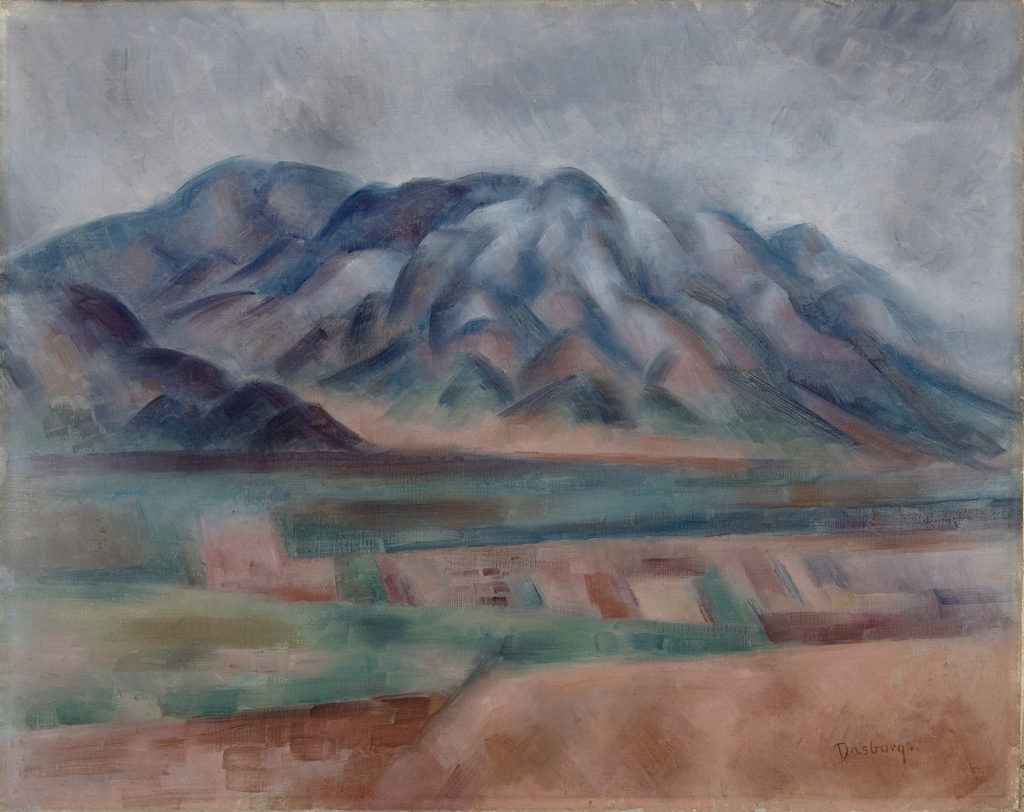
We had the Dasburg room for our stay. This is the one Ms. Ché wanted. It's in the Juniper House, a newer building -- but not that new, it's 40 years old -- with eight guest rooms and a conference room. We knew that it had a view of the sacred Taos Mountain, but we didn't know it had a little outdoor terrace (actually the roof of the room below) from which to watch the Mountain.

Juniper House at Mabel's Place, shadows of your correspondent and Ms Ché in the foreground.

The Mountain from the Dasburg "terrace"

Mabel's Place was full up on Christmas Eve. Many guests were attending the dances and Christmas Eve feast at the Pueblo. We were otherwise occupied on Christmas Eve as that is Ms. Ché's birthday. But Christmas Day was an ideal one to settle in. 

Up a steep set of stairs in Juniper House, we found the Dasburg room, named after  one of Mabel's artist guests, Andrew Dasburg, one of Ms. Ché's favorite New Mexico artists. We almost bought one of his drawings last year, but we decided to put it off for now, and it is probably for the best, as Ms. Ché was involved in that wreck in January of this year and I've been contending with the co-payment costs of very expensive RA treatment. While the price of the Dasburg drawing was certainly fair, it was a heavy expense for us at the time, and we would soon have some other expenses we didn't anticipate. cough.

I was disappointed there was no Dasburg work in the room, though there was a Georgia O'Keeffe (another of Mabel's friends). I sketched out an image of the Mountain while I was there, terming it "after Dasburg", intending to leave it in the room when we left, but I forgot. Sigh. Well. We'll just have to go back, won't we? (Smile.)

The Mountain smiled on us the whole time. It's hard to put into words the effect Taos Mountain has on us. In its own way, the Mountain has a kind of protective-watch-over energy. We can see and feel it. The Mountain is there as both the dominant element of Nature and as a stern and strong 'person' -- hard to explain.

Artists have been captivated by it for generations, and many thousands of paintings, drawings, photographs and prints have tried to capture its essence. I don't think any have quite succeeded. You have to see it for yourself. And then hope that your lines and colors will at least convey a partial sense of what the Mountain is in the flesh -- as it were.

The view is blocked by the Big House and Juniper House and the many trees bordering the property so that from most locations at Mabel's you can't see the Mountain at all, or at best you only have glimpses of it. Even in winter when the trees are bare, you only see bits of the Mountain through the branches from ground level.  From the second floor, you can see it better if you're in the right place, and from the third floor solarium, you have a 360° view of the whole property and well beyond.

We were in the Dasburg room on the second floor of Juniper House with an expansive view of the Mountain and its companions on either side. It was breath-taking though not quite as heart-pumping as the view of the Mountain from the Pueblo of Taos itself. There you are in the presence of... the ineffable.

Andrew Dasburg drew and painted the Mountain many, many times. This is an image of a more or less generic Dasburg mountain, but it's obviously based on Taos Mountain.

New Age types come to Taos and often settle there to infuse themselves with the Spirit of the Mountain. I don't know that they get what they come for, but oh well. It's not for me to judge...

I had the thought of doing some sketching with pastels while I was at Mabel's this Christmas, and so I did. It was both relaxing and inspiring to get out my pastels and have at it. Fun, actually. For years, I couldn't -- or alternatively didn't want to. Just the thought of drawing or painting made my joints ache, and it was better for me not to think about it.

But I've been getting used to the fact that I can do things now that I daren't even think of when time was. Even climbing the stairs at Mabel's is possible now though not necessarily easy. There was a time when climbing stairs was an almost impossible struggle for me. Holding a pencil was sometimes likewise challenging. So much of that struggle is over thanks to the treatments I've been given for RA. Even breathing in the rarefied though somewhat smoky winter air of Taos is... possible.

Simple things mean a lot.

I was most grateful to be able to enjoy Mabel's Place with Ms Ché without worry or fear of being unable to negotiate this or that problematic area that is obviously not handicapped accessible. The only areas that were difficult to manage were difficult for both of us.

Some areas of the Big House have low doorways on which tall people hit their heads, and there are tricky steps between one level and another which can trip you up if you aren't careful. Ah but slow and easy does it, and even if you hit your head on one of the doorways as I did, it's laugh-inducing rather than an Owie.

A pointed arch doorway at Mabel's Place -- watch your head, watch your step!


Ms Ché saw our Christmas at Mabel's  as an opportunity to renew and refresh after a very intense school year. She had put in so much time and energy that a break of this sort was essential. To take a break at Mabel's was invigorating. Even if it was only for a day -- this time.

A friend in California says we're in "Disneyland," meaning these sorts of experiences we're having aren't really "real" -- are they? Well, I guess it depends on your point of view, doesn't it?

After a wonderful breakfast in the dining room of the Big House, we packed up to leave, we really didn't want to. The daytimes and overnight we spent at Mabel's have stayed with us so strongly, though, we feel we haven't really left.

Breakfast isn't quite ready


It was a Christmas to remember!

Monday, December 26, 2016

Peace on Earth


Most of those of us who have been around for a while have had the notion of Peace on Earth hammered into us throughout our whole lives. This was, perhaps more than anything else, the Post War mantra repeated over and over again, "Let there be Peace on Earth."

Of course peace never came, not really. The mechanics of it were always the problem, weren't they? If there was to be world peace, a Pax Mundi as it were, just how was it to be accomplished? Scholars and mystics the world over struggled to figure it out, and their conclusion seemed to be that the ultimate peace of the world would only come when the Giant Asteroid wiped out humanity. Or some such. Or we blew everything up in a Nuclear Holocaust.

Nevertheless, many of us, we, the Rabble, haven't given up on something as elusive as Peace on Earth simply because it may be an unreachable ideal.

Unfortunately, our situation in the West -- as that part of the world where Anglo-American culture is dominant is still called -- has become so decadent and corrupt, "ideals" are considered a fool's game. Grab all you can before it all goes to shit seems to be the current ethic if you will, an End Times to end all End Times predilection, because I guess if you don't get yours now, you never will. Never ever.

There's just never enough to go around, and it's too bad for them that's got nothin'.

And of course things are going to shit at an accelerating pace. Make no mistake. The End is Nigh.

Many of Our Betters intend to survive no matter what, and I suspect too many of them will.

I was pondering Jeffrey Epstein's bolt hole up the road from our place. The Zorro Ranch is huge, XX,000 acres, I don't know how many exactly, on the border between the Estancia and Galisteo Basins in central New Mexico. An enormous mansion sits on a mesa overlooking both basins. A little western town, like a movie set, sits below on the Estancia Basin side, where apparently the ranching operations take place. They run some cattle, longhorns included, as well as a variety of artisinal breeds, but there are never very many of them, not like some of the other cattle ranches in the area.

There's some dispute over whether Epstein still owns the Zorro Ranch. Apparently the property records aren't clear about its current ownership. The only people we've ever seen entering or leaving through the ranch gate appear to be workers, mostly ranch hands. There's never been a motorcade of bullet proof SUVs and the like, and we've never seen squadrons of helicopters (black or otherwise) coming in for landings at the helipad up the hill.

This is the Google overhead view of the ranch house and helipad:


The mesa on which this spread sits is probably a couple of hundred feet high, and I expect that deluxe bunkers have been blasted into it to preserve, protect, and defend Epstein and whoever else can hie themselves hitherwards when the End comes. I don't doubt that a list has been made, and preparations for transport of selected VIPs have been made. Shuttles are no doubt on 24 hour call.

Epstein's place is one of many such retreats around the nation and around the world built in the past 20 years or so for the purpose of having "a place in the country" for the rich and powerful to shelter in -- just in case.

Our place is nothing like that at all, just a simple hand-built pioneer adobe ranch house, without a ranch any more, surrounded by a modest working class neighborhood, salt of the earth neighbors with whom we get along (mostly) --- even though we're from California. Heh.

But some of our thinking when we bought this place was not unlike that of the High and Mighty selecting their bolt holes for when the time comes.

When I mentioned to a friend in California that we'd bought this place out in the middle of nowhere in New Mexico, he sensed right away that a big part of the reason was to have a place to go "when it all goes to shit."

True enough, I suppose. True enough. Though I don't see actually how we would survive should the plug be pulled on "civilization." We, like most folks, depend on electricity and natural gas for light and heat. We don't have a generator or a fireplace or even a woodstove. We don't have our own well so we'd run out of water pretty quick. We haven't laid in supplies, though there is -- or would be -- room for a pretty extensive pantry should we want to have stuff on hand for the Apocalypse.

We're several miles from the Interstate, where most supplies originate in any case. But there are farms closer, farms and ranches, where produce is grown, livestock raised and so forth, and the ranchers and farmers are among our acquaintances if not actually friends. Some of them have made preparations of their own, though nothing as elaborate as Epstein's, and I would imagine that should everything go to shit, folks around here would pull together to hold on to some of the attributes of a positive and purposeful way of life.

That aside, however, once Ms. Ché and I are out of medications, I doubt either of us would last much longer as we both have conditions that are guaranteed to be fatal -- sooner without medications than later.

Oh well.

Not that we, personally, have any particular need to survive come what may. Whatever contribution we can make, we're making while we have the chance, while we're here, elders with some discretionary resources. It's not for us to hold on to; it's for us to give away while we can.

Many of us understand the nature of the crisis this year's presidential (s)election has precipitated. The installation of Trump and his cronies into power marks a clear and clean break from the nation's past. Nothing like this has happened before. And there is little or no likelihood that prior practice will be restored. This is the end of the Republic in all ways but name. Much like the Roman Republic, many of the aspects and attributes of the US republic will no doubt continue on as empty shells, meaningless rituals and practices, but the Republic established by the Founders and operated more or less competently for the past 230 years will be extinct, and something else, call it an Empire, will take its place.

I doubt that very many people will notice, as we've been on this path for a long, long time. Nixon in fact established the Imperial Presidency -- to much mockery and laughter -- and the precedent was set. But there was more to it than just the show. The underlying premise was that the USofA, as an Imperial power, had an obligation to establish and maintain a Pax Americana that would eventually encompass the globe, and that the US had an obligation to use any and all strategies and tactics to accomplish the goal.

In other words, the Empire, for all its faults, would one day come to rule the world. The US has never deviated from that path ever since the crises of the '70s that led to military defeat and withdrawal in Southeast Asia and the crisis of the Presidency that led to Nixon's resignation and the installation of the nation's first unelected president. That was the break in the nation's republican heritage that has never been repaired.

Precedent was set and here we are.

The precedent was that presidents (and vice presidents)  can be removed and others installed without consultation or the assent of the People.  Who accomplishes the transfer of power is still shadowy. Who is actually in charge at any given time is a mystery.

From my view, the power of the presidency is a matter of agreement between the contending factions of the permanent government and the Overclass. Until now, the Overclass had been content to rule indirectly through the agency of the permanent government. Now with the advent of Trump, the mediation of the permanent government will apparently be dispensed with and the Overclass will rule us directly.

The narrative among most of the Trump defenders and loyalists -- at least among those who can acknowledge the situation -- asserts that this is a good thing, and it's about time that our billionaire Overlords were openly in charge rather than corrupting the managerial class who have been in charge of the government for  many generations. In effect, we're going back to the origins of the government itself when the very wealthy Founders were the ones who ran and in effect were the government.

One could therefore argue the advent of Trump "re-founds" the nation the way it was supposed to be.

An argument in favor of this New America is that Trump and his cronies are so rich they can't be corrupted -- the way today's Congress and the whole apparatus of government under a managerial class (oh, such as the Clintons, for example) could be and has been. It's a ridiculous argument, but it's one that has gained some currency, without the simultaneous recognition that putting the corrupters in charge means that there is no longer any mediation between their interests and demands and those of the People.

Without that mediation, the People get screwed harder and faster than ever before. Duh.

On the other hand, there seems to be no recognition that there are many things Our Betters could do -- rather than screwing the People harder and faster than ever before -- to secure their almost perpetual rule over us, and they could even engineer their longed-for Peace without resort to nuclear or other armed conflict.

No, it seems that nearly all Trump defenders and loyalists are determined to impose as harsh and destructive a rule as possible on everyone but  themselves -- as revenge, apparently, for harm they believe they've suffered under the Republic. They're disappointed that their hero and champion is not entirely on board with them.

In reality, provided there is any sense of social conscience in and among the Trump-ists, to engineer both domestic and international peace and good will; there is no sign it will happen -- just the opposite in fact -- but you never know.

My wish has always been an end to war and violence.

We may or may not get there.

Signs are not looking good. On the other hand, stranger things have happened.


Monday, November 2, 2015

Incidents in Albuquerque

Not sure where this is going to lead, but I have a feeling it's not going to end well.

There was a road rage incident a little while ago. A four year old girl was killed by a gun-wielding driver who believed he was disrespected by another driver on the interstate. They got into it, apparently, and the girl was shot. This incident made national news -- yet another example of the Wild-West, Albuquerque style.

 Not long afterwards, I think it was the next day, an APD officer who was engaged in a "routine traffic stop" was shot by the suspect and a week later he died of his wounds.

In both incidents suspects were quickly apprehended and now await trial for murder most foul.

Both the media and the police department have gone into full-meltdown mode over these incidents, the media practically demanding that "the gloves come off" and a return to the practices of the past be authorized. You know, shoot first and never face consequences. Those practices that got APD into a consent decree with the DoJ.

Shoot and shoot again and keep on shooting.

The local media has been in hysterics over the deaths of the little girl and the police officer. They've been whipping up hysteria among the public, too. It's shameful. Disgusting. And apparently out of control.

The police department and the police union, for the most part, has been relatively sane about it all -- at least compared to the media. And they seem to be doing their part to engage in public diplomacy. It's interesting to see the contrast. Yet the end point seems to be to get back to the way things used to be.

Kill, kill and kill some more.

The police department claims that violent crime in Albuquerque went up 14% in 2014, but whether it's true or not, who knows? Police have a tendency to lie in pursuit of their objectives, and statistics used by police are constantly being massaged to "prove" whatever police believe needs proving. The public has few resources with which to compare and contrast police perspectives on crime or anything else.

We have witnessed a steep decline in police killing of civilians in Albuquerque, a decline that really hasn't been highlighted by media or anyone else (partly because it is masked by killings by other law enforcement agencies) but I can easily imagine that it will be cited as a primary cause of the supposed increase in violent crime since (say) the consent decree was agreed to last fall.

There is some sign of a community peace movement, however, one that may be able to counter the violence by police and some members of the public.

I'm always an optimist, but sometimes I wonder if my optimism is really justified.

DIGNITY, JUSTICE, COMMUNITY, PEACE

Thursday, June 4, 2015

Flipping the National Conversation

Well, with the overkill (so to speak) local coverage of the death of Rio Rancho police officer Gregg Benner on May 25, it's pretty clear to my rheumy eyes that the phase of the "national conversation" about violent policing has changed once again. It went from the appalling facts of the shooting of James Boyd, a homeless mentally ill camper, in the hills above Albuquerque, to the multiplicity of police killings of black men (and women, who were initially forgotten about in the "conversation") both armed and unarmed, to a consideration of "best practices" by the panel of experts appointed by the President (though its recommendations, both interim and final, were largely ignored -- such is the way of the world -- to now coming almost full circle to consider the pure evil of the criminals out there who shoot and kill police officers with such a disregard for human life, yadda yadda.

But a couple of other things have happened, too.

After it became clear that the only near real-time tracking of police killings in the whole country was being done by a crowd-sourced website called "Killed by Police" and repeated calls on the government to track these killings were being ignored -- or rather, they weren't being followed through on, despite the fact that there has been tracking and reporting legislation in place for decades -- a couple of other intrepid media outfits, the Washington Post and the Guardian, took it upon themselves to do (some of) the tracking that "Killed by Police" has long been doing (since May 1, 2013) and to publish findings relatively quickly (ie: not wait for annual or quarterly reports, but actually publish results in a timely fashion.)

The Guardian's coverage is very similar to the tracking of media reports done by "Killed by Police," and I think they do acknowledge KbP as one of their inspirations for doing their own coverage. The data they have assembled about police killings since January 1 of this year is impressive and they analysis of that data by the Guardian is equally impressive.

Washington Post's coverage is not nearly as extensive, as one of their objectives is to only cover police shootings. While that accounts for the majority of police involved killings in this country, it is not the totality of the carnage, not by a long shot (so to speak) and the way the WaPo's coverage is caveated and slanted is clearly intended to minimize the appearance of carnage at the hands of police and to make it seem as if those who die deserve it.

That's pretty much been the police and local media position on violent policing for as long as I've been following the stories, for decades now, so the WaPo's perspective fits in with the status quo that has long been a feature of local reports of police killings. The typical reports include the police perspective first and foremost, starting with the stenography of police press releases on the incident. They might or might not include contrary witness and/or family reports of what happened (frequently they do not). They almost always take the police reports as truthful and accurate, even though they are often filled with lies and fabrications. Local reports will cover demonstrations, should there be any, but often the coverage of demonstrations "Otherizes" the demonstrators or outright criminalizes them. The victim of the police killing is always, always smeared. The fact that he or she has had "numerous run-ins with the law" is featured and played up -- even if they were only traffic stops or minor issues -- as a means of making the victim out to be the bad guy. Almost always, the officer(s) who kill are protected from any criminal liability for their actions because of a little thing called "fear." So long as the officer(s) says "Fearing for my life and the safety of others ..." at the right time and to the right people (the police officer's union will provide gratis legal advice so as to make this statement useful and meaningful) the officer is almost certain to be exonerated from criminal culpability. By and large, civilians cannot use that legal sleight of hand, however.

Until the killing of James Boyd in Albuquerque in 2014, the pattern of coverage and the "conversation" was almost always the same: local only, but sometimes extensive in the locality wherein the killing took place; nearly complete victim-blaming by the media, with little or no questioning of whatever the police department chose to say about the incident and the victim; implicit hero-ization of the killing officer; contempt for the victim, dismissal or "Otherization" of survivors, family, and protesters.

The Boyd killing changed and began to nationalize the coverage and conversation. When the APD chief released the video of the shooting, he said that the actions of the officers were "justified." He said that what they did was justified because Boyd had two knives and thus was an armed and dangerous threat to be neutralized.

Except that isn't what the video really showed. It showed Boyd surrendering to the police, the pocket knives nowhere to be seen (they were in his pockets). The video showed Boyd gathering up some of his things and beginning to walk down the hill toward police. The video showed one of the officers (whose helmet cam was recording the scene) say "Do it!" and immediately a flash-bang grenade was launched and a dog was released. The video showed Boyd dropping his things and pulling out his knives while officers (still thirty to forty feet away) shout at him to get on the ground. The video showed Boyd turning to face uphill and away from the police as six shots are fired at him, three from each of two officers. All six shots strike him, and the video showed Boyd collapsing on the ground mortally wounded. The video then showed subsequent actions by the police that I won't describe.

The video was quite clear about what really happened, and the narrative the police were spinning out to the media and the public about "justification" --- because of some mortal threat Boyd represented to the lives of the officers and the safety of others -- was simply false.

It was the last straw. There had been so many killings by APD so frequently, and often so outrageously, that even the local media had started questioning what was going on. The mayor and police chief always, always defended the actions of police, and the DA never, ever found that any of their killings were unjustified. This had been going on for years, and finally, enough of the survivors and victims had gotten together to press the Justice Department to do an investigation of the pattern and practice of the APD. That investigation was underway, though slowed, when Boyd was shot and killed.

Small-scale protests against police killing had been going on for years, and civil awards to victim families had reached tens of millions of dollars, but the killing of James Boyd unleashed a torrent of condemnation from the public. Demonstrations grew to include thousands of protesters, and in one unfortunate night of protest, the APD used horses and ordnance against the protesters. Thanks to the wind, the police actually wound up gassing themselves and the residents of the dorms at UNM. Oh well. There was some vandalism by protesters as well and as usual, thought the vandalism was quite minor (mainly spraypainting several police substations) it was blown completely out of proportion by the media and used as justification for the police crackdown on protest.

Only the protest didn't stop. It continued through the spring and into the summer. Early protests apparently got the DoJ to release it's long-stalled pattern and practice report, leading to the media referring to its "scathing indictment" of APD's pattern and practice of unconstitutional policing. In fact, the report was an indictment, quite remarkable in its way for the blunt honesty of its findings that the APD used force and lethal force too frequently, too often unconstitutionally, and that reforms were necessary.

Until then, the APD had been lauded by city officials for their excellence. Suddenly, that was no longer the case.

Numerous police departments around the country had previously been found to have a pattern and practice of unconstitutional policing. It was so common as to be expected, and there had already been extensive media coverage of the slaughter APD was engaging in long before the Boyd killing. When the son of the Deputy County Manager was killed by police, for example, it was clear to anyone paying attention that police killing was not at all confined to the Otherized poor and dispossessed. Anyone could be a victim, no matter their prominence and position, or worse, anyone's son or daughter could be killed by police.

However, findings of pattern and practice violations and recommendations and even orders for reform were frequently fought tooth and claw by police departments, and in many cases they were openly defied. Police simply would not adhere to reforms nor would they listen to the public. Defiance was too frequently the rule and the killing and violent policing went on without let up.

I laid the blame for this on people like David Grossman whose "killology" trainings and seminars made killing out to be the highest accomplishment a police officer could achieve. It was the officer's raison d'etre. To kill -- righteously -- was the whole purpose of Warrior-Police. It was sickening to read or watch his presentations and justifications for police violence, for it was clear (to me at least) that the man was quite mad and was going around the country infecting police departments with his madness and leaving police officers convinced that their killing spree was not only justified, it was required by their oaths and their natures.

Others, like Bill Bratton, had used their positions as police chiefs to institute a version of policing that formalized falsity and didn't curb the killing. It merely made justification for overpolicing and killing by police much easier. Through false narratives about broken windows and other minor offenses and defenses of intrusive policing methods, and through acknowledgement of "tragedy whenever someone loses their life" -- while fiercely defending officers who take those lives -- Bratton and others like him managed to make over-policing of poor and minority communities and routine death at the hands of police seem normal, and furthermore -- most dangerously -- Bratton and others managed to make this kind of policing and falsity into American "best practice" policing.

As the deaths piled up and the brutality of police was revealed more and more frequently by cell phone and body-cam videos, however, more and more people saw for themselves what was going on, and more and more of them were revolted  by what they saw.

It was noted that FBI statistics of police killings were grossly understated to the point of ludicrousness. The police kill-rate was two to three times greater than the FBI's "official" statistics suggested, and those who used FBI statistics were subjected to ridicule, as was the agency itself, as it made no attempt to gather and present accurate information or statistics on police killings.

When James Boyd was killed in March of 2014, people recognized that mentally ill and homeless people, whether armed or unarmed, are frequent victims of police aggression and death, and they have little or no recourse as there is so little mental health and/or homeless service available -- and accessible -- to the public. Treatment and services are very hard to come by and sustain thanks to the way mental health and homeless service have been cut back especially since the Reaganite dismantlement of the state mental hospitals and mental health service system as it once was.

When Mike Brown was shot and killed by Ferguson police officer Darren Wilson in August of 2014, the conversation about violent policing changed to focus on the fact that black men, often unarmed black men like Mike Brown, are subjected to violent policing and killing by police at a rate far out of proportion to their numbers in society. There were hours of "negotiations" with James Boyd before he was executed in the Sandia foothills. Many black men were simply shot on sight on a belief that they were armed and dangerous. The mere sight of a black man was too often considered an a priori threat to be neutralized. Mike Brown was unarmed. He was shot at as he ran away from the officer. He was killed as he turned to surrender.

And as is almost always the case, the officer was considered "justified" -- because he was frightened of a Big Black Man who had "demon eyes."

Ever since, the national conversation has focused on the prevalence of police abuse and killing of black men, almost to the exclusion of any other victims of police violence. This focus has caused more than a little tension due to the fact that blacks are by no means the only victims of police violence and killing. There are many others; the problem is the violence the police bring to situations not calling for it.

Blacks too often are victims, and blacks too often are considered existential threats to police simply by their existence. This is derived in part from military beliefs and training that propose that the mere presence of an armed -- or thought to be armed -- Iraqi or Afghani or other native of some foreign land under American attack or occupation is sufficient justification for killing said native, regardless of any other fact at all.

But it also comes from America's long history of black and brown oppression and murder. It simply doesn't occur to police that an "Otherized" racial/cultural minority is actually "human." They have become objectified to such an extent in the minds of many police officers that their killing is seen essentially as nothing more than pulling out a weed.

This is demonstrated by the many killings themselves and by the fact that so often, police officers who use force or lethal force provide no first aid to their victims and all too frequently prevent EMS from attending to them.

This happened in the South Valley of Albuquerque not too long ago when a sheriff's deputy shot and wounded Billy Grimm, claiming that he saw Grimm with a gun, and then the officers refused any medical aid to Grimm for hours after he was shot, though EMS was available within minutes. They claimed that Grimm refused their orders to exit the truck he was in, and it was only after he did so and a dog was unleashed on him that officers felt the scene was "secure" enough to allow EMS to enter and tend to their victim. By then, of course, it was too late, and Grimm died in the hospital shortly thereafter.

Shaun King at dKos has documented numerous similar incidents in which a victim has been shot and mortally wounded by police -- who then refuse to provide any aid whatsoever to their victim and often prevent others from rendering aid.

This callous indifference to human life displayed over and over again by police officers, every one of whom is trained in first aid, is one of the hallmarks of American policing, obviously a matter of department policy that is nearly universal.

It's criminal negligence, though some court decisions have stated that officers have no affirmative obligation to render aid to those they have injured. Some of the consent decrees that have been entered into with police departments require police officers to render or summon aid to their victims immediately ("Provided it is safe to do so" -- always the caveat). But this is policy, not law. Court decisions can protect officers if they don't render or summon aid, but the policy of the department can easily change the dynamic, just as policies can stop the killing.

In Albuquerque and Oakland, among a few other places, the killings by police have all but stopped.

It can be done.

The national conversation is now shifting to the risks police officers encounter on the job, including the fact that they might get shot or injured. Well, yes.

It's one of the hazards they supposedly signed up for. The problem is that too often, facing any risk at all is considered to be an unacceptable hazard for a police officer. Killing a subject that might pose a risk is the far better alternative, no? Large numbers of the public have been saying "NO!" quite clearly and loudly, but with the wounding or death of several officers recently, the conversation about that risk is now under way.

What sort of risks should officers expect to face and handle? Police unions and many departments say "None at all." A risk is by definition a threat, and threats are not to be faced, they are to be neutralized with whatever force the officer deems necessary, including lethal force, in every case.

That has long been the position of police and their departments. But the questions that have been raised about violent policing have shone a light on police behavior that was often ignored or thought acceptable in the past. No longer is unquestioning acceptance of grotesque behavior by police considered necessary. The questions that have been raised -- about the constant killing, the "Otherization" of Americans subjected to violent policing, the racial elements in violent policing and police killings, the distance of police culture from that of the communities police are supposed to serve and protect, and the risks and hazards police are expected to take -- have reached a kind of crescendo.

My view has long been that police are way too violent, they kill and maim far too often and unnecessarily, and they are enabled by a corrupt system of injustice that protects them from accountability let alone criminal liability. That has to change.

There are signs it is changing.

Until recently, police departments as a rule had no idea they were doing anything wrong or that the louder and louder objections from the public were something they needed to listen to rather than simply suppress. The hundreds of millions of dollars -- indeed, billions -- paid out to victims of violent policing meant nothing to them. The money didn't come out of their budgets, and because police as a rule are not held criminally liable for any use of force they deem necessary -- regardless of other facts -- they saw no reason to change their behavior under pressure from the public. The public was often seen as enemies, and those who actively protested police violence were often seen as "enemy combatants."

This was wrong from every direction, but police were -- and to a great extent are -- incapable of seeing the truth of the matter, presuming that they can enforce their will through greater levels of violence.

That conversation may be next. Should police become even more violent than they are? Is 3 a day too few to kill? Should every police encounter include a bit of ultraviolence -- just because?

Or should policing become more or less a substitute for absent social services? Should violent policing be consigned to the ash heap with so many other theories of policing that have come and gone?

Should the police be abolished?

That's where this conversation needs to be directed sooner rather than later.

We need to find a better way of ensuring something close to dignity, peace and justice in our society, because what's been happening is going entirely the wrong direction.

[I'll try to add links later, as I am pressed for time today... ]


Monday, May 4, 2015

(Day Before) Yesterday

I've tried to watch as much as I could of the unfolding events in Baltimore on WBAL's livestream (which was sometimes superb) and wherever else I could.

Day before yesterday, I saw some really remarkable and memorable things.

There was a rally at City Hall Plaza sponsored by Black Lawyers for Justice, a sometimes marginalized outfit due to its militancy -- and its blackness. There were thousands of people gathered on the Plaza and many more scattered around the area. I saw the culmination of the rally during which members of the "gangs" of Baltimore, the Crips, the Bloods, and the Black Guerrilla Family, came together as one, and said essentially, "Look, this is our community, it's our city, and we are all one family. We aren't going to fight one another. We are going to protect our communities, protect one another, and protect our city. We love Baltimore,"

They were talking about non-violent self-policing, something many of us have advocated as an alternative to the heavy-handed violent policing that takes place today in too many communities suffering under occupation by armies of police who do things like killing Freddie Gray. And so many others.

It was a very moving moment in the program of the rally, one that moved the on air reporters nearly to rapture. They never thought they would see the day... and here it was, as they watched, the community coming together, bringing peace and dignity and -- perhaps -- justice of a kind that Baltimore had been yearning for but which had always been so elusive, just out of reach. Here it was, finally, the sign Baltimoreans had been waiting for. The time had come.

Baltimore would heal. The rally was followed by a march from City Hall to the intersection of Pennsylvania and West North where so much of the action of the previous weeks since Freddie Gray was killed had taken place (it's the site of the burned and looted CVS drugstore as well.) The march and the gathering at the intersection in West Baltimore were like a huge party according to those who were there. The spirit of the rally at City Hall and the sense of accomplishment that the officers involved in Freddie Gray's death had been so promptly held to answer was infectious.

Baltimore would heal.

I don't know that I would go quite that far, not yet. But I was struck by what I was witnessing vicariously through the live broadcast, and I believed the participants were sincere. Baltimore has a long and deep reservoir of racism and worse, so I'm not convinced -- yet -- that the Powers That Are in that city are quite ready to let go of it, not yet. Not yet. But the unexpected is always possible...

Later that night, I happened to be watching RebelutionaryZ's livestream as curfew violators at the intersection of Pennsylvania and North were rounded up one by one. A woman had been apprehended, and Reb said he'd met her, liked her, she was a good person, he said, who was being roughed up by police for no good reason. Another woman asked him what she was being arrested for, and he said all he knew was that she was out after curfew. She hadn't done anything.

The woman became irate, and she asked, "When are they going to leave us the fuck alone?" She said this sort of thing happened every day, and she was tired of it.

Witness:

[Scroll to approximately 1:08:30 in the video]


Yes. "Leave us the fuck ALONE."  It is really that simple. Will it happen? I don't know. But the signs are a lot more encouraging this year than last.


Sunday, December 21, 2014

Imagine

[The killing of two NYPD officers in Brooklyn yesterday has captured the news cycle; it's a tough situation for NYPD, the city, and the families of the men who were killed -- the killer himself is dead as well, and according to reports, he shot his girlfriend in Baltimore before heading up to New York.) Blame is being cast on the protests against police murder and impunity and on the protesters, as if somehow they caused the death of the two officers, and the bloody, murderous actions of the police themselves had nothing to do with it.]

It's time to start imagining a society that isn't dominated by police

Radical, I know.

José Martín posted this notion of a society that isn't dominated by police over at Rolling Stone the other day, and I hope it gets some traction, because there are ways to diminish or even eliminate police activity and presence in modern society. Many people have said we don't need them at all. We don't need police, we don't need prisons, we don't need the whole panoply of police/suppression/punishment under which we've been forced to live. There are other ways to deal with the issues of crime and punishment.

Martín's alternatives are as follows:

 1): Unarmed mediation and intervention teams

Police are so often deployed in situations they are incapable of handling without use of force, violence and way too often, death. This is due to the way they have been recruited, socialized and brainwashed into believing that every encounter is an opportunity for Righteous Battle against Demons.

Nonviolent intervention is typically required -- when any action at all is required -- but police are the wrong agents. The problem is that in many locations, there are no alternatives. Calling 911 does not get an intervention team dispatched. It get's the police, and too often, the deployment of the police gets someone dead.

2): Decriminalization of almost every crime

Part of the problem with contemporary over-policing practices is that so many activities that weren't crimes forty or fifty years ago are now criminalized, and it seems that more activities are criminalized every year. It's out of control. Decriminalization is a necessary strategy to reduce the tendency to over-police. It works.

3): Restorative Justice

This is a key to reducing both policing and incarceration, and it is being used in some localities to accomplish both ends. Again, the problem is that too often there is no available alternative to police and incarceration, so restorative justice that respects human life and dignity isn't always possible.

4): Direct democracy at the community level

Direct democracy is a means of building community. When people know one another, work with one another, and have a sense of common purpose, the likelihood of anti-social actions is reduced. But direct democracy is hard, and it's so very much easier just to maintain the status quo.

5): Community Patrols

One of my suggestions has long been to forbid police from patrolling certain areas and to establish and maintain neighborhood/community patrols instead. This suggestion is fraught with dangers. Yet it may be the best way to curb the tendency of police to cause trouble rather than resolve it.

6): Mental health care

Perhaps the most obvious of all. So many of the current issues surrounding police misconduct, abuse, and murder have a direct connection with the absence of mental health care in our society. It's long past time to restore an appropriate and available level of care for those in crisis.

Imagine that these and other creative solutions to the problem of policing in this country were implemented.

Just imagine: Dignity, Justice, Community, Peace.

Saturday, October 25, 2014

Two Deputies Shot And Killed in California. Suspect Apprehended and In Custody After Multi-County Chase.

Two deputy sheriffs were killed in California yesterday, one in Sacramento, one in Auburn. I was alerted to this news by a friend's email, otherwise I might not have known about it.

The suspect allegedly shot and killed a Sacramento County sheriff's deputy outside a Motel 6 in suburban Sacramento yesterday morning when the deputy approached the suspect's car. The deputy was shot and killed before he could reach the car to ask the occupants what they were doing. The car, containing the shooter and a female passenger sped off. Before they did, the officer's partner opened fire on the car and its occupants, apparently without effect.

According to the Sacramento County sheriff's office, the shooter and his passenger, who may be his wife, then tried to carjack a driver's vehicle a couple of blocks away, but the driver apparently resisted and was shot in the head. They then drove a short distance where they carjacked another vehicle which they drove some distance away to another residential area where they took a gardener's truck at gunpoint -- after detaching the gardener's equipment trailer.

The couple were spotted some distance away at a county park; police were dispatched but the couple had already driven quite a distance farther on, to I-80, which they drove to Auburn, another twenty five miles or so from the scene.

In Auburn, Placer County deputies spotted the truck and pulled it over. As they approached the vehicle, the driver opened fire, killing one deputy and wounding the other. From that point, the story is somewhat confused. Apparently other deputies arrived on the scene and arrested the female passenger while the driver/shooter escaped the scene on foot to a house nearby where he hid for several hours while heavily armed officers patrolled the area searching for him.

They entered the house where he was hiding and arrested him. Apparently he surrendered without incident. He was apparently wounded in Sacramento when the car he was driving at the Motel 6 was initially fired on, but he was not badly injured.

My account is taken from the Sacramento Bee's report of the day's actions. The report is fairly coherent, though it is not at all clear why deputies were approaching a car in the parking lot at the Motel 6 in the first place. The fact that the driver, Marcelo Marquez, was apparently able to kill two deputies, wound another, as well as wounding a civilian, elude capture for hours and yet was apprehended and taken into custody alive and apparently relatively unharmed is... little short of astonishing given the litany of individuals who are killed by police day in and day out all over the country, too often for little or no reason.

Placer County Sheriff Ed Bonner had this to say yesterday:

“The suspect is in custody, as you know,” Bonner said quietly. “I think there’s those people who would say, ‘Well, you know what, I wish you’d killed him.’
“No, that’s not who we are, we are not him. We did our job. I’m incredibly proud of the men and women who go out there every day and put their life on the line, and today this organization, this family, has suffered a horrific loss.”

What he's saying goes against so much routine police dogma and doctrine, however. By contemporary policing standards, every civilian is a potential enemy illegal combatant -- especially if they are brown or black male -- a threat to be neutralized, neutralized with as much force as the officer deems necessary.

But that isn't quite what happened in either Sacramento or Placer County yesterday. A man who was clearly a threat -- who had allegedly killed and wounded officers and a civilian, was pursued and apprehended without killing him or even (apparently) severely wounding him. Civilians in Auburn especially were put through a very difficult situation when schools were locked down and checkpoints established, manned by heavily armed police who seemed to have no problem implicitly threatening them, putting much of downtown Auburn under a hostile occupation.

The questions I would ask about yesterday's events in Sacramento and Auburn start with "Why the difference" between that and, say, almost any of the more than 1,600 police killings since May 1, 2013 -- some of them in Sacramento and Placer Counties. What was it that allowed or required police and sheriff's deputies from city and county agencies throughout the area (one I'm very familiar with having once lived in that general area of Sacramento and Placer Counties for decades) to apprehend the suspects without killing them whereas in so many, many, many instances documented over and over and over again, police use lethal force all but instantly in confrontations with civilians.

What made the difference this time?

I don't know. I have some ideas, but I'll have to think about it a bit more and ask other questions along the way.

There's a followup story in the Bee that's also interesting, pointing out that Marquez and his wife were apparently from the Salt Lake City area, and that there was "nothing unusual" about them.

I would also point out that the killing of law enforcement officers is EXTREMELY RARE in this country, vastly fewer than the number of police killings of civilians. That two were killed and one was wounded yesterday in Sacramento and Auburn is remarkable, especially given that the alleged shooter is still alive, and according to reports is willing to speak with the media -- though he is not being allowed to while the investigation continues.

I grieve for all those killed and wounded yesterday in Sacramento and Auburn. It shouldn't have happened, ideally it wouldn't have. It's remarkable that law enforcement officers were able to apprehend the suspect and his wife/accomplice without using lethal force.

It's a story that needs to be told more fully. There are many lessons to be learned...

Sunday, October 19, 2014

Now That We Know This -- And Have No Excuse For Not Knowing -- What Do We Do?

"Police killing ruled 'justified'" -- every single time. No matter what, if the officer says he (or rarely) she felt threatened, then any use of force including lethal force is almost always ruled "justified," and the officer is in essence rewarded for a job well done. Killing, crippling and maiming, causing any amount of emotional and psychological trauma on witnesses, survivors and victims, ruining lives, destroying communities, all of it and more is ruled "justified" if the officers says he or she felt "threatened." Or if, as is so often the case, the officer's absolute authority is questioned...

Now that we know this -- and we have no excuse not to know it by now -- the question is what is to be done?

Tens of millions, hundreds of millions of dollars in payouts to victims of police brutality and murder have had no negative affect on police departments or on elected and appointed officials who write off these sometimes extraordinary payouts as simply the cost of doing business, or as a necessary public safety expense. To them, all these millions are nothing; they are not coming out of the department's budgets or the officer's pockets, or the hides of city administrators. Ha! They're a levy on taxpayers, either directly or indirectly.

The protests don't have any perceptible effect on the culture of suppression, oppression, and killing that has routinized and professionalized among police forces nation wide. The public can rise and yak and yabber all they want about the brutality and killing. Officials and their officers don't care. It's nothing to them, except perhaps some welcome overtime for the officers on the line, and damn, isn't it fun to get out all those riot costumes and toys and threaten the crowds of protesters with immediate and lethal force when they get uppity? Heh. Put them in their place.

"Scathing" reports by the DoJ and investigative journalists haven't had much of an effect on the police killing spree, except for this: when the DoJ issues a "scathing" report, the police undergo a "progressive professionalizing program," in which their rules and their training is coordinated with the "best and most progressive" national policing standards. It doesn't necessarily cut down on the killing for it isn't necessarily meant to. The killing and brutality may get the Rabble riled up, but that's rarely the problem. The problem is that the police aren't doing it right. Once they have the rules and the tools and the training that meets national standards, they're home free. Use of force, especially lethal force, is now routinized. Have at it.

As long as the Right People are served and protected, what's to worry? What's to complain about?

If that means a thousand or more of the Rabble are gunned down by police every year -- 3 or 4 a day, every single day -- so what? If that means tens of thousands or hundreds of thousands of the Rabble are brutalized and traumatized by police every year, often arbitrarily -- so what? If that means millions upon millions of Americans are sent through the bloated prison industrial system -- so what? As long as it's primarily the Rabble who's subjected to this, why should anyone who matters care? They don't. They won't. It doesn't bother them because it doesn't involve them.

The way the officials in Albuquerque have behaved toward the problem of police violence and killing is instructive and it should be seen as exemplifying the point of view of most officials faced with growing outrage and protest by the Rabble toward police.

The only time they concern themselves with the opinions of the Rabble regarding the conduct of the police -- or really regarding much of anything else -- is when the Rabble interferes with comfort, convenience and routines of those in charge. The response then is always the same: suppression. If need be: oppression. Otherwise the Rabble is really rather free to carry on as they choose, but no one (who matters) is listening, and no one (who matters) gives a good god-damn. Even if they put on a show of "concern..." Sure. Right. Whatever. They have more important things to do, and a far more important clientele to serve.

The mayor and city manager of Albuquerque have been quite clear that they are not interested in hearing from victims of police violence. The mayor refuses any but the most distance-keeping contact, and the city manager's interactions are typically filled with bluster and threats toward those who seek justice. He was, after all, the chief officer of the New Mexico state prisons. (A whole long other topic, but it is informative to understand where he is coming from, and to understand that his state prison tenure was considered "progressive.")  It's useful, too, to understand that the mayor and city council of Albuquerque are not in charge of the police. As is the case in most cities around the country, the police are not accountable to nor are they supervised by elected officials. They are only accountable to the city manager or the equivalent, an appointee who often holds the mayor and council hostage to an agenda that the public is essentially unaware of. In Albuquerque, too, the appointed police chief appears to be a figurehead, nothing more. From appearances, he has no authority and very little knowledge. The police department appears to be run directly out of the City Administrator's office with little or no consideration of the "chief." That, too, is not all that unusual in city administrations around the country.

How city governments actually work is another topic that I could go on about at great length but not here, not now.

To these people and especially to those whom they serve, "justice" means suppression of the Rabble by any means necessary, including killing and brutalizing them routinely for any reason at all -- or no reason but to keep them in a state of fear, panic and terror.

For whatever reason, many of the Rabble are convinced they can get justice by appeal, but most often they can't. There is no one to appeal to who cares. There are very few who the Rabble might appeal to who see justice in the same way the Rabble does.

That's a major problem right there: "justice" to the victim/citizen is one thing, "justice" to the perpetrator/ruler is quite a different thing. "Justice" to the perpetrator/ruler protects them from the Rabble; "justice" to the Rabble is something else again: a brake on excess, exploitation, and oppression and an expression of social fairness.

So how does the Rabble deal with this situation? What will it take to change the dynamic sufficiently to reduce the rate of killing and brutalization by police on the one hand and ensure fairness on the other?

Is it even possible or have we reached the point where the Powers That Be have so divorced themselves from the interests of the People, there is no longer any way to heal the divide?

What then must we do?

Let's explore the topic next time....

Monday, August 18, 2014

I Saw The Most Amazing Thing

The police were inciting the crowd on W. Florissant, forming a line of gas-masked and roided-up officers, bringing up the armored cars, launching sound-cannon, ordering dispersal of the crowd, and threatening dire consequences. The crowd became angry, but community monitors were moving them back away from the police line. When the police continued to threaten and acted like they were going to use tear gas, the media -- dozens of them -- moved in, directly between the crowd and the police, and they stayed there no matter the threats and loud sounds. They stayed, and they protected the crowd, whether they meant to or not, they did.

The police stayed in their line, they did not advance on the people. They did not fire tear gas. They sent one of their vehicles to a side street and another went to the middle of the block.

People refused to leave, but they were not violent, despite the incitement by the police. There may have been a few water bottles thrown at the police line but nothing more.

The media's action prevented another night of police riot.

Who'd a thunk.

Of course it's early yet...

Friday, August 15, 2014

Transformative


I haven't been writing here much lately in part because so many of the events of the last week have been so overwhelming, draining, and frankly appalling.

The murder-by-cop of Michael Brown in Ferguson, Missouri, was shocking to anyone with a shred of conscience, and we saw over and over again that the powers that be in St. Louis simply had no shred of conscience, compassion, or simple human decency.

From the moment young Brown was shot down in the street by a still unnamed Ferguson cop who seemingly was completely out of control, apparently the only concern of those Powers,  was to keep those Negroes suppressed.

At first they called it "crowd control," and they got the dogs and the riot gear out, and the police stormed and stomped around to frighten and intimidate the onlookers, the witnesses to the killing, and the family of Mike Brown in actions that didn't surprise anyone who's been paying attention, but which certainly shocked anyone with a grain of empathy in their souls.

The dead body of Mike Brown was left bleeding out in the street for hours and hours that awful Saturday, while police chased away family members and went around confiscating cell-phone cameras and other potential evidence.

There were dozens of witnesses, but the man who was with Mike Brown and was closest to the murder when it happened was somehow ignored in the media rush to find some excuse for the police behavior. Oh, he was interviewed by media shortly after the killing, but only the CBC in Canada put his statement on the air, and others who had things to say about what they saw were largely invisible for days while the police issued statement after statement that seemed patently false or protective of the officer without regard for truth or justice.

The people of Ferguson were understandably upset at the official stonewalling, lying, and wagon circling. They were "allowed" a bit of "space" to gather in the streets to protest, but on Sunday that protest turned into what has been deemed a "riot" during which a number of businesses were looted and one was burned. The one that was burned, the convenience store at the Quick Trip gas station down the street from the site of Mike Brown's murder, was where there were initial claims that Mike Brown had "stolen a cigar." But it turned out that no such claim had been made by the proprietors. It was one of many false rumors that were circulating in Ferguson in the first hours and days after Mike Brown's homicide, rumors apparently intended to impugn the young man's character so as to more easily justify his summary execution.

Yet even on Sunday, as the "riot" progressed, there were suspicions that provocateurs were at work and the looting and burning going on sporadically in the community was not an expression of spontaneous rage at all. No, even then, the "riot" was being seen by many in Ferguson as the work of agents of chaos, not the people. The burning of the Quick Trip convenience store was even attributed to the proprietor as a means to obtain insurance money. The "riot" itself was seen as a means to distract attention from the killing of Mike Brown and put the focus and the onus on the community because it's largely black and working class and supposedly gang-ridden.

In other words to make it seem that Mike Brown's death-by-cop was a natural consequence of the innate criminality of the residents.

There was an immediate and strong push-back by those residents and the family of Mike Brown. They denounced the violence, and they wanted answers from the authorities, answers which were not and so far are not forthcoming.

In fact, it seemed that everything was being done by those authorities to cover up what had happened, to blame the victim, and to control the mob of angry Negroes.

It was a scene out of the brutal South of yore. It was absurd. It was terrifying. It was wrong.

As protests continued, the authorities, who I took to calling the Cowards of the County, escalated their repressive measures, until finally on Wednesday night, while people were in the streets demonstrating non-violently, a military-style operation was launched against them. It was the kind of thing we've seen over and over again, especially since Occupy suppression in 2011 and 2012, in which police deploy overwhelming military-style force against angry but generally non violent citizens and residents for the purpose of instilling terror.

Wednesday night's operations were even more outrageous than other similar instances in that it was entirely uncalled for. There was no violence, no riot, no effort on the part of the people to do anything but let their presence and outrage at the actions of Authority be seen and known as widely as possible. They defied repeated orders to disperse sufficiently quickly and thoroughly enough to be subjected to a terroristic operation in which assault vehicles were deployed, snipers positioned, machine guns were trained on the crowd and individuals "painted" with laser targets, and ultimately sound-weapons, tear gas, grenades and rubber bullets among other ordnance were deployed liberally by camo-fatigued "troops" "sweeping" the streets with automatic weapons pointed in battle array.

It was an absurd level of overkill, and it was promptly and forcefully denounced by military veterans who pointed out that even in the overseas war-zones where they'd served, they weren't as armored up as the St. Louis County and other police in Ferguson were (there were said to be 15 police agencies deployed in Ferguson on Wednesday under the command of St. Louis County police) and they were forbidden to go through the streets firing weapons or even pointing them at citizens and residents.

As was pointed out by Ferguson residents and as was obvious to anyone watching more than the national news about what was happening, the police were, time after time and essentially from the beginning, starting with the murder of Mike Brown itself, the ones instigating and precipitating violence, not the citizens and residents of Ferguson.

The police were using violent tactics against nonviolent protest. They were apparently attempting to incite violence by the protesters so as to excuse their own violent behavior in suppressing the protests. It was stark and appalling and for those who saw more than the national news about it, the tactics were obvious.

As it happened, a number of media workers were directly subjected to those tactics, including arrest, tear gassing and being told to "leave the area," and to "shut off cameras." A Huffington Post reporter and a Washington Post reporter were hustled out of a McDonald's restaurant by camo-fatigued police and arrested -- apparently for not moving fast enough to suit the officers. A St. Louis alderman was pulled out of his car by camo-fatigued officers, arrested and held overnight in jail, apparently for "being there" and bearing witness to what was going on. An Al Jazeera news team was tear gassed and their equipment dismantled -- apparently because they were bearing witness and broadcasting/recording what was happening. Other independent media were fired on, gassed, and threatened throughout Wednesday's operations.

This does not sit well with media types, and there was an immediate outcry.

Apparently, the outcry reached the Attorney General's office in Washington, and even the President on vacation on Martha's Vinyard became aware.

Something had to change.

And it did. Literally overnight.

Eric Holder issued one of his harshest and most direct statements yet regarding police action and misconduct, practically ordering the Ferguson and St. Louis regional police apparatus to change its behavior toward the people of Ferguson immediately.

The President came out from socializing on Martha's Vinyard to suggest that things were a bit out of hand in Ferguson, and they ought to cool it.

The Governor of Missouri who had been absent through the turmoil showed himself in town talking with the faith community.

Senator Claire McCaskill showed up to say that the militarized response to the protests was inappropriate and doing more harm than good.

Then the Governor held a press conference at which he announced that the St. Louis County Police Department, which apparently had been in charge of the armored response to the public outcry was being relieved of duty for policing protests in Ferguson, and that the State Highway Patrol would henceforth be the lead agency in command. A captain named Ron Johnson would be in charge. There would be changes made in the approach to the people and a different tone would be set going forward.

So let it be written, so let it be done.

And so it was.

Captain Ron Johnson became a rock star within seconds of his appointment. He said he would be out on the streets and so he was, leading a march down W. Florissant Avenue, talking with the people, wearing a casual uniform without even a hat -- let alone a helmet -- and bringing with him a number of other officers also in casual uniforms, all of whom mingled with the people and respected their dignity and their rights. '

Armored backup was staged some distance away, but it was never deployed during the boisterous protest/party (hashtag #Partest) proceedings yesterday and last night.  Police kept their distance and didn't interfere despite the fact that thousands of people were on the streets until late into the night, and cars honked their horns incessantly as they passed by what has become the community gathering grounds at the burned out QuickTrip gas and market.

There were constant reports on the scanners of gunfire in the area, but the one incident that could be confirmed indicated that a man accidentally shot himself in the leg. Others turned out to be fireworks. Some were apparently bogus. There were a couple of incidents of fighting or assault and battery reported -- and confirmed -- but in each, the victims were promptly cared for, and the fights broken up by #Partest participants. There was no necessity, in other words, for police involvement in these incidents, and so far as I know, police were not involved.

They stayed well in the background, and in one case I'm aware of, they were "invited" to leave the McDonald's parking lot. Which they did.

The #Partest wound down some hours after I went to bed, apparently without incident.

The people of Ferguson used the opportunity last night to celebrate liberation from a brutal military-style occupation, and used the opportunity to dialogue with one another about what needs to be done to improve the situation and deal with the issue of police misconduct in the specific case of Michael Brown's murder but in the broader context of policing and civil society as well.

It was transformative.

There were dozens of solidarity demonstrations around the country last night as well. Tens of thousands, hundreds of thousands of people turned out in city after city for a National Moment of Silence observance to honor the memory of Michael Brown and everyone who has been a victim of police brutality and murder. Thousands showed up in St. Louis at the park in front of the Old Court House facing the Gateway Arch, and at 6:20pm, they raised their hands in common cause, in the now iconic gesture based on reports of Michael Brown's upraised hands as he was shot dead: "Hands Up! Don't Shoot!" All over the country, thousands and thousands of people were doing the same thing at the same moment.

In city after city, people marched and declared their solidarity with the people of Ferguson, and with the many thousands of named and nameless victims of police brutality everywhere.


The optics changed radically overnight.

And perhaps today behavior will change.


Saturday, July 26, 2014

We Want the Killing to Stop

It seems like such a simple thing, doesn't it? Stop the killing. Cease fire. Put down your weapons. Take up the cause of... true righteousness.

The killings in Albuquerque -- the recent bludgeoning deaths of two homeless men and the even more recent execution of a fleeing suspect -- have garnered attention in part for their sheer mindlessness and cruelty, especially in the case of the homeless men, but as we learn more about the execution, it becomes clear, there's something deeply foul in the minds of those who set out to assert power over the common herd.

They kill because they want to, first of all; and they kill because they think they're supposed to: the correct path in their minds is Death to the Other. "The Other" being literally anyone in the way of... (their) power.

The three boys who have confessed to killing the two homeless men (both Navajo-Diné) in Albuquerque probably thought they were doing nothing wrong -- if they thought about what they were doing at all. I think we'll find out as the story unfolds that at least two of the boys, and maybe all three, are part Indian themselves, so it cannot be considered a racially motivated crime the way some people are already trying to make it out to be. No, the men they killed were not so much of a different race as they were just different enough to be... threatening. They were homeless, and thus a few rungs farther down the social ladder. They were apparently drunks. But harmless drunks. Their very harmlessness was part of their vulnerability and part of the threat they posed to someone -- in this case, three adolescent boys -- looking to assert their own power. The homeless men hurt no one, they wished ill on no one, and that was part of their weakness and their vulnerability and their threat. The boys who killed them probably saw weakness and vulnerability in the Other as a threat to their own status, one it's possible they only managed to secure -- in their own minds -- through violence and cruelty toward The Other.

And where might they get the idea that violence and cruelty toward the weak, the poor, the homeless, the drunk or the addicted was a way or the way to secure their own status or well-being?

It's not as if they haven't had examples. In Albuquerque, for example, a homeless mentally ill man was summarily executed on a hillside, infamously video-recorded by the killers themselves, then hailed by the police chief as a "justified" shooting-murder-execution. Dozens of individuals have been killed by Albuquerque police in the last few years, but that homicide rate is easily bested by the homicides among the people of Albuquerque with no police involvement. The killing goes on with seeming abandon, and when we try like anything to curb some of it -- that part of it generated by the police, for example -- we're liable to see some horrible murder spree take place that the police took no part in. Except... as examples.

Examples of how to properly treat the mentally ill, the homeless, the drunk, the addicts, and the down and outs among us. If you don't kill them outright, then beat them bloody and drive them away or haul them off somewhere and dump them. If you can, you kill them. Why not? They're just useless space takers anyway.

If this is how the police treat them, under the color of authority, and with the full confidence in all the legal protection the city can provide, then why shouldn't a few teen-age boys who see what's going on do likewise? Why shouldn't they?

We want the killing to stop, but why should it stop when The Powers That Be engage in the very same kind of violence they claim they want to thwart? What is this nonsense? If they are the examples to follow, in some ways it's a wonder there isn't much more violence and cruelty and mayhem than there is.

Those who have the power have for long wielded it irresponsibly and then blame the victims of their irresponsibility for the outcomes.

It's sad and sickening.

We see the same methodology and mindset in almost all the conflicts which seem to be engulfing the world this summer. Irresponsible power-madness, continual victim-blaming, and  endless bloodshed. The destruction of Gaza merely one of numerous similar endeavors by powers and would-be powers who think they're doing what's necessary and what they are supposed to do to assert their status.

We want the killing to stop, and that means we want those who wield power in our world to do so responsibly, and this they refuse to do.

Refuse. Outright. They insist that what they do is right and proper, but anyone who emulates them (without "authorization") gets whacked; anyone who defends themselves against the irresponsibility of their rulers gets whacked; anyone who speaks out against the madness is tracked, and if it looks like they might turn into a threat to power, they are whacked.

We want the killing to stop, and we take what actions we can to monkeywrench the killing machine, but every step forward is countered by what seem like many steps back. When someone like David Correia takes to defending police brutality -- because no gun was unholstered and used -- then we have to wonder, is this the world we envision for the future: as much brutality from the police as they can get away with, so long as no one is shot? Absurd.

No, those who wield power must be brought to consciousness of their responsibility. They've lost any sense of it.

Those who wield power set the example for the rest of society, and when that example is filled with violence, bloodshed, and cruelty, is it any wonder there are so many emulations among those who take their cues from the powerful?

This is a simple -- and too simplistic -- understanding of human nature, but until those in power learn to act with dignity and with justice, as opposed to violence and vengeance, the killing won't stop, it will simply get worse. It's a descent into madness.

We want the killing to stop, but we want more than merely that.

We want to live with dignity and justice, community and peace.

It's not too much to ask and expect.