This came in my email today, and I thought it was important enough to share. The situation in West Virginia (oh, and in North Carolina coal country too) may not be absolutely dire, but it's not getting better. There is a need for volunteers to help out with both the short and long-term projects.
But before that, I got just a little education about these things from the likes of Kathy Mattea, song stylist and fierce advocate for the people of coal country.
What are we doing to the Earth? What are we doing to ourselves?
West Virginia needs our help. Please
read the urgent message below from our friends with the West Virginia
Clean Water Hub, a grassroots effort to get clean water to communities
and help organize in the fight against Big Coal, Big Gas, Big Oil, and
terrible government. These are radical folks, in it for the long haul, and they could really use some solidarity right now. Can you answer their call? - The Occupy Sandy Team P.S. Read or listen to this NPR story about the scale of the crisis (WV Clean Water Hub is also featured). Dispatch from West Virginia: It's been a ridiculous few weeks in and around the coalfields of southern West Virginia. The water crisis has not abated, with hundreds of thousands of people still struggling to cope with toxic tap water. Babies, children, pregnant women, and all kinds of folks are getting sick and in many cases being hospitalized due to chemical exposure in their homes. The other day, a
Charleston school had to shut down after teachers and students fainted from the fumes. And of course, the state and federal governments seem to be doing everything in their power to do absolutely nothing.
To cut to the chase: WE NEED YOU! We especially need longer-term volunteers who can commit to 3+ weeks to several months of organizing around the water crisis and other existential issues in this area. You will be providing water, making phone calls, coordinating with community members, working on sustainable water alternatives, and
driving, driving, driving.
**WHAT WE CAN PROVIDE: Warm housing, internet connection, reimbursement for water & (some) gas purchases, and other excellent people. **WHAT WE NEED FROM YOU: Your time & physical presence, a vehicle (important but not necessary), organizing skills, and the willingness & ability to work with residents under challenging, stressful circumstances.
I had some hopes that Nate would be livestreaming the planned direct action with RAMPS in coal country over the weekend, but nothing showed up on his Ustream site, so... It's another one that I didn't get around to finding out what happened until this week.
Jeebus, what a nightmare.
The video above only gives a taste of what was done to the protesters. The article at Waging Nonviolence is a hair curler.
Mountain Mobilization organizer discusses police crackdown following historic action
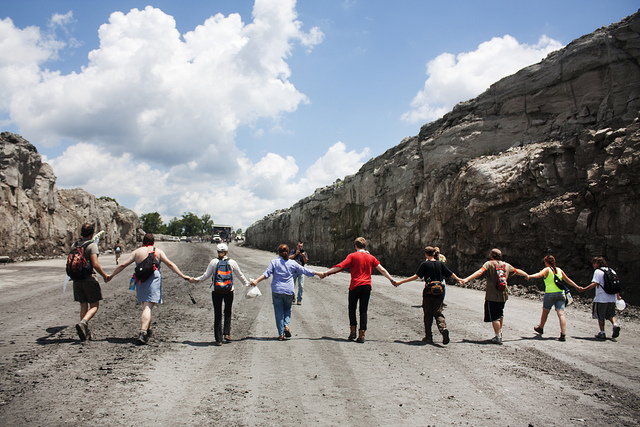
Protesters walking onto Patriot Coal’s Hobet mine in West Virginia’s Lincoln County. Photo via Mountain Mobilization.
A new chapter was added to the storied history of resistance against
the coal industry on Saturday with not only the largest direct action
against mountaintop removal, but also one of the harshest crackdowns
that anti-strip-mining activists have ever faced.
More than 50 people taking part in the Mountain Mobilization in West Virginia — a week-long regional gathering meant to unite affiliated groups and allies — shut down Appalachia’s largest mountaintop removal site for three hours. Meanwhile, West Virginia State Police made 20 arrests, set bail at $25,000 per person and allegedly beat 20-year-old West Virginia native Dustin Steele
while he was in custody. Police also forced those who didn’t get
arrested to walk for four hours down a public road rather than let their
arranged transportation pick them up, thereby subjecting them to
harassment from pro-coal demonstrators.
Though I've pretty much de-twitted, I checked Nate's Twitter feed, and found that Dustin was the only arrestee released. According to reports, he was beaten severely by sheriff's deputies while in custody and neither he nor any other protester in custody received any medical assistance for injuries. From indications, Dustin was released so that he could seek medical assistance on his own.
They are being held on outrageous bail, may be in custody for months before they go to trial, and apparently some may face federal charges because of the presence of explosives on one of the vehicles they temporarily prevented from from moving.
The miners in the region believe they have no option but to continue mountain-top removal mining, because "it's all they know." They identify far more closely with the mine owners than they do the enviornmentalists who are trying to shut down mountain-top removal mining in Appalachia. This seems to me to be a classic case of the victims of oppression and exploitation identifying and empathizing inappropriately, but in the video, it's easy to see the dilemma the mine workers face. When asked what alternative the enviromentalists have to offer the miners, they have no answer. "I changed career in my 50's," says one. She went back to school, got another degree and went into another career.
Well, bully for her, but that kind of response to a genuine fear the miners have if mountain-top removal mining is shut down is not just arrogant and out of touch, it is tailor-made to alienate the very people the environmentalists should be recruiting. Unless there is a alternative for these miners -- and there isn't in this region -- they're stuck. Saying "change careers, I did" is foolish and counter-productive and ultimately insulting.
That option is simply not available to most of the mine workers. Not. Available. What are they to do?
The environmentalists -- at least in the video above -- have no answer. And so they are subjected to ridicule and worse by the miners. Something similar is happening in the mining regions of Spain, but not so much over environmental concerns. No, the government is cutting the subsidies for mining in the region, forcing the closure of mines and the unemployment of thousands of miners. Same thing would happen in West Virginia if the environmentalists were successful in shutting down mountain-top removal mining. The Spanish government is offering the back of its hand, literally and figuratively, to the miners thrown out of work, and naturally they are fighting back however they can -- and it has gotten very intense not only in the mining regions of Leon and Asturias but in the fancy areas of Madrid as well.
The loggers in the Pacific Northwest go through the same thing with environmentalists and "gubmint regulators." The problem is always the same: the lack of alternatives for those thrown out of work and the disinterest in the plight of the miners/loggers by government/environmentalists.
I want the forests preserved and the mountain-tops to remain in place, but I understand -- I think -- the animosity of the miners and loggers and all the others who would be put in mortal jeopardy if they lost their livelihoods without some sort of alternative way of making at least a modest living.
This is essential for the development of appropriate empathy, and the difficulty that some advocates and some governmental officials have with the concept is part of the reason why we often see people voting or acting against their own best interests -- not to mention the interests of the planet.
More to come...
----------------------------------------------------------------------------
My Gal, Kathy Mattea, West Virgina coal miner's daughter, and fierce advocate against mountaintop removal mining, renders "Coal Tattoo:"
I saw some of a discussion on the Other Possibilities Network between Matt and Nate -- who had been at the RAMPS action at the Hobet coal mine in West Virginia -- and someone I only saw referred to as OPNInfo -- which filled in a lot of the details of what happened (though there was reluctance to speak too openly about the action because half the people who were arrested were still in custody.)
The discussion did get into the vexing problems of alternative means for the coal miners to make a living, and there were no answers. The fact that many of those who participate in direct action in West Virgina coal country are not residents of the area is another problem, but Matt made clear that the locals are in a very difficult position. They may hate mountain-top removal mining as much as any enviro fanatic, but they have essentially no choice in the matter; Big Coal runs the WV economy and the state, and the locals put themselves in real physical as well as livelihood jeopardy if they engage in the kinds of actions that RAMPS conducts -- or even if they are seen to support them.
The one local person who was arrested, Dustin Steele, was reportedly beaten severely in custody, and Matt believed that happened because he was local (from Matewan) and the authorities wanted to "teach that boy a lesson he won't never forget." The utter corruption and completely arbitrary nature of the West Virginia justice system was another topic of discussion.
The protests and the reaction of some of the locals and the authorities to them in West Virginia coal country is really a microcosm of the context in which The Struggle so many Americans and peoples around the world are engaged. A very powerful economic and political force is being challenged by some of the apparently weakest social and political players out there. So far, there have been few victories among the challengers, but the fact that they keep at it, and from time to time reap some reward, is heartening.